Latest Posts

Terminology: When a corsage wasn’t flowers

Today a corsage is a small bouquet of flowers pinned to your bodice or worn on your wrist, but that hasn’t always been what a corsage is.  Corsage used to be a term for a bodice.

"Dress of clear muslin, worn over a slip of clear silk, having the corsage low, and en cœur in front", from Godey's, August 1860

Via VintageVictorian.com

While a small bouquet of flowers and a blouse may seem like very different things, the terms are actually related.  Women used to gather a small nosegay of flowers to wear on their bodice, or their gentlemen admirers would send them small bouquets to be worn to an event.  These nosegays were called ‘corsages’ (basically a shortening of ‘corsage bouquet’) because they were specifically meant to be worn on a woman’s corsage.

"A corsage by Charvet. It is a blouse of pink cambric finely plaited, and with a white cascade frill, also of cambric, down the center. The scarf is of white cambric and the waistband of pink cambric." From the Chicago Tribune, 1898. Via Wikimedia Commons

In the same way, men would wear flowers in their buttonholes, and these were (and still are, in the UK and a few other places) called ‘buttonholes’ though the name didn’t stick as well in America, and today they are more likely to call them boutonnieres (which is just French for buttonhole).

The term ‘corsage’ comes from the French cors, or body, and thus has the same root as corset.  It dates back to the 15th century, but only in the 19th century did it become commonly used as a term for a bodice.
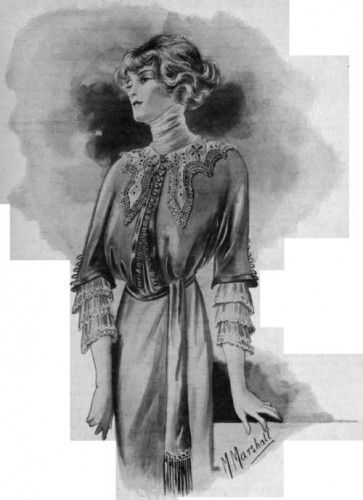
"A charming blouse corsage" from the Every Women's Encyclopedia 1910-12

Via chestofbooks.com

In the early 19th century a corsage was predominantly a bodice, but by the end of the century the term was used equally for both uses, so that in 1893 one might read an article describing flower clusters for a corsage and a year later an article describing the latest fashions in corsage bodices, and a few months later read:

Corsage bouquets are boldly treated to be in keeping with the puffed sleeves that rule for the nonce…A dainty corsage decoration for a young lady is composed of two light bunches of lily-of-the-valley, connected by fine sprays of amilax

The term corsage for a fitted bodice was still widely used until the start of WWII, but is rarely seen as a term for a bodice, rather than a cluster of flowers pinned to the bodice, post 1940.
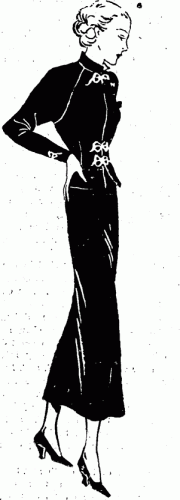
Ensemble of navy jersey, the sleeves in one with the corsage, the collar small & upstanding with a tight waistline & a close-fitting skirt. Bows of white ivory at the neck, on the corsage & sleeves, complete the picture. Evening Post, 30 November 1935

A corsage usually, but not exclusively, referred to a women’s bodice, and usually, but not exclusively, referred to a tight-fitted, structured bodice.
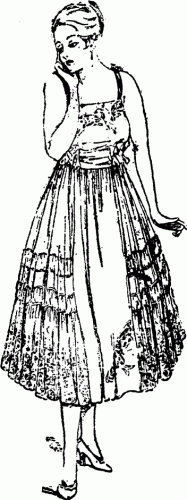
A Charming Evening Frock of Lace, with a Corsage and Panel of Embroidered Net. Observer, 14 July 1917
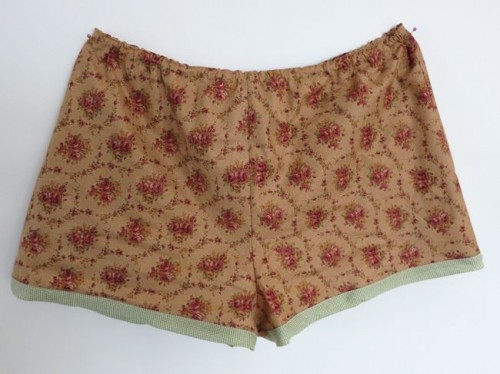
The Toeses & Roses tap pants

Last week’s Sew Weekly challenge was to use two different prints in one outfit.  Mixing prints is a bit of a struggle for me.  I’m a sewing minimalist – famous for my white on white!  I do like a good print, I just usually like it to stand on its own.

But I want to push myself, so I consulted my list of things that I actually need to make for myself (because I don’t believe in making something I don’t need and won’t wear just for the sake of fulfilling a Sew Weekly  challenge — that’s just wasteful), and top of the list was tap pants.

As you may know, I love tap pants. I have quite a few pairs, but with the amount of swing dancing I do, and how often I wear skirts in windy Wellington, I can never have too many pairs.

And top of my list was a pair to wear under my ‘Not Actually a Circle Skirt’ dress (which I didn’t blog about here, because, well, it’s kinda boring, and I didn’t really make it), and I thought “Ha! The dress is already a pattern — I’ll just make patterned tap pants to go under it.”

So I pulled out all the pattern possibilities in my stash, and sat on the floor with the circle of the skirt spread around me, and the fabric sitting on it.

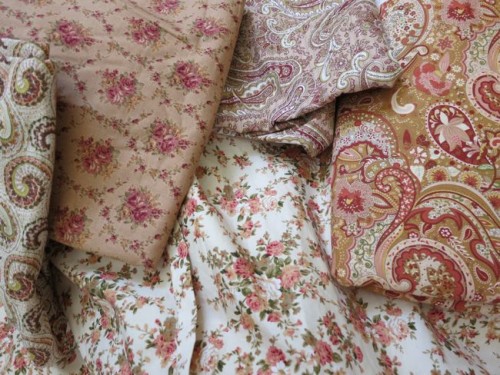
Skirt fabric (bottom), and (from left), weird paisley, rose trellis, muted paisley, bright paisley

I like the bright paisley on the far right best, but the rose trellis second from the left was a much nicer, finer, smoother cotton, so it won the fabric battle.

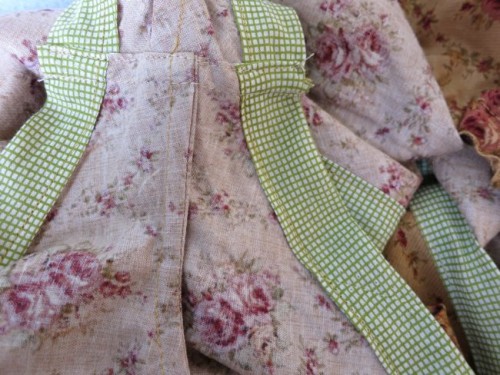
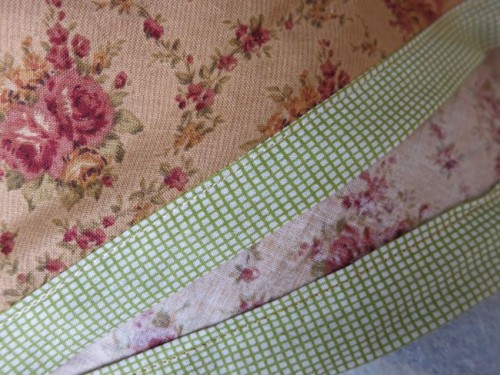
I’d got everything but the hemming done on the tap pants when I decided that patterned tap pants under a patterned dress was a bit of a cop-out ( I mean, it’s not often that you get to see both of them together!), so I did a pyjama hem on the tap pants in this sweet green and white checked voile.

Little checked bias pyjama hem

Voilá! Two patterns in one item.

Problem: How to actually photograph the darn things?

Other than on the wall, of course!

With the Waialua to Wellington tap pants I chickened/stuck by my morals/got lazy (it’s all about perspective!) and just photographed them on Isabella. But these tap pants are much less lingerie-y, so I decided to bet brave and creative about finding a way to show them off.

Also, Mr D teased me into taking this picture, and I saw it and had a “River Song discovers that she has Alex Kingston’s derriere” moment:

Ho-lee Guaca-squacka-waka-mole!

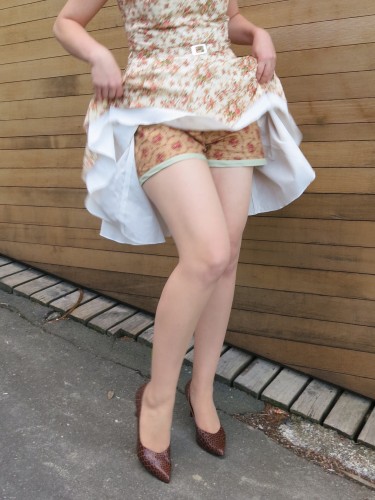
Are those my legs?!? If my legs look like every day that I’m going to wear short shorts all.the.time! (they don’t, but all the dancing I do is sure paying off!). So this time I’m photographing the tap pants on me under my dress.

Ooh la la!

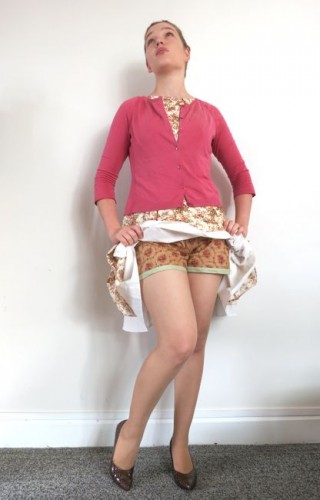
Roses and tap makes me think of the ‘Moses Supposes’ number from Singing in the Rain (love that film, love that song!). So these are ‘Toeses & Roses’ tap pants, because calling them ‘Let’s Kill Hitler’ is something only Steven Moffat could get away with.

Toeses and roses

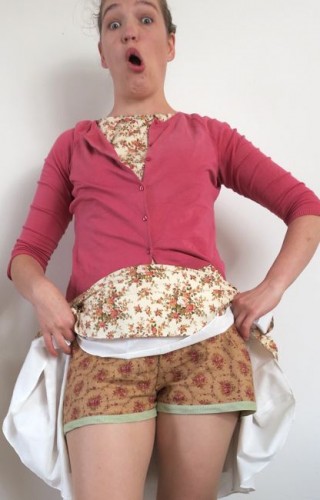
In my nod to the film I wore a cardigan over my dress — love Donald and Gene’s cardigans in that scene!

Making a Donald O'Connor funny face

Just the facts, Ma’am:

Fabric: 3/4 metre of rose-trellis patterned cotton, and a scrap of green and white checked voile for trim.

Pattern: My own, based on a vintage pair of tap pants that I own.

Year: 1950s

Notions: 28″ of elastic for the waist.

Hours: 1.5, including dithering over fabric. Not bad for me!

Wear again?: Yes! Even after I give away the ‘Not Actually a Circle Skirt’ dress. These are super comfortable and practical. They would make great summer pyjama bottoms too.

Total cost: I think I paid $2 for 2 metres of the rose patterned cotton at an op shop, and $5 a metre for the green and white voile, so for the amount of each I used, $1.50.

And the inside?  French seams all the way.  Nothing to scratch and irritate as I dance the night away!

French seams & pyjama hems

And for a final bit of happiness:

Fuzzy kitty toeses and roses!

Rate the dress: red, floral, and stripes in the 1890s

UPDATE: (hey, look!  She finally had time to tally the scores from last week)

So, last week most of you thought the embroidered mull Regency evening gown was the very epitome of Regency evening gowns, and your ratings depended on whether you thought that was a good thing or not.  Did epitome mean perfect example, or boringly typical example?  And do you even like Regency evening gowns in the first place?  Well, it appears you do, and while not perfect, it came in at  8.5 out of 10.

~~~~~~~~~~~~~~~~~~~~~~~~~~~

I know.  I’m running really late with this Rate the Dress.  I haven’t even tallied the votes for last week’s Regency yet.  I’ll get those up in a bit, but I want to at least get you a dress for now!  So here you go.

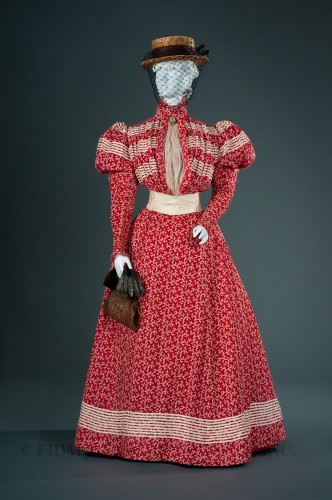
The last few Rate the Dresses have been pretty subdued colour-wise.  Time for something a little brighter, such as this printed dotted-swiss day-dress from the FIDM.

Day Gown Paris, France, c. 1897 P. Barroin, Designer Printed dotted Swiss, silk chiffon, silk taffeta & cotton braid, FIDM

There is a lot going on in this dress: patterning over dotted swiss, stripes over patterning, skirt and sleeves and blouson bodice.  Too much, or one harmonious whole?

Rate the Dress on a scale of 1 to 10 (and be sure to leave your comment on the post, not on the image, or it won’t get counted in the final tally of votes)