
All posts filed under: Learn

Advertising at the end of the War (WWII, that is)

I  found a wonderful magazine page a few month’s back, full of advertisements. None of the products advertised would be particularly interesting to me, except that the magazine is from late 1945, and the advertisements make specific reference to the (hopeful) end of wartime shortages.  It’s a fascinating glimpse at rationing, and the foreseeable end to it: Unfortunately I just found two pages of the magazine, and there was no identification of what magazine it was, or a precise date, though I’m certain it’s either English (most likely) or Australian (less likely), and that it dates from late 1945 or early 1946. First, a rather sad version of Mary Had a Little Lamb: The Loving Stitch: A History of Spinning & Knitting in New Zealand, gives an excellent account of wartime wool (and knitting needle) shortages, and how women coped with them (hint, it includes #8 wire!) Next, a rather standard beauty ad, though my modern mind can’t help wondering precisely what it is men who call her Pat know about her… Another classic ad …
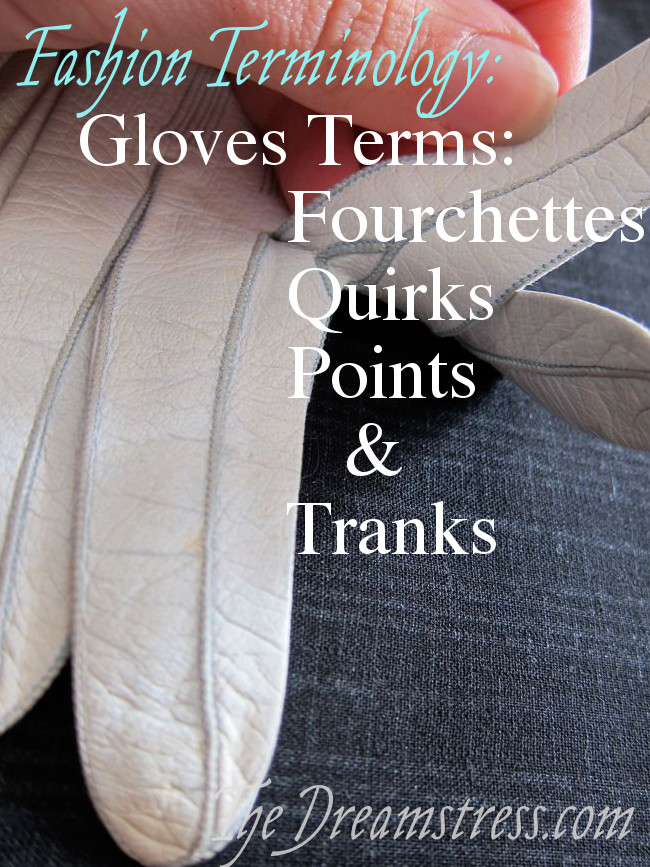
Terminology: Fourchette, quirks and other glove terms

For this terminology post, we’re looking at glove terms: fourchettes, quirks, tranks and points. I love  these  words just because they are  so random and specific.  Other than glove makers and fashion historians, who would know that there are specific words for the different parts of gloves? The main piece of a glove, with the back and front of the glove and the tops and bottoms of the fingers all cut in one, with only one side seam, is the trank.  It’s shown in pretty pink in the photo above. Going between the fingers, and attached to the trank, is the fourchette (in lovely lavender  in the coloured photo above), also called the fork or forge  which is: A forked strip of material forming the sides of two adjacent fingers of a glove In other words, this bit: It is from the French, for forked, because a fourchette is forked, and allows the fingers to fork. Some fourchettes have an extra little V gusset at the bottom, called a quirk  (shown in beautiful blue in …

The Sewing Workshop, 1760 Musee Reattu - Arles, France.

Terminology: What is sewing carbage? (or cabbage, or garbage)

Carbage or cabbage, and more rarely garbage, is the name given to the bits of fabric left over from cutting out an item. You can see the box of ‘carbage’ under the tailors table in Amman’s woodcut. The term dates back to at least the 17th century, where it was also used for ‘shreds and patches used as padding’. In 1648 Robert Herrick wittily commented on tailors credit: Eupez for the outside of his suit has paid But for his heart, he cannot  have it made The reason is, his credit  cannot get The inward garbage  for his  cloathes as yet In another poem he complained of women’s fashions: Upon some women, Pieces,  patches, ropes of haire, In-laid garbage  ev’rywhere Some versions Herrick’s poems use carbage instead of garbage, and I would dearly  like to know which were  used in the original. Butler’s 1660s Hudibras makes clear how important cabbage was to tailors: For as  tailors preserve their cabbage, So squires  take care of bag and baggage In the  mid-17th century play Hey for Honesty …