Latest Posts

ScroopPatterns.com

Hooray! Scroop Patterns now available in paper format!

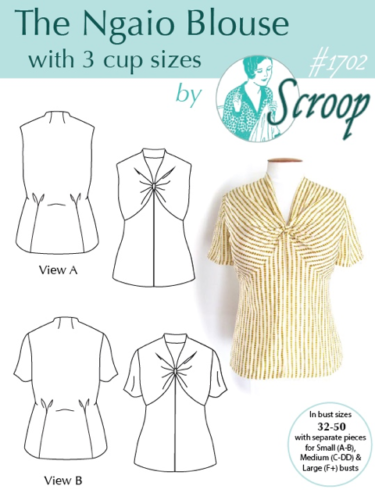
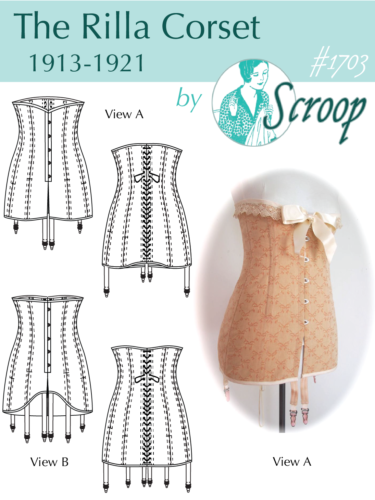
I’m delighted to announce that selected Scroop Patterns are now available in hard copy!

The Scroop Ngaio Blouse scrooppatterns.com                    The Scroop Rilla Corset Pattern Scrooppatterns.com

Get your paper versions of  the Rilla Corset  and  the Ngaio Blouse  exclusively through:

 Wearing History

 http://wearinghistory.clothing


About the patterns:

Hard copy Scroop Patterns are printed on high-quality, medium weight bond paper, with easy to use spiral-bound instruction booklets.   Both patterns and instructions are in full colour.

Wearing History is based in Southern California, USA, and ships worldwide.

In keeping with Scroop Patterns commitment to supporting small businesses, and to reducing waste whenever possible, the hard copy patterns are printed by a small, local to Wearing History, printing company.

And, of course, if you don’t want to wait for shipping, you can always get your digital print-at-home Scroop Patterns through scrooppatterns.com

What’s next?

Even more Scroop Patterns  in hard copy!

Leave a comment to let me know which one you’d like to see in paper next!

WWI era corset, 1910s corset, Rilla corset, corset pattern

SaveSaveSaveSave

SaveSave

SaveSaveSaveSave

SaveSaveSaveSave

SaveSave

SaveSaveSaveSave

SaveSaveSaveSave

SaveSaveSaveSave

Rate the Dress: Worth takes on three centuries of fashion

Last week’s Rate the dress took us to the 1740s.  This week we’re travelling back in time half a century to ca. 1690, AND forward half a century to ca. 1790, and finishing up ca. 1890, all in one dress.  Only Worth would try that!  But did he succeed?

Last week: An unknown young lady of ca. 1740 by Bartholemew Dandridge

I’m always a bit trepidatious when I post a historical child for Rate the Dress because of the children-as-adults issue.  Luckily the response to our girl-on-the-cusp-of-adolescence was (almost) unanimously positive.  You thought she was perfectly dressed for a young lady in her first almost-grown-up frock, with the ideal balance of frills and boldness.

The Total: 9.3 out of 10

It was the princess dress to appeal to both our inner little-girl and our more critical adult selves!

This week: A House of Worth Reception gown of ca. 1890

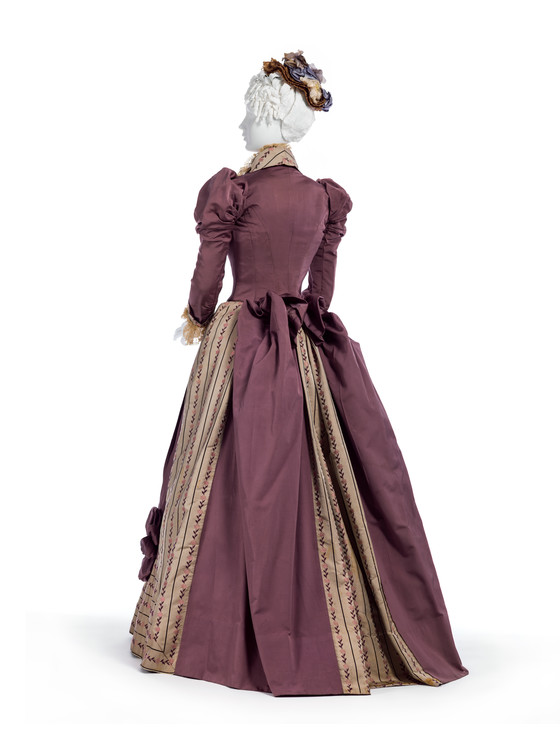
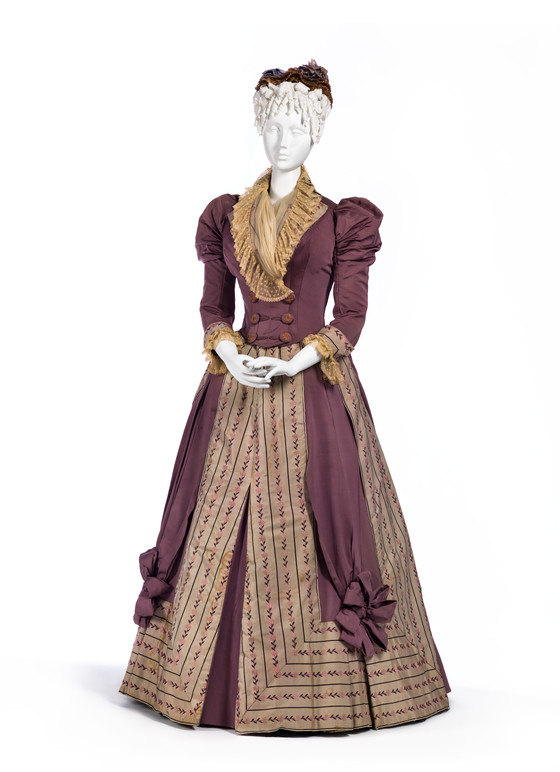
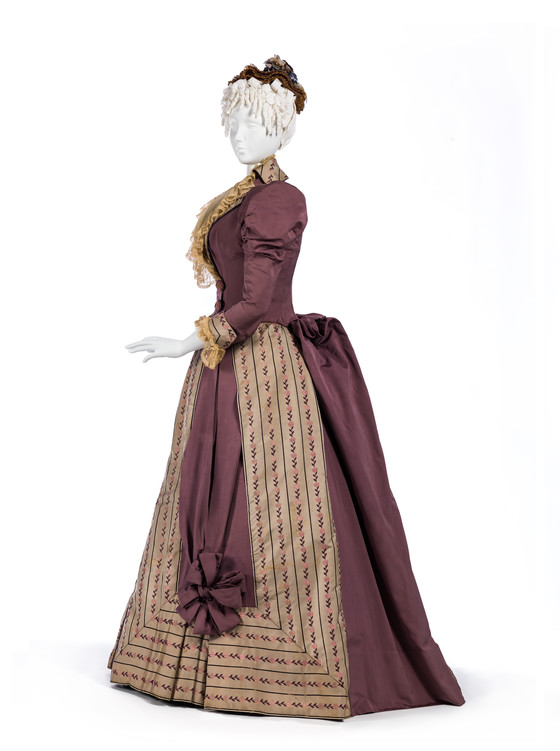
This grape purple and pale gold Worth reception gown from ca 1890 is heavy on the historicism.  It has a skirt inspired by mantua fashionable in the 1690s, and a bodice that gives a nod to redingotes fashionable in the 1790s.

The interesting stripes, which run vertically down the front of the skirt and then turn to run horizontally around the hem are an unusual and distinctive design feature.  They aren’t common in many eras, but appear in 1680s & 90s fashion plates:

The House of Worth has added their own twist to the stripe frames, by placing them around elaborate bows which anchor ribbon ‘sashes’ falling from the waist.

Woman’s Two-Piece Dress, Worth, France, Paris, circa 1890, silk faille & silk twill with silk embroidery, linen lace, and silk plain weave trim, LACMA, 55.19a-b

The dress of the skirt is picked up in a sculptural ‘butterfly’ bustle that evokes the the bustling of late 17th and early 18th century mantua


Woman’s Two-Piece Dress, Worth, France, Paris, circa 1890, silk faille & silk twill with silk embroidery, linen lace, and silk plain weave trim, LACMA, 55.19a-b

Recueil des modes de la cour de France, 'Femme de Qualite en Deshabille d'Este' Jean LeBlond (France, active circa 1635-1709) France, Paris, 1682 Prints Hand-colored engraving on paper, LACMA M.2002.57.65

Recueil des modes de la cour de France, ‘Femme de Qualite en Deshabille d’Este’ Jean LeBlond (France, active circa 1635-1709) France, Paris, 1682 Prints Hand-colored engraving on paper, LACMA M.2002.57.65

While the lower half is all 17th century, the bodice takes its cue from double-breasted Georgian redingotes, with a soft, lacy collar inspired by fichu.

What do you think? Is this tri-cententenial mashup one for the history books?  Or is this take on la mode 16-17-1890 demode in any era?

Rate the Dress on a Scale of 1 to 10

A reminder about rating — feel free to be critical if you don’t like a thing, but make sure that your comments aren’t actually insulting to those who do like a garment.  Our different tastes are what make Rate the Dress so interesting. However it’s no fun when a comment implies that anyone who doesn’t agree with it, or who would wear a garment, is totally lacking in taste.

(as usual, nothing more complicated than a .5.  I also hugely appreciate it if you only do one rating, and set it on a line at the very end of your comment, so I can find it!  Thanks in advance!)

The quest for Regency uplift: J.S. Bernhardt’s 1810 Stays, View C

I love ‘Regency’ and Empire fashions: the high waisted silhouette of the 1790s to the late 1810s.

Ladies’ Museum, Morning Dress for December, 1799.

However, my body does not.  I’ve got small, firm, low-set breasts, very sloping shoulders, a relatively large square ribcage, and scoliosis.  It’s a natural fit for 1910s, but not ideal for ca. 1800.  Most of the bust supporting undergarments (whether they are stays, long or short, or jumps) of that 25-year span that I have made or tried on haven’t really worked for me.  Some are literally painful: twisting my already twisted spine into unhappy positions, or trying to use my shoulders to yank my very-resistant-to-upwards-yanking bust up, and thus cutting into my shoulders.  Others are just disappointing: flattening my bust into total nonexistence, or gaping sadly over each cup.  Some seem OK at first, and then get progressively less comfortable over hours of wear.

I’ve felt like a total costuming failure with all my attempts at making Regency/Empire stays.  Some have been so bad I haven’t even been able to make myself blog them.  Some of it is my dislike of gussets, but mostly it’s my body, because my staymaking attempts have looked great on friends without my shoulder/ribcage/spine/bust issues.

When I’ve worn dresses of this era I’ve just cheated, using the dress itself to support me – with a small bust, it works OK, but it’s not ideal, and I don’t really end up with the right silhouette.  And I end up with the same painful using-my-shoulder-to-yank-up-my-bust issue that the stays have had.

So one of my goals for this year is to make a pair of 1790s front-thrusting ‘transitional’ stays that really work for me, and a pair of ca. 1810 bust-separating Regency stays that also really work.  I’m going to try every available pattern until I find the two best ones, and then do my best to perfect them for me (unless I get really lucky and manage to make something that is perfect the first try).

My first attempt was the View C short stays from J.S. Bernhart’s 1810 book, via the fantastic formula and research that Sabine of Kleidung um 1800 has done:
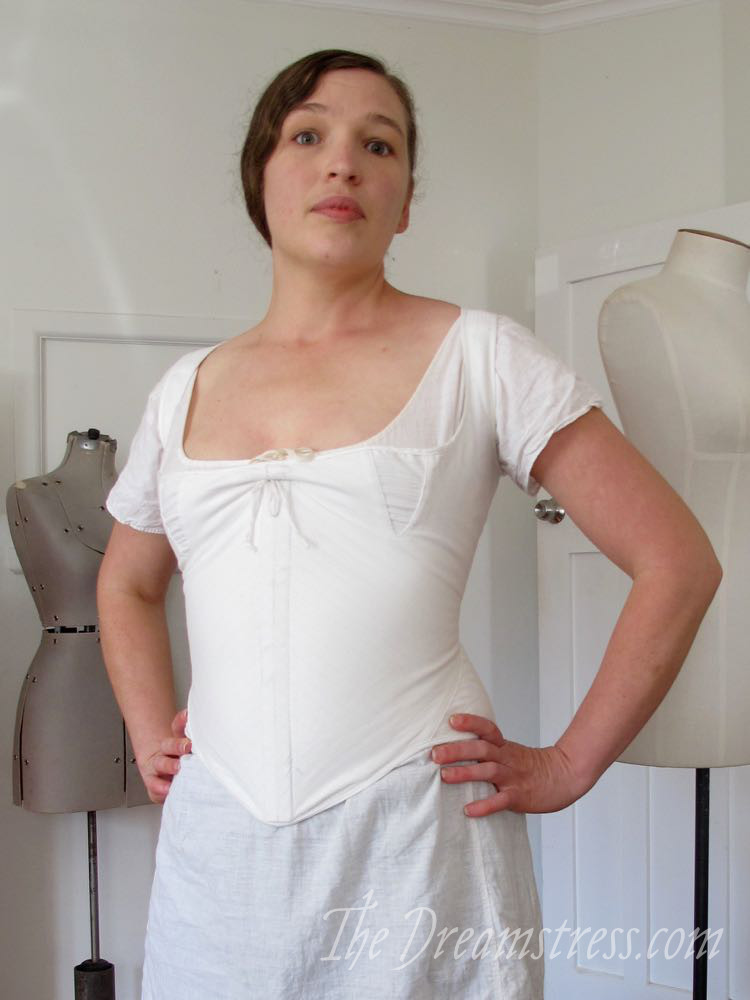
Short stays from J.S. Bernharts 1810 book, View C thedreamstress.com

I’m actually pretty pleased with this pair. They have a couple of issues that need working out.

First, I need a longer busk – I haven’t been able to find the one I want in New Zealand.  I’ve done the best I can and used a too-short option and sewn a channel for a wider busk as well as the narrow one shown here.  I’ll order a couple from Redthreaded when I’m back in Hawaii in September.

Second, the pattern itself needs a little tweaking.  I suspect the formula works really well at small sizes, and gets progressively less accurate as you get bigger.  It’s definitely too big on me: the stays lace completely closed:
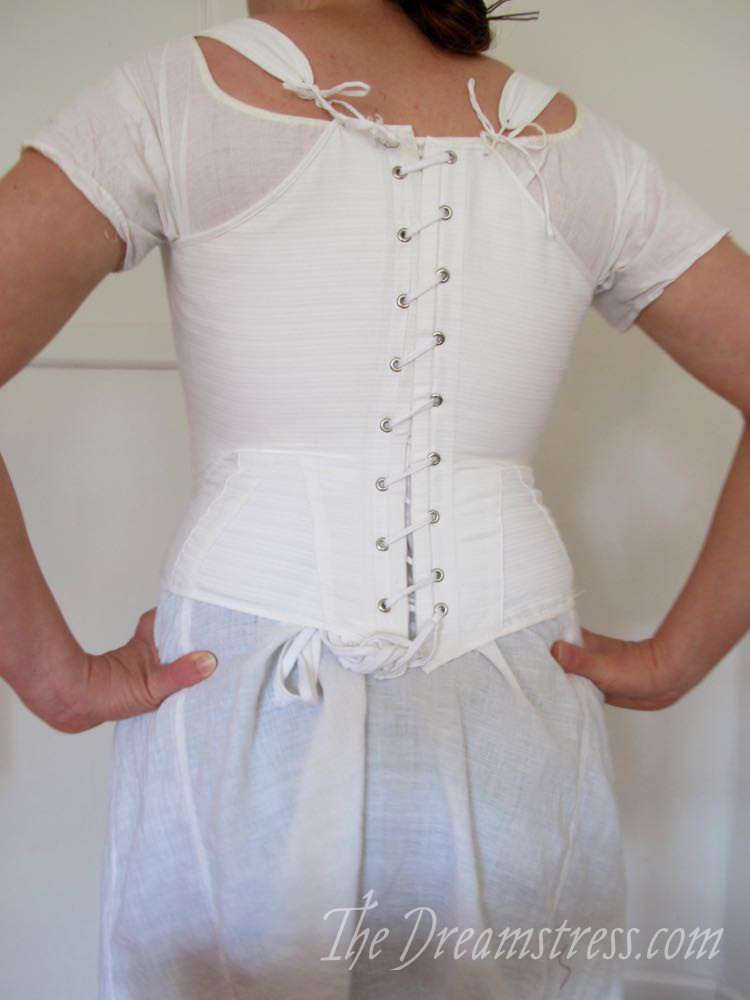
Short stays from J.S. Bernharts 1810 book, View C thedreamstress.com

The straps angling in to the centre back are brilliant for my sloping shoulders, and really take the pressure off of them.  However, if I want to wear anything with a lower back, they are too high, so I think I could tweak them to have a lower back, but straps that still angle inwards.
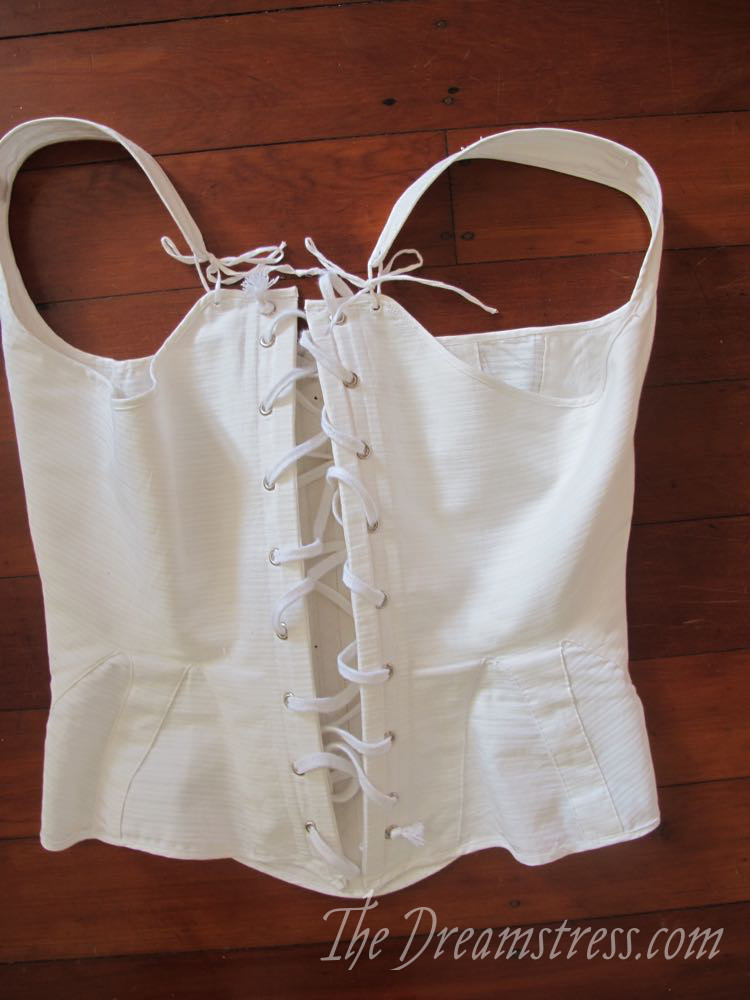
Short stays from J.S. Bernharts 1810 book, View C thedreamstress.com

Simply making the pattern smaller may fix the next issue:  separate breasts are all well and good, but I think my bust gussets are too far from the centre front.
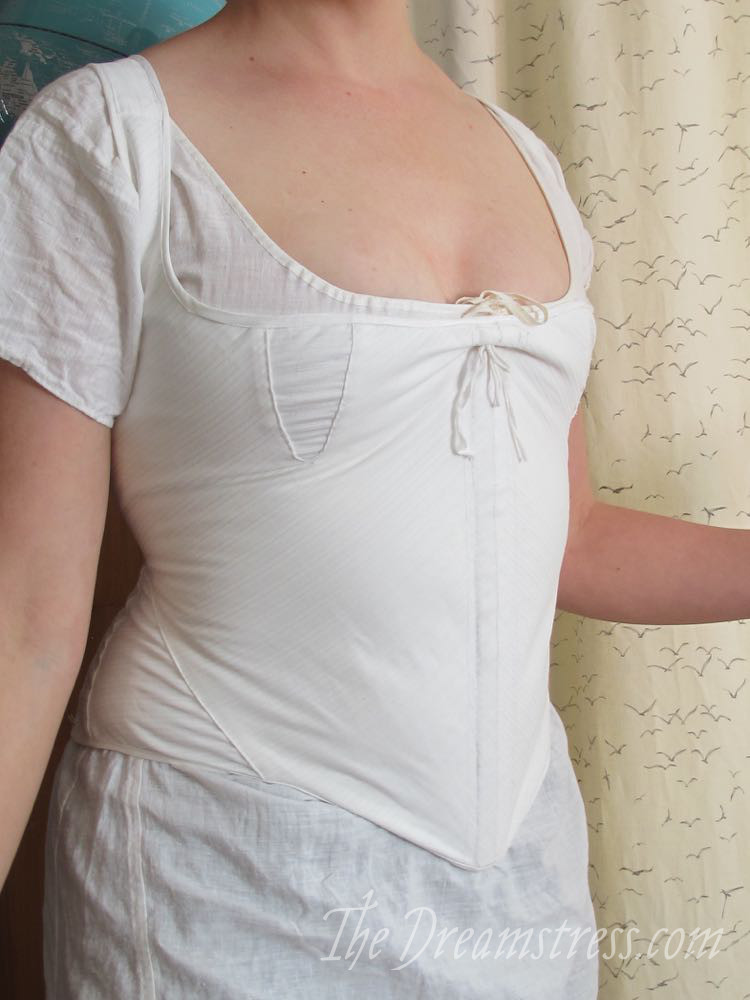
Short stays from J.S. Bernharts 1810 book, View C thedreamstress.com

The final issue is the hip gussets.  Sabine was super helpful in figuring out the size of my gussets, but I haven’t gotten them quite right.  Bernhardt’s pattern is very much just a suggestion: my hip gussets are way bigger than Bernhardt’s suggestion, and still not quite big enough.
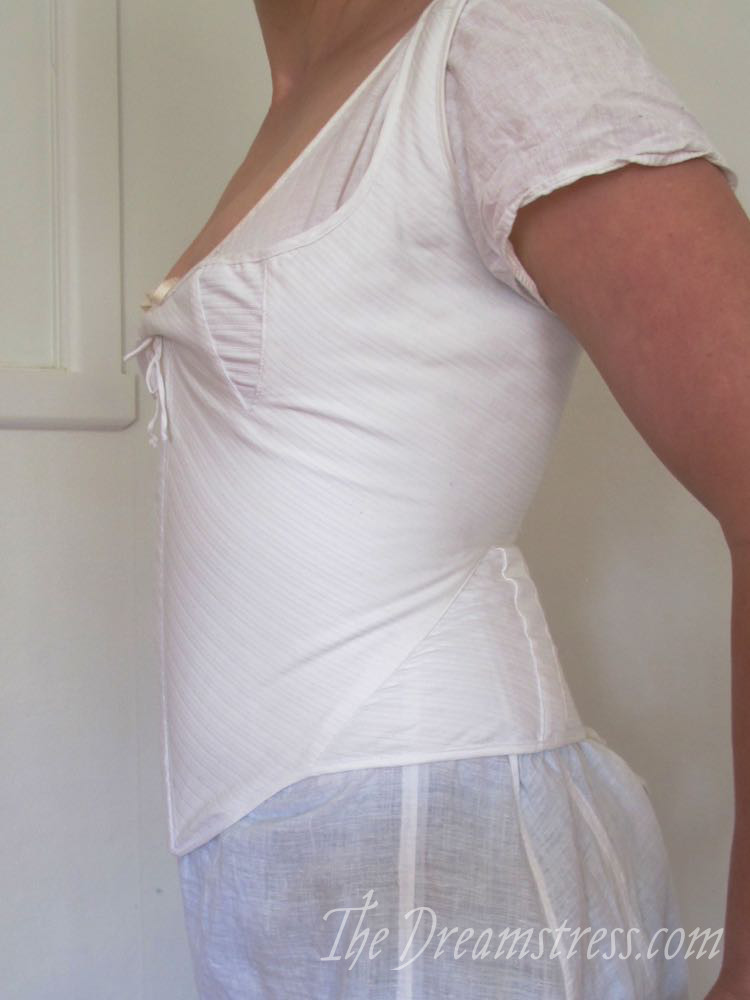
Short stays from J.S. Bernharts 1810 book, View C thedreamstress.com

I think the hip gussets are also not quite at the right place – they would sit better right at the outward curve of my hip, instead of slightly to the back.

It’s almost as if the stays are too wide only at the front.  If I took just an inch and a half out of the centre front seam, it would move the bust and hip gussets towards the front, and give me a lacing gap.  I’m really tempted to do it, but am not looking forward to the binding issues that would create.
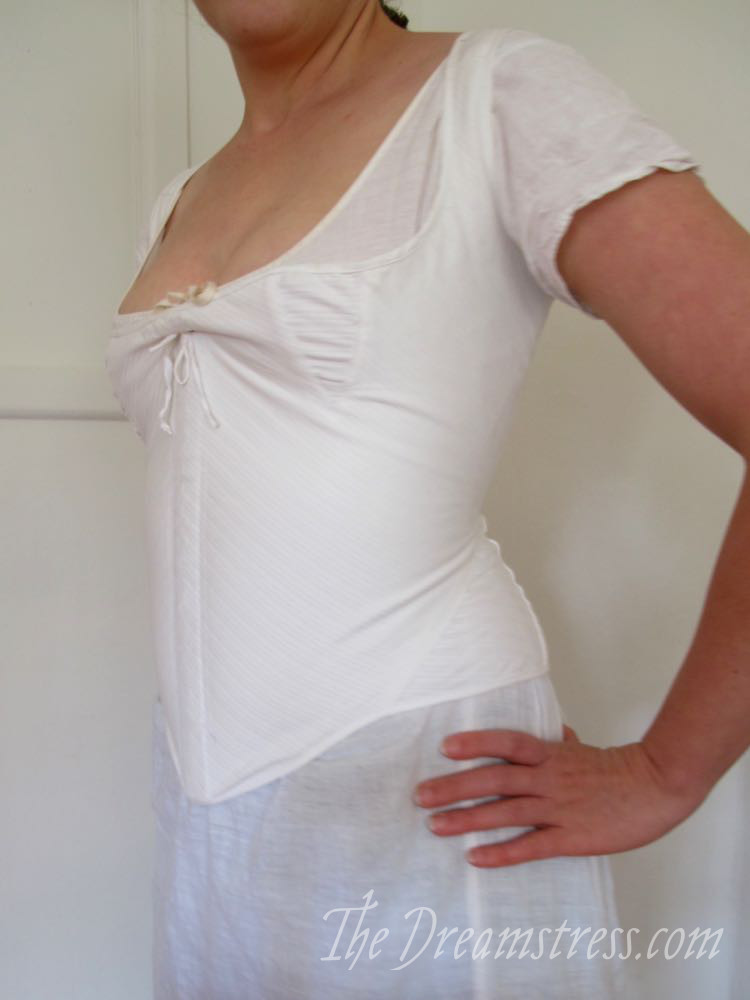
Short stays from J.S. Bernharts 1810 book, View C thedreamstress.com

The other plan would be to simply make another pair, with the alterations.  I did have these as a working-toile in my mind, which is why I used shortcuts like metal grommets.
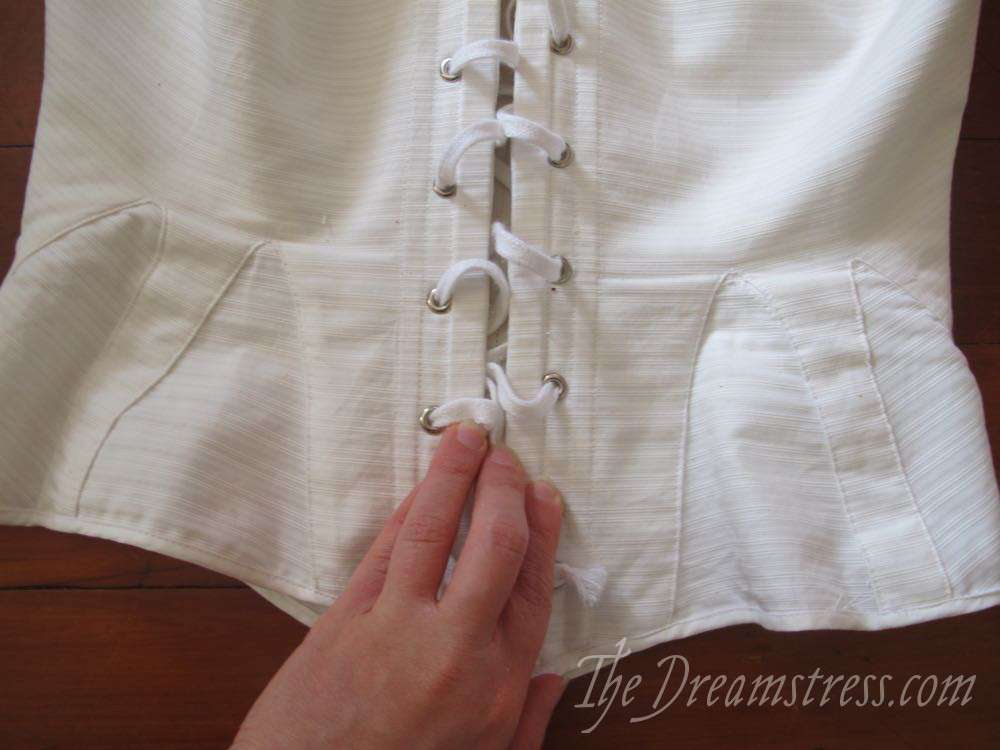
Short stays from J.S. Bernharts 1810 book, View C thedreamstress.com

The Historical Sew Monthly Challenge #3: Comfort at Home


In any case, these were finished in time for the Historical Sew Monthly Challenge #3: Comfort at Home

What the item is: 1810s stays

Material: midweight linen (lining), midweight cotton twill (outer)

Pattern: J.S. Bernhardt’s short stays pattern C, as translated and gridded by Kleidung um 1800

Year: 1810

Notions: synthetic whalebone, wooden ruler, cotton thread, metal grommets, cotton lacing cord

How historically accurate is it? Construction wise, not so much – I used metal grommets, and sewed by machine. I also have no idea if my fabric is a correct match to this style of stays. I wanted to test the fit and wearability of these over time, and was less concerned with total accuracy of construction. Once I’ve got the fit totally sorted, I’ll make a more-close to accurate pair.

Hours to complete: 12 or so

First worn: For photos on the 30th of March

Total cost: $15 or so – the fabrics are all pieces I picked up for very little at op shops, the ruler was $1, the only real expense was a bit of boning and the grommets.

SaveSave