Last week I showed you an embroidered ensemble said to have belonged to Madame Élisabeth, sister to Louis XVI. There must be some magic in being a princess, because the full first 10 scores were perfect scores, and the frock managed an incredibly impressive 9.4 out of 10 (which is practically a perfect score these days), though some of you did make it hard for me by giving it multiple scores.
Personally I wanted to love the outfit, but every time I looked at it my eye tried to tweak the motifs and rearrange the embroidery ever so slightly, and if it isn’t perfect as it is, I really can’t give it a perfect score, so it was really only an 8.5 out of 10 from me.
This week we’re downgrading from a well known princess to an unknown noblewoman, with this portrait of a wealthy Florentine woman (presumably a noblewoman) of the 1540s, possibly by Bronzino.
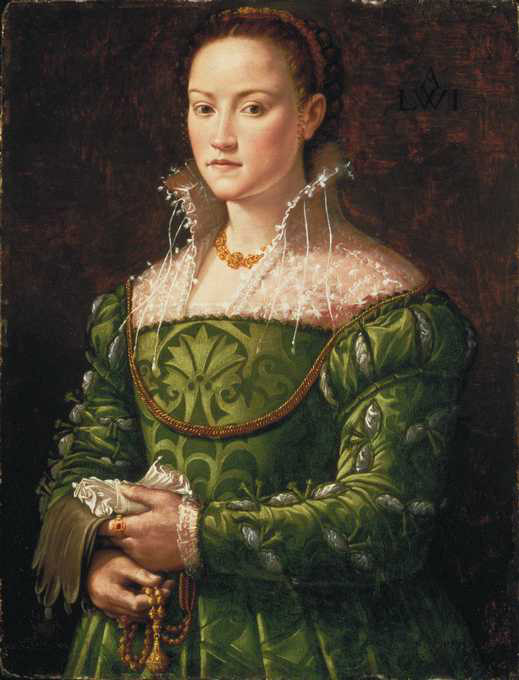
Portrait of a Florentine noblewoman, ca. 1540, possibly by Agnolo di Cosimo (Bronzino), San Diego Museum of Art, San Diego California
Mid-16th century Florentine fashion can be much the same, but this woman has chosen a dress with just enough of a difference to stand out. The deep green shade of her dress is slightly unusual, and lends an air of simplicity and visual relaxation to the elaborate brocaded or cut velvet patterning of the fabric. The vivid grass shade plays off the gold of her jewellery and the white of her linen and lace, and subtly highlights the rosary she holds: emphasising her piety as a desirable trait.
The garment plays with a balance of structure and softness, symmetry and serpentine. The overall shape is quite formal and structured, the delicacy of her partlet is offset by the stiffness of its high, standing collar, which appears to be supported by wires, foreshadowing the late-16th, early 17th century rebato. The partlet sports soft surface tufts and loose, dangling strings (which could presumably be used to tie it closed in front) as a counterpoint to the engineered shape. The tufts of the partlet are echoed in pert little ties ornamenting the sleeve slashings, which lead the eye down to the fine lace of her cuffs, and back up to the white of the partlet that frames her face.
What do you think? Is this different enough to stand out from the mundane ranks of mid-16th century Florentine styles, and attractive in its differences?
Rate the Dress on a Scale of 1 to 10