Latest Posts

HSF/M ’15: Challenge #5: Practicality

For the fifth Historical Sew Fortnightly challenge of 2015 (due by May 31st), we’re getting down and dirty and making something that is about getting work done: building up, cleaning up, fixing up, and generally being practical.

Fancy party frocks are all very well, but everyone,  even  princesses, sometimes needs a practical garment that you can DO things in.  In this challenge we’re creating the jeans-and-T-Shirt-get-the-house-clean-and-garden-sorted outfit of your chosen period.

This challenge is particularly interesting, because the get-work-done outfits are the ones that are least likely to survive.  People keep their special occasion garments: their wedding outfits, party frocks, and delicate pieces, and museums are full of these, but who has a paint-spattered, slightly ripped, well  worn T-shirt and their gardening jeans carefully preserved for posterity?  It’s a bit ironic, as we’ll spend more time in these type of garments than in our posh togs.

So, let’s focus on work aprons, wash frocks, slat bonnets, shorter skirts, basic blouses, short gowns,  and other working garments: the unsung wardrobe heroes of the past.

For many periods in the past, and for many people, their entire wardrobe would have been working clothes.  Their have always been more workers than rulers, and if you are building pyramids in ancient Egypt, cathedrals in Medieval Europe, garrisons in frontier America, or railroads in Victorian England, or growing or preparing the food that fuelled all of this, your clothes will need to accommodate this.

Practically doesn’t have to be all about working class garments: even the upper classes and royalty needed practical garments on occasion.

And by practical garments, I’m not thinking of outfits  for playing at being peasants, like Marie Antoinette’s famous pretend shepherdess frocks, or frilled organza aprons that were only good for pretending to cover your frock while you played hostess and your servants did all the work, but garments that really were about being practical.

One famous example that comes to mind is that of the young Alexandra of Denmark, later Princess of Wales and Queen of England.  When she first met her future mother-in-law, Queen Victoria was quite impressed by Alexandra, because she wore the same jacket with different skirts two days in a row.  Victoria saw this as a sign that Alexandra had the practical, down-to-earth temperament needed to keep the Crown Prince in check.  She didn’t realise that it was necessity: Alexandra might be royalty, but her family was so impoverished that she and her sisters made their own clothes, and waited tables when her parents entertained.

Alexandra’s  clothes from later in life certainly weren’t practical, but for the teenage Alexandra, most clothes would have been made to be worked in.

Margaret Hale must also have practical clothes for being “Peggy the laundry maid” and other tasks in which she might be “a born and bred lady through it all, even though it comes to scouring a floor or washing dishes.”

And one can well imagine that while the Bennet girls might not need to know how to cook, a simpler dress or an apron for more ladylike household tasks would certainly have come in useful.

One of my favourite Costume Parisien fashion plates (from 1813): is a perfect example of a fashionable lady being practical.  An all-white frock for raking might not be the best choice, but her nankeen gaiters are a smart choice.
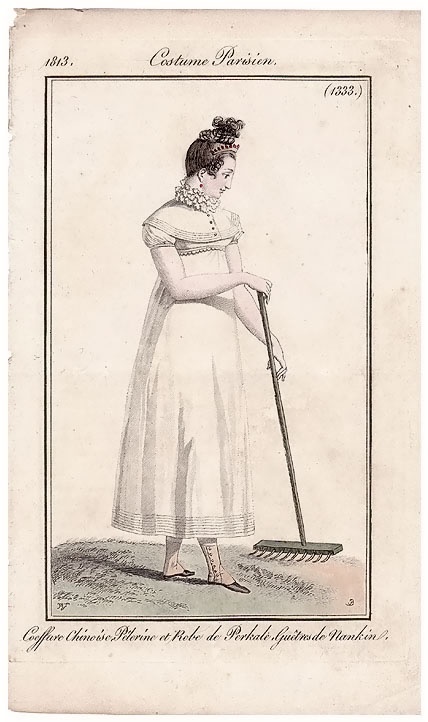
Fashion plate, 1813

For more inspiration, you might find these posts and pinterest boards useful – note that not all the images in all of them apply, as sometimes they feature ‘best’ clothes:

The inspiration post for HSF ’13’s Peasants & Pioneers challenge

Artworks featuring Labourers at the Yale Centre for British Art

Italian working class dress 1575-1600 at Festive Attire

17th c Commoners  

1700-1800 Working class clothes

1840-50 Commoners

1850-60 Commoners

Images of  Working women  and their dress

Fashions for domestic help, 1906

Sensible frocks for daily wear, 1911

1930s Hooverettes at Festive Attyre

Land Girl overalls at the Museum of New Zealand Te Papa Tongarewa
Having an Anne moment

Like many girls, and particularly girls who were avid readers, and even more particularly girls who grew up to like historical clothing,  I love Anne of Green Gables and L.M. Montgomery.

I either owned or had the Anne books on constant loan from the library, and I read, and re-read them, until I knew every detail of Anne’s life, and that of her children.

Then I availed myself of Hawaii’s wonderful state public library system, which allowed you to order books from any library in the state, and moved on to Anne’s other heroines.

I got to know Pat (whose devotion to cats I shared, but whose devotion to a house seemed a tiny bit excessive), Jane (who I admired for her kind heart), Marigold (too young, but loads of fun), Emily (who, to be perfectly honest, I thought needed a good slap, and who I still have trouble reading about without rolling my eyes and thinking “seriously girl, just get over yourself”, but who is probably responsible for my tendency to over-use italics), the Story Girl (interesting, but the first book too fragmented, the second, too sad), Kilmeny (man, that book is problematic!), and finally, Valancy, whose story  I found deliciously risque, because I was the most widely read  but determinedly innocent teenager to ever exist (see, I told you, Emily’s fault!).

As an adult, I’m determinedly refusing to give up the things I loved as a child and grow up and read “adult” novels (mostly).  So I’m having a lovely  time assembling a full collection of Anne books – in glorious hardcover (like technicolour, but stiffer, and on a book), because I like my books to be as book-ish as possible.

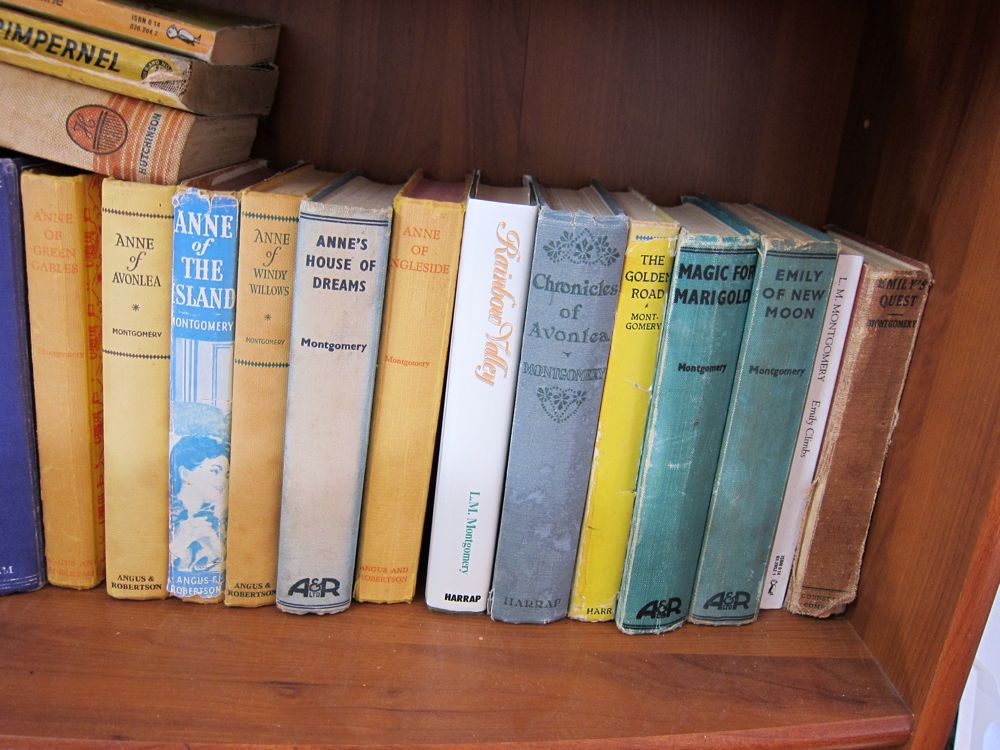
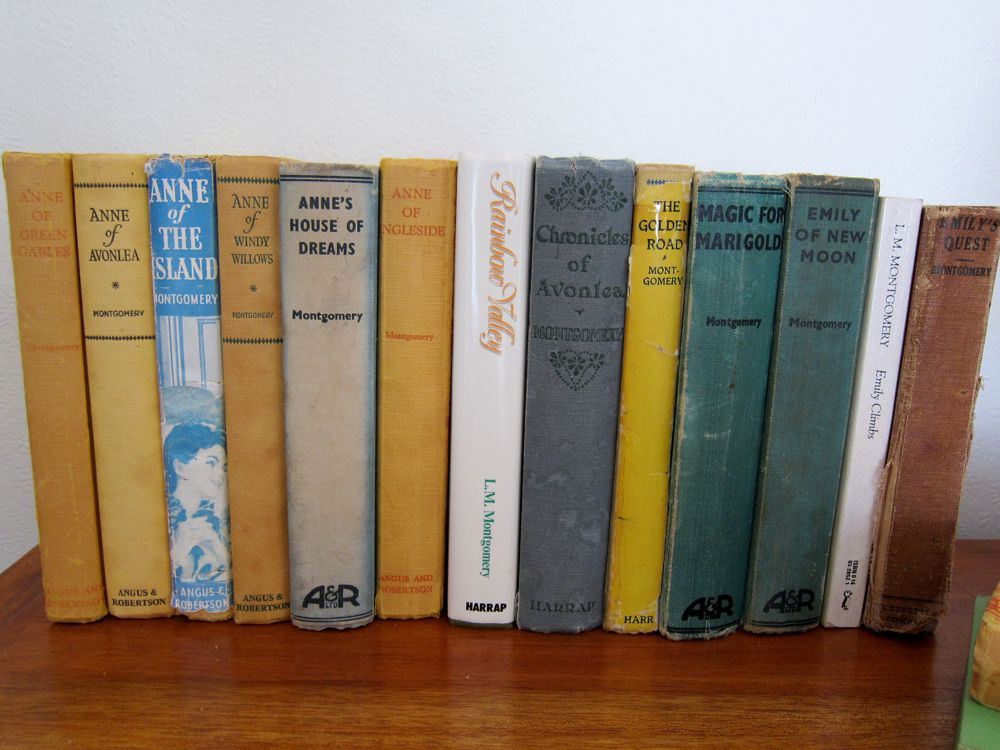
The collection was going slowly, until a stop at a junk shop manned by a hairy Viking in a kilt* on the way to Art Deco Weekend (true story) yielded almost the entire set of Anne books, and The Golden Road, and Magic for Marigold.

Oh, happiness!

L.M. Montgomery Books thedreamstress.com

The hairy Viking said “Oh, I’m glad to get rid of these.  They are so outdated and no-one reads these anymore”, thus earning himself a glare and a muttered “that’s what you think” as I snatched my precious.  If no one reads Anne anymore it’s a sad, sad world!

L.M. Montgomery Books thedreamstress.com

This does mean that I now have duplicates of a couple of the Anne books, so have to decide which ones I want to keep.  Oh stress!

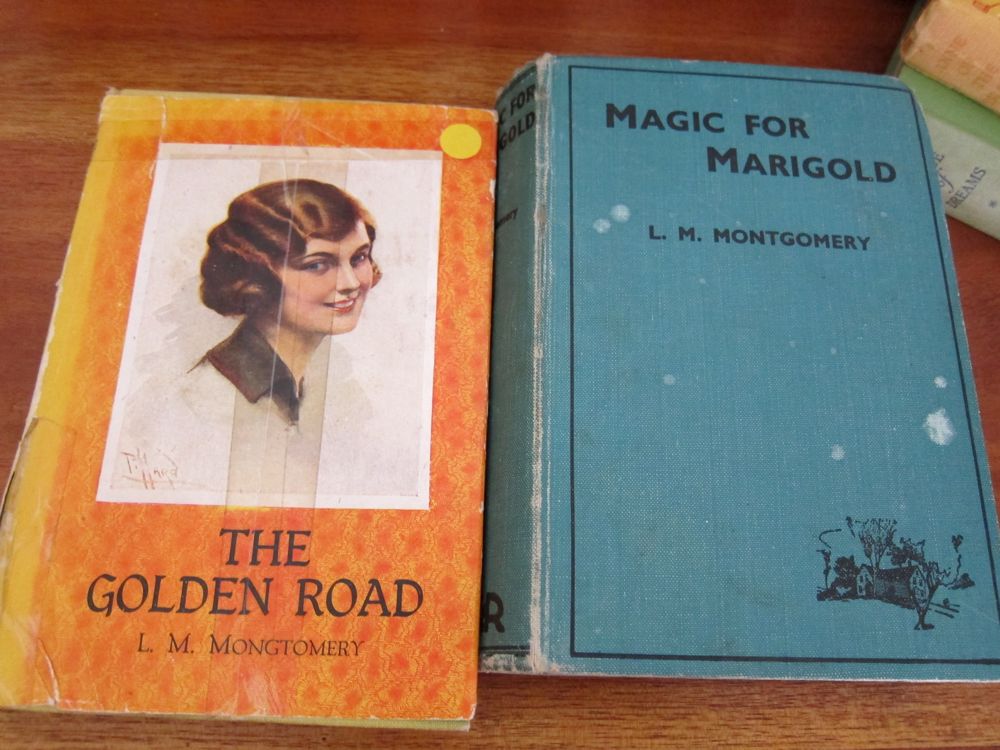
But look how cute they are!  Particularly The Golden Road, with it’s great ’30s cover:

L.M. Montgomery Books thedreamstress.com

Delicious!

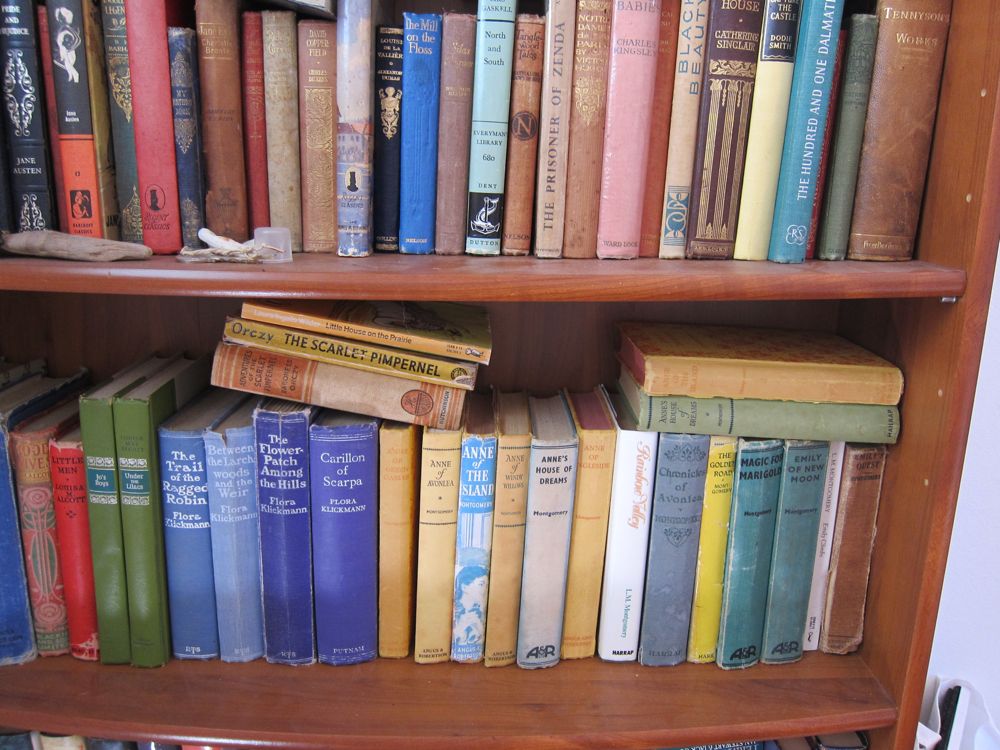
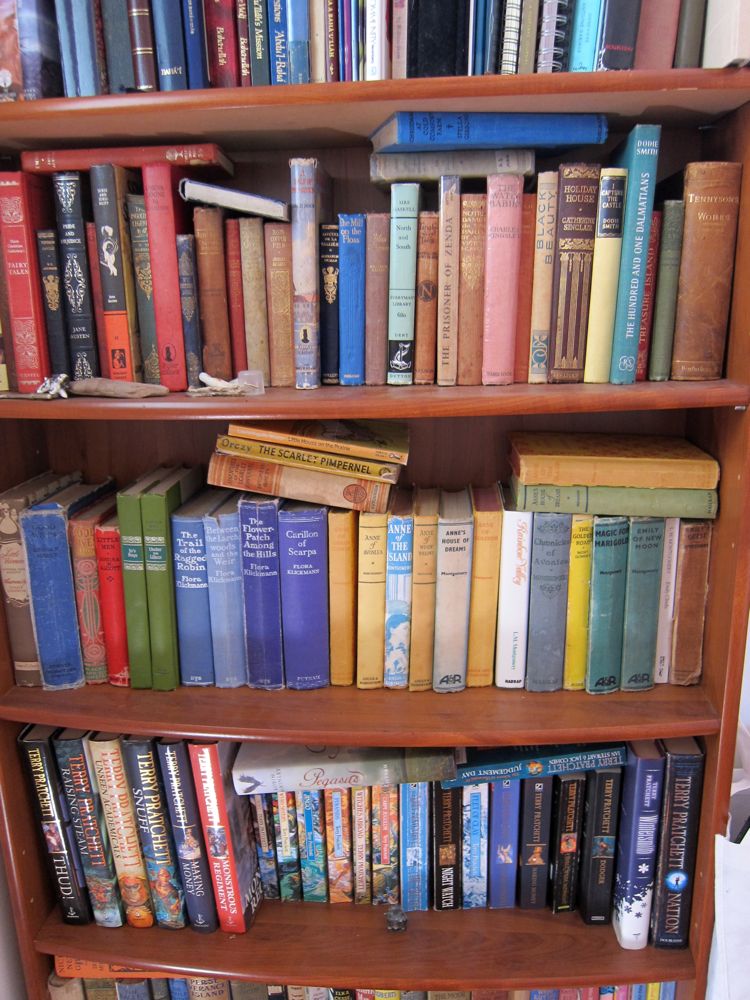
It also means that my bookshelves are starting to overflow.  I really hate when I have to start stacking books on top of each other.  It feels so disrespectful.  Books should never be tossed or put on the floor or have their pages folded, and ideally, they should all have their own little spot on the shelf to stand in.*

L.M. Montgomery Books thedreamstress.com


Yep.  I have book issues!

But oh, such lovely books!  How could you not want to take the best possible care of all of them?  How can you not want to love them and pat them and tell them what good little books they are and that you are going to read them over and over again?

IMG_5531


Ahem.  Issues.

Any other Anne fans?  Surely we can prove the hairy Viking wrong?

And if not Anne, are there any childhood books you hold dear and are collecting?


* does not apply to rubbish books.  Certain popular novels can be folded, flayed, dropped on the floor, in the bath, and have food dropped on them with abandon.

Rate the Dress: Walking in the pink, 1878-80

Last week I showed you a dress that transitioned between the 1830s and 40s.  Based on your historical preferences, some of you wanted it to be more 1830s, or more 1840s, but most of you said “Oooooh!” and gave it a 10.  Which is why it managed a 9.2 out of 10, despite  few ‘Meh’s.

Looks like we’re on a winning streak!  Can we keep it up?

Much to my surprise, last weeks dress actually received some criticism for NOT having enough trim. Some of you wanted trim on the skirt too.

So this week, I’ve gone all out on trim:

This afternoon dress, in lilac pink and puce silk taffeta, is trimless only in the sense that there are no added fabrics.  When it comes to self fabric trim, Madame Grazini  went all out.  The bodice features fishbone pleating up the centre front, framed by a faux jacket in the puce, with self fabric buttons.  The real tour de force is the skirt though: ruching, fishbone pleating, tiny pressed pleats, rosette ruffles, bows, shirring, and bustling.

It’s an excellent example of the way the slimmer natural form silhouette made up for its restraint in shape with an excess of ornamentation.

What do you think of it?

Rate the Dress on a Scale of 1 to 10