Last week I presented Mrs Lockett Agnew (nee Augusta Isobel Sheil), in an 18th c. inspired 1880s reception ensemble. There were a few tiny niggles about the very high neck, or the top-buttoning only jacket, but generally you thought it fabulous, and even if you didn’t like it personally, you thought it was perfect for Augusta, giving it a smashing 9 out of 10 (basically anything above a 9 is a perfect score these days!).
This Week’s Rate the Dress dress shows the transition from 1830s to 1840s fashions. The more elaborate sleeves and scalloped edging looks back to the cluttered detailing of the Romantic era, but the overall silhouette of the dress follows the smoother, sleeker line of the 1840s.
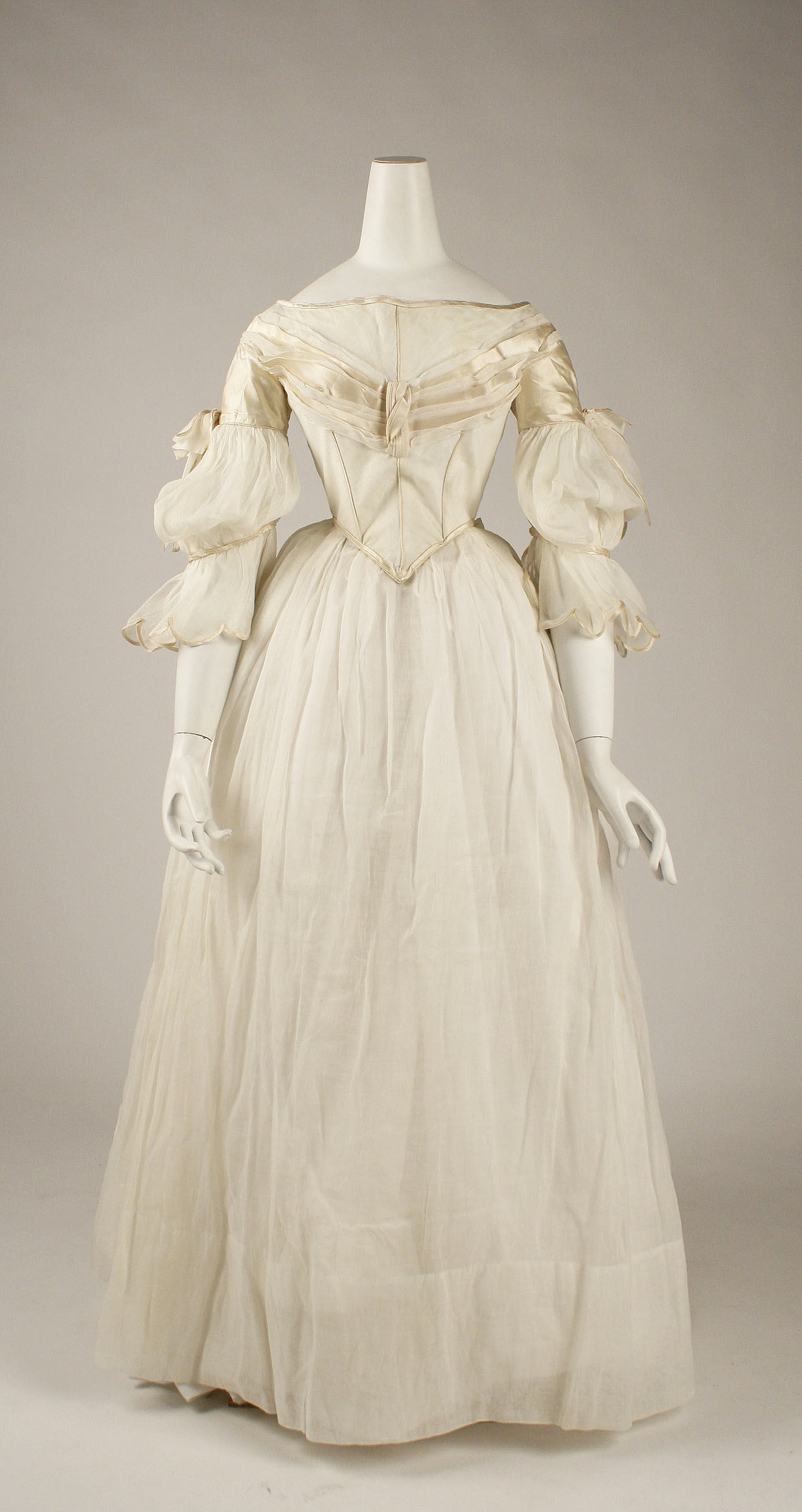
Evening dress, ca. 1840, American, cotton, silk, Metropolitan Museum of Art, 1982.132.1ab
Made from a stiff cotton tarlatan, with details in silk satin, the dress uses the shine of the satin weave to highlight and define the detailing, while keeping the an overall simple, monochromatic ivory.
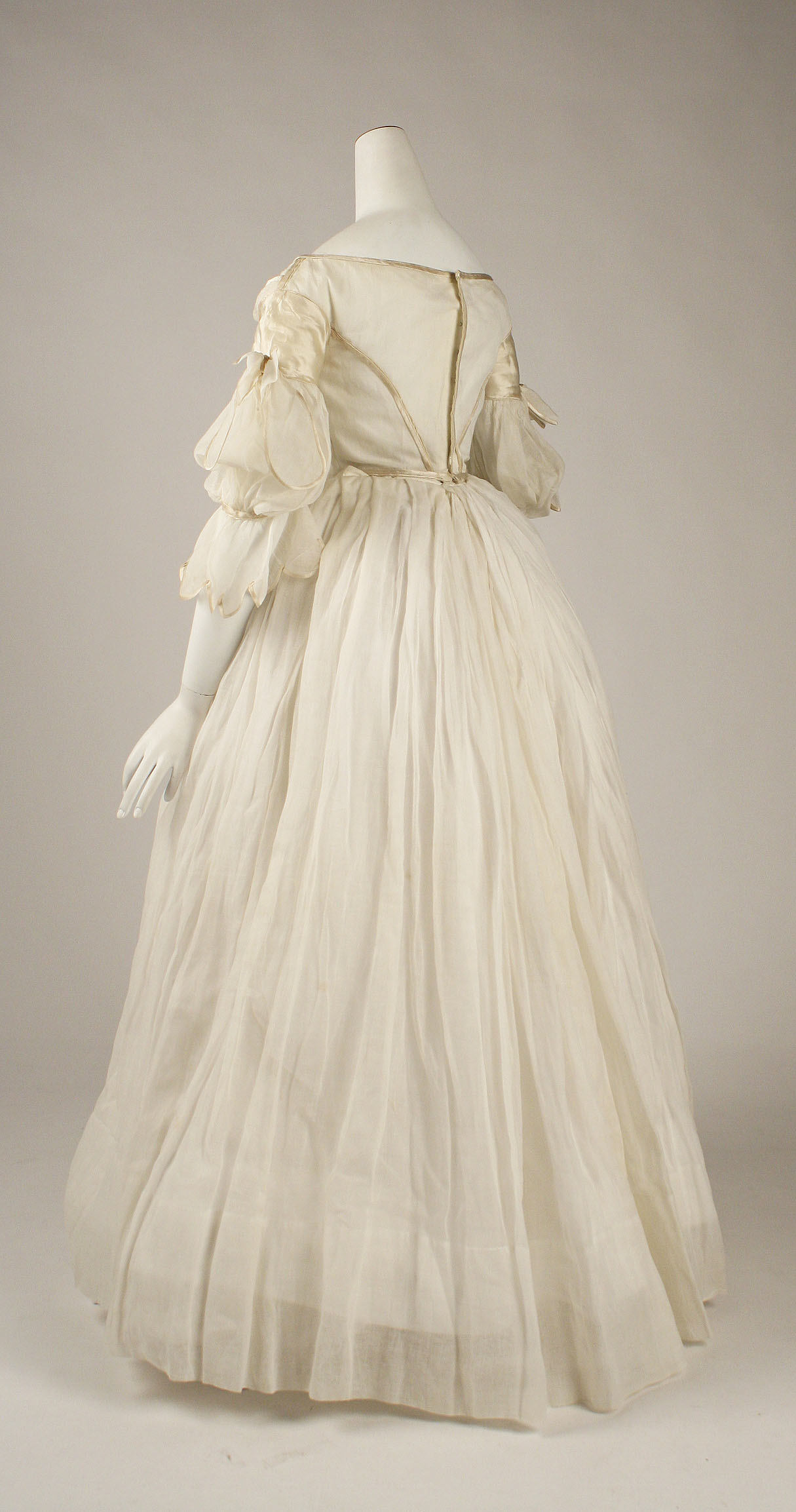
Evening dress, ca. 1840, American, cotton, silk, Metropolitan Museum of Art, 1982.132.1ab
While this may have been a wedding dress, white was also a very popular choice for evening dresses, particularly for young women (think of Meg, two decades later, taking her tarlatan to wear to the Moffat’s ball, where she would “look like an angel in white” according to Amy).
White was symbolic of youth and purity (as much, if not more, in a general sense, in that a young girl would be unsullied by the experience of life’s woes and cares, than a specific, literal, virginal sense), and brighter, deeper colours were considered too worldly and sophisticated for younger women.
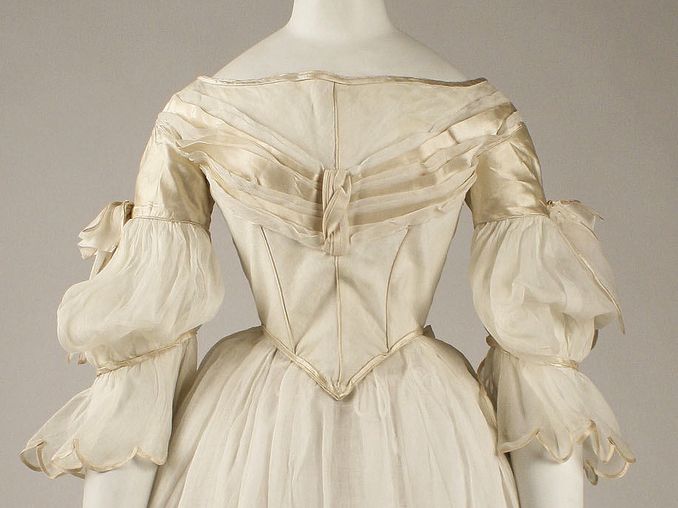
Evening dress, ca. 1840, American, cotton, silk, Metropolitan Museum of Art, 1982.132.1ab
The cut of the bodice, with a slightly higher neckline, and the softly drooping puffed sleeves add to the impression of youthful girlishness, but the dress shows a distinct sophistication in its execution, if not the intent of its design – it’s clearly the work of an experienced seamstress.
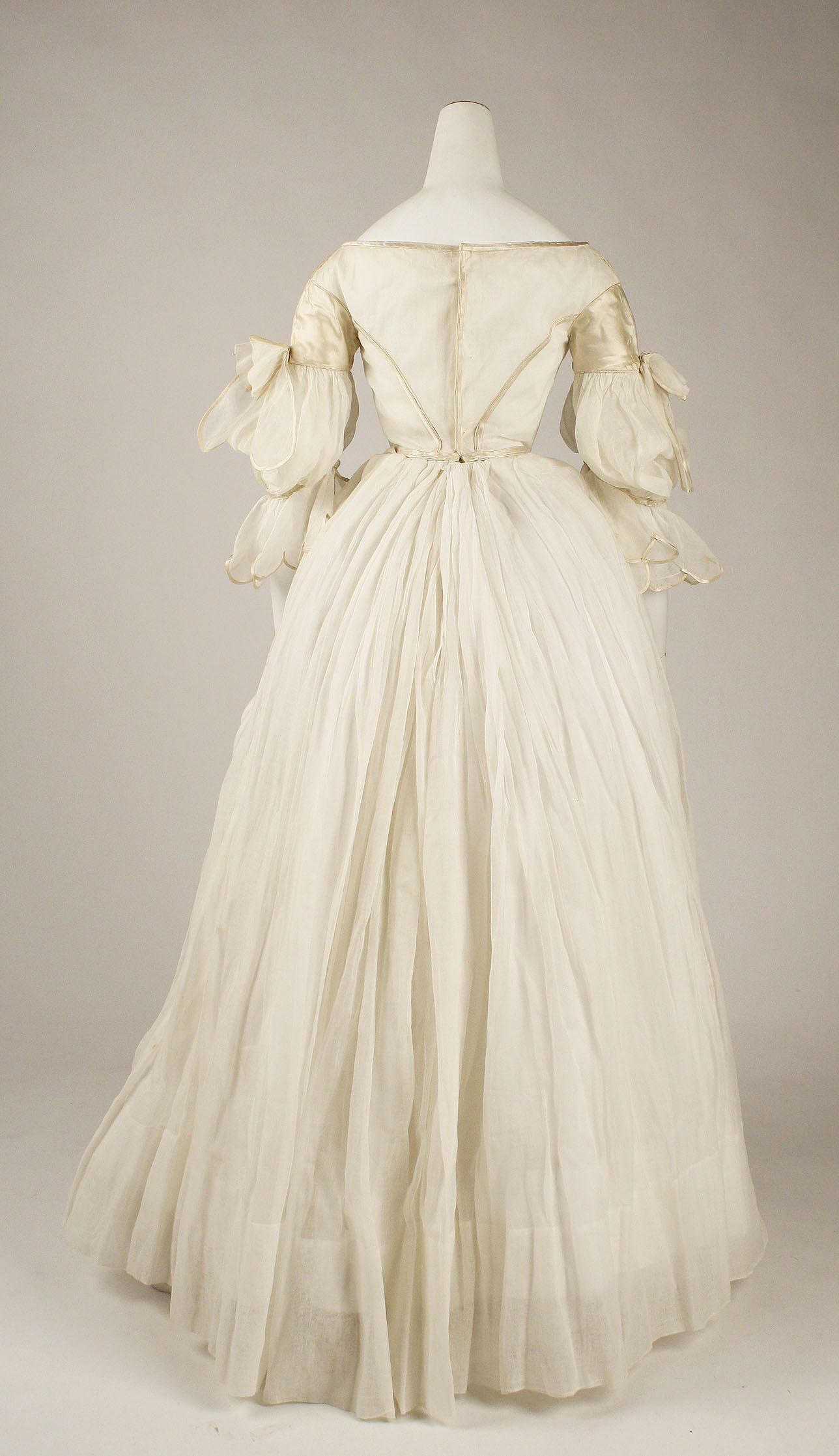
Evening dress, ca. 1840, American, cotton, silk, Metropolitan Museum of Art, 1982.132.1ab
Beyond ideas of youthful purity, white was a popular choice for evening dresses because it was so effective – in an era of dim nighttime lighting, a light coloured dress would stand out more in a candle-lit room.
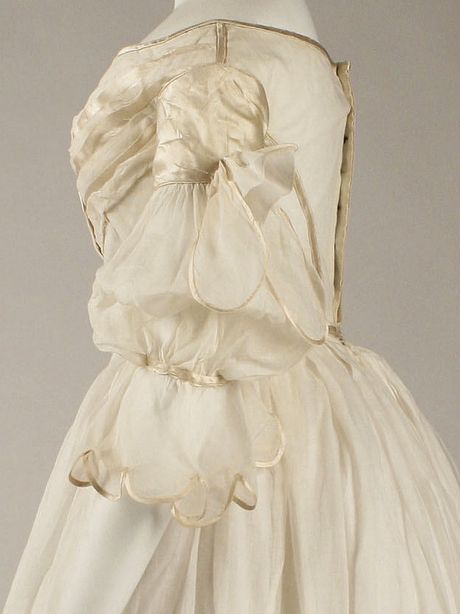
Evening dress, ca. 1840, American, cotton, silk, Metropolitan Museum of Art, 1982.132.1ab
In this dress, the satin areas would catch the light even more, highlighting the painstaking trimming on the seams (piped seams and seam trim), around the scalloped sleeves edges, and on the sleeve bows.
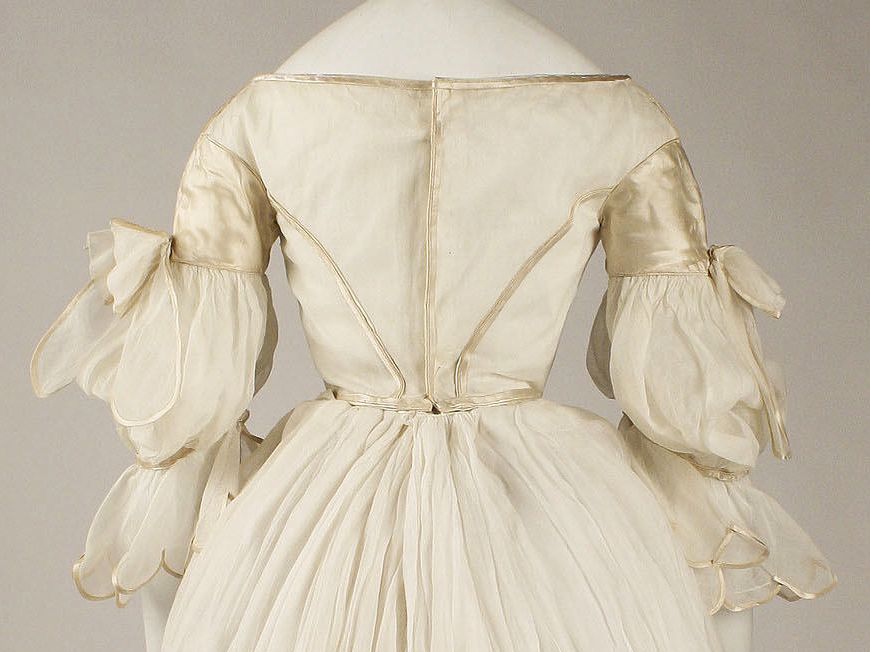
Evening dress, ca. 1840, American, cotton, silk, Metropolitan Museum of Art, 1982.132.1ab
What do you make of the mix of girlish details, sophisticated sewing, and simple colours?
Rate the Dress on a Scale of 1 to 10