Latest Posts

Rate the Dress: 1880s ensemble

The week before last I showed you quite a challenging garment: a Schiaparelli dress.  Last week’s offering of a 15th century Florentine ensemble in pink was perhaps not challenging enough: everyone loved it, but not enough to start any really interesting discussions around it.  I think it was just pretty, with not much to say, or as Daniel noted “pleasant, with no punch.”  Still, it came out in a rash of 9s & 10s, with only two 8s, for a total of 9.5 out of 10, which is pretty much a perfect score these days.

I’ve shown a few weeks of fairly restrained, muted garments, so I wanted to show you something with lots of colour this week.  Hence this dress in rich, vibrant peacock blue, paired with a russet, orange and gold brocade on more peacock blue:

Afternoon ensemble, 1885—88, American, silk, metal, Metropolitan Museum of Art, 2009.300.2033a-e

Afternoon ensemble, 1885—88, American, silk, metal, Metropolitan Museum of Art, 2009.300.2033a-e

This dress is classic mid-late 1880s: saturated colour, bold patterning, asymmetry, a mix of draping and pleating, and a nod to the aesthetic movement with the ruching/smocking across the bodice and on the skirt panel.  Oh, and a MASSIVE bustle, which I did not expect from the front view.

Afternoon ensemble, 1885—88, American, silk, metal, Metropolitan Museum of Art, 2009.300.2033a-e

Afternoon ensemble, 1885—88, American, silk, metal, Metropolitan Museum of Art, 2009.300.2033a-e

And it comes with it’s own matching paletot out of the brocade fabric:

Afternoon ensemble, 1885—88, American, silk, metal, Metropolitan Museum of Art, 2009.300.2033a-e

Afternoon ensemble, 1885—88, American, silk, metal, Metropolitan Museum of Art, 2009.300.2033a-e

Asymmetry is often unpopular on Rate the Dress, as are extremely striking, off the wall colour combinations.  This dress is definitely punchy.  How will it fare?

Rate the Dress on a Scale of 1 to 10.  

The ‘Bambi & Bows’ 1929 dress

Whew!  A day late, but my dress for the HSF ‘Pink’ challenge is done!

1929 'Bambi and Bows' dress

Things got held up by a nasty attack of hayfever, which turned into a nasty cold.  And at the same time I’ve got a massive, top-secret, super-exciting project to work on: the biggest project I’ve ever had.  And it’s amazing.  And due on the 28th.  And in the meantime I’ve got a trip away to Napier’s Art Deco weekend, and a trip away to Auckland on the weekend of the 2nd of March.

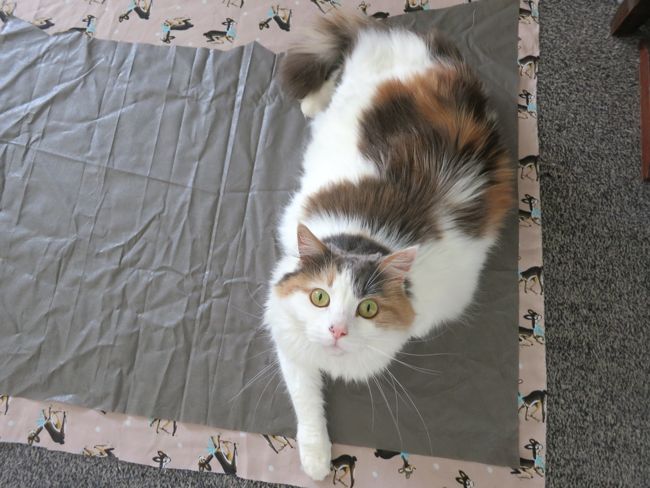
So for a while not much happened with the fabric except Felicity lying on it:

Felicity the cat thedreamstress.com

But this weekend I hauled myself out of bed, and, with the help of a box of tissues, I alternated an hour on The Project and an hour on my dress, and got it done late on Sunday.

1929 'Bambi and Bows' dress

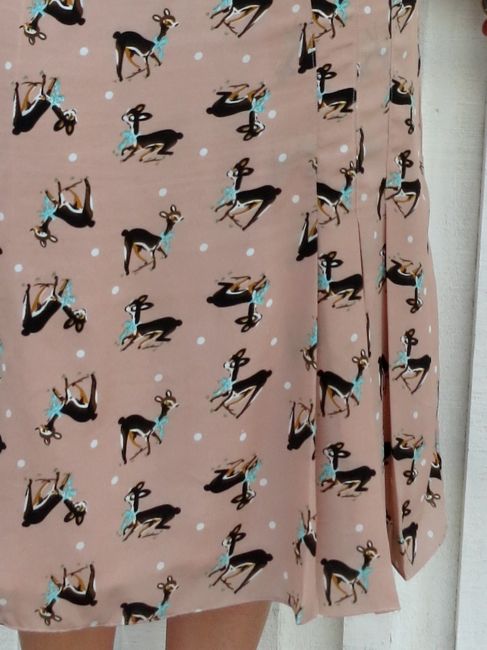
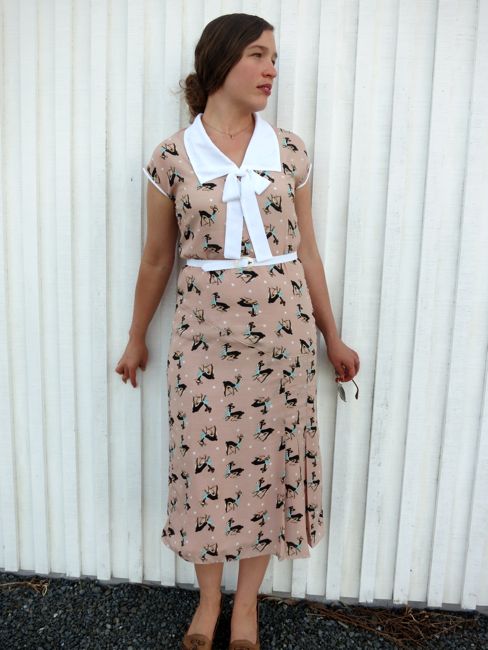
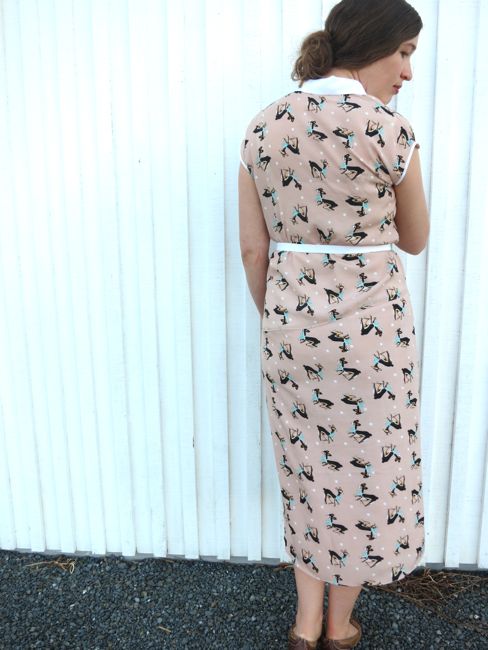
As you can tell, the fabric is indeed pink, and features darling fawns with bows around their necks scattered  across it.  The English-language edition of ‘Bambi, A Life in the Woods‘ was published in 1928 (the movie did not come out until ’42), and was an instant hit, inspiring a whole plethora of fawn themed designs.  The fabrics I know of were probably intended for children’s wear, but finding such a perfect Bambi fabric was too good to pass up on for a 1929 dress.

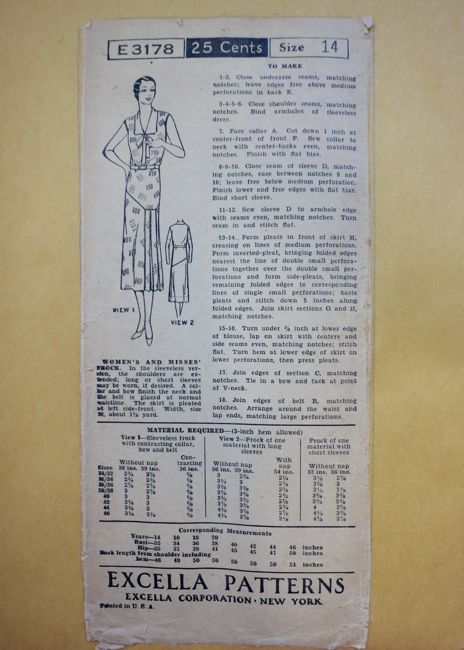
Excella E3178 late 1920s dress

Excella E3178 late 1920s dress

I was extremely dubious about this dress as I sewed it up: it just looked like an almost-flesh-coloured sack.  Then I added the collar and bow and belt, and suddenly it all came together, and I’m in love!

1929 'Bambi and Bows' dress

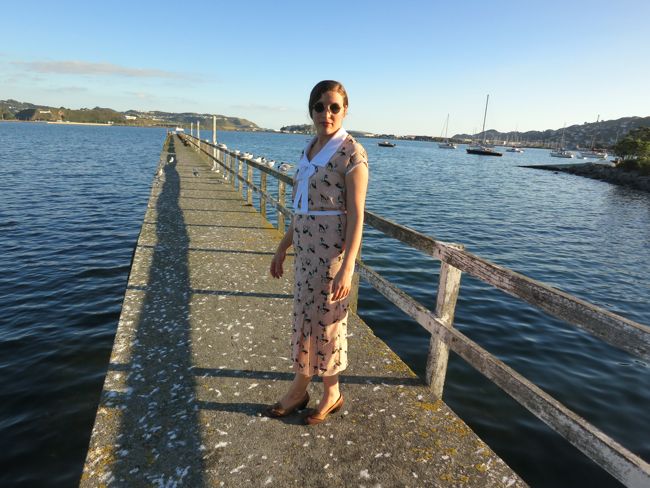
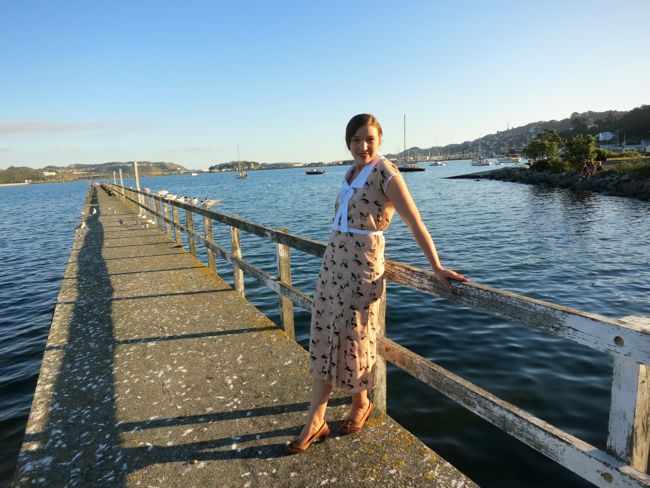
I’ll be wearing it next weekend at Napier’s Art Deco weekend, along with a matching cloche.  For now though, I did a simple -pre-dinner photoshoot in Wellington.  Mr D was quite grumpy that I insisted on a pre-dinner shoot, so I let him choose the location.  Inexplicably he decided to head to our favourite beach, rather than simply walking around our neighborhood, which was my choice (and which would have taken half the time).

1929 'Bambi and Bows' dress

1929 'Bambi and Bows' dress

So I have no idea what the dress has to do with the photoshoot locations.  Bambi on the beach?  OK.

The Challenge:  #3  —  Pink

Fabric:    2m of pale pink  poly-chiffon  (shhhh) with fawns ($16 per metre), 1/4m white rayon challis ($2).

Pattern:  Excella E3178

Year:  1929

Notions:  Thread, a vintage shell belt buckle ($2), vintage 1960s fusible belting.

How historically accurate is it?  The fabric is poly, so not accurate, though the particular weave and hand is a good match for early rayon chiffons.  And I overlocked all the interior seams, because poly frays like mad.  And I have no evidence than any adult ever wore a dress patterned with fawns in 1929.  So 75%

Hours to complete:  7.  I was slow.

First worn:  Sun 16 Feb for the photoshoot.

Total cost:  $36

1929 'Bambi and Bows' dress

A family tragedy

My sister the Chef is named after our great-great-grandmother.  It’s a very unusual name: so unusual, in fact, that every single google result for it is about GGGrandmother, one of her ancestors, or one of the five women named after her, including my sister.

So I won’t be telling you GGGrandmother’s name, because my sister deserves a little privacy on the internets.  Instead, I’ll call her Anna, a name she sometimes used, perhaps because it was easier for the general public to pronounce and wrap their head around.

Growing up, I wondered why my sister was named after our GGGrandmother.  I’m named after my paternal grandmother, and my youngest sister after our maternal grandmother, but three generations back is a long way to go for a name. And why all those other women (and men, carrying the slightly more common masculine version of her name)?

The answer, at least in part, is the story of her life.  As a child I was told a very simple version of it: a child friendly, bowlderised version (not my parent’s whitewash, simple them repeating the version they had heard), but as an adult I’ve come across other versions, and read accounts from the time, and put together the dates and known facts.  In doing so,  it’s become apparent that Anna’s tale is infinitely more tragic than the one I grew up with.

This is Anna’s story as I understand it.  There are slightly differing accounts across the different branches of the family, and disagreement on some of the details, so I have simply chosen the ones that best match the facts, or make a cohesive story without affecting the truth of the tale.

NOTE: The following story is very, very sad.  It doesn’t involve any human cruelty (the hardest kind of sad), but it is nonetheless absolutely heartbreaking, so if you are feeling down you might want to skip it and click on the ‘Felicity’ tag instead and cheer yourself up with cute kitty posts.

Anna was born in Michigan in the 1860s, the daughter of Dutch-ish immigrants (the Netherlands being a slightly different thing at the time).  Her parents struggled with the stony Michigan ground and woods, and so they moved the family to the plains of the newly opened Dakota territories, where she met and married Jacob, another Dutch-ish immigrant.

Jacob was a carpenter and well-digger.  The new couple settled on a homestead, with a house and a barn.  A year after their marriage Anna became pregnant, but sadly, the child died at birth.  A year and a bit later there was another pregnancy, and Anna gave birth to a healthy baby girl (we’ll call her Gertie).

Gertie was barely two years old when Anna went into labour with a third pregnancy.  The labour did not go well, so Jacob rushed the mile or two into town for a doctor, taking Gertie with him, so as not to leave the responsibility of her with Anna.

It was the end of winter, and as Jacob neared town, a terrible blizzard swept in.  He and Gertie made it to the town, but they were trapped at the doctor’s house as the blizzard raged around them, frantic with worry for Anna, alone, and in labour, in a cold little house in the vast prairie.  Attempts to get back to Anna were futile.

It was almost three days before the blizzard cleared enough for Jacob, the doctor, and some friends to rush back to the homestead.  As they neared it, the worst possible sight met their eyes.  The house was a smoking ruin: destroyed by fire.

They raced to the house, calling Anna’s name frantically, hoping against hope that she had survived her labour, the fire, and the blizzard.

They finally found her collapsed at the door of the barn, dead from exposure, her body curled protectively around her tiny baby.  Amazingly, the baby, just three days old, had survived.

Anna had managed to give birth on her own, cut the cord and deal with the afterbirth and dress and wrap her baby.  Sometime in the wait for her husband the stove had caught on fire, and Anna, weakened from labour and with an infant, was unable to fight it.  She’d attempted to make her way to the barn in the raging blizzard, and while she couldn’t save her own life, she’d given it to enable her infant to live.  She wasn’t even 25.

The tiny infant was my great-grandfather.  Named after his mother, he was called Bert.  He was sent to be raised by relatives until he was 12.

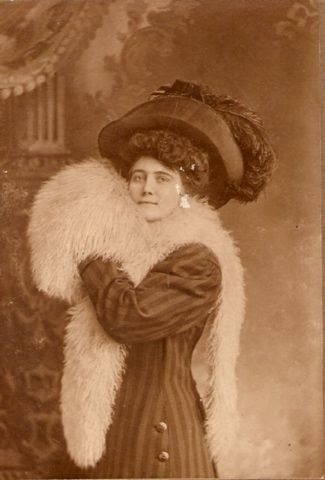
I posted a photo of his older sister, Gertie, on Facebook yesterday.  She was married by the time she was 20 (this photo, taken in 1907 or 1908, was probably  done just before or at the time of her marriage).  She had four children of her own, but also sadly died young: just a decade older than her mother.  I wonder if she remembered Anna at all, in faint memories of lullabies or being held.
Great-Great-Aunt