Latest Posts

Five for Friday: Inspirational Innovations.

I’ll be doing favourites posts every four challenges this year, which highlight the creations I feel best captured the spirit of the challenge, but I’m going to do a special post all about the Innovations challenge, because I loved what came out of that challenge so much.

Of every Challenge we’ve ever had in the HSF, this was my favourite by far.  I was so impressed and inspired by all the research.  I learned so much from reading all the blog posts about it, and seeing the way that people considered innovations.  It’s all very well to create pretty things fortnight after fortnight: this challenge let us show off the understanding behind all of the items.  I can’t thank all the participants enough for entering into the spirit of the challenge, for researching, considering, and bringing a multitude of fascinating innovations to light through their creations.  I’m really hoping that the research and investigation doesn’t stop with this challenge, but continues on throughout the HSF 2014!

Here are five of my favourite Challenge posts for the knowledge they shared, not just the charming challenge item they created.  As always, it was so hard to choose!  At one point I had thirteen tabs open in my browser window, for all the innovations I wanted to highlight.  You’ll see more of them when I blog about favourites for Challenges 1-4.

  1. Elizabeth of Sewing and Sightseeing considered both textile and societal innovations, and made a gorgeous 1820s-remodelled-in-the-1830s block printed dress based on clothes worn by mill girls.  She discusses roller printing, and the much bigger innovation of women living alone outside the family home, and working and earning their own livelihood.  Wonderful!
  2. On Living History made a beautiful Marseilles cloth petticoat, and wrote about the development of the cloth (with lots of lovely links). A gorgeous petticoat, wonderful research, and good reminder to me that my Matellase/ Marseilles cloth terminology post has been sitting there half finished for over a year!
  3. A Modern Needle Through Time wrote a fabulous blog post on Ellen Louise Curtis and the development of paper sewing patterns.  Sadly, she didn’t get to use that particular innovation it in her finished Challenge item, but the story is a joy in and of itself.
  4. Caroline of Dressed in time looked into the history of riding habits, and made a late 19th/early 20th century riding apron.  I found it particularly fascinating because I’ve catalogued turn-of-the-century riding habits for museums, and have always been slightly mystified by the aprons.  Not anymore!
  5. Sewing machines were one of the most popular innovations, with many people making 1860s machine sewn items.  Parva Sed Apta  wrote a beautiful history of the sewing machine,   and  took it a step further and considered how sewing machines would change sewing and crafts, beyond just ‘this item has a machine sewn seam’.  Instead of a garment she made a box to hold sewing machine notions from 19th century instructions.  Beautiful!

I hope these all inspired you as much as they inspired me!  There are more through the comments on the challenge page, and through the photos in the facebook album.

To finish off, here is an illustration of calico printing in 1805: you can see how labour intensive it would be, setting that individual block over and over again, and how roller printing would revolutionise fabric production.
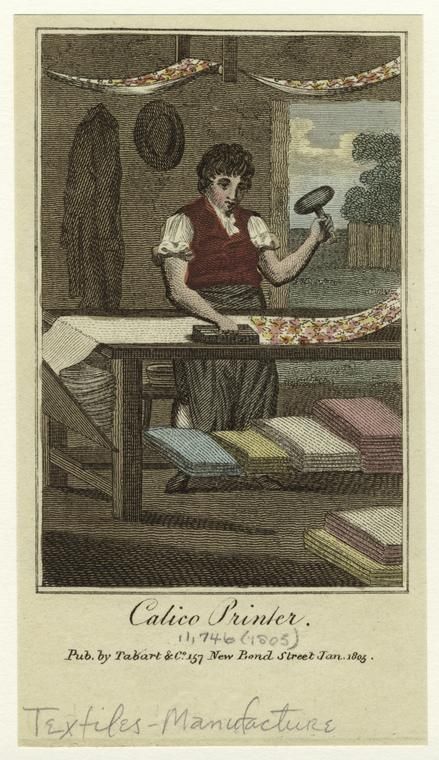
Calico Printer, 1805, New York Public Library
Calico Printer, 1805, New York Public Library
Charming creek: a walk in Coal Country

My sister the chef tramps in the same way I sew: slightly obsessively.  So any road trip with the two of us involves me with a bag of hand sewing at the ready in the most accessible pocket of my backpack or suitcase, and frequent rambles and daywalks with the chef leading the way.

In the days before New Years eve we’d had nothing but tiny 20 minute explores to scenic locations, and sister was getting restive, so I promised her a proper long walk (a compromise between my ‘What about a museum?  Is there a botanical garden around here?’ and her ‘Let’s stay in this great cabin I heard about!  It’s only a five hour walk up a mountain – super easy!’).  The weather threatened rain, but we both geared up with merino tops and waterproof jackets and set off on the Charming Creek walkway, which she had read about in a tramping book and I liked because it sounded charming.

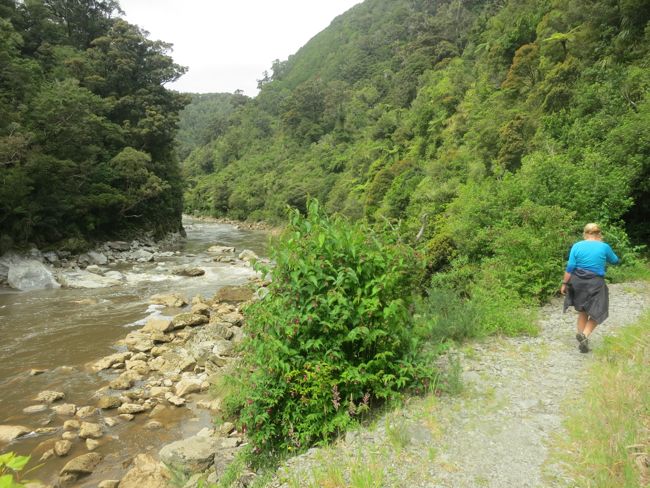
The path began in a carpark literally next door to the coal mining buildings I showed you in Monday’s post, and wandered off along Ngakawau stream, up Ngakawau gorge.

Charming Creek walkway, West Coast New Zealand

Only 10 minutes into the walk we began to encounter the remains of the track’s coal and timber history.  First wood and iron bins for ferrying coal and lumber down to the Ngakaway railyard, slowly rusting and rotting away in the wet weather, still on their train tracks.

Coal carts, Charming Creek walkway, West Coast, New Zealand


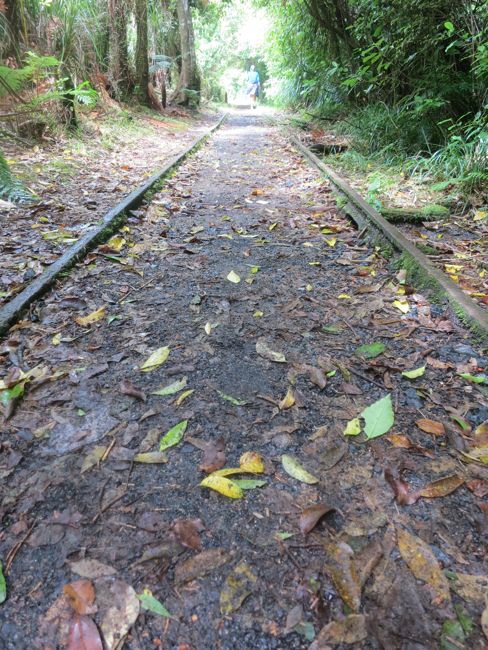
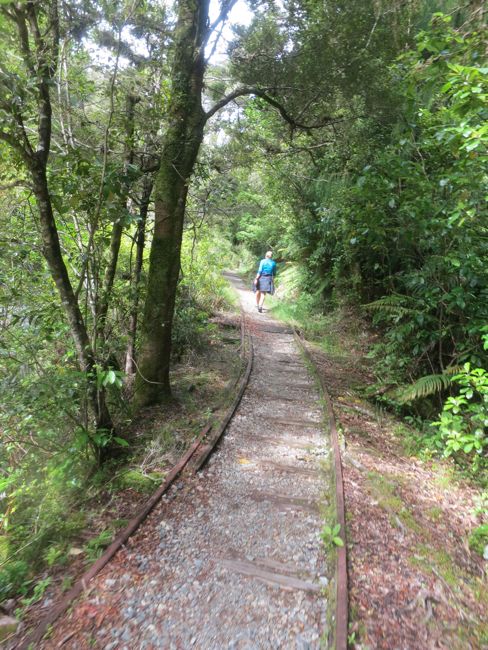
From that point on the walk followed the old train tracks, part of a private railway that was built specifically to haul coal and lumber out of the narrow gorge.  Most of the track was framed by the iron rail lines, but in places even the old wooden sleepers were extent, their tops worn shiny by the tread of thousands of hiking boots.

Charming Creek walkway, Ngakawau, West Coast, New Zealand


A few minutes up the track from from the coal bins a brick oven loomed out of the bush.  I believe it was part of a foundry, for building and repairing parts for the railway.

Charming Creek walkway, Ngakawau, West Coast, New Zealand


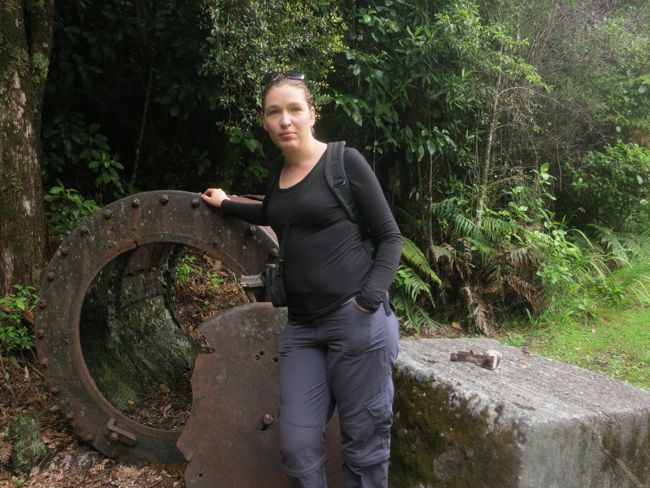
In the same clearing were enormous bits of engineering: once essential parts of the railway and coal and lumber businesses.  (and on I side note, I made the top I’m wearing in the photo not that long ago, but never got around to posting about it, because black merino knit, while iconically Kiwi, just isn’t that exciting.  Also, it could use the tiniest bit more ease, or I could use a few less holiday treats and more of those tramps the Chef keeps advocating)


Charming Creek walkway, Ngakawau, West Coast, New Zealand


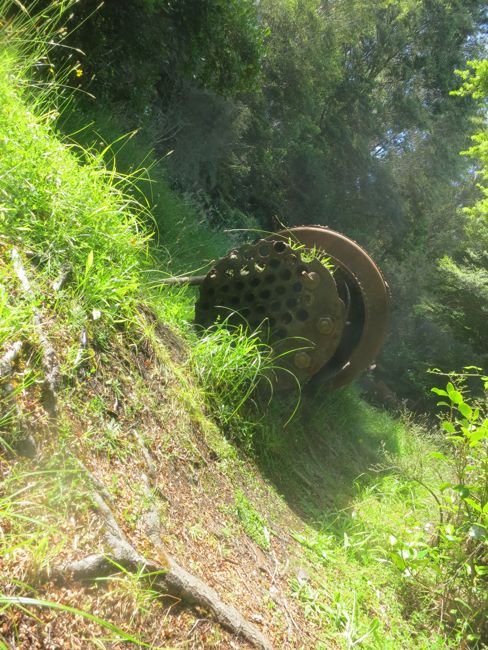
Uphill from the oven were the train engines themselves: abandoned when the lumber and coal ran out.  A simple shelter had been built over them to protect them from the weather, but there were bits of iron flaking off them at every point.

Charming Creek walkway, Ngakawau, West Coast, New Zealand


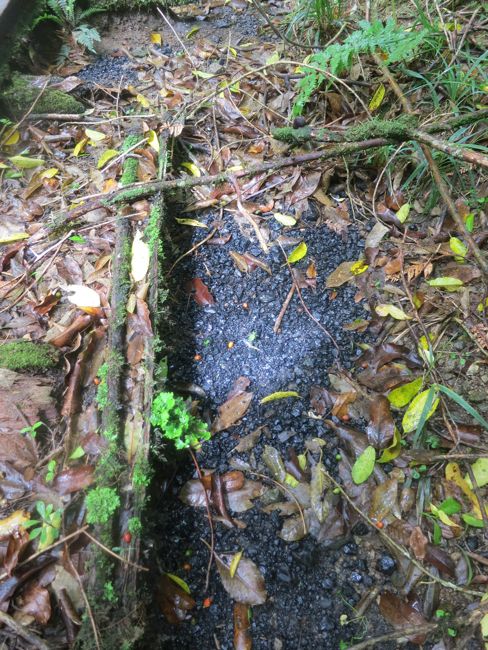
After the excitement of industry we continued up the gorge along the river.  The threatened rain never materialised, and instead the weather improved as we walked.  Still, the ground looked damp: all dark and shiny, but instead of slipping as we walked over it, the soil crunched.  I realised that we were literally walking on coal:

Charming Creek walkway, Ngakawau, West Coast, New Zealand


The track itself was made up of all the thousands of bits of coal that had spilled over the edges of the bins in their thousands of trips up and down the line, gathering in the centre of the track, and along the hollows on either side.  It was quite surreal.

Charming Creek walkway, Ngakawau, West Coast, New Zealand


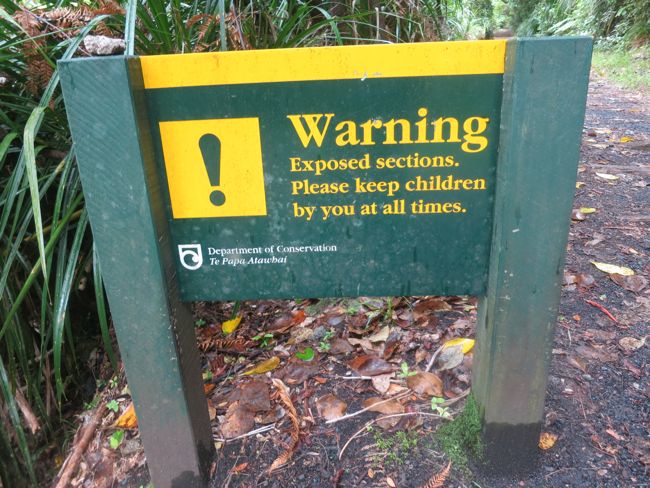
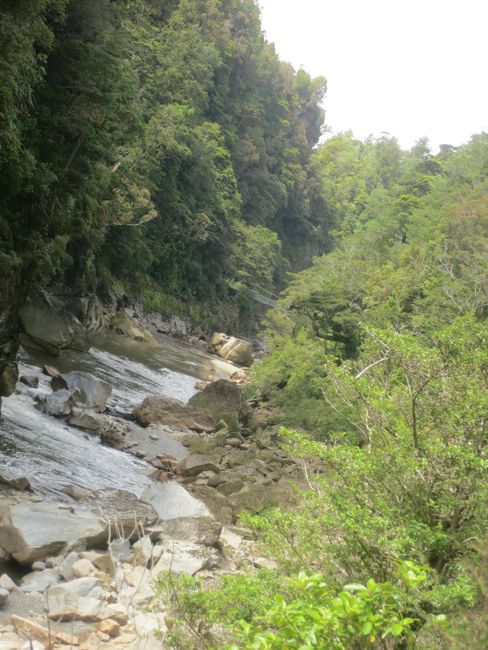
As we made our way up the gorge the track became wilder.  There were sheer drop-offs, with the stream thundering below, and scrambles over boulders.  The Department of Conservation helpfully posted signs to keep you safe as you walked, though, as I occasionally have the sense of humor of a 12 year old boy, they just made me giggle:

Charming Creek walkway, Ngakawau, West Coast, New Zealand

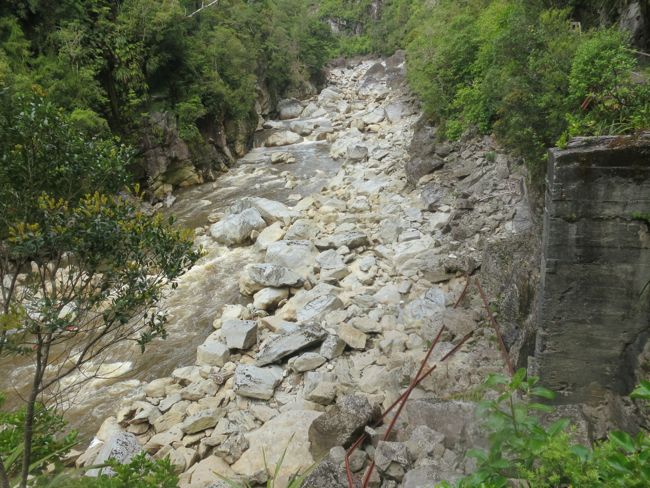
In places the train lines were buried by rock-falls from the gorge walls.  In other places land slips had completely obliterated the old train track, leaving the lines in twisted heaps of metal far below.  In these places,  DOC had built new tracks, or little bridges over the gullies in the gorge wall.

Charming Creek walkway, Ngakawau, West Coast, New Zealand


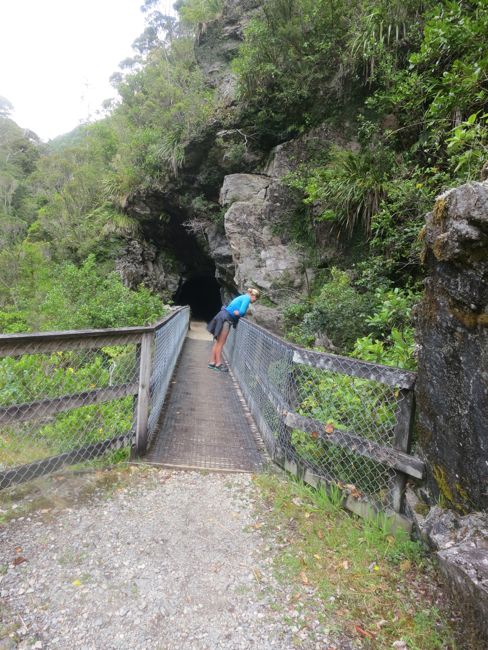
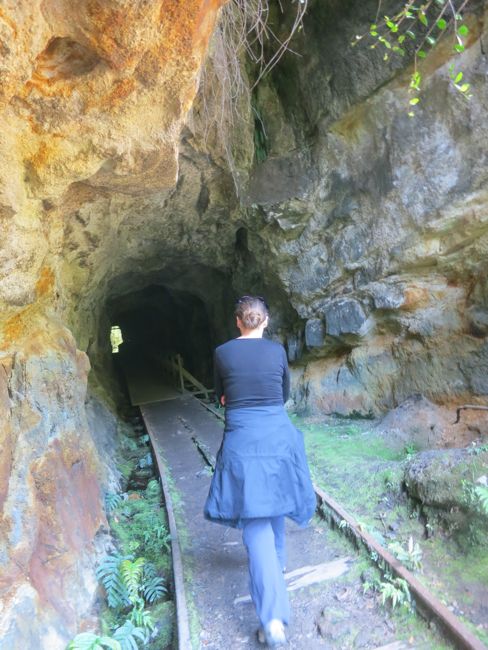
In other places the Department of Conservation had it easy: when laying the train line in the early 20th century the engineers had simply blasted  through difficult spots, and so the track passed through long, cold, dark tunnels, where the coal crunched underfoot and you simply had to aim for the light at the other end.

Charming Creek walkway, Ngakawau, West Coast, New Zealand


I wasn’t particularly fussed by the tunnels, but looking ahead on the track I could see something that made me much less happy:

Charming Creek walkway, Ngakawau, West Coast, New Zealand


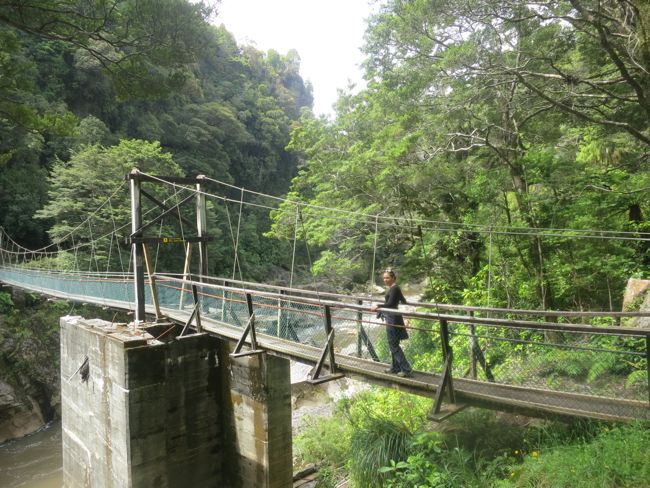
“Oh boy!” said the Chef, when we got to it, “A swingbridge!”  And she skipped across it, stopping to jump up and down on it, and sway it wildly back and forth.

Charming Creek walkway, Ngakawau, West Coast, New Zealand

I, on the other hand, gingerly crept across it, hands firmly clutching the sides, one foot inching in front of the other, eyes fixed in front of me as I sang the song about what kind of pumpkin I was (not a happy one).

Charming Creek walkway, Ngakawau, West Coast, New Zealand


I was so petrified on the swing bridge (I know, I’m a wuss) that I didn’t even look upstream and see the amazing sight awaiting me:

Charming Creek walkway, Ngakawau, West Coast, New Zealand


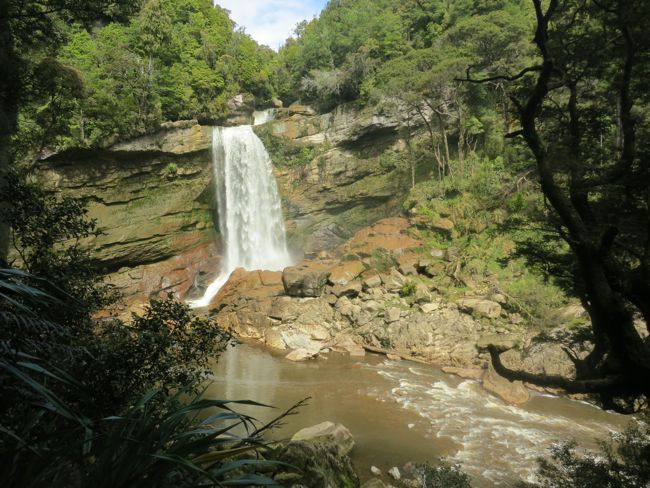
Isn’t it fabulous?  Such a spectacular waterfall!  I stood on the track just looking at it and taking photographs of it from every possible angle as the sun finally came out, until the Chef finally took the camera off of me.

Our next hurdle, directly after the waterfall, was the longest tunnel on the walk:

Charming Creek walkway, Ngakawau, West Coast, New Zealand


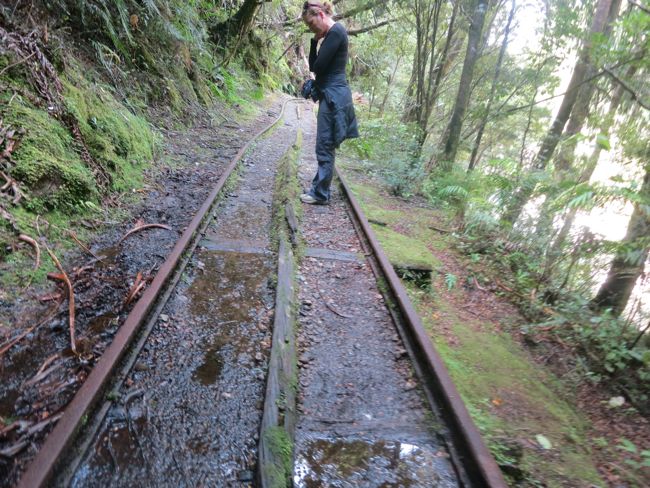
Beyond it was the best-preserved section of the old train lines, with all the sleepers and the wooden third rail (which helped to act as a break) still intact.


Charming Creek walkway, Ngakawau, West Coast, New Zealand


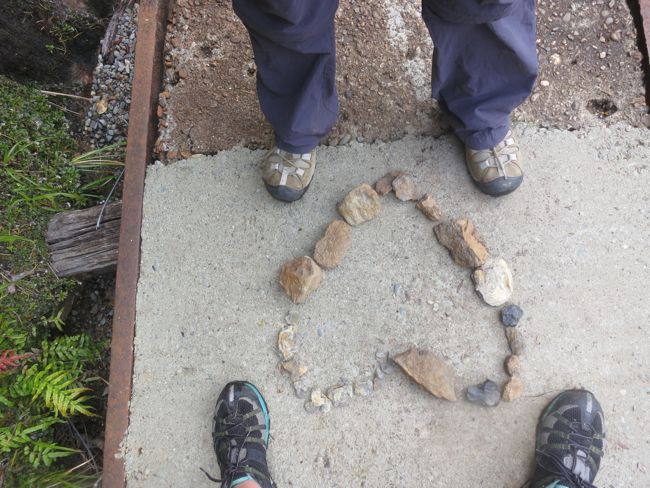
We also saw a far more modern memento, which someone had left on a section of track that had been turned into a cement bridge to cross a little stream:

Charming Creek walkway, Ngakawau, West Coast, New Zealand


And then there was more history: the remains of the original lumber mill for which the track was build.  Once there was an entire mill, and an overseers house, and workshops, and a tiny train station here in the bush.  Now there was nothing but bits of train engine among the grass:

Charming Creek walkway, Ngakawau, West Coast, New Zealand


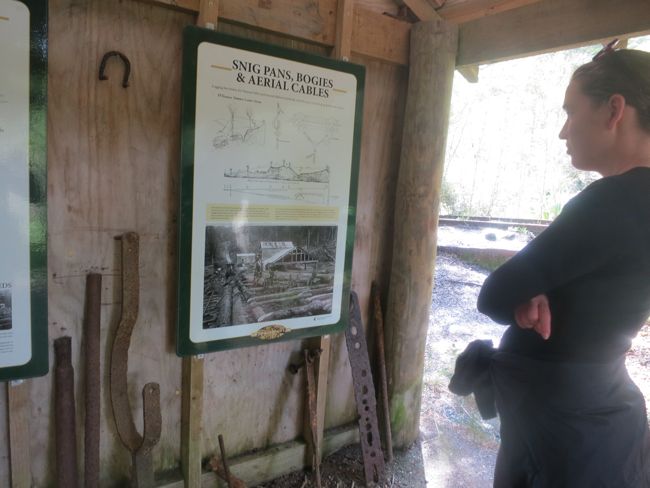
And a little modern lean-to, with an interpretive display and remains of the lumber and coal industries.  Isn’t it wonderful how all the little pieces are just leaned agains the wall, totally unsecured?  I hope no-one is rude enough to take them away.


Charming Creek walkway, Ngakawau, West Coast, New Zealand


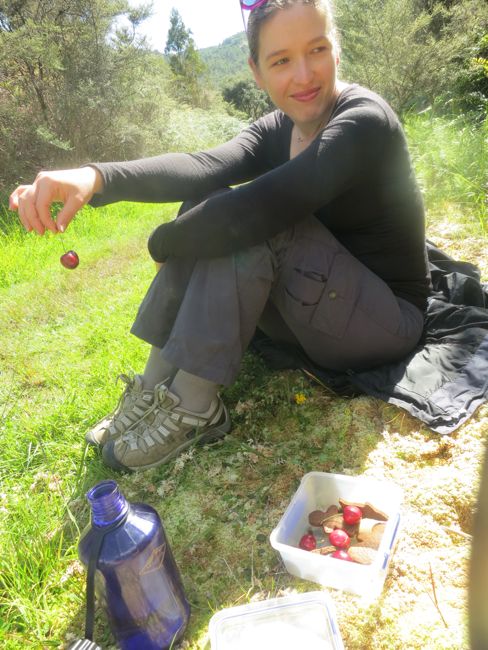
Beyond the lumber mill we found a lovely patch of moss, where we sat and enjoyed the sunshine and ate cherries and gingerbread biscuits and had a chat with a South Island robin (more about that later)

Charming Creek walkway, Ngakawau, West Coast, New Zealand


And then it was back down the track in the sun, past the lumber mill and the heart, through the tunnel, another look at the waterfall, and across the swing bridge (not a happy pumpkin), and then down the tracks, through bush and tunnel and back to the coal mine carpark and the beach, and a wonderful international New Years celebration.

Rate the Dress: Late 15th century Florence does the Bible

Last week I  showed you a striped Schiaparelli frock.  It certainly caused a lot of commentary (almost twice the average for the last 4 months), but the response was quite divided.  Some of you thought the gown the epitome of Schiaparelli’s clever design and cutting.  Others thought it strange and hideous.  Many, many of you loved the back view, but hated the front.  I’m almost the opposite: I think the front is spectacular and unique and an absolute mastery of fabric, and without it, the gorgeous back would simply be run-of-the-mill red carpet: so sexy and pretty that it becomes boring.  So we’ll have to compromise at 7.8 out of 10, which is still rather good!

This week I wanted to show you something in very bright pink, but couldn’t find the right dress, so instead let’s travel back in time to the Renaissance, to Domenico Ghirlandaio’s depiction of the birth of John the Baptist.  While  Ghirlandaio was illustrating a scene from the Bible, his paintings are exquisite glimpeses into domestic life in upper-class Florentine households at the end of the fifteenth century.

The young woman who looks out of the painting in this detail from The Birth of John the Baptist is a perfect example of this.  Her front-lacing bodice, snug sleeves with her camisa sleeves peeping out in puffs, and pink-over-robe, along with her elaborately arranged uncovered hair, all represent fashionable Florentine dress for an unmarried noblewoman in the late 1480s.

Domenico Ghirlandaio (Italian artist, 1449—1494) Detail from Birth of St John the Baptist

Domenico Ghirlandaio (Italian artist, 1449—1494) Detail from Birth of St John the Baptist

What do you think?  Most of what you can see is the pink over-robe, with its intriguing leafy trim hanging down from under her arm, but there are also the delicate patterns of the fabric, and the details of the lacing and sleeves  to consider.

Does the whole look work for you?

Rate the Dress on a Scale of 1 to 10.