Latest Posts

HSF Challenge #21: Green

When I introduced the first HSF colour challenge (White) I hinted that there would be a second colour challenge this year, and that it would be a little more challenging.

The challenge?  Green – from palest spring green  through to darkest pine green, and from barely-there eu de nil, to vibrant chartreuse.

White, I think, is easy: almost every historical costumer has a number of white items, just because for most periods white would be the standard colour for most underthings.  Green might be a little harder.  It has been used in most periods, and while it’s never been the pre-eminent dye, redolent of status and riches, it’s often been a very expensive desirable colour.  Green, for all that it is the colour of nature, is actually a very hard dye to achieve with natural dyes, and for most of history it took a double dye bath (first yellow weld, and then an over-dye of indigo or woad (which is indigo, but that’s another story) to achieve green.

Green was complicated to dye, and has an equally complicated symbolism.  It’s been the colour of purity and holiness, and the colour of corruption and deceit. The woman in the Arnolfini portrait wears green, and her dress divides art scholars.  It’s a pretty obvious clue that the portrait is not, after all, a marriage portrait, but what does it actually mean?  Does it symbolise hope?  New life?  Or a less desirable attribute?  Robin Hood & his men wore Lincoln green not to blend in with the forest, but to advertise their loyalty to the area (Lincoln being famous for its green dye), and their success as outlaws: Lincoln green was a reasonably expensive dye (which suddenly makes them seem less like rebels against an unfair ruler and more like Depression Era gangsters in fancy suits).

Whatever green means, it’s certainly not as ubiquitous as white, and it may not be everyone’s favourite colour.  As much as I love Flora Poste, she did describe it as “such a trying colour.” Still, I hope many of you will embrace the spirit of the HSF: to be a challenge, and to inspire us to try new things, and use Challenge # 21 as an opportunity to dig in your stash, think outside the box, embrace the colour, and expand your palette.

Or perhaps you already love green!

I love green: it’s probably my favourite colour, and I own oodles of delicious green fabric.  Oddly though, the only green item in my historical wardrobe is the Luna Moth frock, and I don’t even like the shade of green.  Clearly it’s time for me to add some more green to my personal costuming palette!

Here are a few of my favourite pieces in green to get you thinking about the most verdant of colours:

The aforementioned Arnolfini Portrait.  Whatever the gown symbolises, if it does indeed mean anything but that Van Eyke thought a large addition of green would balance the painting, it is certainly gorgeous.
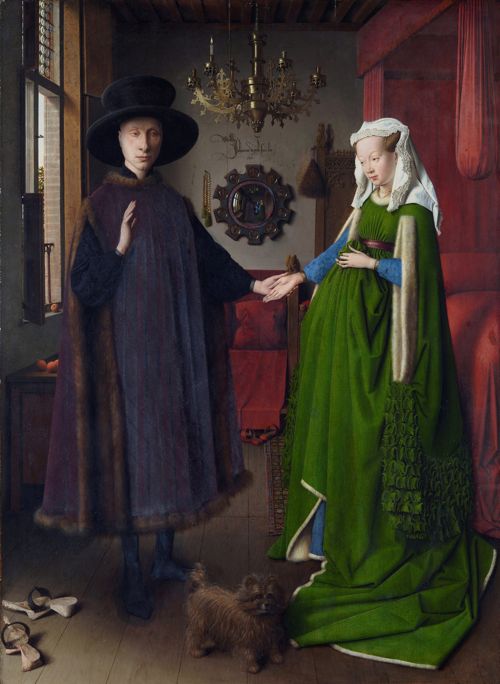
The Arnolfini Portrait, Jan van Eyck, 1434, National Gallery London

The Arnolfini Portrait, Jan van Eyck, 1434, National Gallery London

There are many, many 18th century green frocks that make me drool and dream of endless sewing time and fabric budgets, but this one probably takes the cake.  Oh, that fabric!

Robe a la Francaise (detail), 1755-60. Silk damask brocade with silk trimmings.

Robe a la Francaise (detail), 1755-60. Silk damask brocade with silk trimmings.

One of green’s associations in English tradition is with the faerie queen and the fey world, which is probably why these green shoes, with their little turned-up elven toes, just seem so right to me.

Shoes, 18th century, Nordiska Museet

Shoes, 18th century, Nordiska Museet

You know how I hate fringe?  Well, as much as I hate fringe, I love bobbles, and this ensemble comes in one of my favourite shades of green, and has bobbles.  Love it!

Oh, oh, oh, the next one is just deliciousness!  It’s looking a bit mossy in this photo, but the dress is rich emerald green, and everything about it is stunning, and I just can’t imagine another colour it would look half as good in.

Tea gown, 1895, Worth

Tea gown, 1895, Worth, featured in Paris Haute Couture

I’m sure that when I posted this frock as inspiration for my chinoiserie gown you all swooned.  Barely-there is not my favourite style of green, but it is so characteristically Edwardian, that I have to love it for being perfectly of its time!
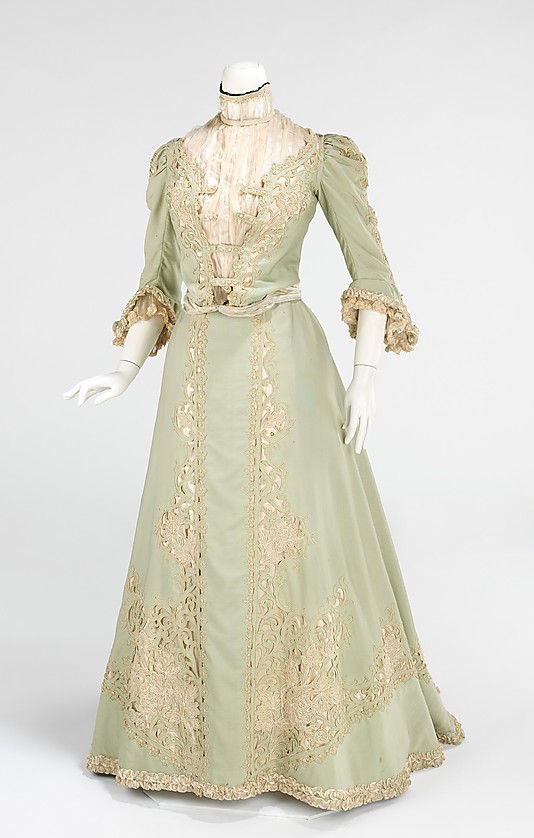
Promenade dress, ca. 1903, American, wool, silk, Metropolitan Museum of Art

Promenade dress, ca. 1903, American, wool, silk, Metropolitan Museum of Art

For those of you afraid of green, not every outfit has to be all green to qualify.  This outfit is mostly not green, but the pop of green, so unexpected, is what makes it effective:
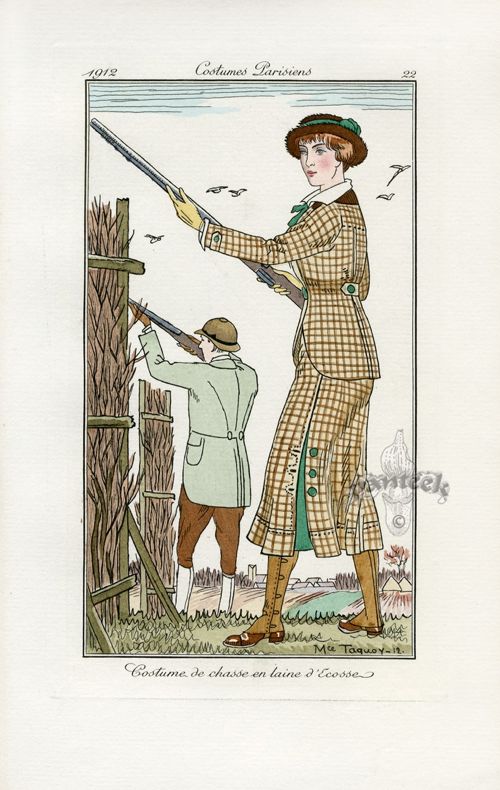
Journal des Dames et des Modes 1912

Journal des Dames et des Modes 1912

I think part of what makes the hunting suit so effective is that the flash of colour is green, not the more expected red, and that it is jade green, not the more expected hunter or forest shades.  And jade green?  Jade green is just sublime in almost all applications!

Chiffon & lace dress, French, c.1923, from the Vintage Textile archives

Chiffon & lace dress, French, c.1923, from the Vintage Textile archives

One of the periods that really did green, and did it fabulously, was the 1930s.  This green striped dress (and matching hat) is just amazing.  The way the stripes are turned across the dress, and open up into pleats with the skirt?  Gorgeous!

I hope some of these greens got you inspired!  For more inspiration, I have an entire pinterest page of green gorgeousness (it goes roughly backwards from the 1930s)

Challenge #21 is due October 21.

Rate the Dress: Lady in White

Last week I posted a vibrant, exotic 1930s frock with a simple silhouette.  Some of you were a little unsure of the bolero, both in length and decoration, and karenb went against the trend and flat out didn’t like it, but it got so much love from everyone else that it managed an more-than-respectable 8.5 out of 10.

This week let’s tone things way down (colour wise – ornamentation wise things are going to get a little busier)  with a white themed ‘Rate the Dress’.

Perin-Salbreux’s ‘Lady in White’ is very white, from her powdered hair to her fashionably pale skin, through her pearl bracelets, white on white on white on white dress, and to the peep of white shoe.  Her dress is probably part fancy dress, part fantasy, meant to conjure up images of the ancient maidens who the 18th century public imagined to have dressed constantly in white while garlanding altars to love with roses.  The details of the outfit, though, are pure late 18th century: the shorter petticoat with deep ruffle, the puffed sleeves, the ‘poof’ trim, are all typical of the 1770s, though they aren’t always combined in one ensemble.

Portrait of a Lady in White, Holding a Crown of Roses in Her Right Hand, Her Left Arm Resting On an Altar to Love, 1776, by Lie Louis Perin-Salbreux (French, 1753-1817)

Portrait of a Lady in White, Holding a Crown of Roses in Her Right Hand, Her Left Arm Resting On an Altar to Love, 1776, by Lie Louis Perin-Salbreux (French, 1753-1817)

Regency frocks have a reputation for being ‘boring white dresses’, for their pale simplicity.  Do all the frills and furbelows to our unnamed ladies dress keep it from being equally boring, or are white on white frocks nearly always yawn-worthy?  Or are they even worse when they are white and frilly?

Rate the Dress on a Scale of 1 to 10

1903 Chinoiserie Promenade Dress: Skirt Decoration

Over the last few days I have been hard at work on the 1903 Chinoiserie Promenade Dress (yes!  It has an official name, date, and designation), and have realised how much I’ve bitten off.

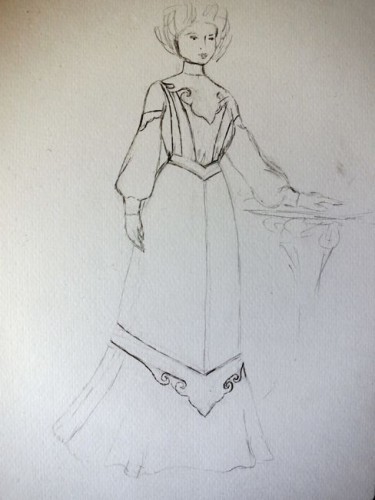
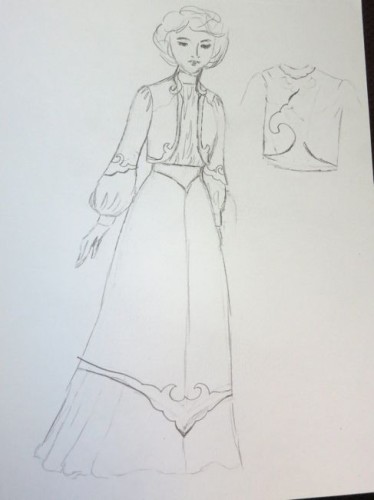
Mostly I’ve been working on the skirt decoration.  My design inspiration looked like this:

Design sketch for a 1903 chinoiserie inspired promenade dress

I played with other ideas:

1903 chinoiserie skirt thedreamstress.com

But they looked a little too…vulgar?  Crude?  (In most senses of the words.)

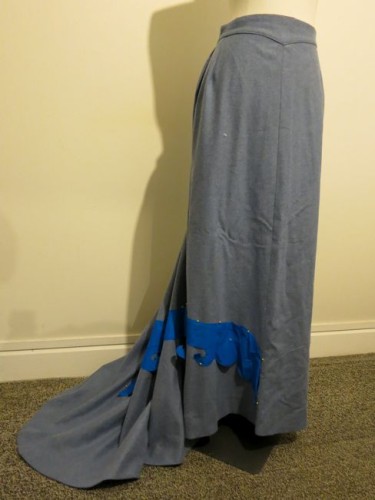
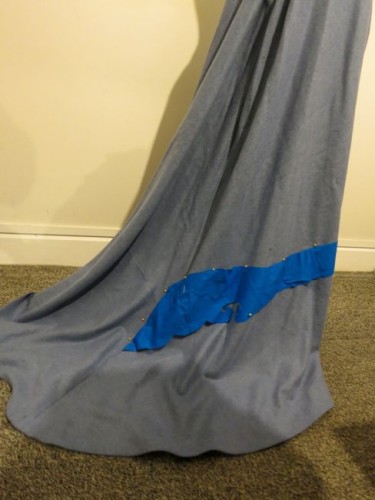
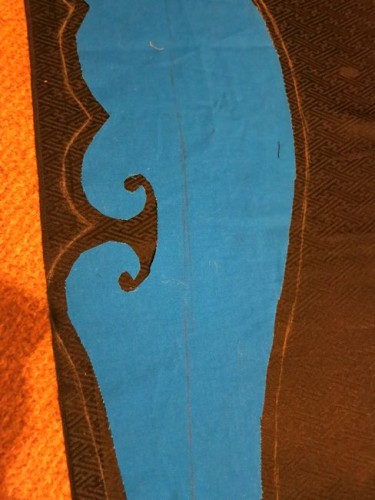
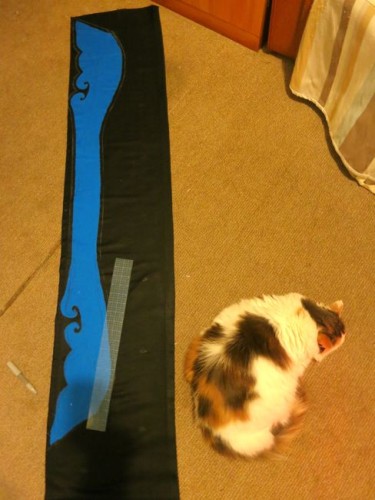
So I stuck with my original design inspiration.  I sketched it out on to a piece of fabric laid out on the skirt, cut out my sketched shape, and pinned in on the skirt to get an idea of how it would look.

1903 chinoiserie inspired promenade dress thedreamstress.com

It’s a little more spread out and subtle than in the design sketch, but I think it works better that way as a real-life translation.

1903 chinoiserie inspired promenade dress thedreamstress.com

With the design sorted, I needed the fabric to make my applique shapes out of.  I rummaged through the entire stash, but nothing seemed right, so it was time for a trip to the Asia Gallery  (and a fervent prayer they had suitable obi in stock).

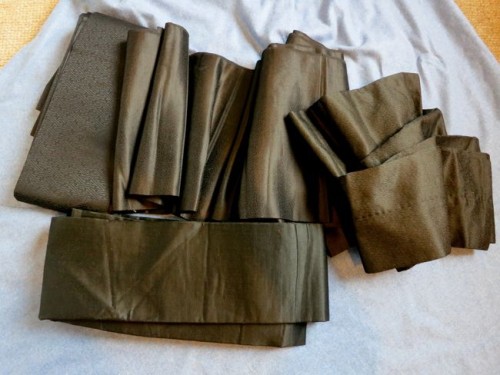
I actually came home with not one, but four obi that I thought might do:

1903 chinoiserie inspired promenade dress thedreamstress.com

I’d really wanted a black silk satin with a small floral jacquard pattern, which I’ve seen in the past, but unfortunately they didn’t have anything of that description.  So what I got was (from left): a meander pattern jacquard, a little curlicue jacquard, a textured jacquard, and a plain black satin.  The last turned out to be a bit of a mistake: too old and fragile for me to do much with.  Should have checked it better.  But…the support fabric hidden under the satin is basically a coutil, so it was still worth the money!

1903 chinoiserie inspired promenade dress thedreamstress.com

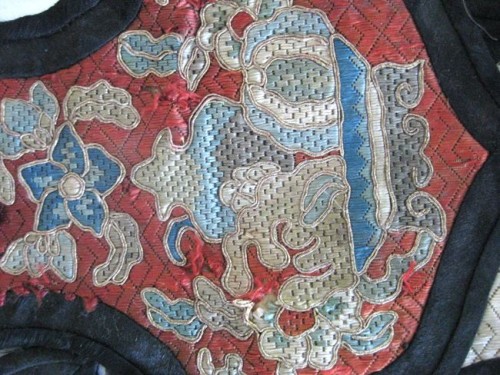
I decided to go with the meander.  I liked the way it marched with the blue better (the others are really old obi, so have a greenish tinge to the black dye), and I liked the way the meander pattern references the meander in the background of my cloud collar.

Cloud collar, Chinese, late 19th century

With my fabric picked, I laid out out my design pattern, and realised that the patterned portion of the obi wasn’t quite long enough to fit the skirt applique and the collar applique.

Oh, wailey, wailey wailey!

But I persevered, and rearranged, and turned and jiggled pieces, and found that by cutting the two back halves of the collar along the obi, instead of across it, I could make it work.

Hurrah!

So I laid out my pieces, added seam allowance, and cut them out.

1903 chinoiserie inspired promenade dress thedreamstress.com

Felicity helped:

1903 chinoiserie inspired promenade dress thedreamstress.com

Then it was time for the making of the piping.

I cut bias strips.  And more bias strips, and more bias strips.

Then I sewed bias strips together, and more bias strips together, and more to those.

Then I sewed my bias strips around my piping cord.

And sewed.

And sewed.

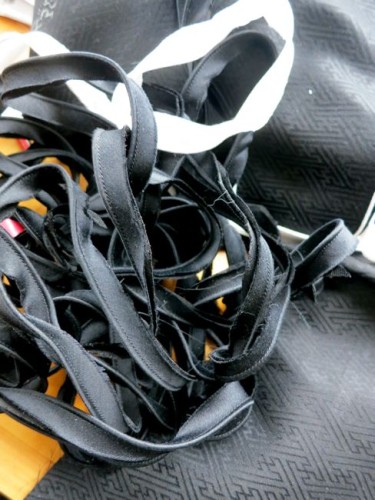
I made 17 and not-quite-a-half metres of black piping.

And 11 metres of ivory piping.

I also found out that my bobbins, on average, hold 17 and not-quite-a-half metres of thread, and that you can use up a bobbin in one continuous line of stitching.

I may have gone slightly overboard with the black piping.

1903 chinoiserie inspired promenade dress thedreamstress.com

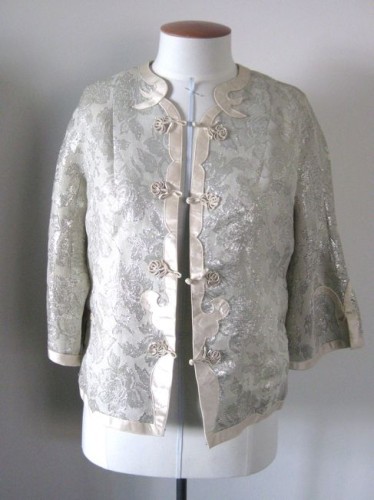
The piping is for finishing the edges of my applique.  I didn’t think I had the patience (or, to be perfectly frank, the skill) to do the wide bias-bound borders that you see on the cloud collar, but my Chinese jacket is finished with teeny-tiny piping.

Jacket, silk & lame, mid-20th century, made in Hong Kong (probably)

Jacket, silk & lame, mid-20th century, made in Hong Kong (probably)

I liked the idea of imitating the multiple layers of border finish that you see on many antique Chinese robes, and thought that two layers of piping would be a suitable Western nod to that.  My inner layer of piping is ivory silk left over from Carolyn’s wedding dress, and my outer piping is plain black satin from the backing of the obi I am using for the main applique.  Hurrah frugality!

1903 chinoiserie inspired promenade dress thedreamstress.com

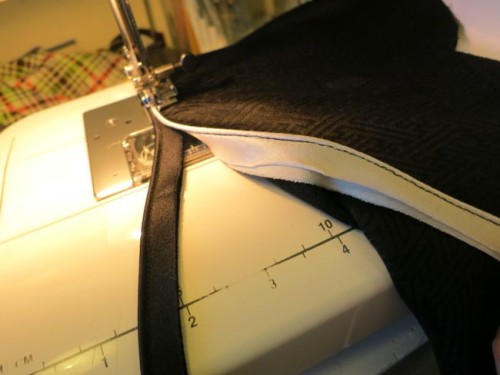
I sewed the ivory piping on first, turned and pressed it, and then sewed the black piping on, using the stitching to hold the whole thing flat and tidy.

1903 chinoiserie inspired promenade dress thedreamstress.com

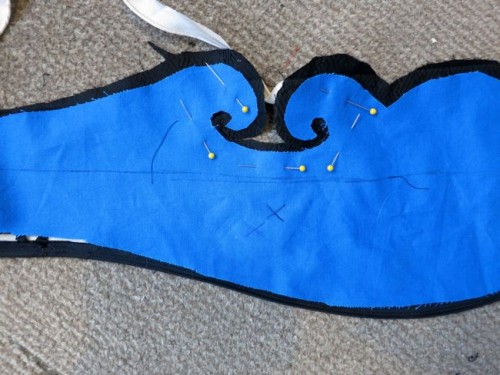
On the lower edge of my skirt piece, I had to hand-sew the white piping around the tiny curved areas, because it was too finickity to do by machine.  I used my pattern as a template for the sewing.

1903 chinoiserie inspired promenade dress thedreamstress.com

Now, to sew the panels to the skirt!  I really, really want to post this on time on Monday!

Clearly the bodice isn’t going to happen in time, but I’ll still have the completed skirt, and I have fully drafted and fitted the bodice, so there has been progress, and I’ll keep working on it.