Latest Posts

Rate the Dress: 1930s exoticism in orange

Last week’s frock, featuring Margaret, Countess of Tyrol, in a gown that was part fantasy, part contemporary to the 14th century ruler, and part contemporary to the 16th century artwork, evoked some very interesting discussions.  It seemed the more you knew about 14th century fashion, the less you liked the frock and the liberties the 16th century artist took with earlier fashions.  Despite an impressive swathe of 10s, the historical inaccuracies, and the dud of a cape (let’s face it, no-one liked the cape) dragged Margaret down to a respectable but not exactly impressive 7.3 out of 10.

Today’s pick for ‘Rate the Dress’ is an interesting sartorial balance to last week’s frock.  The silhouette (which was generally quite popular last week) is strikingly similar, despite the centuries that separate the garments.  And both frocks owe their exotic flair to the same area of the world: what we today would call the Middle East.  But where Margaret owed her frock’s aesthetic to status and technological limitations, rather than a specific desire to reference exoticism, this week’s frock flaunts its explicitly Orientalist look.  It comes through in the challenging colour scheme which evokes images of  spice bazaars, with mounds of tumeric, saffron and paprika.  Even more obvious is the embroidered and beaded bolero, with motifs taken from Moroccan tile work.

Silk gown with beaded bolero, Germain Monteil, 1930s, sold by Leslie Hindman.com

Silk gown with beaded bolero, Germain Monteil, 1930s, sold by Leslie Hindman.com

What do you think?  Do the orange and red create a delicious frock?  Does the bolero add interest to an otherwise simple gown, or does it look like she’s wearing a bit of a courtyard across her chest?

Rate the Dress on a Scale of 1 to 10

The 1903 Chinoiserie ensemble – the skirt

I’m sure that when all of you read my post introducing this project you looked at the calendar and though “wait, you have only a week and a half (less really) left to do this.  It isn’t going to happen!”

But look…progress!

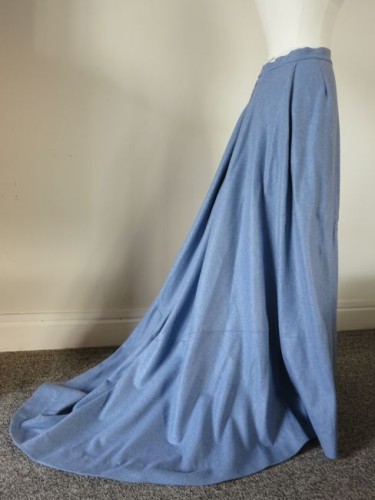
1903 chinoiserie skirt thedreamstress.com

Not just progress, a whole, beautifully made, and almost finished, skirt!

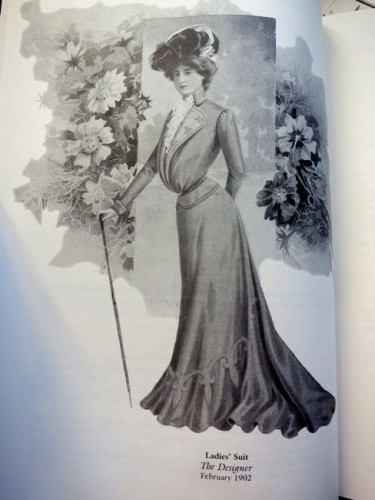
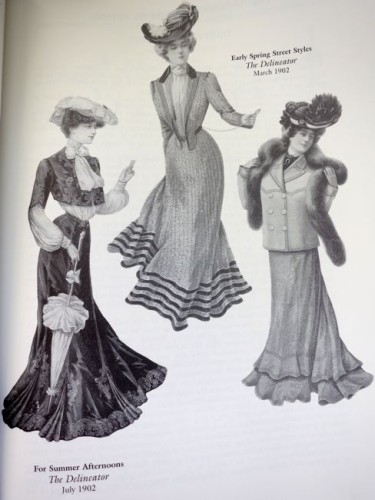
For the basic construction of the skirt I used this fashion plate from 1902:

1903 chinoiserie skirt thedreamstress.com

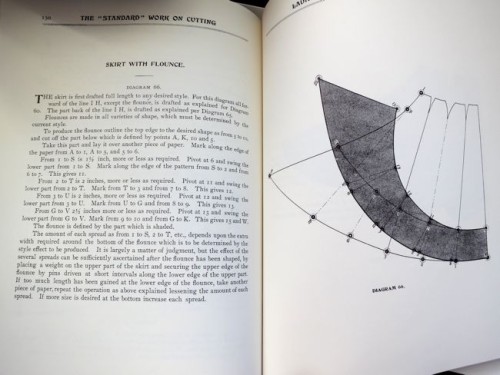
And this pattern from Turn-of-the-Century Fashion Patterns and Tailoring Techniques (originally from the Ladies Tailor Made section of The “Standard” Work on Cutting) to draft my pattern:

1903 chinoiserie skirt thedreamstress.com

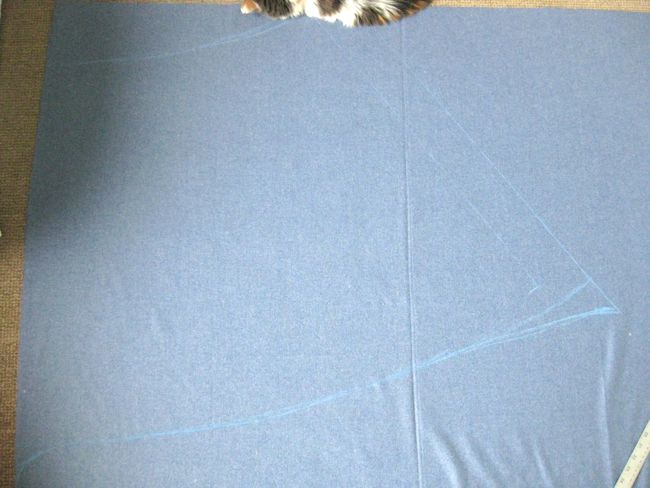
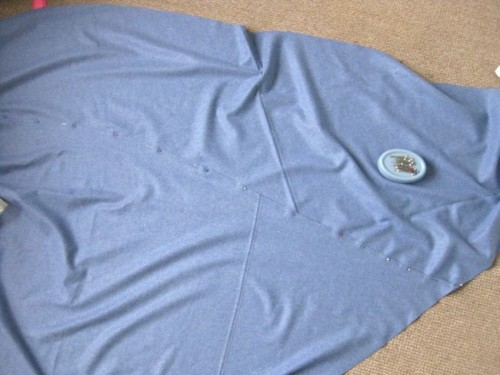
I decided to make the skirt right, and deal with whatever fabric was left for the bodice, come what may.  I drew my pattern out on my skirt: one giant swoop of pattern piece going from centre front to centre back, with no side seams.

Felicity helped hold the fabric down:

1903 chinoiserie skirt thedreamstress.com

Then I drew a slightly curvier swoosh for my flounce, and pinned it directly to the main body of the skirt, and sewed it on with one raw edge showing.  My fabric is felted  and won’t fray, and my LACMA inspiration dress shows that this is period.

1903 chinoiserie skirt thedreamstress.com

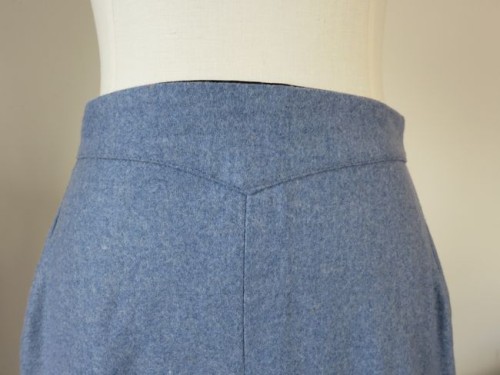
There are little curved V’s at the centre front and back.  All of this will probably get covered by the ‘cloud’ applique.

1903 chinoiserie skirt thedreamstress.com

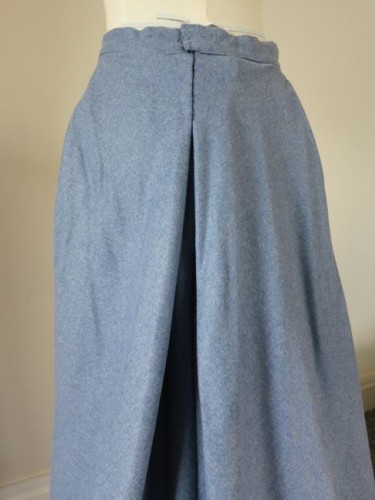
Then all I had to do was sew the front and back seams, set a placket in the back, and pleat the skirt to fit my waist.

1903 chinoiserie skirt thedreamstress.com

There is a single set of pleats that opens up from the centre-back waist, with beautifully set hooks and eyes hidden in the pleating.

1903 chinoiserie skirt thedreamstress.com

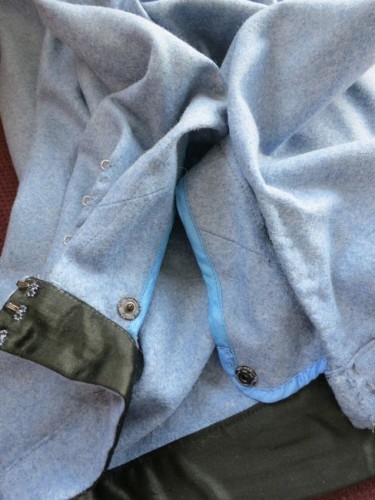
Placket and pleating sorted, I attached a waistband.  It is faced with black silk satin left over from my Midnight Garden corset – the sort I hope to trim the whole skirt in.

1903 chinoiserie skirt thedreamstress.com

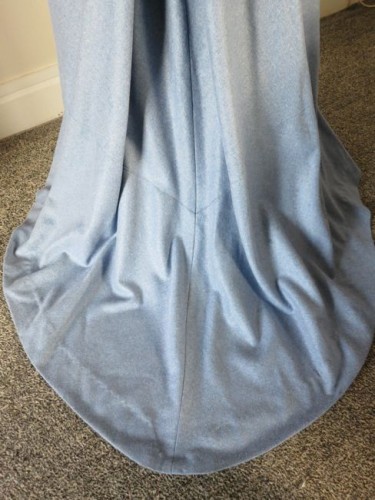
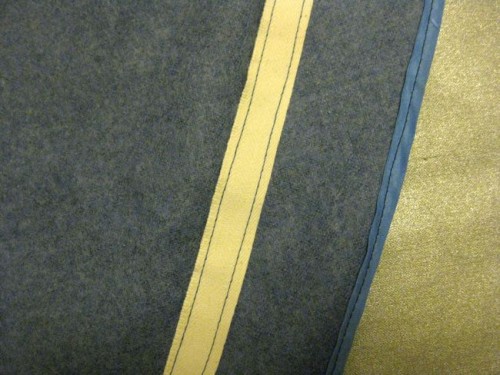
For the hem, I marked the hem up, and then sewed in a line of tape to give the hem a little more body and stiffness and ‘swoosh’ (this skirt seems to be all about swoosh).

1903 chinoiserie skirt thedreamstress.com

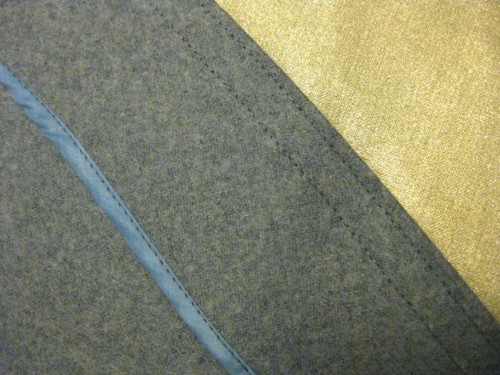
Although the fabric is felted enough to withstand fraying, I though it would be better safe than not, so I finished the edge of the wool with bias binding.  Then I turned up the hem over the tape, and sewed it down with a machine invisible-hem stitch (yes, cutting a few corners here):

1903 chinoiserie skirt thedreamstress.com

Hurrah!  Basically done skirt:

1903 chinoiserie skirt thedreamstress.com

And isn’t it deliciously swoosh-y?

All it needs is a hem protector, and the ‘cloud’ applique, and it will be done!  And then at least I will have something to submit for the challenge, though I’m hoping I’ll manage the bodice as easily and quickly and with as little headache!

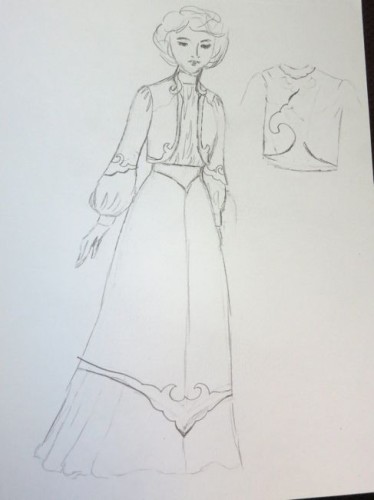
I thought a bit more about the design.  I have been tempted by a bolero (and I know some of you are advocating it).  I even drew up a design:

1903 chinoiserie skirt thedreamstress.com

However, the more I looked and researched, the more obvious it became that short-sleeved boleros were really only for summer wear, and they were only made in silk, cotton, or very light wool.  A bolero just wouldn’t be right for the idea of my outfit.

1903 chinoiserie skirt thedreamstress.com

A 20th century chinoserie frock

There are dozens of gorgeous historical items to be inspired by for the HSF ‘Eastern Influence’ challenge, it’s cold, and I’m feeling slow,and the only things that are inspiring me are warm and wooly.

So….

How about an early 20th century wool suit/frock with chinoiserie influences?

I’ve got this gorgeous delft blue wool – beautifully warm, gorgeous drape, and combined with black and white it would look very striking:
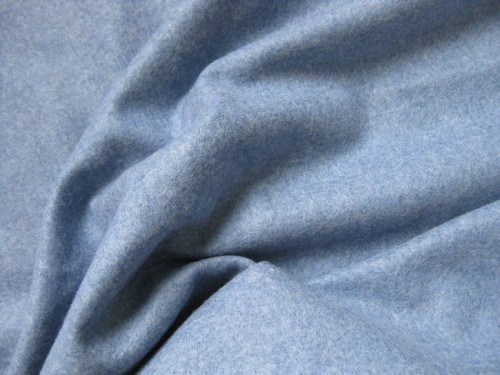
Delft blue felted plain weave wool thedreamstress.com

Problem:  there is only 2.5 metres.  Not a lot for an early 20th century ensemble.  Hmmmm….what if I picked a design that incorporated lots of applique and open space, and used that to stretch my wool?

I went looking for inspiration:

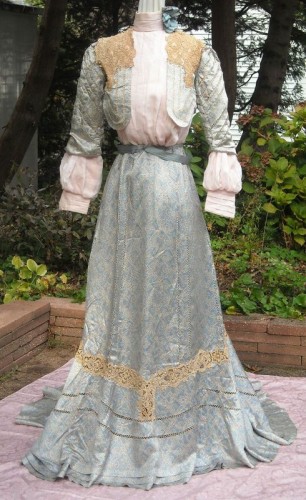
I like the shape of this, and the teeny-bolero would be helpful, but the colour is insipid, and the fabric too light:

1900-1910 day dress, sold on ebay, via pinterest

1900-1910 day dress, via pinterest

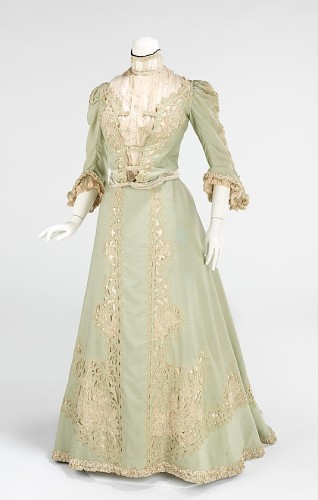
Oooh…closer!  Still a bit too spring-y though, for all that it is wool.  Also, do I have 5 years to do that open cutwork?  Sadly, no:

Promenade dress, ca. 1903, American, wool, silk, Metropolitan Museum of Art

Promenade dress, ca. 1903, American, wool, silk, Metropolitan Museum of Art

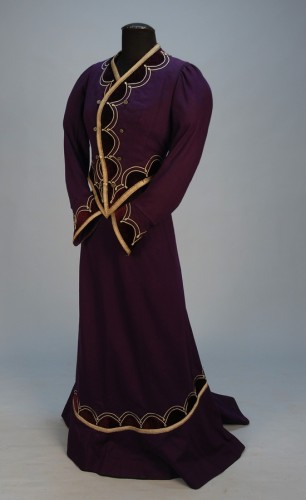
And this is too heavy, and suit-y, and winter-y, and would take too much fabric:

Wool Promenade Suite with Soutache Trim c. 1904

Wool Promenade Suite with Soutache Trim c. 1904, Whitaker Auctions

Ditto this, though the skirt decoration is fetching:
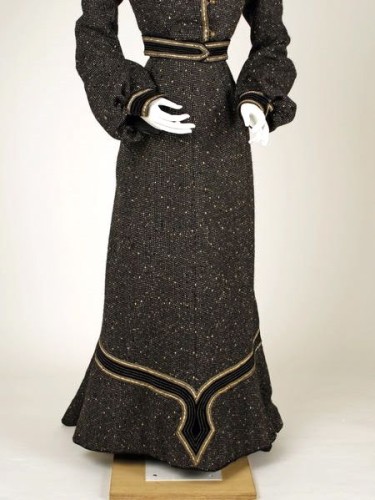
Wool walking suit, 1902, Metropolitan Museum of Art

Wool walking suit, 1902, Metropolitan Museum of Art

I love the chinoiserie of this Jeanne Hallee frock, and the colour combination is getting me thinking though the silhouette is a slightly later date than what I’m going for,:

Dress, Jeanne Hallee  (French, 1880—1914), Metropolitan Museum of Art

Dress, 1907, Jeanne Hallee (French, 1880—1914), Metropolitan Museum of Art

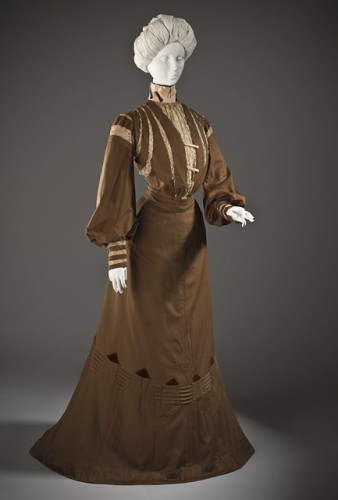
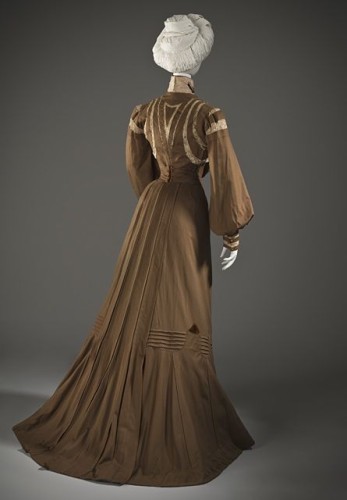
Wait, wait, wait….ladies and gentlemen, I think we have a winner:

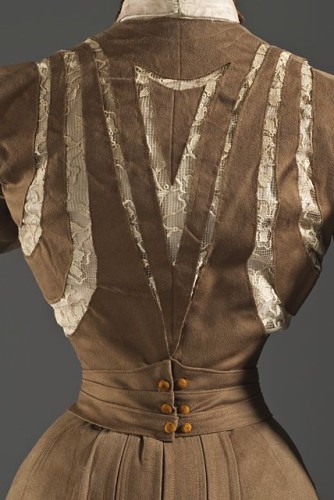
Turn of the century silhouette, wool, a teeny bit of a train (that wool just needs a train, 2.5 metres or not!), and an intriguing use of positive and negative fabrics in the bodice.

I like it!  (also, how much do I love the LACMA for telling us not just what garments are made of, but what parts of garments are made of what, and what weaves the fabrics are.  So much!)

And the Eastern Influence?  Where is that coming from?

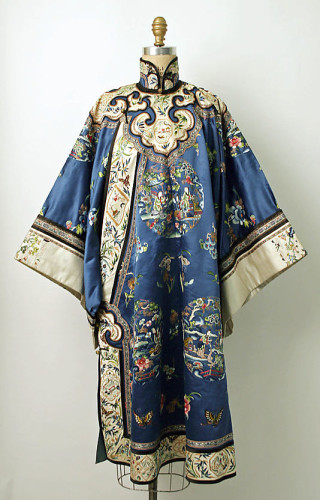
Things like this:

Robe, late 19th century, Chinese, silk, metal, Metropolitan Museum of Art

Robe, late 19th century, Chinese, silk, metal, Metropolitan Museum of Art

I’ve been intrigued by the appliqued borders on Chinese robes and jackets for decades.  When I was just 14 I bought this mid-20th century Chinese (Hong-Kong) jacket, and carefully inspected the borders where one was coming un-stitched to see how it was constructed:
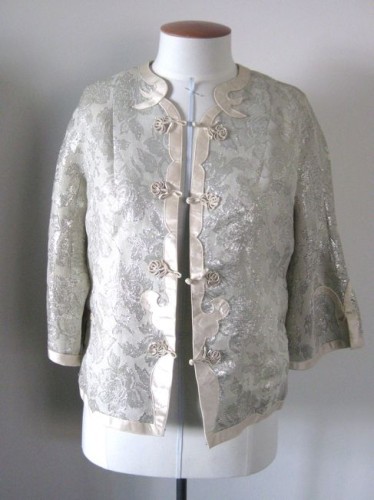
Jacket, silk & lame, mid-20th century, made in Hong Kong (probably)

Jacket, silk & lame, mid-20th century, made in Hong Kong (probably)

In university I filled sketchpads with designs for garments that incorporated the distinctive twisting borders, and pored over the Chinese textiles at my university’s museum.  Imagine my delight when I found an (extremely damaged) late 19th century Chinese ‘cloud collar’ in the East Bay Centre for Creative Re-Use’s rag bin:

Cloud collar, Chinese, late 19th century

Cloud collar, Chinese, late 19th century

These cloud collars were worn for special occasions, particularly weddings.  I’m going to use the basic ‘cloud’ shape as a repetitive motif in my garment, to create a distinctly Chinese aesthetic to a classically Western dress.  It won’t be based off of an actual historical example, but based on the Hallee frock, and the popularity of Chinese textiles in early 20th century America and Europe, it’s certainly plausible.

Still, that’s only going to be rough inspiration.  I need some more specifics.  How about a sketch:
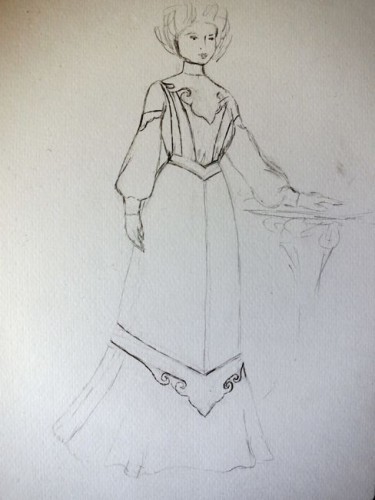
Design sketch for a 1903 chinoiserie inspired suit

(I know!  How long has it been since I’ve taken the time to do a proper costume sketch?).  I still need to colourise it, but basically the skirt will be blue wool excepting the appliqued border, the upper sleeves will be blue wool, with borders of black satin and lower portions of black silk or black wool gauze (or a white or cream fabric?), the ‘cloud collar’ will be black satin, and the strips coming down on the bodice will be blue wool, framing areas of black silk or wool gauze, with a black satin belt.  Probably.  We’ll see what happens when I cut and drape!

So, big plans – I just hope I can get them done!

First up: a skirt, and a trip to the Asia Gallery, in hopes that they have another black silk obi, because I used the last one on my Midnight Garden corset.