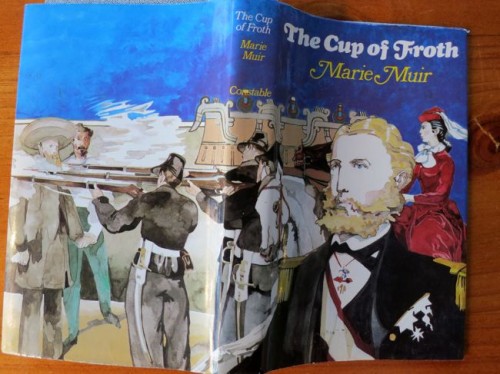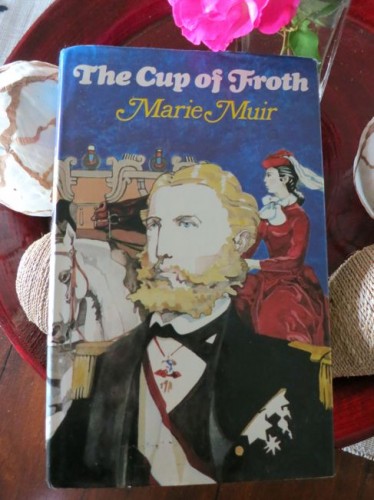
Any book that introduces its protagonist with the sentence “Slim, defiant, Charlotte outfaced them, her great eyes wide, her tender sixteen-year-old breasts straining at the bodice of her plain white gown” is probably only going to go downhill from there.
I’m afraid that my initial fears about Marie Muir’s The Cup of Froth were well deserved. It was uneven, overly emotional, ridiculously dramatic, and a very modern interpretation of a historical period.
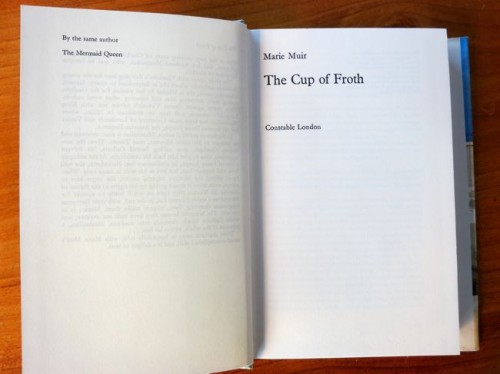
Despite all of this, I persevered with the book, because the story it was telling, if not its own way of telling it, was so interesting that it deserved my time. Blogging about the book seemed particularly timely, as the Charlotte of The Cup of Froth, she of the “great eyes,” is Charlotte of Belgium, later Carlota of Mexico. She came up in discussions of this week’s Rate the Dress, because the fashions she is known for influenced traditional Mexican folk costume.
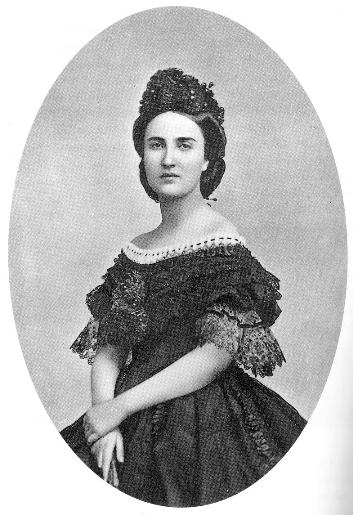
Even badly written, her story is fascinating. The child of Leopold I, King of the Belgians by his second wife, she was named after his first wife, the tragic Princess Charlotte of Wales. As a child she was constantly compared to and reminded of her first cousin, Victoria of England, who was 20 years her senior, and whose upbringing her own father had had a considerable hand in. Muir has Charlotte fume “…Cousin Victoria this, Cousin Victoria that, act like Cousin Victoria, grow up like Cousin Victoria…”
Perhaps it was all those comparisons to Victoria, the most powerful woman in the world, which made Charlotte so desperate for power in her own right, and so determined not to follow Victoria and Albert’s advice in anything, from who to marry, to the final, fatal decision to accept the throne of Mexico. For marriage, Charlotte, against the advice and wishes of her whole family, chose Maximilian of Austria, younger brother of Emperor Franz Joseph of Austria, rather than Pedro V of Portugal.

Maximilian and Charlotte, 1857
Unfortunately, in marrying Maximillian (who Marie has Charlotte and other characters describe as dashing and handsome and charming, which, based on photographs of him at the time, is pushing it just a bit) Charlotte came into the sphere of another distinctive female rival – her sister-in-law Elizabeth of Austria. Whether you are a fan of Sisi or not, you have to admit she probably wasn’t any fun to have as a sister-in-law. Strikingly beautiful, irresistible to men, Charlotte could not help but to suffer in comparison. The Cup of Froth is heavy-handed in most episodes, but the one place it succeeds is in describing Elizabeth’s complete indifference to anyone else’s feelings and comfort, and her complete self-absorbation. The balance to Elizabeth’s contempt was the approval of their mother-in-law, Sophie, who at first felt that Charlotte was everything Elizabeth should have been. As the years past though, and Elizabeth managed to produce a son and heir, while Charlotte failed to get pregnant at all, even Sophie’s approval was lost.
Why Charlotte & Maximilian never had children is one of the big questions of their relationship. Muir’s answer to the question stretches her characterisations to their limit: Maximilian goes off on a trip to Brazil, gets nostalgic about his first fiance, Maria Amelia of Brazil, dallies with a Brazilian girl, and brings Charlotte back some nasties. Cue much emotion and Charlotte’s declaration that they are no longer married, and her intention of turning her energies into making them powerful, rather than giving them a family. Not something that there seems to be any historical basis for!
Charlotte’s rivalry with the females in her life, and her desperate desire for power, status and recognition, married to Maximilian’s equal desire to be free of his brother’s rule, and to have power and influence in his own right, proved a deadly combination. With much wringing of hands, numerous exclamation marks, an equal amount of exclamations, and interminable episodes of emotional desperation, Muir describes how Charlotte, now going by the Italian spelling of Carlotta, and Maximilian are foiled in their attempt to have any autonomy as Governors of Lombardy and Venetian in Italy. Desperate to escape Maximilian’s family, and fatally desirous of power and status, Carlotta and Maximilian accept the invitation of Napoleon III and some Mexican nobility to become Emperor & Empress of Mexico.
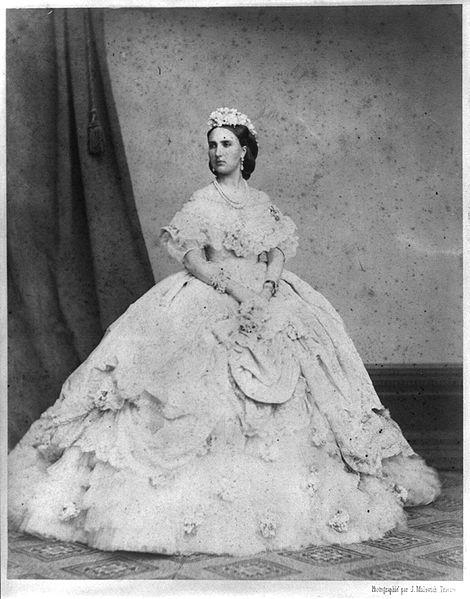
What Carlotta, now calling herself Carlota, the Spanish spelling, and Maximilian aren’t told is that most of Mexico doesn’t want a monarchy, the country is fraught with divisions, most other nations would not recognise the new monarchy, and France has no intention of continuing to provide military or financial support. As a final blow, just as they are departing for Mexico the pair received the news that in accepting the Mexican offer, they have relinquished their status of Austrian royalty. As Muir says, the throne of Mexico is a snare “a Gallic snare, a cup of froth.” They arrive in Mexico in 1864 with nothing to come back to.
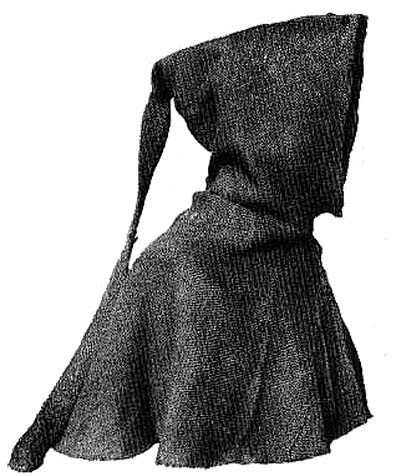
They may have been young, stupid and naive, but Maximilian and Carlota tried their best in a hopeless situation in Mexico. Carlota attempted to woo both the nobility and the peasantry with elegant balls, a modified European court, pageants, parades, and a tour of remote regions. In Europe Carlota was endlessly compared to her beautiful and glamourous sister in law: in Mexico, she could stand alone, and her fashionable European frocks made quite an impression. If you scroll up to the second photograph, you can see how much the fashions of the early 1860s impacted on Mexican folklorica dress – the tiers of striped ruffles, the low shoulders, the puffed sleeves and nipped waist were all translated into a regional dress that persists to this day.
Fortunately for their enduring reputation , but unfortunately for their immediate success, in addition to being naive, Maximilian and Carlota were idealistic: they actually wanted to do the right thing. They passed numerous reforms intended to improve the lives of the peasantry, who were horribly impoverished and subjugated by the nobles. Maximilian also embarked on land reforms, gave the peasantry the right to vote, and instituted freedom of religion. All of these infuriated their only allies, the same nobles who has asked the pair to accept the monarchy, and were not enough to win over the monarchies critics: the supporters of the republican President Juárez.
Abandoned by France and their local allies, the monarchy began to collapse. Carlota fled to Europe to attempt to raise support, but she was too late. After a seige at Santiago de Queretaro, Maximilian was captured, and was executed on 19 June 1867.

Execution of Emperor Maximilian (1868—1869), Édouard Manet
Carlota’s fate was, in some ways, worse. Widowed, with no status or station, she was still one of the richest women in Europe, and had the palace that she and Maximilian had built together. But the stress of the situation and the shock of the execution had left her fragile. Whether she really went mad or not is up for debate. Muir holds with the traditional line of the 19th century historian, describing her paranoia in dramatic detail (seriously, I can’t believe how many exclamation points that book uses), but modern historians suspect her situation was magnified and exploited by her brother and his advisors. They used the excuse of her madness to virtually imprison her, so they could take control of her fortune to fund the colonization of the Congo. It’s a tragic irony that Carlota, who had tried so hard to give the poor and indigenous of Mexico basic human rights, funded (albeit without her consent) possibly the worst example of 19th century European colonization, and the most egregious abuses of human rights.
It’s a pity that Muir’s book, for all that it focuses on Carlota, cannot manage to shape her into a fully-fleshed human. There is a lot to admire in Carlota’s story, and her weaknesses and fallibility could make her an approachable figure, but I spent the book being annoyed with her. It is hard to tell a story that you know from the onset ends so badly, but it’s harder to read it if you just someone would give the heroine a good slap and the hero a good kick.