Latest Posts

A petticoat fit for a Queen

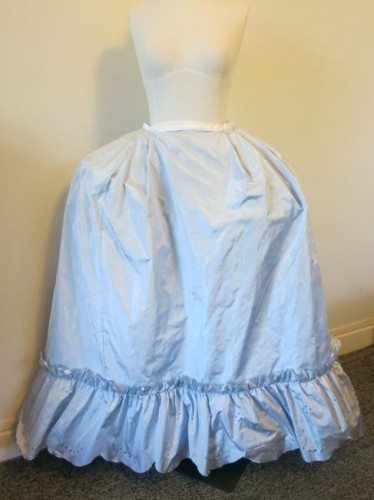
It’s done!

1760s petticoat thedreamstress.com

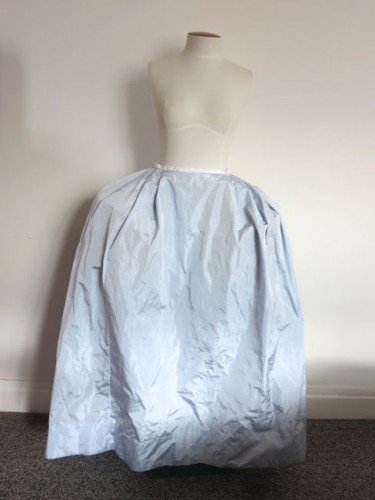
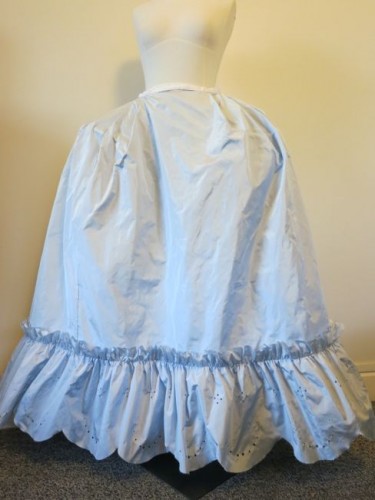
Some 22+ metres of hand sewing later (3x 110cm side seams, sewn twice; 350cm hem, sewn twice; 280cm ruffle, sewn, gathered to 170cm, sewn again; 250cm of piecing additions; 100cm of pleating whipped to waist; 100cm of pocket slits; 30cm of ruffle join), I have finished my Queen Charlotte inspired 1760s petticoat.
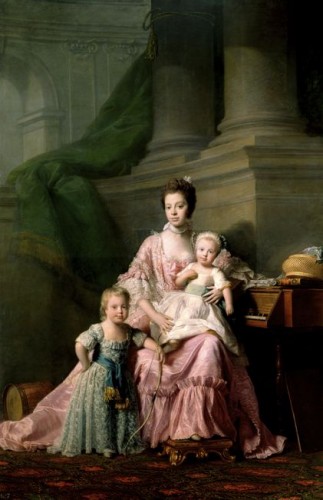
Charlotte of Mecklenburg-Strelitz, Ramsay, 1765

Charlotte of Mecklenburg-Strelitz, Ramsay, 1765

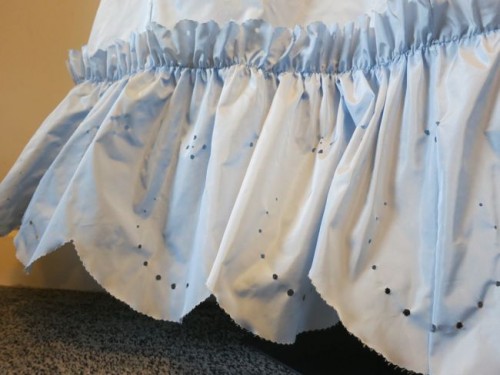
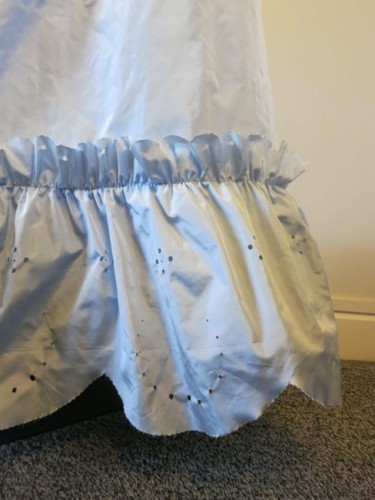
I am extremely pleased!  Especially with the ruffle:
1760s petticoat thedreamstress.com

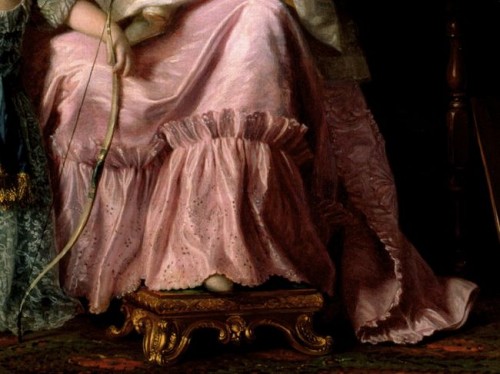
Charlotte of Mecklenburg-Strelitz by Ramsay, 1765 (detail)

Charlotte of Mecklenburg-Strelitz by Ramsay, 1765 (detail)

It’s not exact, but the effect is close.
1760s petticoat thedreamstress.com
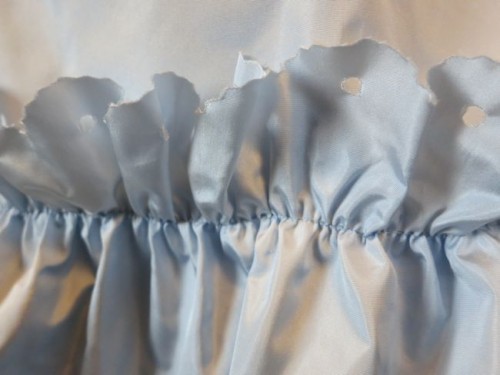
To finish the petticoat, after creating my punched lace pattern, I sewed a single line of even gathering stitches 2″ down from the uppermost point of my small upper scallops.  It’s clear in Ramsay’s portrait that Charlotte’s ruffle is held on with a single line of stitching.
1760s petticoat thedreamstress.com

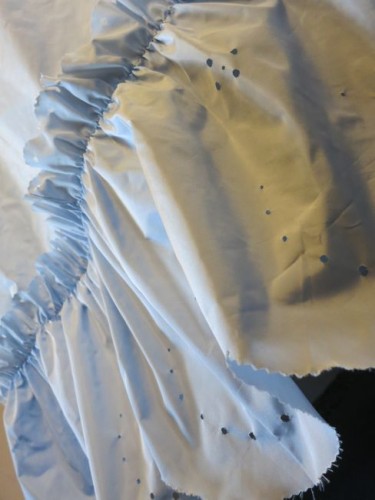
I gathered down my single line of stitching to half the width of the petticoat, and then stitched it on to the skirt using a running-backstitch.  I’m extremely pleased with how close it is to the effect shown on Charlotte’s petticoat – down to the upper portion wanting to stand away from the skirt, and looking fuller and more ruffled than the lower portion.
1760s petticoat thedreamstress.com

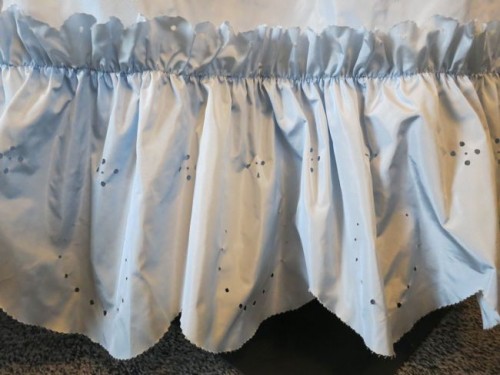
The ruffle took a long time to do, but it was worth it.  So worth it, that if I have enough fabric left when I finish the over robe, I’ll suck it up and finish the ruffle so that it goes all they way around the skirt, and can be worn with a short jacket.  It already goes a little further toward the sides than it needs to for historical accuracy with a front-trimmed petticoat.
1760s petticoat thedreamstress.com

The Challenge:  Pretty, Pretty Princesses

Fabric: 4  metres of pale blue silk taffeta, 1m of white linen.

Pattern:  None, based on examples in Janet Arnold’s Patterns of Fashion 1660-1840, and Colonial Williamsburgh’s Costume Close-Up

Year: ca.  1760.  Ramsay’s portrait of Queen Charlotte was begun in 1764 or 1765, but took almost five years to complete.  The dress presumably dates from before 1764, and matches the slightly more restrained (compared to the French) English styles of the late 1750s and 60s.

Notions:  Silk thread, cotton waist tape.

How historically accurate is it?  The fabric is reasonably accurate in weave, hand and colour for ca. 1760.  It’s slightly lighter in weight than an 18th century taffeta, but not terribly so.  All the stitches used are period accurate, but the use of French seams is not.

Hours to complete:  22. One hour per metre of sewing 😉  (Not really – many went faster than that but punching the ruffle holes took a lot of time).

First worn:    Not yet – I need to finish the robe first.

Total cost: NZ$25 per metre of silk, + $6 for the linen = NZ$106. (purchased over 3 years ago, and in-stash since then).
1760s petticoat thedreamstress.com

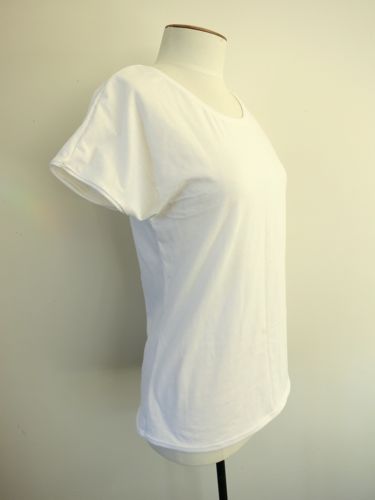
A trio of tees

In addition to a ton of Historical Sew Fortnightly sewing (which I always seem to be a little behind on), I’ve been doing a bunch of everyday wardrobe sewing – I have to keep my hand in for teaching!

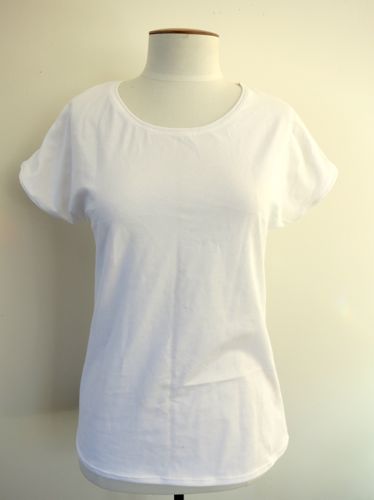
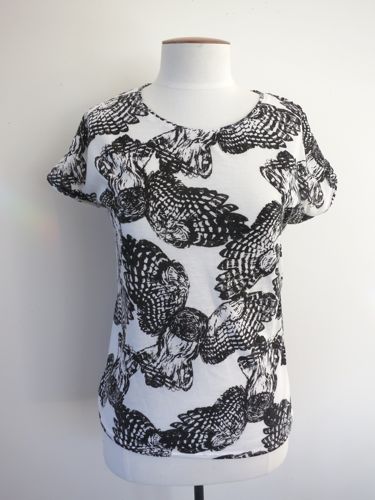
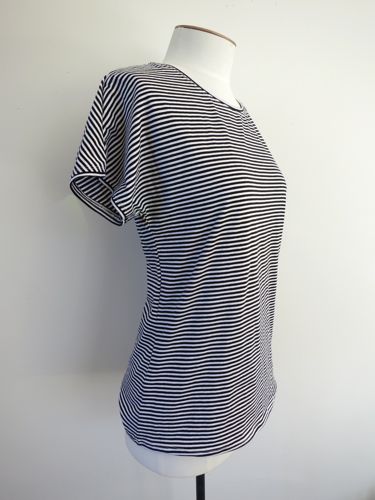
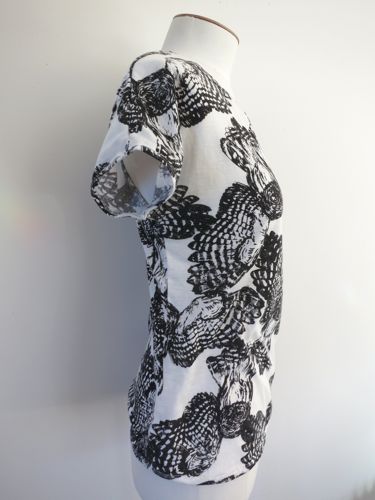
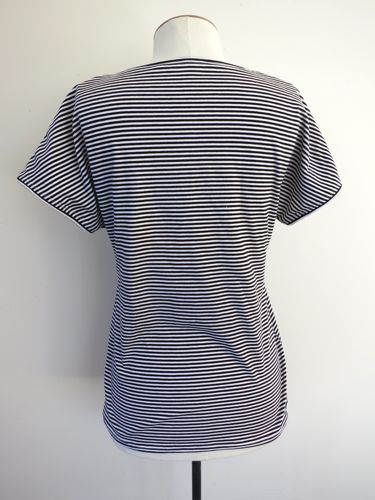
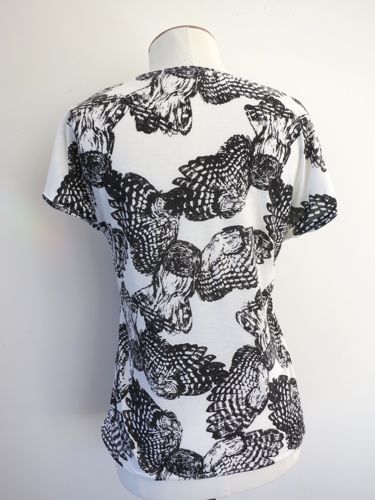
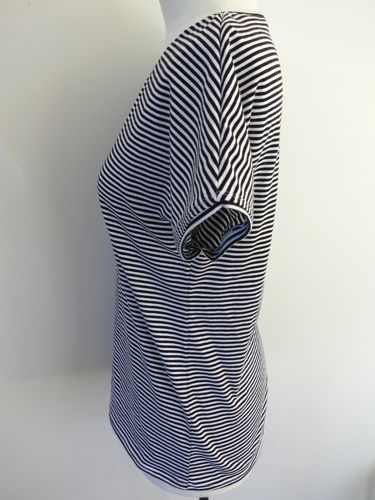
A few weeks ago I took an afternoon off for me, and cut and sewed three t-shirts using my adaption of the Blank Canvas tee (lower neckline, shaped sides, slightly longer sleeves, 2″ added in length).

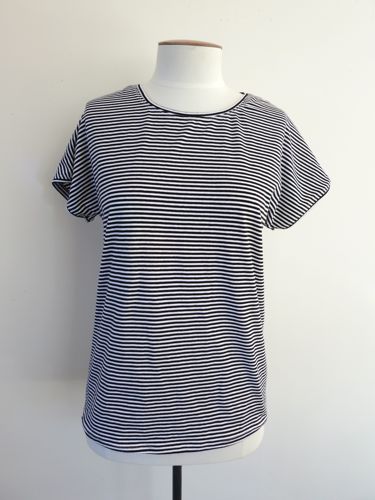
Black and white striped tee, thedreamstress.com

Classic white tee, thedreamstress.com

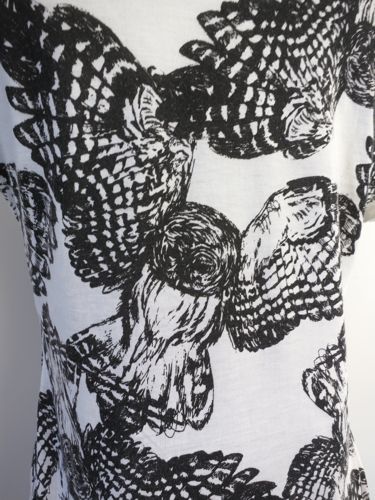
Owl attack tee, thedreamstress.com

I really like black and white t-shirts.  I look great in both black and white, and I appreciate their ability to go with anything.  Jeans, black and white tee over a merino singlet, coloured or patterned jacket or cardigan = instant autumn wardrobe

The black and white stripe and plain white are fabrics I picked up at Fabric-a-Brac in November, the owl fabric I got at April’s Fabric-a-Brac.  They were all less than $2 a metre.  Hurrah for fabric bargains and stash-busting!

Black and white striped tee, thedreamstress.com

Classic white tee, thedreamstress.com

Owl attack tee, thedreamstress.com

Sewing things like tees up in bulk is such a time saver – do all the shoulder seams and side seams, switch the needle, reinforce the shoulders and hem, switch the needle back, sew the neck binding and sleeve hems, close the last bits of neck and underarm, switch the needle back to double, finish neck and sleeves, and done!  All told, it took me less than four hours for three shirts from fetching out the fabric to finished project.

Black and white striped tee, thedreamstress.com

Classic white tee, thedreamstress.com

Owl attack tee, thedreamstress.com

The owl fabric is by far my favourite.  How awesome is it?  The stall I bought it at had quite a bit and was selling it by the metre, and the person in front of me bought all of it but a funny piece with bits cut out.  The seller tucked it away under the table as she didn’t think anyone would want it, but I had a look and reckoned I could get a tee out of it if I cut carefully – and I did!

Owl attack tee, thedreamstress.com

I’ve got just enough of the fabric left to make a pair of knickers with an owl right across the bottom too 😉

Black and white striped tee, thedreamstress.com

Next up in sewing for me: a modern winter cape in grey-wool, and an early ’60s raglan sleeve shift dress in dark teal wool knit.  But first, back to corsets and blouses for lace and lacing!

Queen Charlotte petticoat progress (and punched lace!)

I’ve been working on the Queen Charlotte petticoat steadily, while tackling Lace & Lacing projects, and modern sewing, and client sewing.  There is a limit to how much QC sewing I can do a day, as the taffeta is so stiff that after a few hours my hands start cramping.

The last I left you, I was rescuing my “Ooop!  Cut it too short” disaster.

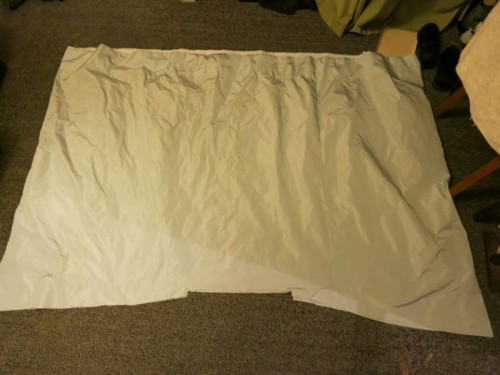
I sewed the extensions on to the top of the petticoat, and was ready to pleat:

1760s petticoat thedreamstress.com

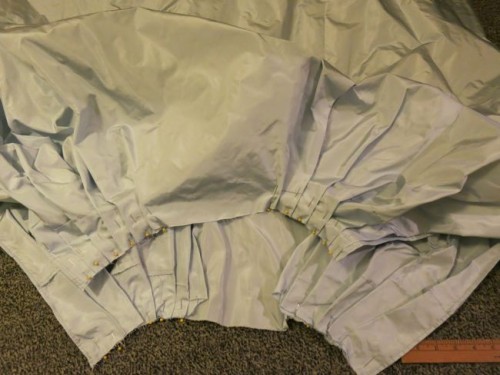
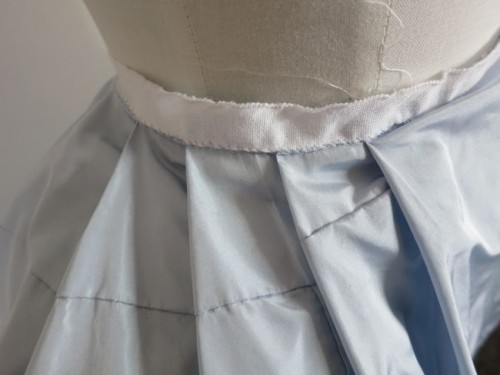
I pleated each side of each half down with 6 pleats, each 2″ deep, and spaced 1″ apart, taking the full 175cm width of each half of the skirt down to 17.5″ – enough to wrap a little on each side over stays and paniers (I know, I used both cm and inches as I sew, sorry if it is confusing).

1760s petticoat thedreamstress.com

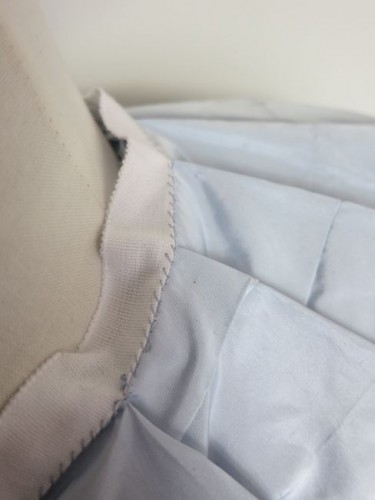
Once I was happy with the pleating, I folded the top of the petticoat down slightly, checked the hem length, and then whipstitched the top of the skirt to cotton tape (I can’t get linen tape in NZ, and can’t justify ordering it from overseas when I own so much cotton tape).

1760s petticoat thedreamstress.com

You can see the piecing of my top extension very slightly in the pleats, but it’s pretty subtle, and will be completely hidden by the robe à  la française, or any but the shortest over-jacket

1760s petticoat thedreamstress.com

Looks rather nice:

1760s petticoat thedreamstress.com

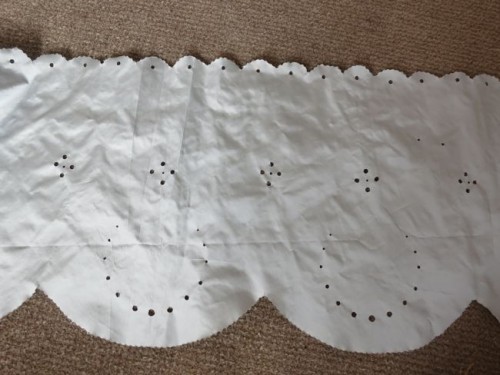
And, in other happy news, I have managed to replicate the lovely lacey punched pattern on Queen Charlotte’s ruffle:

Charlotte of Mecklenburg-Strelitz by Ramsay, 1765 (detail)

Charlotte of Mecklenburg-Strelitz by Ramsay, 1765 (detail)

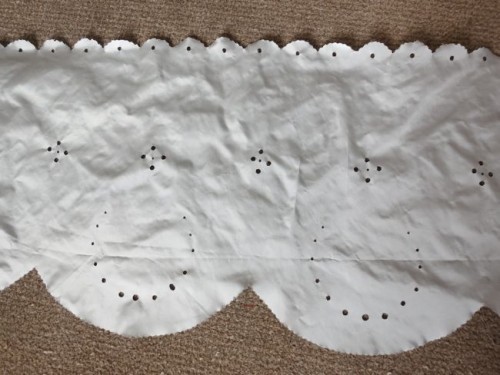
OK, not replicate exactly, as my pattern isn’t nearly as delicate or elaborate, but I used Charlotte’s ruffle as inspiration:

1760s petticoat thedreamstress.com

After squinting at Charlotte’s portrait and every extent example of an 1760s robe à  la française  with punched ruffles that could find, I came to the conclusion that the punched patterns were rarely as elaborate as those shown on Charlotte’s petticoat.  I borrowed the distinctive wreath/crescent moon shapes at the hem of the ruffles, the star/flower shapes that reoccur just above halfway up, and the holes in each small scallop at the top.

So how did I do it?

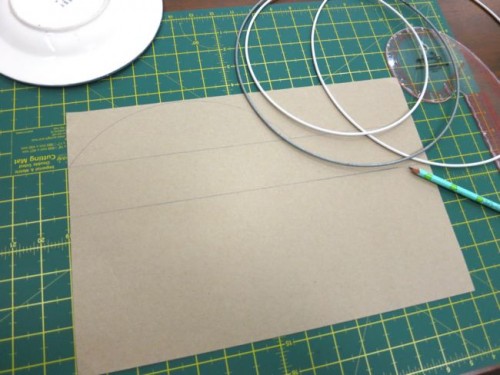
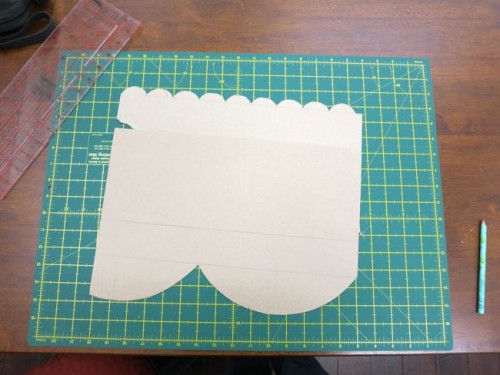
First I had to figure out and cut the scalloped scallops.  I used a variety of circle sizes to create a cardstock template with a large scallop depth and size that I was happy with.

1760s petticoat thedreamstress.com

Then I did the same for the little scallops on the top of the ruffle.

1760s petticoat thedreamstress.com

Then there was a lot of squinting at Charlotte’s petticoat to figure out how deep her ruffle is.  Based on the painting, it is half the length from the floor to her knee.  The problem with this is that 18th century paintings often shorten the length of the shin.  Luckily, this doesn’t seem to be happening in Ramsay’s painting.  I decided that my ruffle would be 12″ long – just over half the length from the floor to my knee.

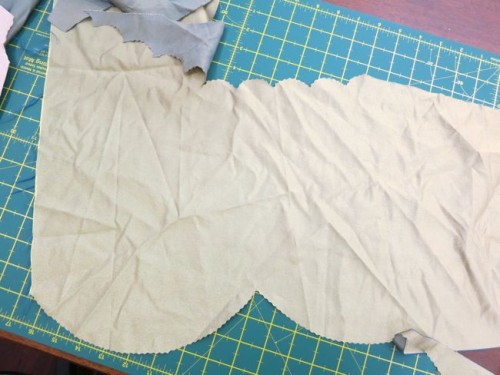
I trialled my ruffle on some stunt fabric, just to make sure that it looked good, and worked:

1760s petticoat thedreamstress.com

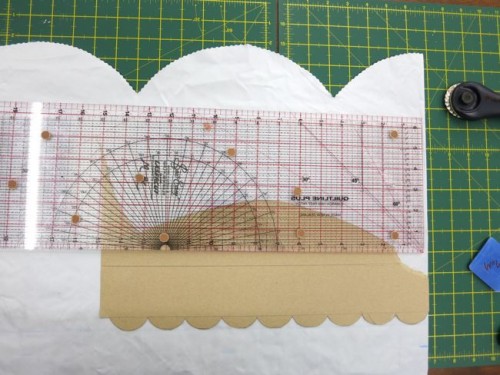
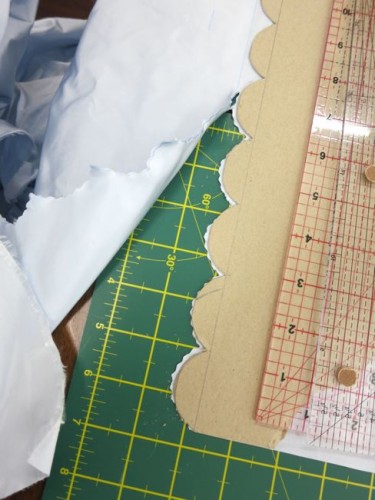
I’m cutting the ruffles with a Fiskars scalloped rotary cutter.  Running the rotary cutter around my big scallops was easy.

1760s petticoat thedreamstress.com

Cutting the little scallops?  Evil.  So hard!

1760s petticoat thedreamstress.com

Once my ruffle was cut I was really tempted to call it good, but it just didn’t have enough dimensionality.  I needed to find a way to create the beautiful punched pattern on Charlotte’s ruffle.  So how did I do it?

This:

1760s petticoat thedreamstress.com

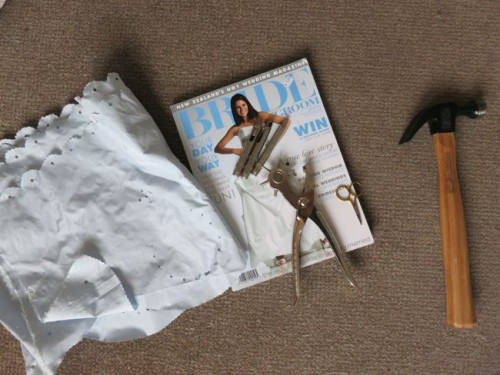
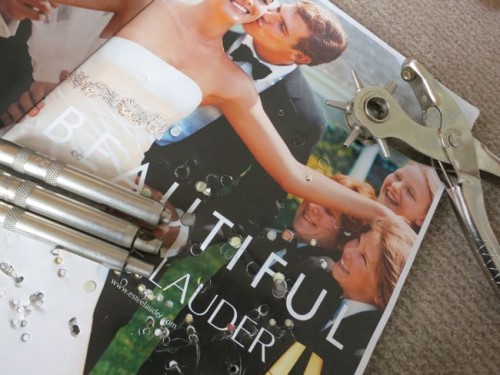
Nine different hole punch sizes, a teeny pair of scissors, a hammer, and a sacrificial magazine (which I actually had to buy from my local op-shop, because I didn’t have anything around the house that I was OK with ruining!).

I drew out my punch pattern on graph paper, and figured out which punch I would use for each hole.  Then I punched holes in my graph paper template, and used it to mark all the hole placements on the taffeta with a pencil.

1760s petticoat thedreamstress.com

The biggest holes are done with single leather punches and a hammer, with the magazine as a buffer.  The littler holes are done with my 6 in 1 turning punch thingee that I inherited from Nana.

1760s petticoat thedreamstress.com

The problem with all of these tools is that they are meant for leather, and weren’t really sharp enough for the thin taffeta, so I often had to finish cutting the holes with my little scissors.

The smaller punches got so bad, and my hand got so tired from squeezing it, that by the end I was putting the taffeta between the punch, putting the other punch holers against the magazine to protect them, and hammering down.  Other than being time consuming and fussy, it worked a treat, until I accidentally got the end of my taffeta caught between the loose punch holers and the magazine and ended up with a few extra holes:

1760s petticoat thedreamstress.com

Oops!

At least they are at the very end of my ruffle so won’t be too noticeable.

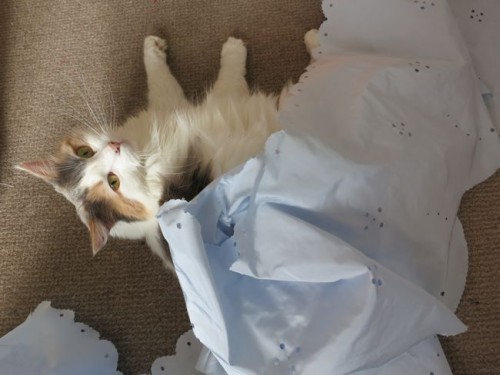
I still need to figure out how to punch the holes that should be centred on the join in the ruffle, and sew the ruffle to the petticoat, and then I’ll be done (hurrah!).  In the meantime, Fiss is demonstrating that the ruffle is just the right length to be a kitty-petticoat, but she still prefers her own pretty fur coat:

1760s petticoat thedreamstress.com