
Latest Posts

HSF Challenge #15: White

The Historical Sew Fortnightly Challenge #15 is our first colour challenge* for the year, and I’m easing you into it slowly, picking a colour that has lots of options for really easy makes (you can never have too many chemises…) and has appeared in every possible period.

White has carried many connotations as a colour, from defining culture and social boundaries in Ancient Egypt (only foreigners and those connected to the afterlife wore colour), to denoting status (white was often an expensive colour to produce and maintain), to implying purity, or simply cleanliness.

For this challenge ‘white’ is defined as anything in the white family – from brightest white, through to ivory and cream and all the shades between.

Whether you make a simple chemise or an elaborate ballgown, your garment should be predominantly white, though it may have touches of other colours.

Here are some of my favourite white garments, from the sublime to the ridiculous.  I’ve posted a lot of fabulously over the top garments, but, of course, little accessories and undergarments are also an option.  For more inspiration, check out my ‘White’ pinterest page.

OK, so the early 17th century silhouette is a bit odd, but oh, the fabric of this dress!  Swoon…

Elizabeth Vernon, Countess of Southampton (1572-1655), circa 1603

Elizabeth Vernon, Countess of Southampton (1572-1655), circa 1603

And how utterly sweet is this:
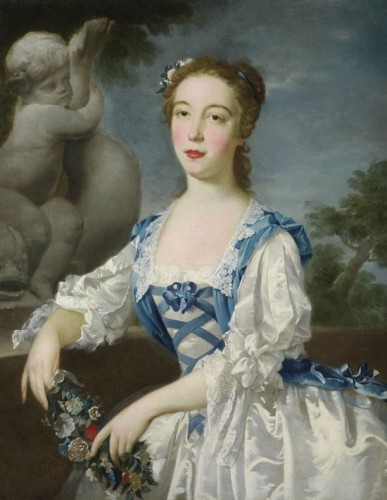
Portrait of a Lady, thought to be the Hon. Anne, eldest daughter of Sir Jacob de Bouverie, 1st Viscount Folkestone ca. 1740-45 Bartholomew Dandridge

Portrait of a Lady, thought to be the Hon. Anne, eldest daughter of Sir Jacob de Bouverie, 1st Viscount Folkestone ca. 1740-45 Bartholomew Dandridge

This fabric is another swoon moment.  It’s so fabulous, and so strikingly modern:

Mantua,  English from French fabric, 1755-1760 from fabric woven between 1753-1755, Silk, silver-gilt thread, linen thread, silk thread, hand-sewn, V&A

Mantua, English from French fabric, 1755-1760 from fabric woven between 1753-1755, Silk, silver-gilt thread, linen thread, silk thread, hand-sewn, V&A

And I know I just showed it, but I still love this outfit:
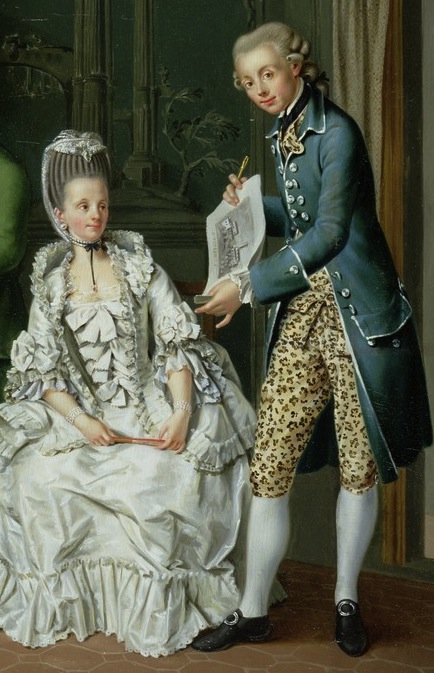
Interior with three men, seated woman and a dog, Venceslao Verlin, 1768

Interior with three men, seated woman and a dog, Venceslao Verlin, 1768

And I adore Regency whites (or creams) in all possible forms:
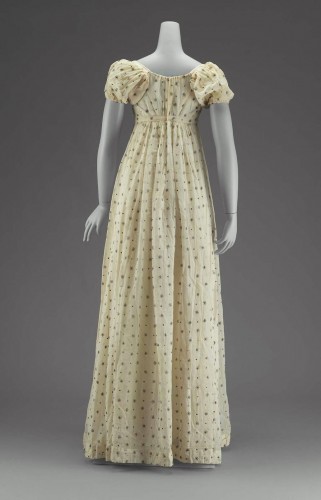
White mull dress, American, early 19th c, MFA Boston, 53.206

White mull dress, American, early 19th c, MFA Boston, 53.206

And add this to the list of stunning mid-19th century dresses made from sublime 18th century fabric:
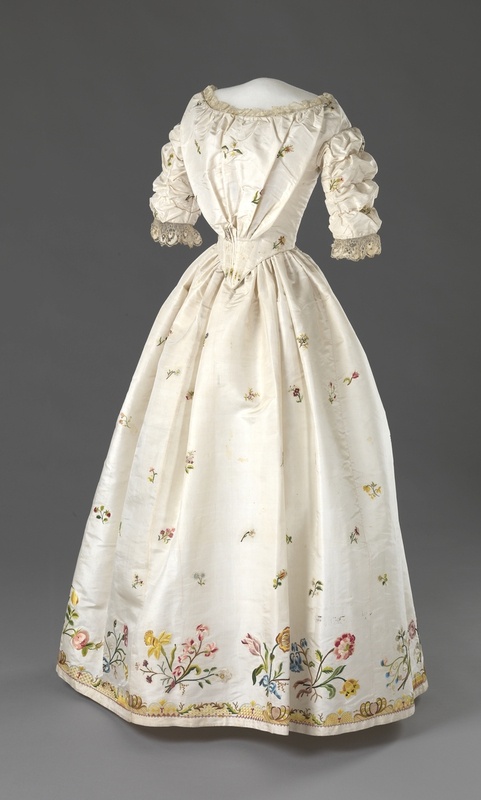
Dress, 1840's, the embroidery dates from the second half of the 18th century, Digitalt Museum

Dress, 1840’s, the embroidery dates from the second half of the 18th century, Digitalt Museum

The great thing about white is that it makes other colours look fabulous, and other colours looks make white look fabulous.  Also, this pleating?  Fabulous.

Girl's Formal Evening Dress with Sash. Charles Frederick Worth,  Paris, 1867, Royal Ontario Museum

Girl’s Formal Evening Dress with Sash. Charles Frederick Worth, Paris, 1867, Royal Ontario Museum

See?  Doesn’t have to be super, super white to count:

Evening dress, 1891—92, British, Silk, Metropolitan Museum of Art

Evening dress, 1891—92, British, Silk, Metropolitan Museum of Art

I ‘curated’ (oh ghastly internet phrasing, though using it for this post is considerably less ridiculous than some usages I have seen) this post, and then realised that all my garments got progressively less formal as I got closer to the present.  Case in point:
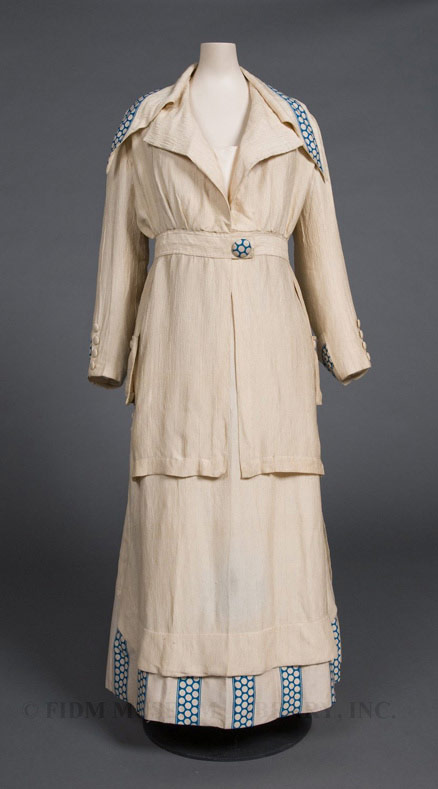
Woman’s Suit, 1913-14, Silk, FIDM Museum

Woman’s Suit, 1913-14, Silk, FIDM Museum

And then, the least formal off all, wide-legged white ’30s trousers:
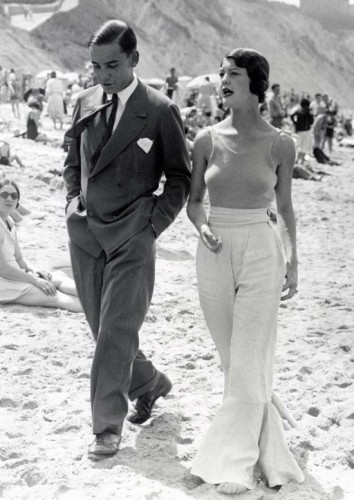
Dutch couple on the beach, 1930s

Dutch couple on the beach, 1930s

*The next colour-themed challenge will probably be a little more challenging, as not everyone likes the same colours, but hopefully everyone will treat it as a challenge and find some way to work the colour into their historical wardrobe.
Rate the Dress: an elegance of leopard-skin suit

Last week I tried something different: I posted two dresses, and we had a dress-off.  It was certainly interesting to see your comments and comparisons.

The dislikers of dress #1 mainly felt it was too much like a uniform, the dislikers of dress number two thought it twee and less polished.  The accusation that it wasn’t fair as the mannequin wasn’t doing the dress justice, so the other had too much of an advantage, was leveled at both dresses by different commenters.  Some of you got quite literal and considered how it would actually work in a nautical situation, though the verdict on which was more suitable for boats and the seaside was anything but unanimous.  Finally, some of you annoyed me (in a loving way) by refusing to give the dresses different ratings (which rather defeats the point of a dress-off!).

Of all the comments I most agreed with Stella, who called the slim dress “beautiful and innovative” and the full-skirted dress “insipid, dull, and looks like it was intended for a small child” but did you feel the same way?

Well, the slim dress certainly got the most enthusiastic ratings (eight 10/10s compared to the full-skirted dresses’ measly two 10/10s), but when I added up the points the full dress came out 7.5 points ahead.  But then I double checked both sets of numbers, realised I sucked at adding, re-did them all and the final verdict was….a draw!  Yes, 7.9 out of 10 for both dresses.  The slim dress half a point ahead of the full in the final add up, but it was too small a percentage to make a difference once I divided by the number of voters.  I guess Norell just designs a good nautical dress!

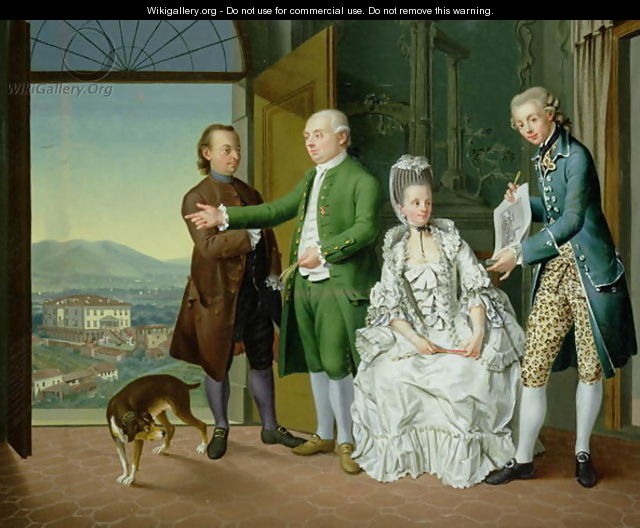
Sometimes I feel I need to introduce a picture. To tell you about it, get you amped up and ready to consider it and rate it. Not this week. This week you’re rating this image:

An interior with elegant company, Venceslao Verlin, 1768

An interior with elegant company, Venceslao Verlin, 1768

Well, not the whole painting.  Not the guy in the boring brown suit, or the guy in the boring green suit, or even the lady in the extremely chic white silk hoodie.  You’re rating the guy wearing leopard print breeches and a matching waistcoat.  Just in case you hadn’t noticed him.

An interior with elegant company, Venceslao Verlin, 1768

An interior with elegant company (detail), Venceslao Verlin, 1768

I can only surmise how this rating will go.  Either you will react in utter horror, wondering if this was the 18th century version of hammer pants or metallic platforms for me, or you will decide that this is truly the awesomest thing ever, and Mr Animal-Print Unmentionables was clearly the manliest baddass of the Rococo, his girlie face aside (I mean, really, look at his face!  Now do a mental face-swap between him and Ms Satin Hoodie and tell me she doesn’t get prettier with his face!).

So?  What’ll it be?

Rate the Dress (or three piece suit, stockings, buckled shoes etc., as it may be) on a Scale of 1 to 10

*Also, based on the title of the work, and in the spirit of the collective nouns for costuming post, I hereby declare that a collection of animal-print menswear, should you be so…ummm…idiosyncratic as to have one, shall henceforth be known as an elegance of leopard-print suiting.  Make it so.

Regency beauty…raking?

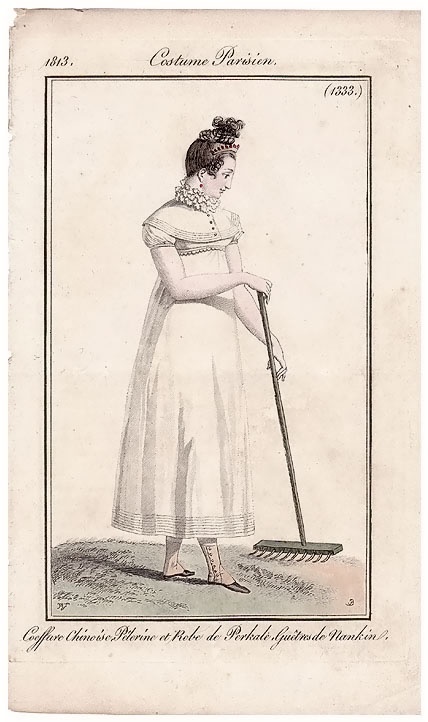
What the heck is going on with this fashion plate?

Costume Parisien Fashion plate 1333, 1813

The caption, according to my dog-French translation abilities, reads: “Chinese hairstyle, pelerine (that’s the little cape thing) and dress of percale, gaiters of nankeen”

Is there a game played with a rake?

Or did our fashionista just wake up one morning, decide to do her hair up in a silly top-knot, put on a tiara, a short sleeved dress and a pereline with a high-ruff collar (thought the collar may be separate), and gaiters over her shoes and go out to rake the lawn?

Whenever I see fashion plates like this I hear the Daleks shriek “Explain!  Explain” in my head.

Explain?