Latest Posts

Want to sew along with me?

I’ve been doing Sew Weekly this year, and have amassed a great wardrobe of self-made stuff, both vintage and modern.

However, my historical sewing has suffered.  It’s been a very un-prolific year for me history wise, and I miss getting really dug-in to elaborate dresses and hand sewing.  All I got done this year was the pet-en-l’aire (and it still needs trimming), the tea gown (and it needs a re-working), Nana’s corset (and it needs straps, and I haven’t even shown you photos), and the 1883 pleated skirt.
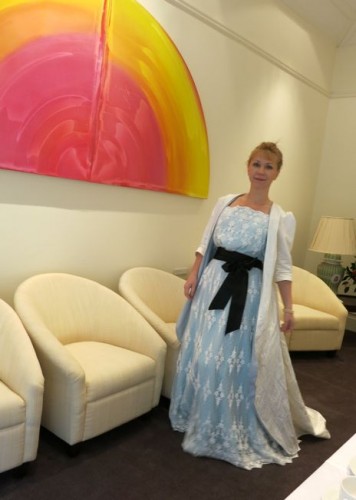
The 1900s tea gown

Thinking about next year, I’ve decided I have quite enough clothes, and I want to focus on historical sewing.  I’d love to do a historical sew-weekly, but I don’t think that’s feasible – I’d just end up creating a ton of drawers and cartridge pleated skirts and would always be in a rush.

Instead, I think 2013 will be the year of the Historical Sew-Fortnightly.  Over the course of the year I’ll set myself themed challenges, and sew 26 fabulous historical garments.  Some will be quite elaborate, some will be simple (but hopefully beautiful and well-made) chemises and drawers, but those are important too.  It will be an excuse to finish some long overdo UFOs (Polly Oliver!  Luna moth!), and to indulge in a year long celebration of historicism.  I’m so excited!
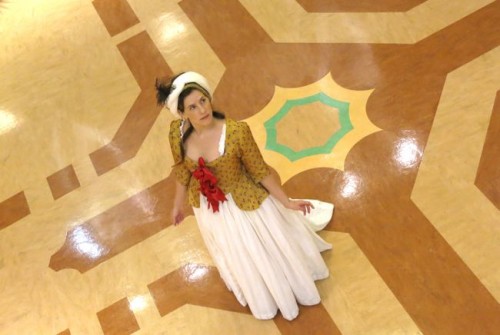
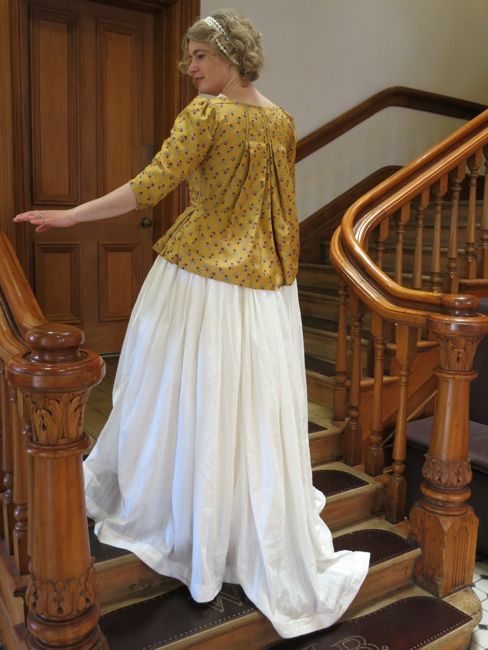
The 1780s pet-en-l'aire

As to what constitutes historical, I’ve decided I’ll go with anything older than 75 years, so pre-1938.  However, I’ve also decided that at least 20 of my challenges have to be pre-1900.

So I have three questions for you:

  1. Would you like to do it along with me?  (Please say yes, because half of the fun of Sew Weekly was having people to do it with!).
  2. If so, any suggestions on how to arrange/coordinate such a thing?  Should we have a group flickr, or a pinterest for each challenge?  I’ll definitely create a side button for my site as part of a mini-revamp I’m working on, and can create a page for each challenge where you can leave comments linking to yours.
  3. What should I do as challenges?  I need 26 fantastic ideas that will prompt me (and hopefully some other seamstresses) to create 26 fascinating historical garments.
Terminology: What is blonde lace?

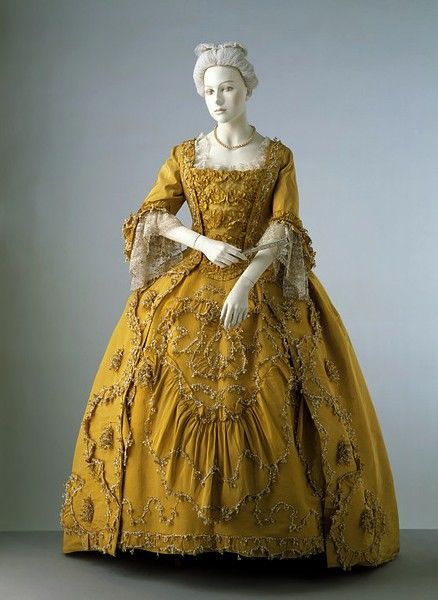
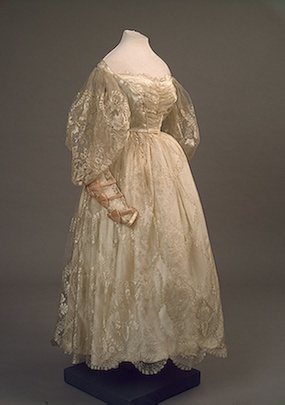
One of the most striking features of Queen Adelaide’s frock in this week’s Rate the Dress is her glorious blonde lace sleeves.

Perhaps you’ve read a Georgette Hayer novel and come across a description of the heroine heading out to a dinner party in a dress trimmed with blonde lace and wondered what that meant?  Maybe you already knew!   If not, wonder no more.

‘Blonde’ is the term used to describe the natural colour of undyed silk, and blonde lace was originally the name for a specific style of continuous bobbin lace made in France (primarily Chantilly, Caen & Bayeux) from natural, undyed silk thread imported from China.

Evening dress trimmed with blonde lace, St Petersburg, Russia. 1830s. Hermitage Museum

Evening dress trimmed with blonde lace, St Petersburg, Russia. 1830s. Hermitage Museum

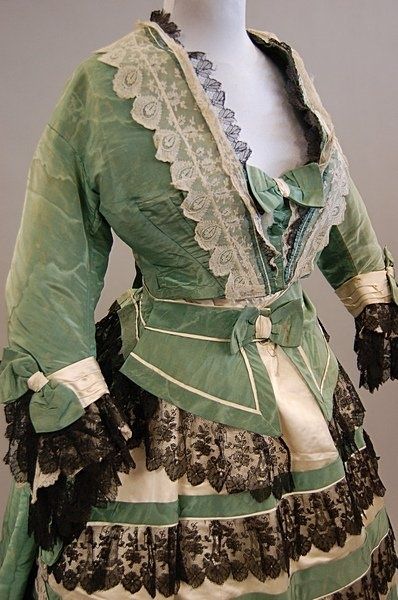
While blonde lace was originally made from undyed and unbleached silk the name later came to refer to lace in a particular style made from silk thread, even if it was bleached white, or dyed black (and occasionally other colours).  In  1902 an ad  offers it in white or ‘butter’, and a fashionable  1895 tea jacket  is made up in ‘black blonde lace’.  Sometimes different shades were be combined in the same garment, as in an  1890s blouse  in brown and white blonde lace.

Gown of watered silk, ca 1865, bodice w: cream & black blonde lace (I think).

Gown of watered silk, ca 1865, bodice w: cream & black blonde lace (I think).  Vendor unknown.

Blonde lace was made from the early 18th century, and was wildly popular throughout the early 19th century (hence its popularity with Hayer’s heroines). Almost every lady who attended court in the 1830s is described as wearing blonde lace.  It’s immense popularity allowed it to withstand the decimation that the handmade lace industry suffered with the introduction of machine made and hand-embroidered bobbin net in the 1820s.

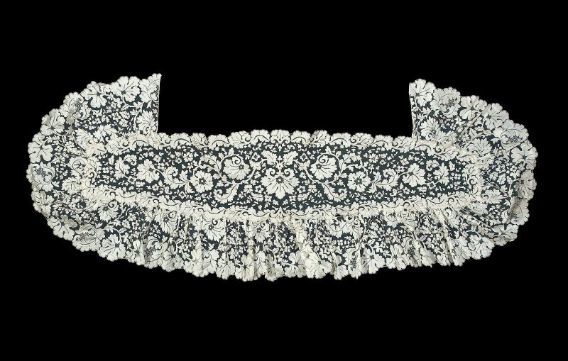
Sleeve ruffle and blonde lace, France, 1750s, V&A

Sleeve ruffle and blonde lace, France, 1750s, V&A

Machine version of blonde lace were available from 1833, leading to a slight decline in the desirability of the lace.  The blonde lace industry was rescued by the growing middle class and their demand for cheaper lace, and by a change in the aesthetics of blonde lace.

Early versions of blonde lace were very light and delicate, with small floral motifs widely scattered on a delicate net background.  From the 1830s the motifs on blonde lace became heavier and closer together, and vast quantities of it, usually in black, but sometimes in other colours, were imported into Spain and made in Spain, where it was used for mantillas.

A blonde lace mantilla Spanish, 19th century, MFA Boston

A blonde lace mantilla Spanish, 19th century, MFA Boston

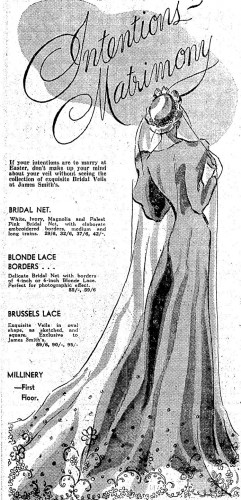
Blonde lace was sold in New Zealand from at least the late 1840s  and into the 1940s (though the 20th century versions are almost exclusively machine made).  Though it was very popular for dresses in the early 20th century, and blouses and trim throughout the 1920s, by the 1930s it’s popularity was in decline, and in the 30’s and 40’s it was rarely used except for wedding dresses.  World War II finally saw the demise of blonde lace except for in very specialised couturier garments.

Hat of blonde lace, Auckland Star, 1 October 1910, Page 23

Hat of blonde lace, Auckland Star, 1 October 1910

Auckland Evening Post, 2 March 1938, Page 16

Auckland Evening Post, 2 March 1938, Page 16

 Sources:

Earnshaw, Pat.  The Dictionary of Lace.  :Dover.  1984

Powys, Marian.  Lace and Lace Making.  :Dover.  2002

Scott, Phillipa.  The Book of Silk.  London: Thames & Hudson Ltd.  1993