Hrrmph. I try to keep my opinions about Rate the Dresses under covers, but your review of last week’s Worth dress rather disappointed me. Whilst I knew the aesthetics of the zig-zag Roger Worth dress might prove challenging, I’d hoped that more of you would recognise the artistry of the construction: the brilliance of the stiffened front-raised hemline, allowing easy walking and dancing, and creating the most amazing movement in the skirt; the clever, clever sleeves, cut at one with the bodice; the un-pieced skirt, with shaping achieved through tucks. And yet, it was these very things that so many of you disliked! A few loved the dress (I love the dress), but so many of you hated it that it came in at a 5.3 out of 10. Poor Roger: worse even then his grandfather!
Carrying on the zig-zag theme from last week, here is Queen Adelaide (consort of William IV of England and aunt to Queen Victoria) in a very regal 1830s gown with fascinating zig-zagged sleeve details, and luscious blonde lace sleeves.
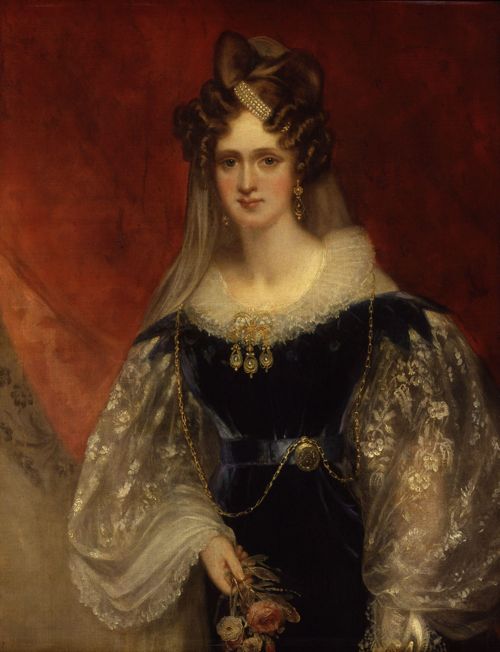
Adelaide Amelia Louisa Theresa Caroline of Saxe-Coburg Meiningen, by Sir William Beechey, c 1831, National Portrait Gallery London, via Wikipedia
Adelaide is probably the most overlooked of the English queens, which is a bit sad, because she really was a paragon of every possible virtue that could have been desired of a Queen and woman in the early 19th century. She was a devoted wife and was widely credited with vastly improving the much older William’s behavior – he drank less, swore less, was more tactful and thoughtful under her influence. She was gracious and regal, beloved by the court and populace alike. The only people who resented her were ‘women of a low kind’ as she refused to allow revealing gowns to be worn at court. Her only failing was as a mother: she suffered numerous miscarriages, and all her children died in infancy. Despite this, she was a kind stepmother to her husband’s 10 illegitimate children from before their marriage, and did everything she could to help the young Victoria, who was heir in place of her children.
Some of her sweetness comes through in her portrait, and the artist has attempted to convey her status, and her innate regality, in the grandeur of her dress and hair, and her delicate femininity in her lace and ruffles. Her noted modesty is shown in the covered shoulders and relatively high neckline of her historically inspired frock.
Adelaide balanced a lot as a queen, and what she didn’t manage to achieve was memorability – she was just too sweet and good to achieve historical notability. This portrait also tries to balance a lot, but has her outfit in it achieved sartorial success, or at least sartorial memorability?
Rate the Dress on a Scale of 1 to 10