In preparation for the upcoming High Tea charity fundraiser for Ronald McDonald House I’m trimming my Indienne chintz pet-en-l’aire.

I’ve dyed pretty new rayon and cotton ribbons (the closest I could get to silk) to replace the nasty synthetic ones on the front, and am figuring out how to do the ruffled trim.
Earlier mid-18th century pet-en-l’aires, like this yellow example, have pinked ruffle trim:

Pet-en-l’air, mid-18th century, sold by Christies
But later 18th century examples, the era I am aiming for, have flatter trim that is finished or turned on the edges:

Pet-en-l’aire, 1770-90, Manchester City Galleries
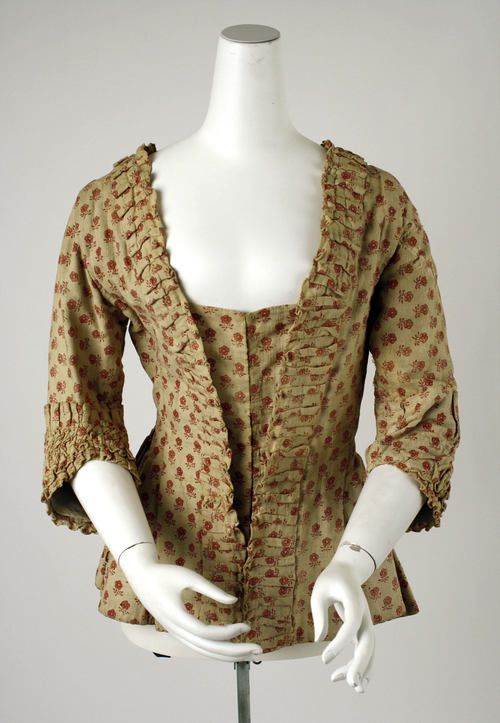
Pet-enl’aire, 18th century, cotton, Belgium, Metropolitan Museum of Art
I’m trying to figure out exactly how the ruffles are made. I have 3.5 options to make the ruffles shown in the examples above:
- Option 1: The ruffles are cut in strips more than 2x the width of the ruffles, the sides are folded back and overlapped in the middle, and then the ruffles are sewn down, with the raw edges hidden on the middle underside of the ruffles.
- Option 2: The ruffles are cut in strips the width of the ruffles, plus turning allowance, and then the sides are turned and hemmed, and the ruffles are sewn down.
- Option 3: The ruffles are cut in strips the width of the ruffles, plus seam allowances, and sewn in a tube with a backing of another, cheaper fabric, turned, and then sewn down.
- Option 3.1: The ruffles are cut in strips the width of the ruffles, plus seam allowances, and a backing of another, cheaper fabric is applied, with the edges turned in on each side and sewn down in a tube sewn from the outside. The ruffles are then sewn down.
The extremely sewn-down nature of the ruffles on the MCG pet-en-l’aire, and the Metropolitan pet, makes Option 1 very plausible.
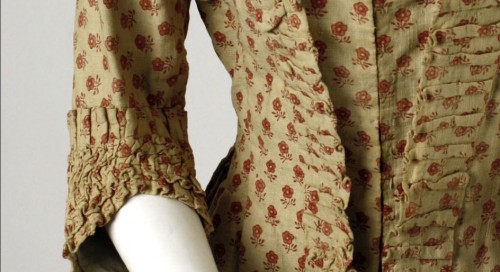
Pet detail, Metropolitan Museum of Art
The peep of a ruffle lining on this jacket from just a few years later than my inspiration pets indicates that in at least some cases, Option 3 or 3.1 was used:

Jacket (Spencer) Date- late 18th—early 19th century, silk, French, Metropolitan Museum of Art
However, there is yet another thing to consider with my ruffles. There are a few examples of pet-en-l’aires and other late 18th century jackets with contrast trim on the edges of the ruffles.
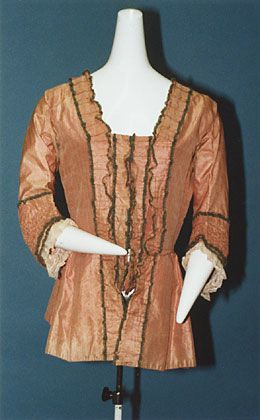
Jacket , c. 1775. French, silk taffeta,
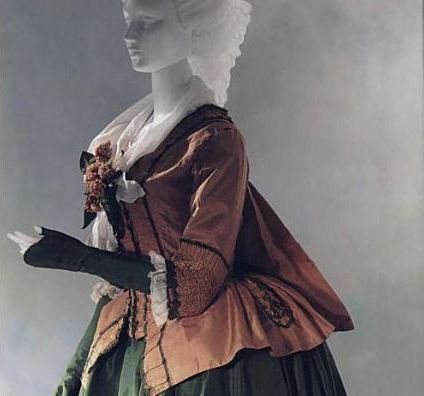
Pet en l’aire with sabot cuffs, 1775, Kyoto Costume Institute
(are those the same jacket btw? If so – what a difference display makes!)
I could use a contrast trim on my ruffles – I’ve got narrow red and cream cotton satin ribbon, both of which would look beautiful with the flowered silk of my pet. But the fabric is already quite busy, would that be too much? And if I do do contrast trim, what is the correct way to do it?
So, aesthetically, and historically-accurately, how shall I tackle this? What technique should I use? And what should my ruffle placement look like?