Hawaiian history is, unfortunately, full of tragedy. It’s also full of moments of triumph, of hope and will overcoming great adversity, of mirth and hilarity, but behind all this there is often an undercurrent of sadness: the inevitable result of cultures, religions, and germs colliding.
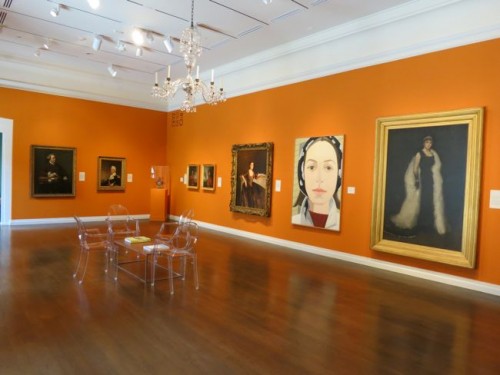
The portrait gallery at the Honolulu Museum of Art
Perhaps the ultimate symbol of Hawaiian tragedy, and of the problems that plagued the young Kingdom in its formative years, is NÄhiÊ»enaÊ»ena (1815-1836), a princess whose whole life was a tug-of-war between two worlds: the old Hawaiian traditions and religion, and the new customs and rules the New England missionaries were introducing to the island.
There are two extent portraits of NÄhiÊ»enaÊ»ena, and they are the perfect illustration of the divide in her life.
In the first portrait, done when she was 10 years old, and commemorating the funeral of her older brother Kamehameha II, whose body had been brought back from England, NÄhiÊ»enaÊ»ena is the traditional Hawaiian princess. She is clad in a spectacular feather pa’u (skirt), and a feather cape, both the provenance of chiefs. Her hair is crowned with a lei, and another lei garlands her neck. In her hand she holds a feather kahili, the symbol of her rank and status. A lauhala (pandanus) tree shades her, and behind her stretches her kingdom: grass hale (houses) and palm trees and finally the perfect blue sea. But on the sea is an ominous sign: a foreign ship.
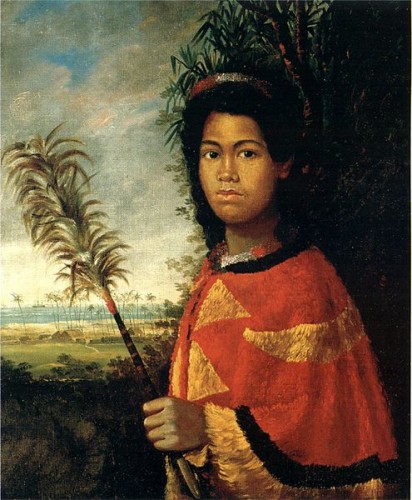
Princess NÄhiÊ»enaÊ»ena, 1825, Robert Dampier, Honolulu Museum of Art
If NÄhiÊ»enaÊ»ena had been born 30 years earlier, even as little as 10 years earlier, her whole life would be encapsulated in the Dampier portrait. As the highest ranking princess in the islands, she would have married the highest ranking chief in the islands. That he was her brother would only have been seen as an added benefit: brother-sister marriage was encouraged to preserve rank and status. In addition it’s more than likely they would have been raised in separate households: one or both would have been adopted and raised as a ‘hanai’ child to another royal couple to maintain ties between families.
NÄhiÊ»enaÊ»ena though, was born just as the most prominent missionaries to Hawaii, from New England, gained a foothold in the islands. Throughout her life the missionaries and those members of the Hawaiian nobility who strove to maintain the old religion and customs saw NÄhiÊ»enaÊ»ena, and her brother, Kamehameha III as symbols of the direction the islands would head in, and fought to control their destinies. Added to this was another pull and temptation: the lax rules and morality of the whalers and traders visiting Hawaii.
NÄhiÊ»enaÊ»ena was alternatively raised in the old Hawaiian style, given every freedom and indulgence that the highest ranking female in the land could expect, and encouraged to love her brother as a future husband, and raised by the missionaries in strict Puritan-influenced Christianity, where the Hawaiian religion was considered blasphemous idolatry.
The second portrait of NÄhiÊ»enaÊ»ena demonstrates the world that was coming to Hawaii, and the person the missionaries had attempted to shape her into. Gone are the feather pa’u and cloak, to be replaced with a prim white dress which would have been unexceptional in Boston or London. Instead of a lei, her head is framed by a frilled bonnet, and a tight bow holds her chemisette snug to her neck. Instead of being framed by her lands, NÄhiÊ»enaÊ»ena is isolated on a white background, her hands out of frame, all trappings of her status removed. Instead of a proud, exotic, princess NÄhiÊ»enaÊ»ena is a demure, restrained New England housewife.

Princess NÄhiÊ»enaÊ»ena by Barthelemy Lauvergne, 1836, Bishop Museum
She may have looked the role for one portrait, but in reality NÄhiÊ»enaÊ»ena chaffed under the confines of the missionaries rules. Only one of their lessons had a lasting impact: while her faith as a Christian wavered and lapsed at times, her sense of guilt at having left the fold remained strong, so whenever she gave in to her desire for a freer life, and her love for her brother, she was wracked by terrible remorse.
Under pressure from the missionaries she married, not her brother, but a different chief, . She loved him, but she also loved her brother, and in the turbulent emotional and historical years of her late teens she alternated between her two loves, never able to feel happy or fulfilled.
The missionaries had done their work too well: NÄhiÊ»enaÊ»ena could not be comfortable in the old ways, which would have given her structure and a moral compass, but the missionaries brand of Christianity was too repressing, so instead she and her brother turned to the whalers and to alcohol to drown their frustration and confusion.
Tragedy was almost inevitable, and it came in the form of what should have been happiness and success. NÄhiÊ»enaÊ»ena became pregnant. Kamehameha declared the child was his, and announced it would be the heir to the throne. The missionary community was horrified, and furious. For a few months, the future path of the islands hung in the balance. Would Hawaiian tradition prevail?
We’ll never know. The baby died in childbirth, and NÄhiÊ»enaÊ»ena went into a lingering decline, literally dying of despair just under four months later. The world she had been born into was too hard for her to live in. One positive did come out of her short life and tragic death: grief proved a steadying influence on her brother & lover, and Kamehameha III would go on to be the longest reigning Hawaiian king.
Today NÄhiÊ»enaÊ»ena and Kamehameha III are finally together. Her early portrait and the matching one of the young Kamehameha III that Dampier painted hang next to each other at the Honolulu Museum of Art, the young royals gazing out at the best example of what the outside world brought to their islands.
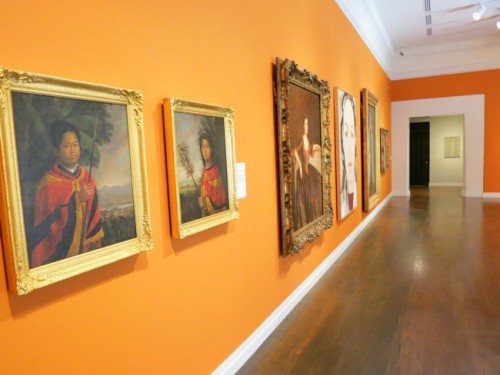
NÄhiÊ»enaÊ»ena and Kamehameha III together at the Honolulu Museum of Art