Latest Posts

Mark your Calendars! Steampunk and Tea coming up

Mark your calendars and plan your trips to Wellington dear readers, because in addition to all the fabulous classes I’m teaching, there are some exciting events coming up for me in the next few months.

First, on the weekend of October 13, Wellington is having its very first steampunk convention ever: AetherCon.

In addition to workshops and fashion shows and contests and exhibitors and lots of other fun stuff, I’m going to be giving a talk on the intersections of Steampunk and history.  I’ll be talking about the fashion tropes, where they come from, some real people behind the personas and lots of other fun stuff.

And away she floated, clinging on to the hanging rope of her dirigible

And then, of course, there is a Steampunk ball!  Swoon!

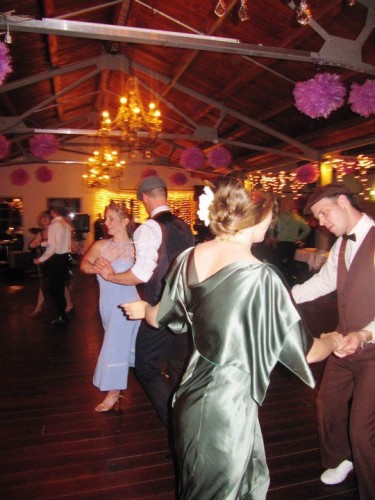
Moving to the end of October, from the 25-28th of Oct, Full Swing is hosting Wellington’s annual Swing ball (and workshops and competitions and vintage shopping tours and other fun stuff): Windy Lindy.

Dancing the night away at Windy Lindy 2010

This year’s theme is Blitz Ball, so it’s the perfect opportunity to dig out your best ’40s gear!

Don’t have the perfect ’40s dress?  Well, you’re in luck, because starting Oct 11 I’ll be teaching a ’40s sewing class!  And, of course, I own all sorts of delicious ’40s patterns.

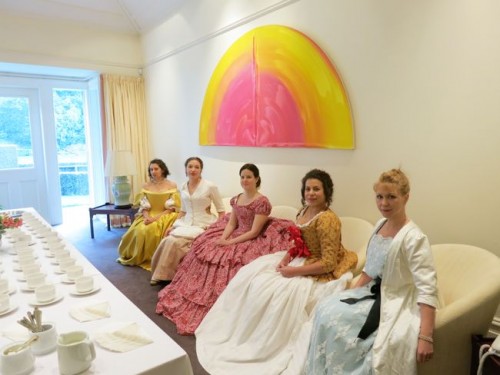
Finally, on November the 25th I’ll be doing my Afternoon Tea talk again, this time in cooperation with Altrusa Wellington as a fundraiser for the Ronald McDonald House.  It won’t be at the Prime Ministers residence (boo), but it will be on a Saturday in the CBD at Capital E, making it much easier for lots of you to attend!

Before afternoon tea

Hope to see some of you Wellingtonian’s at one or more of these, and for those of you who live further afield, I’ll make it to your neck of the woods one-day!

Unexpected treasures: antique textiles at the Honolulu Museum of Art

When I go on a trip, I like to look back over my images when I get back and see what the first image I took was: the first thing that inspired me to pull out my camera and commemorate it.

This is my first photograph from my recent trip to Hawaii:
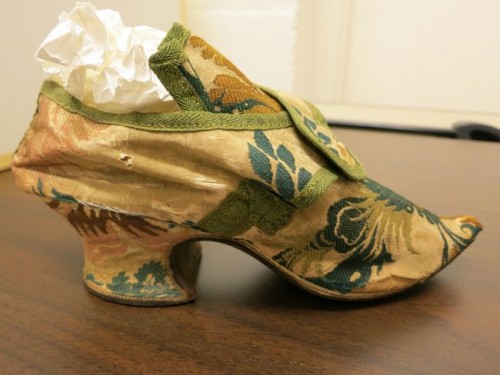
18th century brocade shoe, Honolulu Museum of Art

It’s an 18th century shoe in the textile store at the Honolulu Museum of Art.

I love this.   It’s so typically me: the first thing I wanted to do on Oahu was go to the HMA, and the first thing I immortalised was a 250 year old shoe — not the usual Hawai’i image at all!

I’m lucky enough to know the director of the Honolulu Museum of Art (formerly the Honolulu Academy of Art), and he really wanted me to meet the textile curator and tour the textile store.   Was I interested?   Are you kidding!   Of course!

I thought the HMA textile collection would be very Hawai’i focused — all Hawaiian quilts, vintage holoku, kapa (barkcloth) and woven lauhala mats, with perhaps a big dollop of Asian textiles, thanks to Hawai’is links to Asia.   This was a huge oversight on my part — every other museum store I’ve ever seen (in the dozens) has had the most random collection of fashions and textiles from every time-period and every part of the world.   It’s the byproduct of decades of collecting: of donors who give huge lots of their grandmothers lace and the stuff their great-uncle picked up when he was in the merchant marines; and the result of how difficult it is to deaccession stuff that doesn’t fit the collection.   Of course the HMA textile collection would have bits of anything and everything.

Not only does the HMA textile collection would have bits of anything and everything, it should have bits of anything and everything.   Hawai’i is the crossroads of the Pacific — anyone and everyone has passed through.   So in addition to the bits I expected, the Hawai’ian clothes and textiles,   the gorgeous Chinese and Japanese robes and kimono, there are also shelves and drawers of Indonesian textiles, and (the stuff you are interested in) utterly stunning 18th, 19th & 20th century fashions.

I had the most glorious hour in the textile store with the lovely curator, drooling over the Chinese textiles that will be included in their upcoming textile exhibition ‘Birds, Bats and Butterflies’ (I hope I have the order correct), sighing over the Hawaiian quilts, squeeing when I found the 18th century shoe, and swooning over the 18th and 19th century textiles.

It was simply fabulous, and a wonderful reminder of how many amazing textiles are out there: in addition to all the collections we know and love such as the Met and the V&A and the LACMA, all sorts of other museums will have their own treasures, and many museums will let you make appointments to see and study them.

Next time I’m in Hawaii I want to spend a whole day at the HMA studying the textiles and getting better photographs (please excuse the quality of my photographs).  For now, here are a few highlights:

They have an amazing mid-late 18th century embroidered jacket:
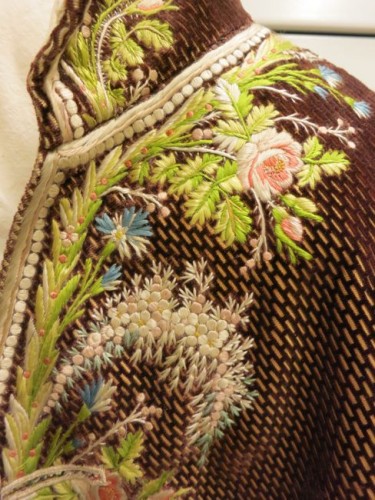
18th century embroidered man’s jacket, probably French (detail of collar)

With matching breeches:
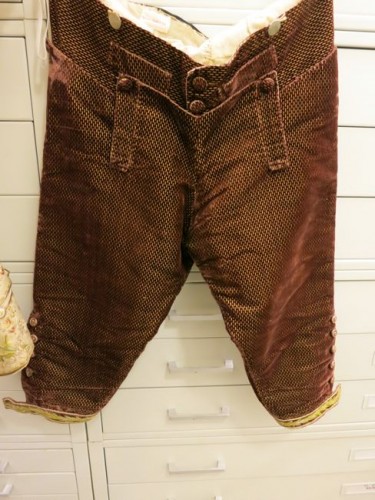
18th century breeches, probably French, Honolulu Museum of Art

And the matching waistcoat:
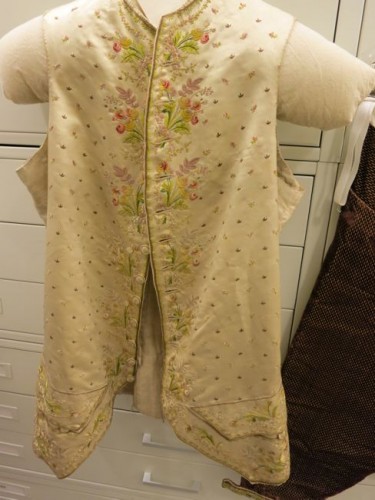
18th century embroidered silk waistcoat, probably French, HMA

The whole outfit was recently featured in an exhibition on men in lace.  Delicious!

They also have a very intriguing garment probably made in Turkey for the export market in the late 19th century, and adapted and worn in the West as a tea gown:
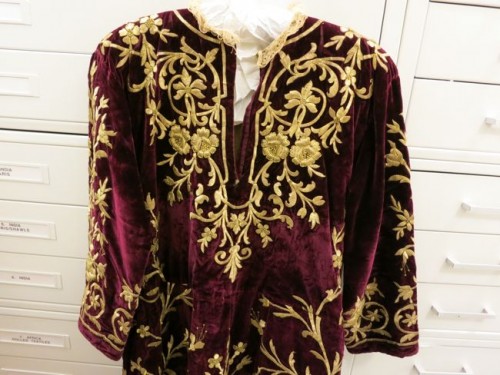
Turkish robe adapted a Western tea gown, HMA

And finally, the most darling, exquisite 1810s frock in sure-to-make-the-Dreamstress-swoon golden-yellow silk.
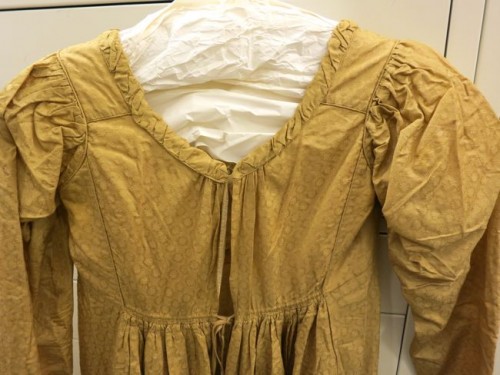
Silk gown, 1810s, back, HMA

I’ll post more about each individual garment in the coming weeks.  (Especially the shoes, as I thought of Her Grace and took LOTS of photographs of every detail of them!).

White Camellia day

Today New Zealand celebrates White Camellia Day, also known as Kate Sheppard Day, or Suffrage Day.

New Zealand was the 1st country in the world to give women the right to vote.  Universal suffrage was achieved on 19 September 1893: 9 years before Australia (1902),  27 years before women in the US were given the right to vote (1920), and 35 years before women in Britain could elect their own representatives (1927).

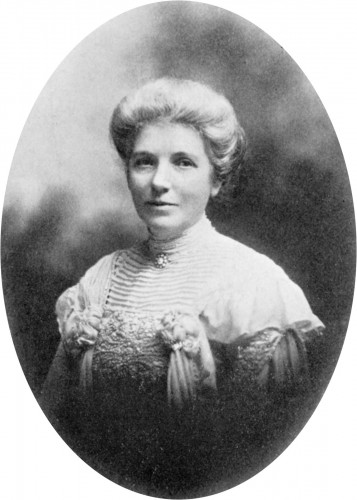
The campaign for universal suffrage was led by a few notable women, including Kate Sheppard, who is commemorated on the NZ $10 note.

Kate Sheppard, 1904. Her image on the note is based on this photograph

For two decades leading up to 1893 these women wrote, campaigned, and petitioned, finally in 1893 assembling a petition with 31,872 verified signatures: the largest petition ever assembled in Australasia up until that point.  Pretty impressive considering that New Zealand’s population in 1893 was just over 700,000!

Those who signed the petition and supported women’s suffrage were given a white camellia as thanks and to wear to signal their support, and the white camellia is still linked with women’s rights in New Zealand.

The petition did the trick and finally convinced New Zealand’s politicians that there was widespread popular support for universal suffrage.  They passed the Electoral Bill on 8 September, and 11 days later it was signed into law by the governor.

Cartoon celebrating suffrage, New Zealand Graphic, 21 July 1894

The New Zealand suffrage movement was quite unique in its strong focus on equality: everyone, regardless of class, social status, race, or property ownership, should have the right to vote.  Sheppard stated “all that separates, whether of race, class, creed, or sex, is inhuman, and must be overcome.”

The 1893 election came just two weeks after the passive of the bill.  Over 2/3 of women in New Zealand voted, an amazing percentage if you consider that well into the mid 20th century women in rural areas of New Zealand made it to town only once or twice a year.