Latest Posts

Rate the Dress: Christina of Denmark (well, maybe) in 1570

Last week was all about tea and tea gowns, and the Rate the Dress was, appropriately enough, a tea gown.  It was rather popular, except with those of you who didn’t think it was tea gown-y enough, or those of you who simply didn’t like the idea of tea gowns, and thought it was too tea gown-y.  You can’t please everyone!  Still, it rated a very respectable 8.7 out of 10.

A long, long time ago, as my second Rate the Dress ever, you commented on Christina of Denmark as a teenager, and prospective bride, in mourning attire.  Unfortunately, the comments got lost in the blog switchover, and I don’t have a record of exactly what you thought!

Let’s see how Christina grew up.

Portrait of a Lady identified as Christina of Denmark, Dowager-Duchess of Milan and Lorraine, 1568-1572, by Anonymous French artist known as the Monogrammist G.E.C. fl. 1560-1575

Well, if this portrait actually is of Christina, not very well!  That beaky nose!  That sallow complexion!  At first I could not comprehend that it might be the same person, but on closer inspection, the deep set eyes, and the pronounced cheekbones are still there.  Of course, the eyes have switched from chocolate brown in Holbein’s portrait to hazel in this one, which is most suspicious!

Anyway, whether or not this is Christina is beside the point, because what I really want to know is, what do you think of the whoever-she-is’s taste in clothes?  The stiff, sharp sleeves?  The elaborate silver and gold metal bobbin lace?  The silk gauze sleeves? The touch of colour in the petticoat?  Just the thing for a noblewoman of a certain age?  Or just awful on any woman of any age?

Rate the Dress on a scale of 1 to 10
Exhibition Announcement: Tattered and Torn, On The Road To Deaccession

Remember the Mon. Vignon garland dress that everyone liked so much as a Rate the Dress?  Well, it turns out there is another Mon. Vignon dress on display this summer in ‘Tattered and Torn, On the Road to Deaccession” on display on Governor’s Island in New York, every Saturday and Sunday from now until September.

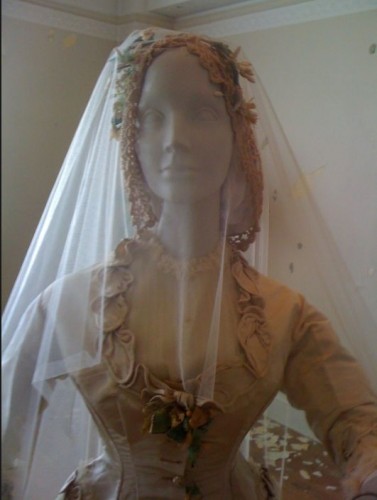
Wedding dress, French, 1872 – bengaline silk with waxed orange blossoms – from Mon. Vignon, 182 Rue de Rivoli, Paris, image courtesy of EHA

The display has been curated by Empire Historic Arts, and shows gowns that would never usually be seen in a museum display: gorgeous gowns that have been well used, and well worn, gowns that show both the exquisite workmanship that has been put into them, and the time since that work was done.

EHA aims to make their exhibitions as entertaining as they are education, and to present aspects of the museum experience that aren’t usually put on display.  As someone who worked in museums, and knows that every exhibition has a backstory that is is every bit as interesting as the one you see on the surface, I heartily approve.

Wedding dress, French, 1886 – silk, faux pearls & lace, image courtesy of EHA

In this vein, Tattered and Torn presents a tale that isn’t often told in museums.  The tale of garments that are in terrible condition.  Fabulous pieces that were just worn one too many times, or stored badly, and now show the marks of the wear and neglect.  Many museums would deaccession these items, or leave them forever in storage, accessible only to the determined costume historian.  With this exhibition the items come to life. It’s a fascinating, and fantastic, idea for an exhibition.  For me, as interesting and wonderful as a perfectly preserved gown is, the story behind a gown’s wear, and behind how museums choose, present, conserve and display gowns, is just as compelling.

We know words like bergere and bustle, cartridge pleats and corsages, but what about accretions and friable?  Have you thought about why the gorgeous wedding gown above is so threadbare in particular areas, but not in others?  And is the wedding gown really less beautiful, and interesting, and worthy of our attention, because it is threadbare?

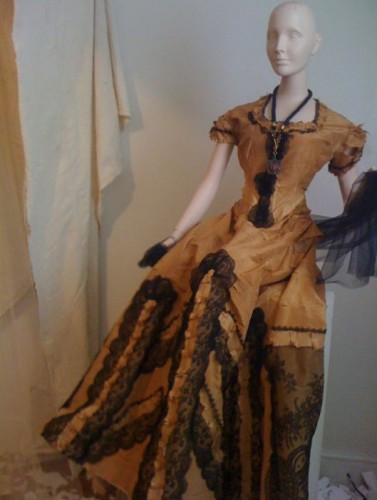
Evening gown, 1865 – made in NewYork of French silk and Belgian lace, image courtesy of EHA

Oh, how I wish I could be in New York this summer!  The gowns look amazing, and (best of all) the curators have indicated that they would be willing to let very interested and enthusiastic costume aficionados inspect the garments up close, both outside and inside.

Swoon!  

Definitely worth a visit if you can possibly make it!  And if you do, and especially if you are able to look at garments up close, and at their interiors, please, please, pretty please take lots and lots of photos and show them!

What: Tattered and Torn, On the Road to Deaccession

When: Sat & Sun, June -Sept 2012

Where: Governor’s Island, New York

Five for Friday: Questions I’m bound to be asked at a talk

Whenever I give a talk there are certain questions I can be almost certain I will be asked.

  1. How long does it take to make one of these dresses?

    A long time.  A long, longtime.  But it does depend on the dress.  A Regency, even hand-sewn, can go together in 12 hours.   I actually counted with the tea gown, and it took between 32-40 hours from draping to hemming.  The Ninon dress was much longer, thanks to all the hand-sewing and bodice boning.  The Japonisme dress would have been relatively quick, were it not for the hand-appliques obi motifs.

    Hours and hours of work

  2.  Are the dresses (and corsets) uncomfortable to wear?

    Chiara in Ninon said “Yes!” much too enthusiastically to this question this time, much to my chagrin.Certainly cramming all five us into a car for the ride from dressing to Premier House didn’t help with the comfort factor.  I like to say that they are ‘differently comfortable’.  Like a suit isn’t the same as jeans, but you wouldn’t necessarily say uncomfortable.

    Ninon: more elegant than comfortable

  3.  How do you sit in them?

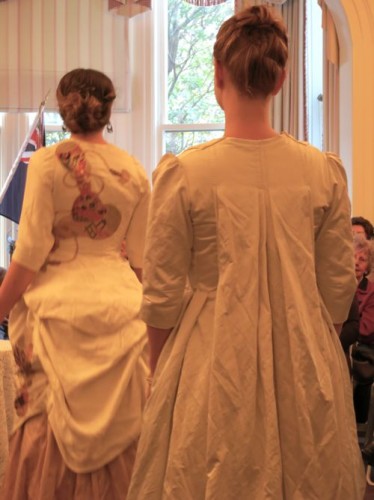
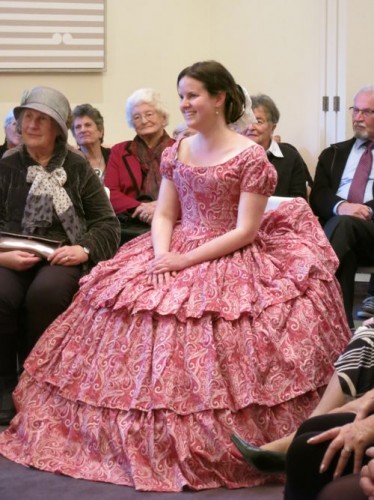
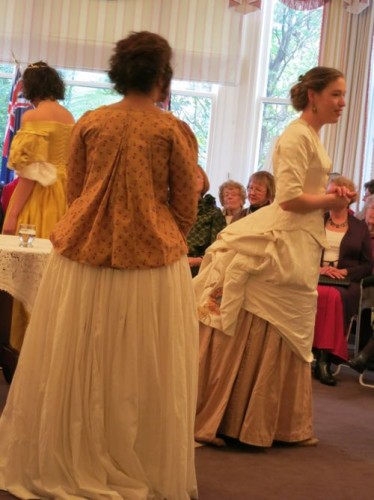
    This question comes up whenever I show the Raspberry Swirl, and to some extent Japonisme with its bustle and Lady Anne Darcy with its paniers.  I have to remember to coach new models in sitting in hoopskirts and bustles, so they can demonstrate onstage.  This time I forgot, but I’ve got brilliant models, so I turned around  in the last few minutes before the talk and noticed  Chiara talking Julie through the finer points of sitting in a hoopskirt.  The trick is to slide your hands along the side of your hoop or bustle as you sit down, catching hold of a hoop or bustle wire and raising it behind you, so that you sit directly on the chair, with the wires collapsed on top of each other behind you, rather than on top of the hoop or bustle wires.

    Julie demonstrates how to sit in a hoopskirt  

  4.  What is holding out the skirts?

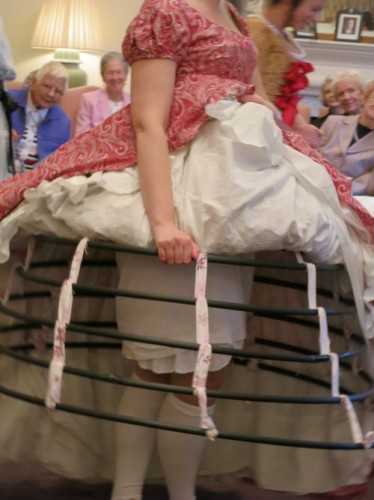
    This gets asked about the Raspberry Swirl (no surprise!) and also the Lady Anne Darcy robe a la francaise and its panniers.  People want to see and touch.  I have to be sure to put the model in (slightly inaccurate) fully closed and modest drawers for the inevitable moment when someone asks to see beneath her skirt.

    Showing off my easy-cheap-not-exactly-historical hoopskirt

  5. How do  they go to the loo?This always gets asked in the most charmingly delicate, roundabout fashion, and I try to find a delicate way to say things like “they didn’t wear anything under their skirts in the 18th century” and “even Queen Victoria wore divided drawers”.  I do NOT ask my poor models to demonstrate squatting in a hoopskirt!

    Delicately discussing indelicate things