This week’s challenge on the Sew Weekly commemorated the Royal Jubilee celebration. The brief said, make something inspired by “any member of the royal family, past or present” and I immediately thought “Past!!!!”. I mean, this is me we are talking about.
So I started brainstorming an idea and working on my project.
Then, with the garment done but for the hem, the Sew Weekly inspiration board came out. Mena’s inspiration board is all from QEII’s life. I guess by “past” she meant royals who were alive during Elizabeth’s early life. My “past” is a little more “past” than that. By three centuries. Oops.
So. Umm… Anyway…
This was my inspiration:

Henrietta Maria (1609-1669), Queen of Charles I, ca1635, Unknown artist, background by Hendrik van Steenwyck, from the National Portrait Gallery, via Wikimedia Commons
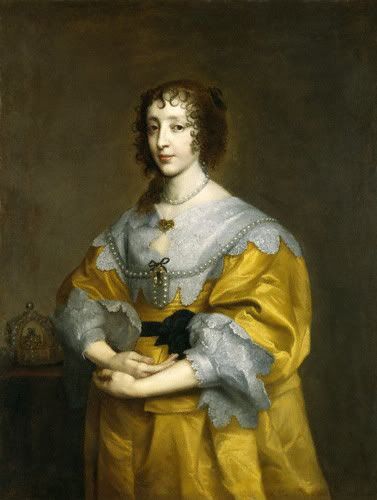
Henrietta Maria, 1632
Henrietta Maria, wife of Charles I, may be a long time in the past, and only barely related to Queen Elizabeth, but she was a member of the royal family, she’s someone who fascinates me, and I love the fashions of the 17th century.
Oh boy do I love the period from 1630-1660. It’s so pretty. The full skirts. The sloped shoulders. The slightly raised waists of the 1630s transitioning to the smooth, pointed bodices of the 1660s. And those sleeves.
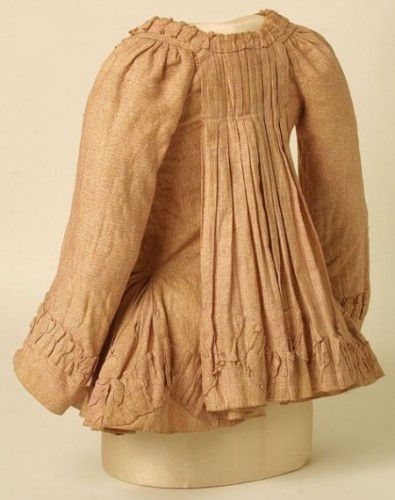
Oh, those wonderful pleated, puffed, just-past-the-elbow sleeves. Swoon…
As you know, I’ve already made a full on historical 1660s gown, and while an early 1630s bodice based on the portrait of Henrietta Maria is on my to-do list, it’s not a week long project. And the whole point behind the Sew Weekly for me is to make a wearable wardrobe. So I wanted to do something 17th century inspired, rather than literally 17th century.
For this project I made a list of the 17th century elements I wanted:
- Rounded neckline with dropped shoulders
- Full just-past-the-elbow sleeves
- 17th century colours
- Pleat details
- Waist definition without a waistline, hopefully with a bow inspired by the yellow portrait.
For my historical coloured fabric I picked a strange, drapey and slightly ribbed darkest green viscose fabric that I found at an op shop, and have accessorized my dress with a waist sash made from a wide vintaged striped silk-satin ribbon.
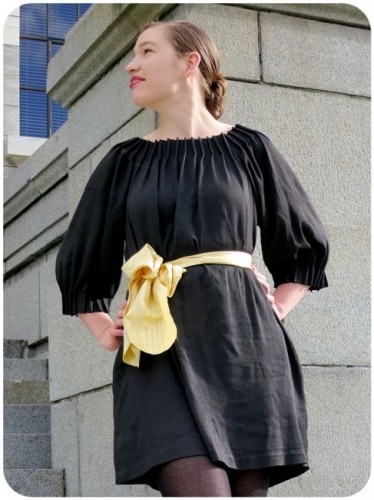
17th century + yellow = happiness.
The darkest green fabric also makes me inordinately happy. It’s so dark as to be almost black, and historically a lot of “black” fabric had a dark green tinge, because it was so hard to dye true black.

In front of the War Memorial Cenotaph, with the Beehive just visible on my left
Making the dress was both extremely easy, and incredibly painstaking. The concept is so simple, but the threads at each end of each large pintuck-pleat had to be pulled through to the back and tied off by hand, because backstitching just looked messy and cheap.
It was also painstaking because I didn’t actually have enough fabric. The op-shopped viscose was a leftover from someone else’s project, and cut in a really weird shape, and quite narrow. I carefully, carefully cut and measured and thought I could get the dress out with only one bit of piecing in one sleeves. Once I started sewing the pleats the sleeves just didn’t look right, and I realised I had cut two left sleeves. Unfortunately I’d already completely pintucked the sleeve with piecing, so the un-pieced sleeve got ditched, and my right sleeve is now pieced in three places, and the grains don’t even match. And you know what? I love it. I think it adds to the dress.

You can just see the piecing on the right sleeve in this image
I first wore the dress to my birthday party on Queen’s Birthday Weekend, but forgot to bring a camera, so DH and I did a photoshoot at Parliament, the Beehive, and the lion statues at the War Memorial Cenotaph on Queen’s Birthday Monday. I figured you couldn’t get much better than a place where Queen Elizabeth has actually been, and that represents her as Head of State for New Zealand, and on her official birthday too!
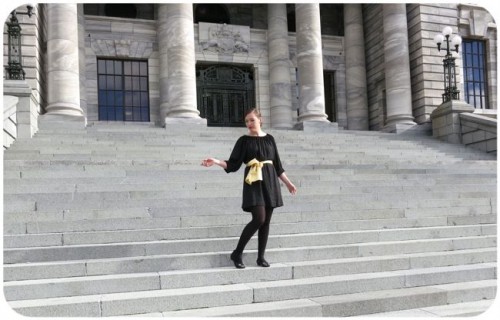
Doing my best regal 17th century hand gestures on the steps of Parliament

Beehive on my right, Parliament on my left
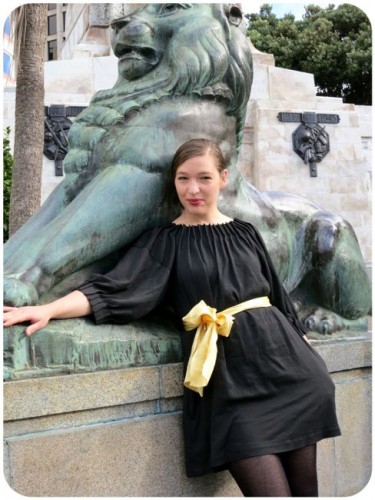
The very regal, very English, Cenotaph lion.
Just the facts, Ma’am:
Fabric: 2-ish metres viscose
Pattern: My own
Year: 1630s meets 2012.
Notions: thread and interfacing
Hours: 4 of actual sewing, another 4 of messing around with the pattern.
First worn?: Saturday 2 June for my sew-in birthday party, then again on the 4th for the photoshoot.
Wear again?: Yes! I love this dress! It’s fun, it’s comfortable, I got so many compliments on it, it will travel well and is suitable for every occasion (so very royal).
Make again?: Yes, my friend wants two now, and my sister wants one, and I want another one, or two, or three…
Total cost: $2 for the op-shop fabric.
And the inside?: Just overlocked. Fancier finishes don’t work with the drape.