Latest Posts

Rate the Dress – When Ladies Meet in 1933

Last week Anna Karolina’s pretty princess dress got lots of love.  Someone even described it as “possibly the most perfect dress ever”.  Wowzers!  Still, there are always a few who are a little less impressed, so that brought it from a perfect 10/10 to a still bloomin’ impressive 9.6 out of 10, the best we’ve seen in a long while.

I’m thinking 1930s this week.  Partly it’s because I’ve been showing you my 1930s patterns, partly it’s because my Goldilocks blouse feels 1930s even though the pattern was published in the 40s (do I think it was an earlier pattern that they re-published in the 40s with earlier illustrations?  Yes I do!), and partly it’s because I just bought the most delicious fabric for a future 1930s garment.

So, a ’30s Rate the Dress.

This is Myrna Loy in the pre-code 1933 ‘When Ladies Meet’, about a very ‘modern’ writer who isn’t fussed that her crush has a wife – until she meets the wife.

Myrna Loy in When Ladies Meet (1933)

Myrna Loy in 'When Ladies Meet' (1933)

Myrna Loy with Ann Harding and Alice Brady in ' When Ladies Meet.'

Myrna’s trademark outfit for the film was this white number with spotted trim.  What do you think?  Modern and liberated, just like her character?  And just feminine enough to make a good effort at snaring a man who should be devoted to another woman?  Or are all those ruffles and spots just a bit silly?

Rate the Dress on a Scale of 1 to 10.  


The ‘Little Bit of Magic’ cape

Just in case you haven’t noticed,  I  love  capes.  However, I do not love Vegas.  It’s hot, it’s commercial, it’s all about alcohol and gambling and stuff I don’t do.  But this week’s theme on the Sew Weekly was “Viva Las Vegas”.  And Vegas is pretty much the promised land of capes.  Elvis, Liberace, Evil Knievel, magicians — in Vegas, it’s  all  about the cape.  So I may not be a Vegas girl, but I can totally be a cape girl.
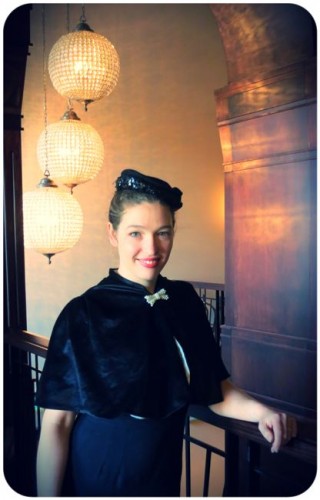
Really though, as awesome as an Elvis or Liberace-style embroidered and bedazzled to the gills cape would be, I don’t think my life and wardrobe can support  that  much awesome.

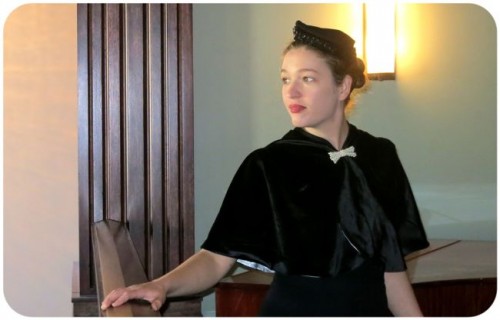
So I went for a toned down version in classic black and white — something to evoke the traditional magician’s cape, with just a little hint of Vegas bling in a shiny, plush velvet, and a patterned jacquard satin lining.

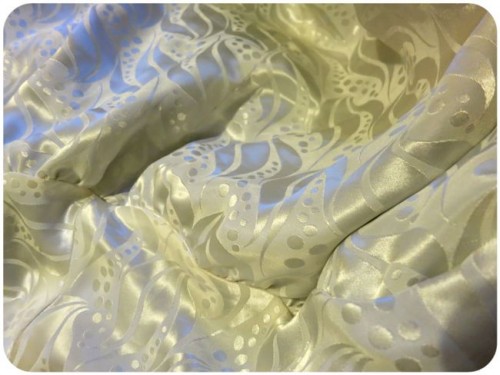
I’m super excited about the lining actually.  The fabric was my Grandmother’s, so it’s wonderful to finally get to use it, 15+ years after I inherited it.  And the pattern reminds me of fountains and stories of glass pools with showgirls swimming in them.  Naughty!
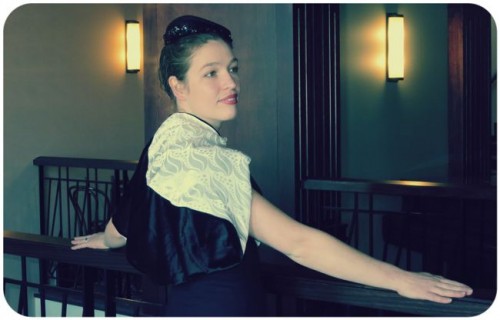
Unfortunately the white fabric was damaged, and I had to cut very carefully to get the full lining out of it, which meant cutting along different grains to the outer fabric, which is a HUGE issue with this pattern.  The disagreeing grain-lines means that in some places the lining tugs just a little, and in others it wants to bag and hang out from below the outer fabric.  I did my best to mitigate the issue, but it isn’t perfect.
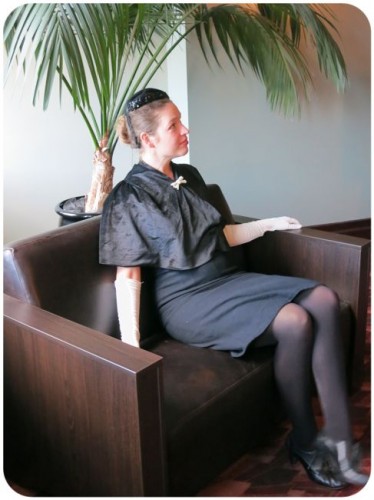
I bought the most gorgeous, elaborate, fabulous frog to fasten the front of my cape, and I couldn’t find it anywhere once the cape was finished.  So instead I’m wearing it with a vintage pearl bow brooch from Nana.  I’m almost glad the frog didn’t show up, as I think the bow perfectly references a magician bow tie (and besides, we all know bow ties are cool), and my brooches don’t get to make an appearance often enough.

To get into the spirit of the challenge I added a little Vegas sparkle with one of my Grandmother’s 1950s hats with a sequin band across the front.  I paired the cape with my Little Black Dress Clip Dress (done for the accesorise challenge), some seriously awesome tights, and, for maximum drama, elbow length white gloves.  Totally over the top, but that’s Vegas!
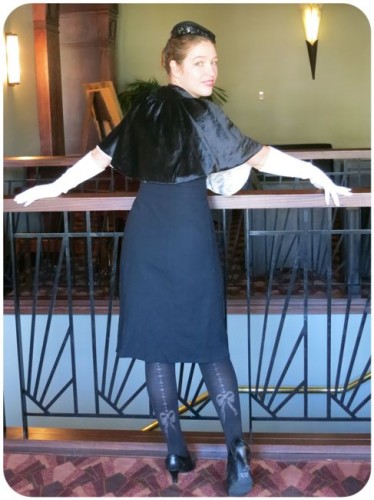
Unfortunately, unlike Vegas, Wellington is  not  the promised land of capes.  Wellington is the land of “Oh blast, I’m trying to cross the street and the wind has blown the cape up into my face and completely blinded me” and “This cape looked so cute over my coat, but it really isn’t cute the way it has been slapping me in the ear for the last 5 minutes”.  So now this is a still-days and indoors only cape.  But it does a great job of keeping me warm.
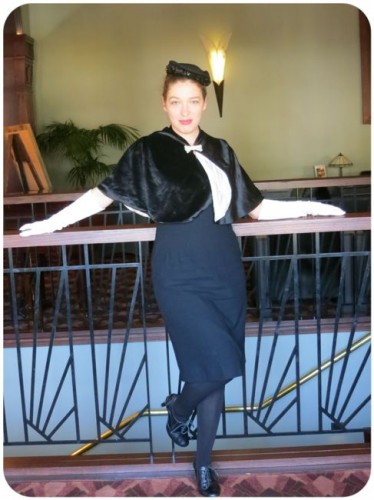
 

I first wore the cape for Yum Cha with friends Saturday a week past, but the pictures from that day were terrible, so I re-did a photoshoot at the Roxy Cinema — a 1930s themed cinema with lots of decoration by Weta Workshop.  And it’s in my neighborhood, and just down the street from my favourite restaurant, and a bit glitzy and over the top.  Perfect!

Just the facts, Ma’am:

Fabric:  1.5m vintage jacquard satin from my Grandmother’s stash, 1m black velvet plush from…I honestly can’t remember.

Pattern:  My own, based on  a 1930s original  (the same pattern as the Capelet of Yay, but without the long stole pieces)

Year:  late 1930s meets 2012

Notions:  thread, and someday a frog (if I ever find the blasted thing – but I’m liking it so much without I might leave it off)

Hours:  5, thanks to the unfortunate directional issues

First worn?:  Saturday 26 May for yum char with friends (and then pretty much constantly since then).

Wear again?:  Yes, but only indoors or on still days

Make again?:  Not in the near future.  Between this and the Capelet of Yay, I think I have enough capes for a little while.

Total cost:  $0 (well, $3 for the yet-to-be-located frog).
The 1780s chintz pet-en-l’aire

I’m making a 1780s Indian chintz inspired pet-en-l’aire.

I’ve been holding off on telling you about this project, because I didn’t want it to turn into one of those things that takes 8 months to make (and maybe never quite gets finished at all) and is difficult to follow as a reader.   But I’m determined to have it done in time to be worn for the Afternoon Tea talk (which has sold out!) just over a week from now.  So I hope it’s safe to start blogging the story!

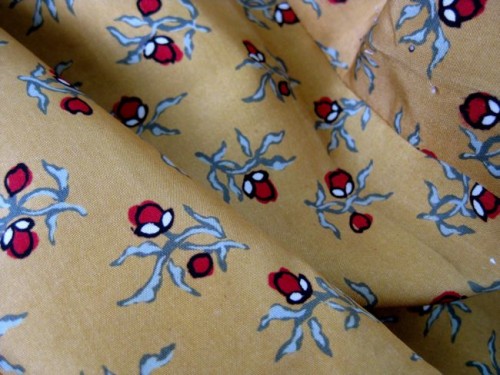
The pet was inspired by this fabric:

Block printed Japanese silk habotai, recycled from a vintage obi

Yum!

It’s block printed Japanese silk habotai, and when I bought it, it was an obi.   I just couldn’t resist.

It was just so, so, so perfect for a late 18th century garment.  The colour scheme, the small scattered floral, the slight imperfections in the print.  It would be even more perfect if it was cotton, since Indian and Chinese silks were usually hand painted, rather than block printed, but I’m willing to settle just a little.

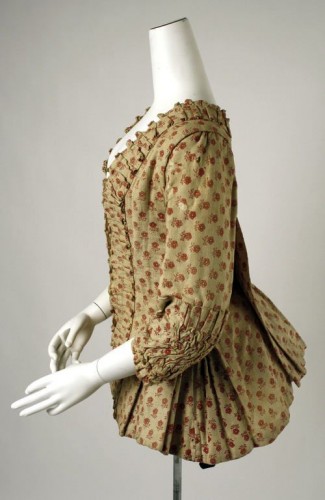
Because it started out as an obi, which yields about 4 metres of 15″ wide fabric, I didn’t have enough to make a full robe and petticoat.  Instead, I decided on a pet.  Something like this:

Caraco jacket, late 18th century, cotton, Belgian, Metropolitan Museum of Art

And this:

Pet-en-l'aire jacket, 1780-90, cotton with silk bows, Manchester City Galleries

The print is closest to the Met pet, but I’m using the shape of the MCG pet as my primary inspiration for the cut of the garment, mainly because I love the front stomacher with its contrast bows (can’t you just imagine dark red silk bows?).

To start with I constructed a little bodice to support the structure of the pet:

Bodice with back lacing to adjust

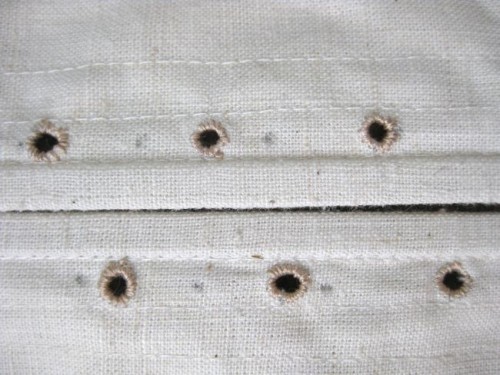
Sometime between sewing the channels to hold the back bones and working the eyelets I decided I was going to handsew the entire rest of the pet.  So everything but the side seams and the boning channels is hand sewn, with varying degrees of skill and elegance.

Hand-worked eyelets

This is not my best eyelet effort ever.

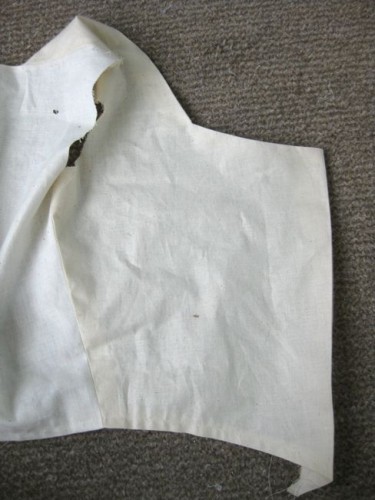
The bodice centre front

My support bodice includes the centre-front stomacher, so the pet will basically have a false stomacher, with the effect achieved by stitching down the side pieces over the stomacher.  I don’t know if this is accurate or not.

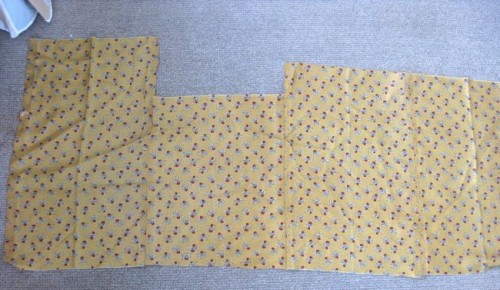
Rough shaping of the pet

With the support done I figured out the best use and layout of 15″ wide panels across the shape of the pet, and cut the rough lengths needed and sewed them together.

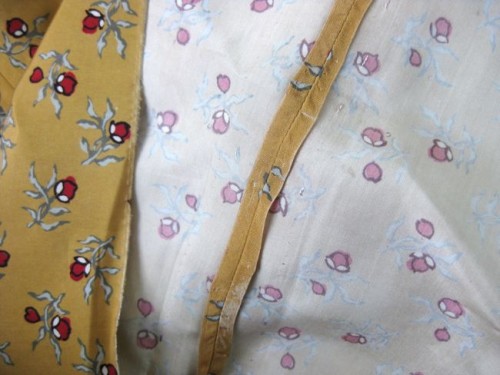
Next: Pleating the back and attaching it to the bodice support.  But first, more images of the fabric for you to drool over:

So pretty! Like little strawberries!

Did you know that yellow and black were worn in support of the deposed monarchy in Revolutionary-era France, because they were Austria’s colours? This fabric is like the cowards version: add a little red and white, so that it works with the tricolour too!

An interior seam