Latest Posts

Early 1930s Patterns, part II of III — the Excella Patterns

On May 18 I showed you half of my early 1930s Excella patterns.  Here are the rest (and one non-Excella pattern just to mix things up).

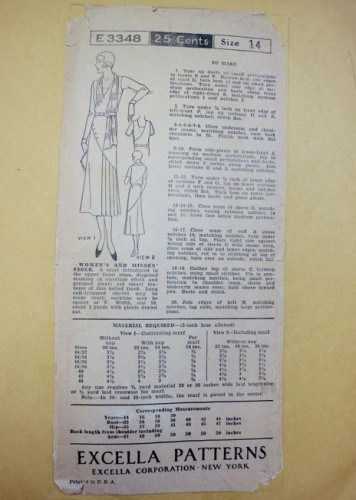
I adore this one.  That wrapping scarf.  So swish!  I’m waiting on the right time to make the whole dress, but I have made the skirt part as a business skirt, which I loved and wore to death.

Excella E3348

Isn’t this one so adorable?  It just sings of sweetness.  I’m not sure the top and skirt go together though.  Maybe if the ruffle and contrast pieces were in the same fabric?

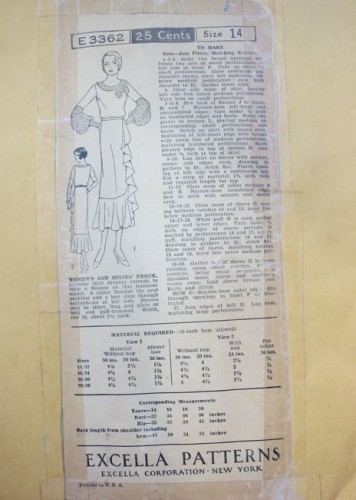
Excella E3362

This dress is possibly the simplest, but may very well be my favourite.  Such lovely simplicity of line.

Excella E3371

From simple to sophistication.  Va-va voom!

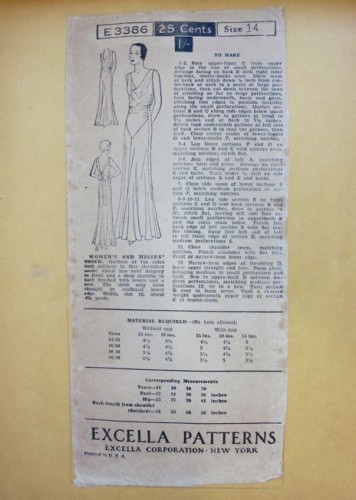
E3386

And this one may be my least favourite.  It feels like Excella needed to make a pattern, and so they just married some bog-standard dress elements to make a new design.  Couple of skirt panels, some simple sleeve variants, cowl neck, tie it together with a sash.  Eh.  Good enough.

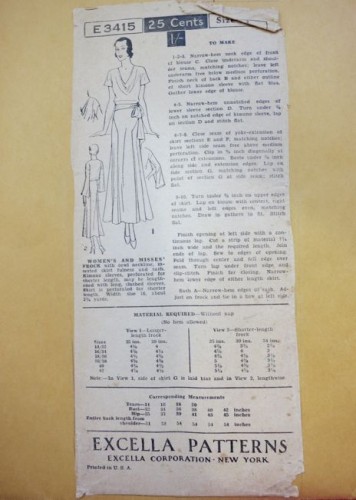
Excella E3415

Doesn’t this one just say 1930s?  I see Joan Crawford in Grand Hotel, Myrna Loy in the Thin Man, Claudette Colbert in It Happened One Night.  Happiness.

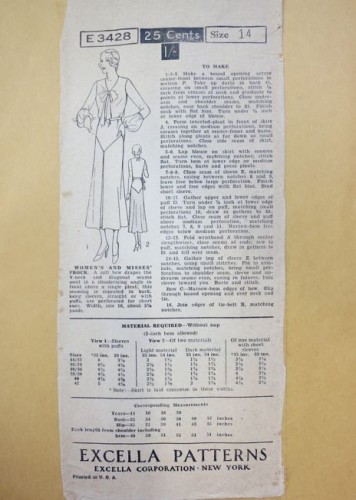
Excella E3428

OK.  Can’t decide on favourites.  Love this one too.  Imagine it in deep dusky violet with golden yellow bobbles on the neck and belt.  Swoon.

Excella E3485

And finally, one you may recognise.  It’s my wedding dress!  Only with a different bodice.

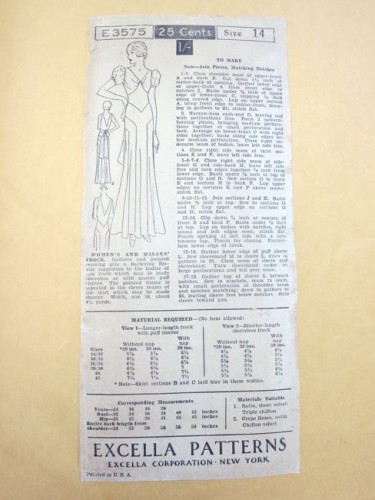
Excella E3575

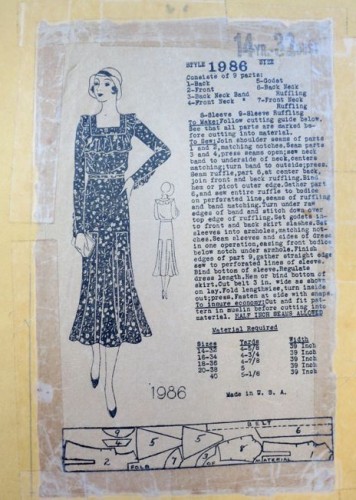
I don’t know what company my final pattern is by, but I adore it.  I like that they showed it in a print.  I also love that it has an age with the size.  And that you see it with a hat and a pocketbook.

1986


Living art at the Metropolitan Museum of Art

We all love the Met for their fabulous Costume Institute, and for the other costume-related masterpieces in the Museum, but there is another artwork in the museum that I love.

As a visitor to the Metropolitan Museum of Art one of the things that intrigued and amazed me was the gorgeous, enormous flower arrangements in the Great Hall.  They were so big!  And spectacular!

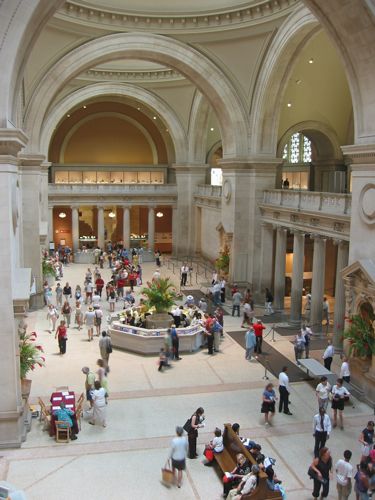
Five enormous, gorgeous flower arrangements in the Great Hall

I noticed them every time I was lucky enough to visit the museum, and later, when I interned at the Met, I got to find out about the flower arrangements, and watch their creation.

The flower arrangements happen thanks to a generous bequest to the museum that pays for their creation.  The same florist was responsible for them for decades, and when he finally retired, his son continued the family business, and the link to the Met.

The flowers are installed weekly on Monday mornings, the day the museum is closed  to the public.  The florist and a helper arrive first thing in the morning, and set to work creating their masterpieces around the hall.

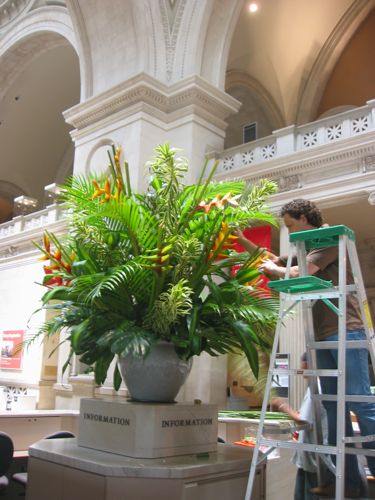
Step 1 – large flowers

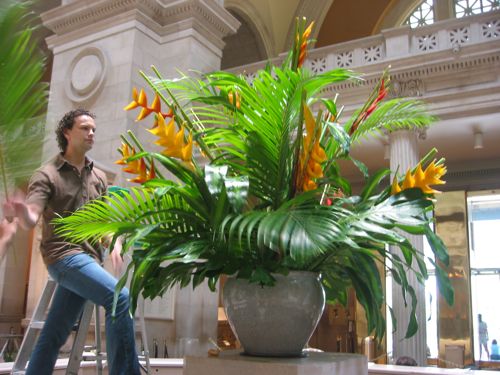
The first arrangement to be done is the central vase that sits in the middle of the circular information desk.  The vase is actually two vases – a small upper vase, and a large lower vase, which helps to create the full shape of the flower arrangement.

Step 2 – large leaves

If I recall correctly, the entire vase arrangement actually spins, to better allow the florist to create a perfect arrangement in the round, without constantly moving his ladders.

Step 3 – palm fronds

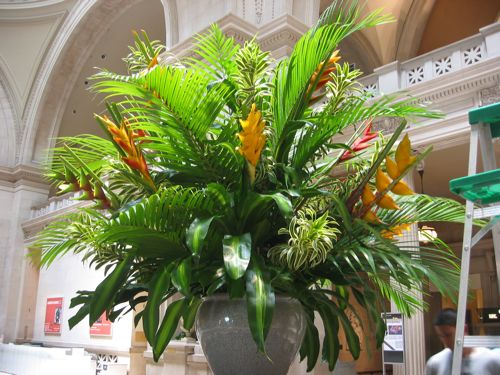
The arrangement is built up in layers of different flowers and leaves.

Palm fronds throughout the vase

The flowers and foliage are carefully chosen to remain fresh and lush throughout the week in the busy, crowded Great Hall.

Step 4 – Contrasting foliage

In the summertime the arrangements are predominantly based on tropical flowers, which can withstand the extreme heat and humidity of a New York summer.  All summer long I watched the florist create arrangements of heliconias and parrot flowers, monstera leaves and palm fronds.

Almost done

In the winter, flowers that prefer cooler temperatures are used.

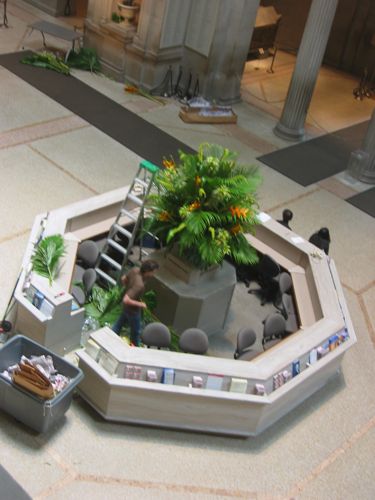
Art in progress from above

One flower is never included the flower arrangements at the Met.  Lilies, despite their large size, relative robustness, and the showy splash of colour they provide, are banned.  Their strong fragrance irritates many allergy sufferers, and on one particularly hot summer day people in the hall, and especially the staff working under the flowers around the information desk, complained of the scent of the lilies.  Then people started fainting.  Lilies have not been used since.

A finished flower arrangement in an alcove

My memories are almost 7 years old, and they are based on casual conversations with the florist, but I thought you might still enjoy seeing the images I took, and getting a little glimpse into one of America’s greatest museums.  I just think the flowers add so much to the museum, and to the atmosphere of the Great Hall.  What a wonderful thing that bequest is, to bring so much life and joy to the visitors, and to add another layer to the Met’s story.

The Great Hall, fully decorated

The Goldilocks & the three bugbears blouse

Last week the Sew Weekly challenge was 1940s.  Exciting!

I love 1940s, but rarely end up sewing it.  And I knew just what I wanted to make.

Not for me one of the endless (but very charming) 1940s dress patterns that Simplicity and Butterick are re-releasing, or even a vintage dress pattern. I was just given Advance 1868, and I think it’s just adorable. Time to make it up!

I picked view #2 because I love the option of a contrast section.

Unfortunately, as I tackled the blouse I quickly began to feel like Goldilocks.

I’d decided to use the green and white voile that I used on my Toeses & Roses tap pants for the contrast portions of View 2 (I’m definitely the kind of seamstress that works with a fabric, falls in love with it, and then wants to make dozens of items in it, as opposed to the kind that makes something out of a fabric, and then is totally over it). So I needed some white to go with it.

Simple! I’m the queen of white fabric — with the dozens of different varieties in my stash matching white should be easy, right? Nope. One was too white, the other not white enough. One was too heavy, another too translucent. None were just right.

Blast! (actually, that’s not at all the word I used. The one I used also starts with a B, and works better with the title of this post, but I’ve had to stop saying/writing it publicly ever since I learned it actually is a bad word)

Finally I settled on a crisp vintage cotton — a bit heavier and stiffer than was ideal, but the closest I could get to the right shade and hand.

Then I went to cut out the pattern. First, my pattern is a size 32″ bust. My bust is 37″. I was going to have to resize.

Blast! (see note above)

Then I looked at the pattern and realised I was missing the entire back piece.

Blast! (ditto)

So I sighed, girded my intellectual loins, and drafted a back piece based off the front and the (very basic) illustration on the back of the pattern. And I sighed some more, and drafted re-sized pieces.

Then I sewed the blouse up, and it was monstrous. Like wearing a tent. The whole thing got unpicked, and I ended up cutting it all the way back down to the original pattern size.

And that’s what you are seeing here:
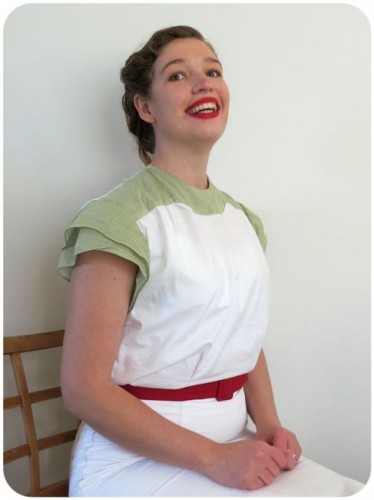
Yeah, it’s still a bit too big.

It’s also pulling slightly funny around the neck and at the back (though more so in these pictures that it did at any time I checked it during a whole day of wearing), so I need to spend a little time with the blouse analyzing what went wrong, deciding if I can fix it with this version, or if I can ever be bothered to make another version. I do like things to be just right.
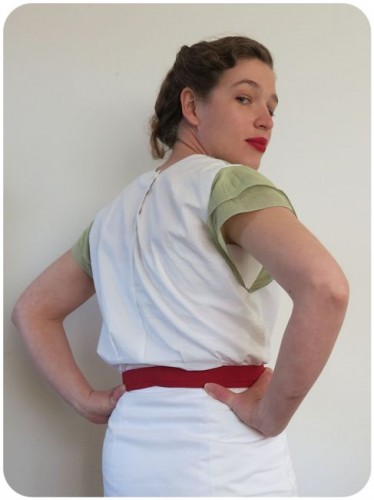
The back was supposed to button all the way up, but I’m flat enough that I can get away with a seam and just one top button, so I did.
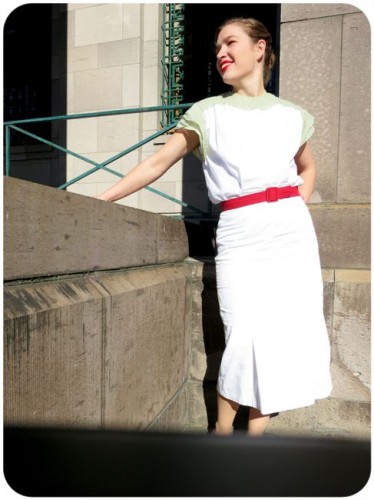
With the blouse I’m wearing my ‘Please don’t photograph me’ 1930s skirt, which turned out to be a bad idea, because the skirt’s anti-photography curse struck again, and all the interesting photographs I tried to take at the old Museum Building (an icon of early 1940s Art Deco architecture in New Zealand, and a fantastic place to do photoshoots, as you may remember from the Laurel Dress & blue dress photoshoots) turned out terribly, and I had to do a quick catch up session in front of the boring white wall. It’s really hard to photograph yourself with a timer!
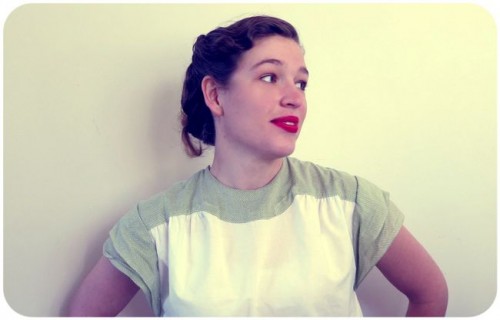
 

Despite the super happy photography, I’m not sure how I feel about the blouse. It’s very…blouson. And my mother was always very anti-broad shouldered styles, so tackling the 1940s always makes me nervous, as it feels weird to accentuate the shoulders. But I managed to wear it all day as I ran errands around town, so it’s growing on me.
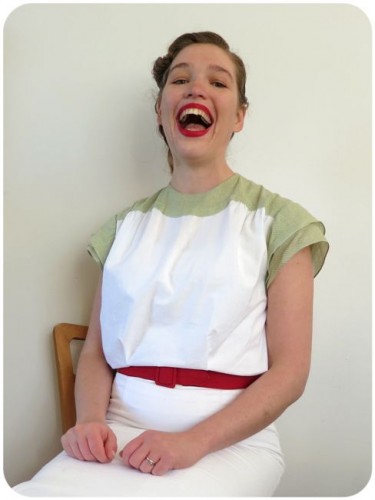
I still have a few bugbears regarding the whole thing, but hopefully one day Goldilocks is going to be skipping happily through the woods in this!

Just the facts, Ma’am:

Fabric: 3/4m white cotton lawn, 1/4m green and white checked cotton voile.

Pattern:  Simplicity 1868

Year: early 1940s

Notions: One vintage hexagonal pearlized button, thread.

Hours: 3

Wear again?: Yes, though I still have reservations about it.

Make again?: Maybe? I’m pretty sick of it for now, but I would like to conquer this pattern!

Total cost: $2.50 or less

And the inside?  Confession time.  The sleeves still look terrible on the inside during the photoshoot.  But the pattern did come with instructions on how to finish them prettily, so that is now done.  The rest is done with french seams, and I altered the pattern so that it used another yoke piece as a facing to finish the neckline and catch all the raw edges from where the yoke meets the bodice front.