Latest Posts

Yet Another Underbust Corset

Remember how I told you about the process of developing an underbust corset, and how I went through a lot of prototypes to get my formula just perfect?  That means that I made A LOT of underbust corsets.  I’ve given some away, torn some apart and recycled the pieces, but still have quite a few to show you.

I really love this one, but I’m still tempted to call it the ‘Not Another Underbust Corset’, because I’m afraid that is really how I felt making it.

It’s made of vintage post WWII synthetic brocade, which was called ‘Kyoto silk’ at the time to make it sound a bit fancier.  The fabric was a gift from my honorary aunt Artie.  The piece was just big enough to make the corset.
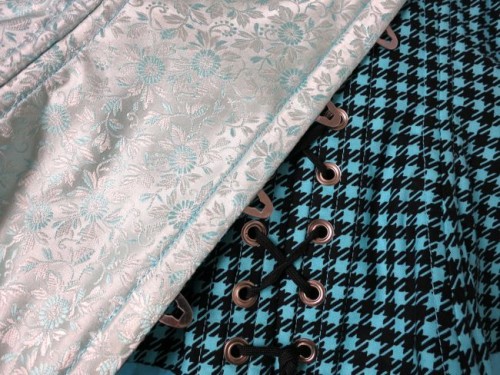
It’s lined in a fabulous printed houndstooth craft cotton in aqua and black.  I love the contrast of the bold lining and the delicate pastel outer.
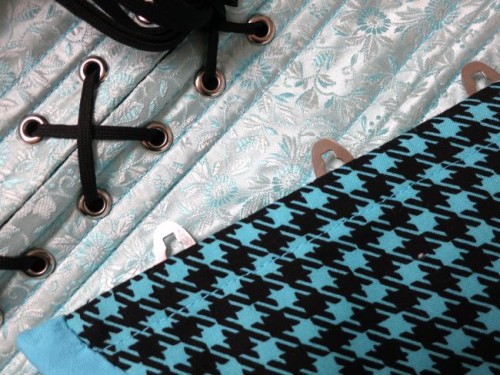
The houndstooth lining was a fairly recent purchased, picked up at a 50% off sale at Arthur Toyes.
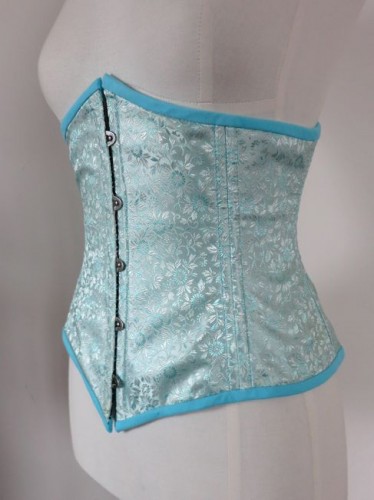
Like all my later, more successful, underbust prototypes, this one is boned on either side of each seam.  Not only is that a much easier way to do boning, it creates a much more balanced aesthetic, and gives better fitting.  Wins all around!
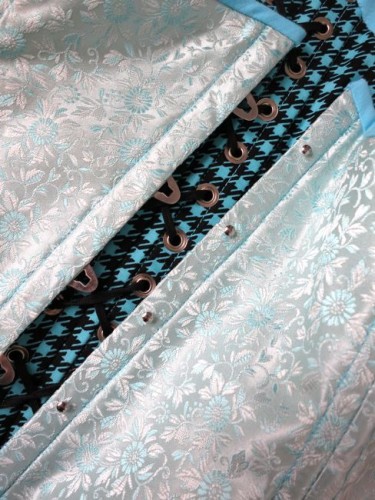
I’ve used a silver busk and silver grommets for this corset.  While you can get gold coloured busks, they are much more expensive than the silver coloured ones, so I rarely use them (especially not on prototypes).  Luckily there was no aesthetic compromising with the busk and grommets in this corset – the pale blues really called for silver.
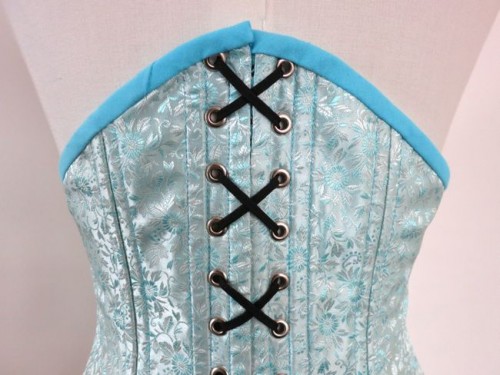
Grommets, on the other hand, come in a number of colours – silver, black, brass/gold, and white, but I have found in teaching corsetmaking that 50% of students pick silver coloured grommets, 20% pick black, and 15% pick brass/gold or white.
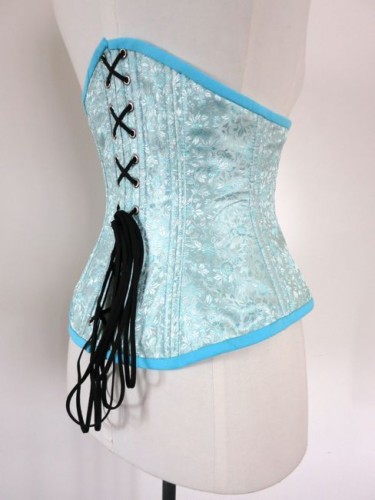
While I’m very happy with the construction of this corset in most ways, there are a few little things about it that bug me.  First, I’m not convinced the bright aqua cotton binding is the right colour.  I was in a hurry to finish this, wanted to finish it exactly as I would have the students finish it, wanted the binding to be obvious so it would be easy to see and study, and wanted to use fabrics that I had in my stash.  Hence the binding.
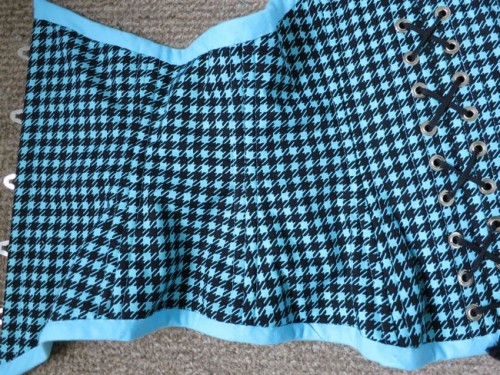
It fills all the practical requirement perfectly, and it looks fantastic with the houndstooth.  From the front though?  I don’t love it.  I think it would have looked better with a self-fabric binding, or in a much softer blue with a bit of a sheen to it.  Maybe if I find reason to keep the corset in my stash I’ll re-bind it one day.
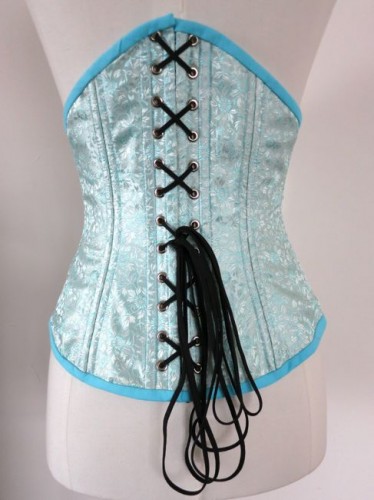
I also don’t love the black ties.  I liked white even less, and black went with the lining beautifully.  What would really be fantastic is a dull silver.
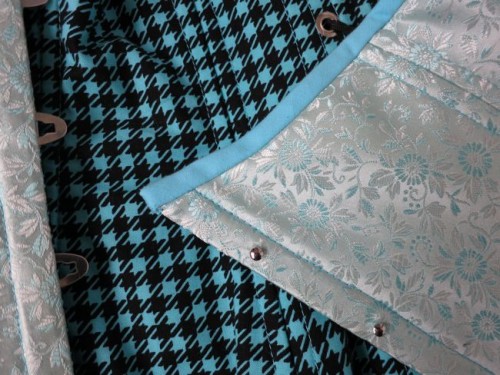
Still, it’s a pretty corset, it makes a great demonstration corset, and it was done.  And I’m too self critical!  (says she, self critically!)
 

Island maid, or what I learned this week

I guess this is the week for quirky confessions.  Yesterday I told you about my ignorance regarding the Prisoner of Zenda, today I’m going to tell you about my geographical ignorance.

You see, I have never in my life been more than two hours drive from the ocean.

Really.  Never, ever.

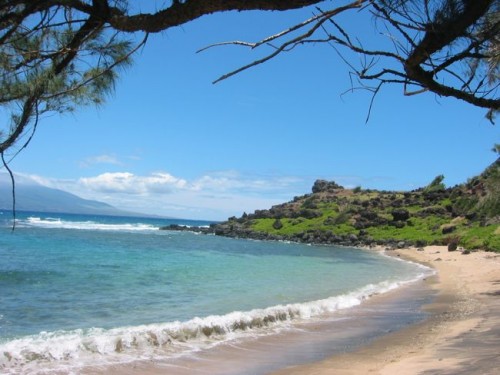
I am an island girl.  I was born and grew up on Moloka’i, Hawaii, an island so small that you could drive from end to end in less than an hour.  And then, all you could do was turn around and drive back.

But at least you drove past some pretty gorgeous beaches!

Then I went to school in the SF Bay Area, where I was never more than a few minutes from the ocean.  Once we drove inland towards Sacramento as part of a birdwatching excursion for an Ornithology class, and that was as far as I ever got from the sea.

After university, I briefly worked in New York City, and that’s just another island.

And, of course, now I live in New Zealand, which is also an island, albeit a much bigger one.  You can’t get more than an hour and a half from the sea on either the North or South Island.

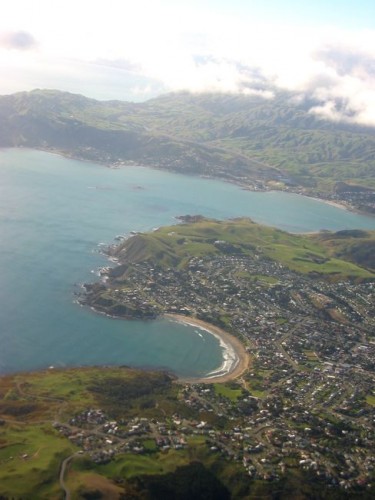
Sea meets shore at Titahi Bay, Wellington, 2003

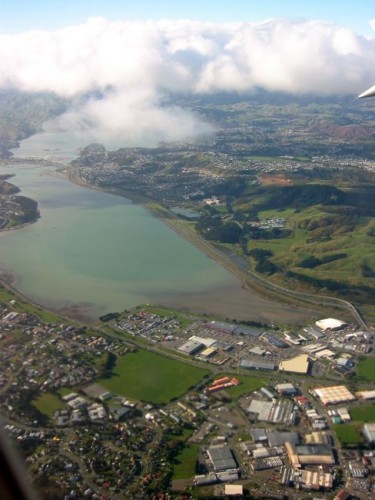
The estuary at Porirua, near Wellington, 2003

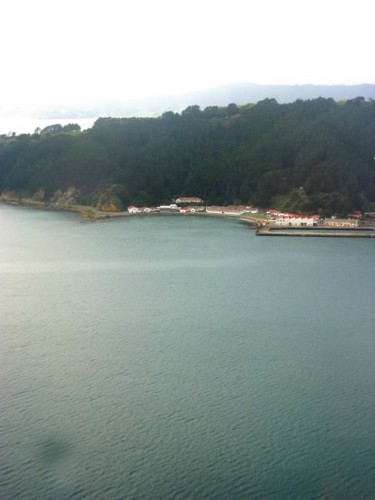
Miramar peninsula, Wellington, 2003

(Cute story about the three photos above.  They were taken as I arrived in Wellington for the very first time.  I had no idea the names of the places I was photographing.  No idea that the city would one day be my home.  No idea that I would see that last view of Miramar on an almost daily basis).

Wellington harbour with Matiu Somes Island, 2012

Miramar peninsula, 2012, with the buildings I photographed in 2003 just visible at the far left

Most of the places I am interested in visiting are also islands, or sit at the edge of the sea, with mountains rising behind them and islands scattered before them.  Iceland, Britain, Haifa, Tasmania (which did not get included in my Aussiephobia), Taiwan, Tahiti (well, that’s actually a collection of islands, but you know what I mean!), Nauru, Japan (see Tahiti), etc, etc….

I’ve also long had a fascination with the Canadian Maritime islands, sparked by L.M. Montgomery, a family link to Nova Scotia, and Great Big Sea (you totally knew I was going to bring that up, didn’t you?).  They are top of the list of islands I want to go to!

Mr D and I and the church my parents were married in, Molokai, 2004

So, the things I didn’t know:

Yesterday I discovered that Wikipedia has a list of island by area (bless you Wikipedia, your corset entry may be heresy, your corduroy entry inaccurate, but you do have some wonderful resources!).  Awesome.

I love comparing things – it helps to understand them.

What I found out from the list is that the South Island of New Zealand is the 12th largest island in the world, the North Island the 14th, and Newfoundland the 16th.

I had no idea Newfoundland was so big.  Also, it looks like a rabbit with its nose flying off in astonishment (you know those cartoons where characters eyes bug out a few inches beyond their face when they are surprised?  Yes, it’s just like that, but it’s nose is flying off.  It must have smelled something pretty amazing!).  I did know what it looks like, but only just noticed the rabbit.

See the bunny? Via Wikipedia

The other things I found out that really surprised me?  Prince Edward Island (5,620 sq km) is way smaller than the Big Island of Hawaii (10,434 sq km).  Almost half the size in fact!

I had no idea.  Somehow reading Montgomery’s books I always pictured it New Zealand island sized.  Suddenly it really makes sense that it is just a wee bitty island.  Or at least reasonably small.

Sunrise over Molokai, 2006

So that’s what I’ve learned this week.  What have you learned this week?


Friday Reads: The Prisoner of Zenda

OK, first off, I need to start this post with a confession.

I found out about the Prisoner of Zenda from a comment on this blog.  Yes, up until a few months ago I had never heard of it.  I don’t know how I (historical literature obsessed freak that I am) managed to miss it.  It’s had eight film adaptions after all, launched an entire literary genre (the Ruritanian romance) and added the term ‘Ruritanian’ to our language!

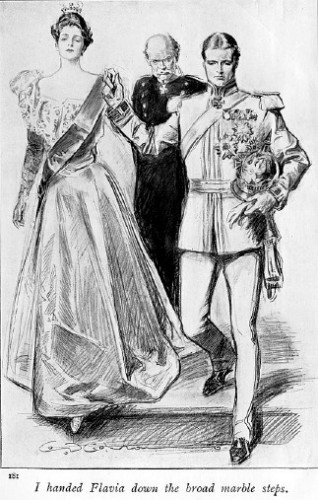
Frontispiece to the 1898 Macmillan Publishers edition, illustrated by Charles Dana Gibson. Via Wikimedia Commons

Once I realised the dreadful gap in my literary knowledge, I was determined to fix it.  No luck at the Wellington Public Library, no luck in any bookstore I popped in to in NZ.  And then, in a secondhand bookstore just down the street from ThreadDen in Melbourne – success!      And, best of all, it was the only book in the shop that wasn’t Au$20 (really, I thought that books were exorbitantly expensive in NZ, but Oz is even worse!).

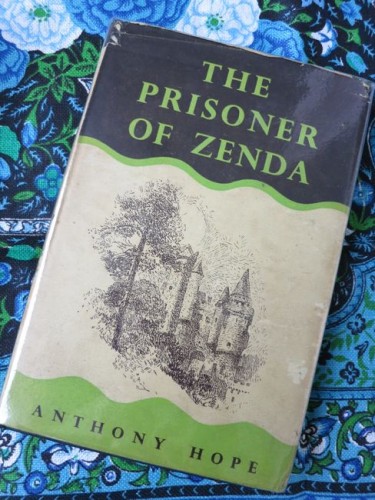
So, here is my copy of The Prisoner of Zenda, read from cover to cover on the flight back from Melbourne to Wellington (in between writing blog posts and watching The Big Bang Theory).

The Prisoner of Zenda

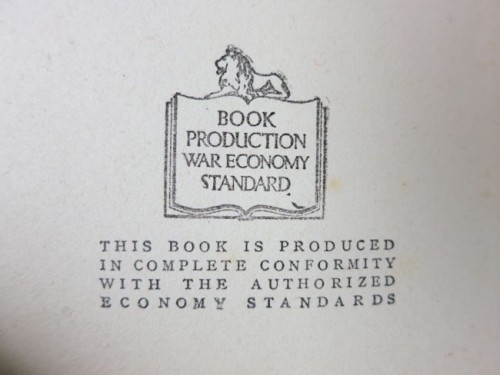
It’s a British 1945 edition, published while wartime restrictions were still in effect.

A little bit of history in my historical literature

Right.  The actual review!

The Prisoner of Zenda isn’t high literature: it’s frothy escapism, late Victorian style.  Its value today lies in its influence on late Victorian literature, and the way its popularity reflects the mores and desires of the time.

The Prisoner is a fantasy set in what might be called an alternative universe – late 19th century Europe just as it was, with the addition of one extra country: Ruritania, with its old fashioned monarchy, and a peculiar dependence on swordsmanship, though they clearly know what guns are.  To Ruritania comes one Rudolf Rassendyl, a Englishman whose appearance causes some consternation among the populace – more even than his knowledge that his looks reflect an ancestresses dalliance with a king of Ruritanian should account for.  His appearance on the eve of the coronation of a new king intertwines with kidnappings, crownings, romance, intrigue, sieges, and the inevitable swordfights.

Late Victorian it may be, but the writing feels very modern.  It’s an easy read: fast paced, lively, descriptive without being over-wrought.  The novel is set at a date roughly contemporaneous to its writing (1890s) but it might have been written in the 1940s, or the 1970s.

The plot is farfetched, laughable, fabulous, and launched a whole series of books set in fictional European countries featuring royal intrigues, mistaken identities, swashbuckling, honour, loyalty, the now-cliche  good-and-evil twins, and unrequited love.  Everything Hollywood could desire for dozens of film adaptions featuring daring swordfights and great costumes!

OK, the swashbuckling makes for great movie scenes, and fun reading, but in a way it’s the one really weak link in the book.  The Prisoner is fantasy, but imagining Victorian gentlemen as accomplished swordsmen, thirsting for blood, is just ludicrous.

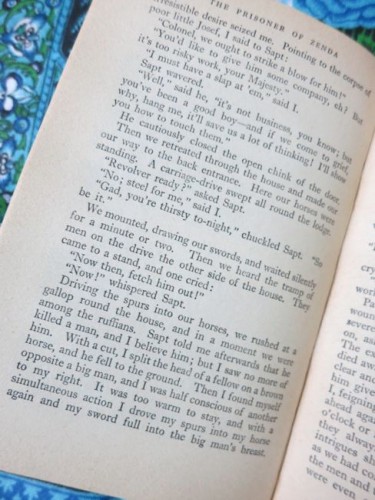
"Gad, you're thirsty to-night" Gad, I giggled!

Funny it may be in a modern sense, looking back at the end of the 19th century, its probably one of the the things that made the books so popular at the time.  It also gives the most revealing insight into the Late Victorian mindset.

Our hero is romantic, sentimental, stalwart, stoic, valiant, ruthless, not by turns, but all at the same time!  The combination of strict adherence to honour at the cost of personal happiness and macho derring-do is a (perhaps unwitting) representation of the pull between the 19th century and the 20th century, between historicism and modernism, as the turn-of-the-century hero tries to cram it all in.

Or perhaps its just a silly but entertaining novel with a charming but completely unbelievable hero.