
Botany wool, often known simply as botany (though I find the ‘wool’ part helpful in differentiating it from the general ‘flowers and trees’ type of botany) is an early name for merino wool produced in the Antipodes.
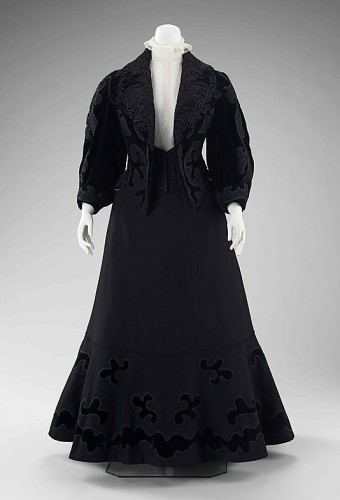
Walking Suit, J. Hartjen, ca. 1905, American, wool, silk, fur, Met
(OK, so I’m not 100% sure that suit is made of Botany wool. But it might very well be. And it’s spectacular. And there are only so many images of socks I can show you).
In the 19th century it was spun into cloth and used in outer wear, and so the term ‘botany wool’ could mean the fabric, not the raw materials. In the 20th century it has mainly been used in knit sweaters and hosiery, though as late as 1922 you could still buy ‘Botany wool’ serge.
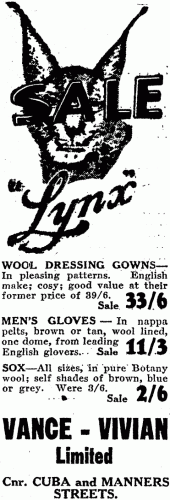
Socks of botany wool, Evening Post, 14 July 1938, Page 30
According to most dictionaries, the term arose in the 1880s, when the Australian wool industry was established enough to export in reasonable quantities. However, there are advertisements describing cloth as ‘botany’ in New Zealand at the end of the 1870s, so it may be a bit older. It was the main term used for merino wool in the Southern Hemisphere at least until WWII, after which it was gradually replaced by the term ‘merino’ (which had previously only referred to Spanish wool), though some manufacturers still describe items as being made from merino/botany wool to this day.
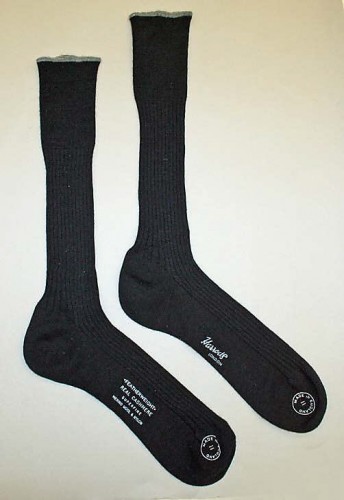
Stockings labelled ‘merino’ rather than ‘Botany wool’, Harrod’s, ca. 1960, British, merino wool, nylon, Met
Botany wool advertisements begin appearing in New Zealand newspapers (and one assumes that New Zealand would have been an obvious market) with regularity in the early 1890s.
The name comes from Botany Bay in New South Wales (so named because Captain Cook’s on-board botanist was so charmed by the plethora of flowers and trees in the area), which, like a number of locations in the Southern Hemisphere (*cough, cough, New Zealand*) produces superb merino wool. An 1886 article on the frozen mutton trade describes the origins of the term:
Good merino wool, it does not matter from whence it comes, is known as ‘Botany’ simply because the New South Wales people were the first to send Home [to England] wool of that particular description.
Sheep that produce fine, soft, merino-type wool were introduced into Australia and New Zealand at the end of the 18th century and in the first half of the 19th century, with the most notable groups being the flocks brought by the seriously awesome Eliza Furlong. At least one story claims that George III had a suit made from the first lot of Australian merino to be turned into cloth.
While the term was not indicative of where the wool came from, wool itself probably came from all over Australia (and probably, at various points, New Zealand) there actually were wool works in Botany Bay Sydney in the 19th century, and into the early 20th century. A fire destroyed the works in the 1890s, but they were rebuilt. The striking and industrial action that plagued the industrialised world in the early 20th century shut down the works on a number of occasions – in 1911, and again after WWI in 1919. The wool industry saw a slump after WWI, as prices were kept artificially high during the war, helping the industry in the short-term, but hurting it in the long-term, as the high prices encouraged people to invest in alternatives such as artificial silk (rayon).
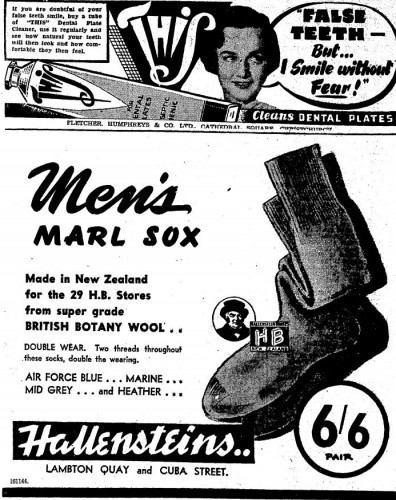
Note the emphasis on ‘British’ during WWII, Evening Post, 20 November 1944, Page 7
While wool stockings don’t sound that fun, compared to other alternatives, knit merino must have been very comfortable to wear. Have you ever worn merino wool? It’s fabulous. Lovely and scrummy and soft and warm and not at all itchy. Those of you in the Northern Hemisphere where it is hard to find don’t know what you are missing!
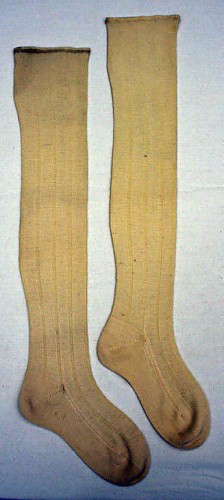
Stockings stamped ‘botany’, 1920s, American, merino wool, Met
Some Botany wool is described as “Cashmere finished”. I’m not entirely sure what this meant. Was there cashmere added? Or was it simply a brushed effect that made it feel softer? Botany wool was also blended with other fibres. In the 1890s you could buy ‘Cammelaine‘ a yarn for socks, of blended botany wool and camel hair. In the 1920s you could buy “pure botany wool llama socks” – leaving one to wonder exactly what those were made of!
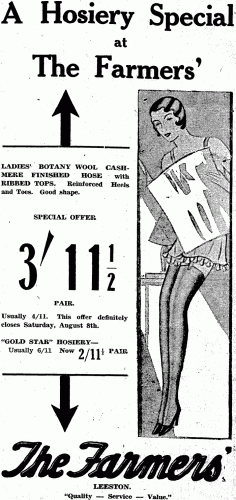
Cashmere finished hose, Ellesmere Guardian, 7 August 1931, Page 7
Botany wool appears to have been highly regarded worldwide as a high-quality, luxury fabric, but the British governments still took steps to promote it. In 1934 Queen Elizabeth (the Queen Mother) bought “a child’s jersey and skirt suit in Botany wool, decorated with Mickey Mouse pictures” at a display of British manufactured textiles. Was it just a publicity stunt (in the best possible sense) or did Princess Elizabeth or Princess Margaret have a Disney themed frock as a child? Hard to imagine!
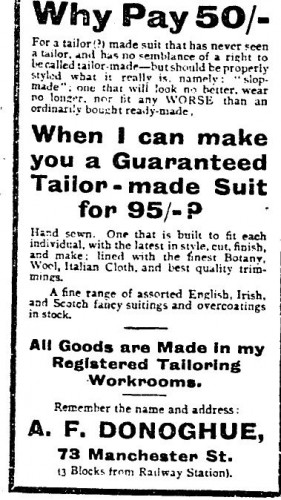
A cheap suit with good fabric – The Press, 12 March 1908, Page 5
Update: Here is a 1960s jacket of
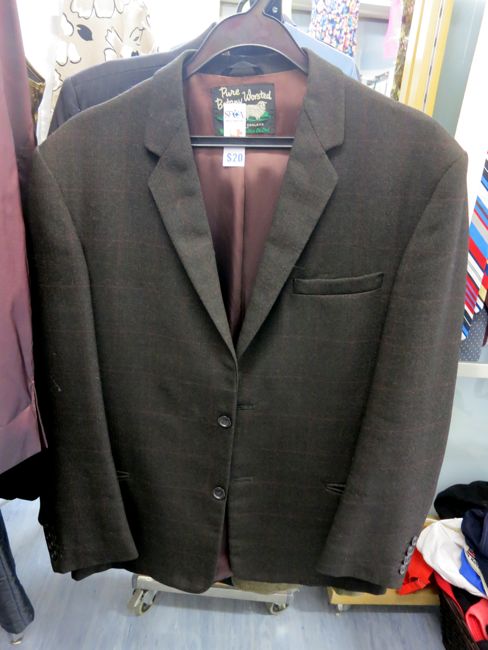
1960s jacket of botany worsted wool

The label of the 1960s jacket of botany worsted wool
Sources:
O’Hara, Georgina, The Encyclopedia of Fashion: From 1840 to the 1980s. London: Thames and Hudson Ltd. 1986
Dictionary.Com “Botany Wool”.

