The chesterfield is a man’s overcoat with simple vertical seams, no side-back piece, and a velvet collar, usually in grey with black.
The velvet collar is the defining feature of the chesterfield (as the fitted waist has since been lost) and is said to be based on the black strips that supporters of the old regime sewed on their jackets after the execution of Louis XVI in 1793. This last bit, while quite romantic and appealing, is, alas, probably apocryphal.

Coat (Chesterfield), 1929—30, American, wool, silk, Metropolitan Museum of Art
According to The Encyclopedia of Fashion, the coat was named after Phillip Dormer Stanhope, 4th Earl of Chesterfield, . This seems somewhat improbable, Stanhope died in 1773. As the first known use of the term was in the 1840s, it seems likely it refers to a 19th century Earl of Chesterfield, perhaps the 6th Earl of Chesterfield, who cut a bit of a swath in London the 1830s and 40s. There are certainly references to it as a Lord Chesterfield coat, indicating a link between the Lord and the coat.
The Chesterfield was interesting as a fashion innovation not because of its velvet collar, but because, unlike earlier coats, it did not have a waist seam, and was cut quite loosely around the body. This meant that Chesterfields were true overcoats: they could be put on over most other garments, and taken off easily when indoors.
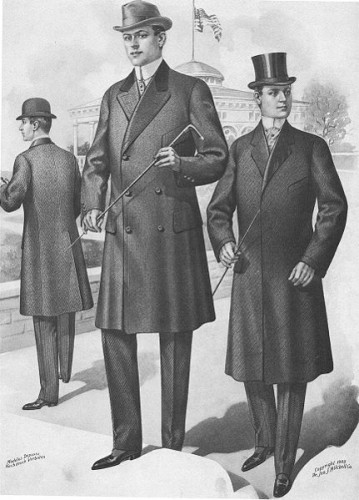
Chesterfield fashions for October 1901, via Wikipedia
Though they may only have begun as a fashion in the 1840s, they quickly became popular even in the far fashion outposts of the British Empire as Chesterfield coats were being imported into NZ as early as 1853. There is an even earlier reference to men’s ‘Chesterfield wrappers‘ in 1848, and these may be the same thing. Certainly by 1858 they were a common, and recognised, cut of coat.
The early Chesterfield coats were quite loose overcoats, such as this Chesterfield of melton that was stolen in 1880 (the account is quite amusing), but at the end of the century the style saw a revamp and became more fitted.
The revamp of the Chesterfield corresponded with a surge in popularity, and a the rise of a number of specific variants, including an 1890s caped variant, and the 1900s town-posh DB Chesterfield (with velvet collar) and the country-rustic SB Chesterfield, with cape. There were even regional variants, and evinced by this 1890 advertisement for Zealandia clothing, including a Chesterfield coat.
Thornton’s Sectional System of Cutting Gentleman’s Garments (1893), written right at the forefront of the change, describes:
The Principal Characteristics of the Chesterfield…the turns of the collar and lapels are bold in character, in keeping with the general outline of the garment, and all the details arranged in accordance with the requirements of a winter overcoat… The buttons are of horn or smoked pearl…The edges are double stitched…Sometimes the seams are strapped, a style which produces a very good effect.
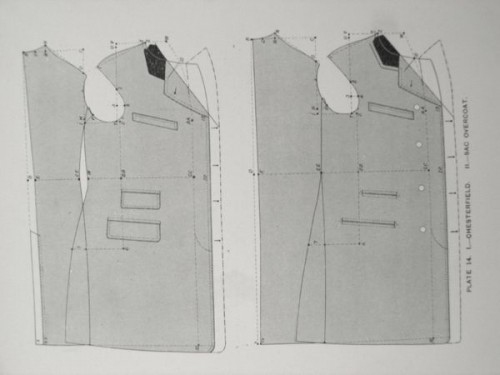
The pattern for the Chesterfield (left) in the Sectional System book
Along with the more fitted style came another variant: the double breasted Chesterfield, which has been one of the more common Chesterfield styles in the decades since.
Despite the popularity of double breasted Chesterfields, you could, and can, still get the single breasted styles. In 1912 one of the latest styles was a “Gent’s Single Breasted Chesterfield in grey tweed with velvet collar, turned back cuffs, fly front fastening, and lined with Italian cloth”
Even bigger than the double-breasted innovation was the gender leap the overcoat made. The loose coat fit perfectly with the more active outdoors lifestyle women were beginning to adopt.

Double-breasted ladies Chesterfield jacket (far left) featured in the 1907 National Cloak & Suit Company catalogue
Their introduction into women’s wordrobes, not surprisingly, also saw a huge adaptation in the coats style as they were re-structured to fit female bodies, and (let’s be honest here) the whims of women’s fashion.
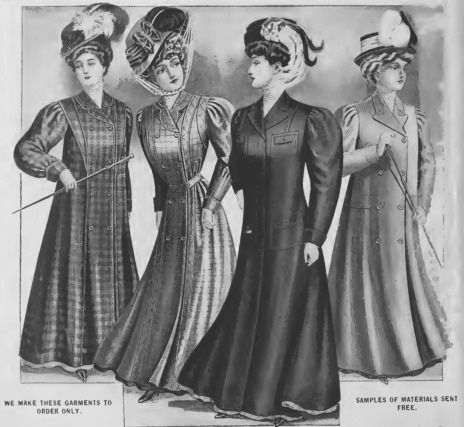
Ladies outerwear in the National Cloak and Suit Company catalogue, 1907. The two on the right would be Chesterfields if they had velvet collars.
Today Chesterfields are usually grey or black wool, but in past decades Chesterfield could come in all sort of wool fabrics. The Sectional System mentions the many suitable woolens available. Chesterfields coats are advertised in melton cloth and beaver in New Zealand in 1900, and again in 1903
Intriguingly, one 1870s advertisements in New Zealand indicate Chesterfield as a type of cloth, rather than a type of garment. This may have been a single confused seller though, as other tailors clearly indicate that they are a garment.
Chesterfields are still worn today, both by men and women, though they have yet to return to the peaks of fashion they saw in the mid-19th century, at the turn of the 20th century, or from 1920 to the 1960s.
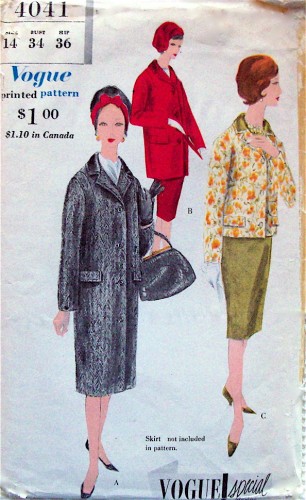
Vogue pattern for a Chesterfield coat, 1959 via the Vintage Pattern Wiki
As 20th century fashions changed drastically, the Chesterfield changed with it, and the definition of what is and isn’t a Chesterfield stretched somewhat. As the Chesterfield is most defined by its velvet collar, a jacket that is not technically a Chesterfield in the rest of its styling, but which has a black velvet half-collar, may be called a Chesterfield jacket, or be said to have a Chesterfield collar.
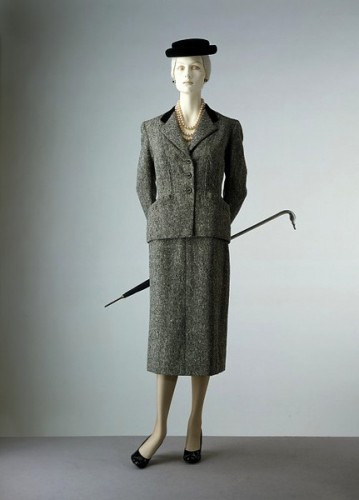
Suit with Chesterfield collar, England, ca. 1954, Morton, Digby, Tweed lined with silk velvet and half-lining of crêpe de Chine, plastic, V&A
For more interesting info on Chesterfields check out this article at the Gentleman’s Gazette.
Sources:
O’Hara, Georgina, The Encyclopedia of Fashion: From 1840 to the 1980s. London: Thames and Hudson Ltd. 1986
Merriam-Webster Online Dictionary
Rothstein, Natalie (ed) Four Hundred Years of Fashion. London: V&A Publications. 1984
Thornton, J.P. The Sectional System of Gentlemen’s Garment Cutting. 1893