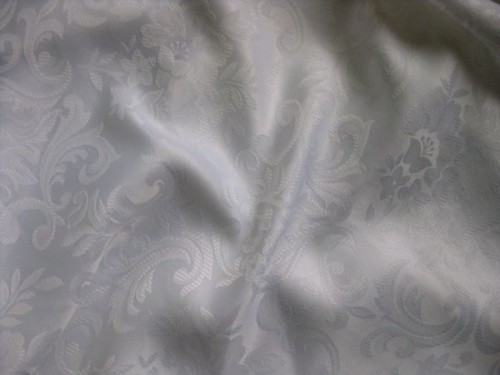
Astrakhan (also spelled astrachan) is, properly speaking, the tightly curled fleece of the fetal or newborn karakul (also spelled caracul) lamb. Less accurately, it can also refer to the fleece of fetal or newborn lambs from other species, or a knitted or woven fabric that imitates the looped surface.
Astrakhan has a distinctive tight, whorled, loopy surface with a slight sheen. The younger the lamb, the tighter and shinier the loops. True astrakhan comes in a range of colours from pale golden yellow to black, though black is the most desirable.
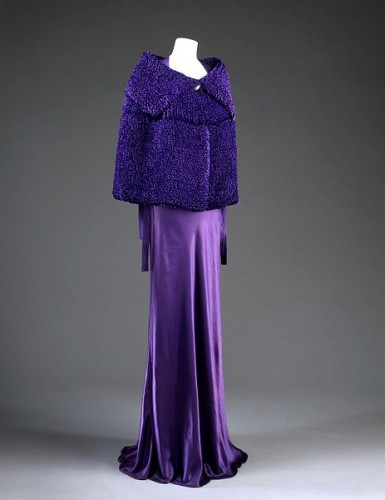
Evening Cape of silk ruched to imitate astrakhan, Lanvin, Jeanne, Winter 1935 V&A
This may be the part where you are thinking “fetal or…wait, what!?!”.
Yes, the most desirable form of astrakhan is that from a lamb 15-30 days away from being born, and it is sourced by killing both the ewe and the unborn lamb. Horrific.
There are other ways to source astrakhan: either by waiting for the lamb to be born, or by utilizing the pelts of lambs that are born dead (beware that some companies selling lamb-ewe fetal kill astrakhan describe it as ‘stillborn’ – a euphemism if I ever heard one!), or die shortly after birth in adverse weather conditions.
The last two options, stillborn lambs and ones that died within their first few days, are probably how astrakhan first became used: peasants sought to wring any value that they could from a dead animal.
It’s no surprise that there were enough lamb mortalities to start a fashion for the pelts of Karkul sheep. The sheep are from the high mountainous regions in Central Asia, an area with very severe and unpredictable weather which would easily contribute to a high lamb die-off.
Astrakhan (the Russian name) is also known as broadtail, Persian lamb, Karkul lamb, karakulcha, krimmer (another Russian term), agnello di Persia (an Italian term also used by posh fashion magazines trying to be..well…posh), breitschwanz (German, used by somewhat less posh fashion magazines), garaköli bagana (in Central Asia), slink or slinky (usually used for generic newborn lamb fleece, not that of the Karakul sheep), and finally, swakara (for ‘South West African Karakul’) if it comes from Namibia, where a population of the sheep was introduced in the early 20th century. There is no standard as to whether most of the names should be capitalized or not.
The name used for astrakhan can differentiate between how the fur is sourced (newborn vs. fetal), but there is no international standard for most of the usages, so the name is usually not a guarantee of the type of fur you are getting. The U.S. Fur Products Labeling Act (16 C.F.R. Part 301) for example, designates broadtail as specifically fetal, while a New Zealand company emphasizes that its broadtail is exclusively from natural lamb casualties.
The use of astrakhan dates back centuries in Central Asia and the Middle East, where it was used in traditional garments and gave its name to the Karkul hat.
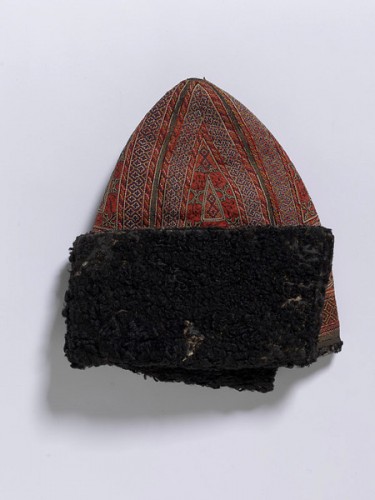
Hat, wool & silk with metal embroidery and astrakhan lining, Iran, 1820-1880, V&A
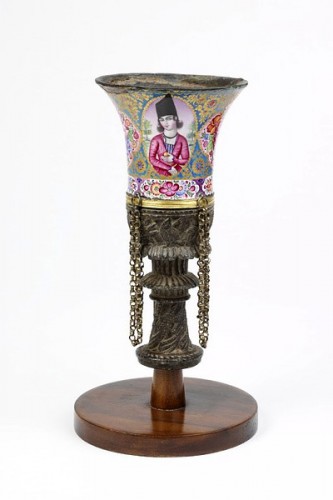
Bowl featuring a man wearing an astrakhan hat, ca. 1800-1830, Shiraz Persia (Iran), V&A
Astrakhan has always been a luxurious fur: far more pricey than most sheepskins. When the Shah of Persia was crowned in 1914 they used an astrakhan hat when the official crown was too heavy, and a few years later Warren G. Harding’s wife, the First Lady of the US, purchased an astrakhan coat for the phenomenal price of 6000 GBP (and this at the same time that the Hartnell wedding dress cost just 53GBP!)
While astrakhan fur probably made it into Western fashion at numerous points in history, the earliest uses of the term ‘astrakhan’ (or variations on the spelling) in Western fashion that I am aware of are in the 19th century. ZhoZho found a Regency fashion plate featuring ‘astracan’ fur, though if the fur featured in the plate is astrakhan, it is a very rare white variety.
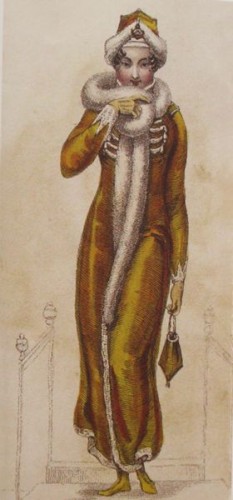
From Rudolph Ackerman’s The Repository of Arts, Literature, Fashions, Manufacturers, &c. Hand-coloured etching on paper. Vol. 5, Feb. 1, 1811, via ZhoZho
The Victorians loved Astrakhan. Its dark, heavy, glossy, ornate surface fitted perfectly with ornate aesthetic in
the late 1860s and 70s, and the heavy, fashions at the end of the 19th century.
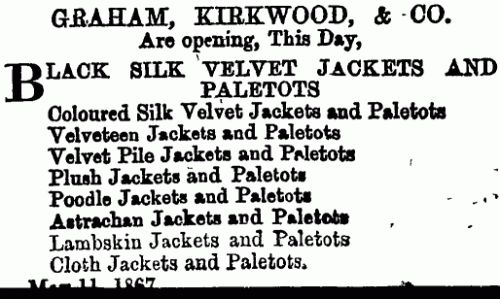
Page 7 Advertisements Column 4 Daily Southern Cross, Volume XXIII, Issue 3070, 20 May 1867, Page 7

Le Caracul (L’Astrakhan) Pierre-Louis Pierson (French, 1822—1913) 1860s, Albumen silver print from glass negative, 1975.548.154, Met
Astrakhan was popular as collars and trimming, as well as full jackets and coats (if you could afford them!) from 1890 to 1908.
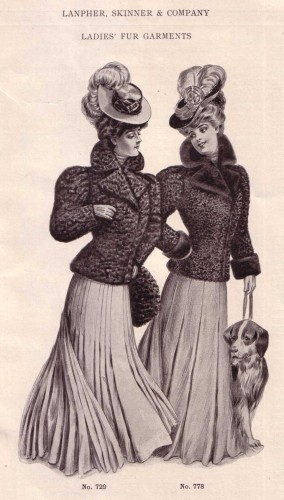
‘Lanpher Furs, North Star Brand. Lanpher, Skinner & Co., St. Paul, Minn. Season 1906-7. 72 pages, page 5, via Wikimedia Commons
Astrakhan was universally popular for the first half of the beginning of the 20th century. The Edwardians loved it, it was all the rage again in 1916-19, and, along with all forms of lamb fur, and (lets face it, pretty much all fur). It was popular again at the end of the 1920s, and then again throughout the 1930s, where it particularly appeared in hats, the new trend for sport wear, and the Russian military-inspired fashions, particularly paired with the Cossack hat.
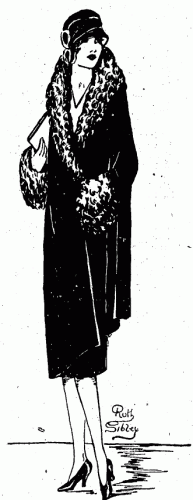
A very new caped coat in black cloth, velvet, or crepe, with shawl collar and cuffs of black astrakhan. Evening Post, 1 December 1928
Despite its 19th century popularity, it doesn’t seem that attempts were made to cultivate Karakul lambs outside of Central Asia until the early 20th century, when a flock was established in the US, and a group was brought to Argentina. Ten years later, in the 1920s, a population was established in Canada, and one in Texas, and one in Libya, which quickly became profitable. To the best of my knowledge the Libyan sheep are the only ones that are still being farmed commercially.

Astrakhan and possom fur coat, 1920s
Astrakhan has experienced resurges in popularity throughout the 2nd half of the 20th century, and has appeared on catwalks within the last few years, despite the overall decline in popularity in fur, and (obvious) arguments against it.
The ethical arguments for and against astrakhan aren’t new. A 1905 article explains how the mother and baby are both killed to source the fur, but claims that as the meat is eaten, it is not inhumane. Unfortunately it appears that today most commercial astrakhan is raised and killed almost exclusively for the fur.
Despite my acceptance of vintage fur, and the availability of ethically (natural death) sourced slink astrakhan in New Zealand, I just can’t bring myself to wear it in any form. The whole concept is too awful and inhumane. I know that it is illogical, it’s the ‘Bambi’ effect, and doesn’t ‘match’ with my other garment choices, but that doesn’t change my reaction. Sometimes people aren’t logical: that’s what makes us human.
Sources:
O’Hara, Georgina, The Encyclopedia of Fashion: From 1840 to the 1980s. London: Thames and Hudson Ltd. 1986
The Humane Society, Investigation: Karakul Sheep and Lamb Slaughter for the Fur Trade, Updated October 24 2009
And a huge thank you to all the commenters on yesterday’s post with your links to slink skin sellers in NZ!