Latest Posts

Terminology: What is a bosom friend?

To go with our 18th century ‘Rate the Dress‘, this week’s terminology post is 18th century.  Our term: bosom friend.
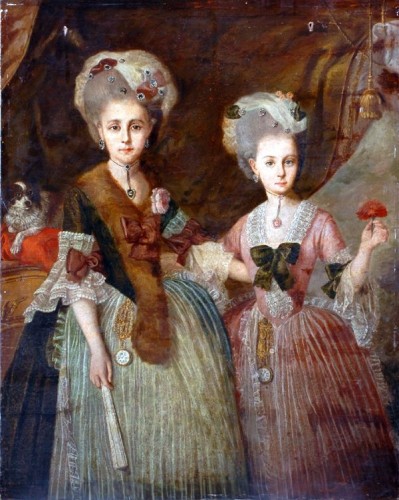
An unknown French woman in a tippet, with a bosom friend (the human kind), 1770s

A bosom friend isn’t just the 18th century word for your BFF.  It is, literally, a friend for your bosom: a shaped tippet of wool, flannel, or fur, and later a knitted scarf, which kept the chest warm and served as a bust enhancer for less well endowed women.

Bosom friends were worn from the late 18th century till the mid 19th.  They were particularly useful with the low necklines and thin muslin dresses at the turn of the century.

A 1789 entry in the Norfolk Chronicle explains the garment:

The fashionable belles have provided themselves with bosom friends for the winter.  Their province is to protect that delicate region from assault in every kind; and they may be had at all the furriers shops in town.

Once muslin became the predominant fabric, bosom friends weren’t just for winter use.  In 1802  Nancy Woodeford, a country parson’s niece from Norfolk, England, wrote of a friend coming to visit wearing ‘a fur tippet, a bosom friend and a Muff and a Winter Cloke’.  And this in July!
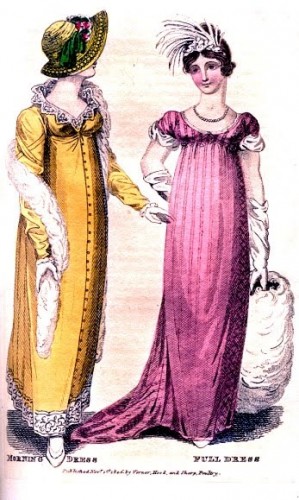
Morning and evening dress, November 1806

The fashionable belles and country matrons of Norfolk may have embraced them, but not everybody approved.  A 1796 article published in Philadelphia describes them as pads worn in the bosom as a safeguard against cold weather, and adds that they are ‘scandalous’ and ‘suspicious in appearance’.  Oh dear!  I think that must be about their double-use as bust enhancers.

Scandalous or not, ‘bosom friends’ were certainly as open to mockery as all fashions.  In 1807 a very amusing satirical poem  (page 83) was dedicated “to Mrs _____, who had presented the author with a bosom-friend constructed of fur.”

Madame Mole Raymond, Vigee Le Brun. 1787.

The last description I can find for a bosom friend comes from the 1840 Workwoman’s Guide, which gives complete instructions for a knitted bosom scarf:

Set on your pin seventy stitches, and knit in imitation knitting for about 100 rows, when knit twenty-five stitches for the next row, after which take another pin and fasten off the next twenty stitches, the knit the next twenty-five stitches on another pin.

Continue knitting the twenty-five stitches on one pin in the same stitch, fastening off one stitch at the beginning and the end of each row, next to the middle, which forms the hollowing round the neck .  When the stitches are reduced to four fasten off.

Do the same with the other pin containing twenty-five stitches, and fasten off.

Sew white ribbon to the corners to hang it round the neck.

Some persons do not hollow out bosom friends, but knit them square or oblong.

Goodness!  I bet that makes perfect sense if you actually know what you are making, but if you don’t it makes none!

I’d be tempted to call my winter scarves ‘bosom friends’ from now on, but it turns out that a modern company has co-opted the other, less warm and cuddly and more provocative, meaning.  If you take my meaning!

Unfortunately I was not able to find any images of what was definitely a bosom buddy, so I hope you enjoy my Georgian to Regency winter wear images.

Sources:

Blauvet, J, Avalanche, Anthony, and Glacier, Gregory.  Fashion’s Analysis Or The Winter In Town, Part 1: A Satirical Poem, With Notes, Illustrations, Etc. J Osborn, 1807
Buck, Anne.  Dress in Eigteenth-Cetury England.  B.T. Batsford Ltd: London. 1979
Cumming, Valerie, Cunnington, C. W, and Cunnington,P.E. The Dictionary of Fashion History. Berg Publishers, London.  2010
Schorsch, Anita.  Images of Childhood: An Illustrated Social History. Mayflower Books,  1979
The workwoman’s guide, containing instructions in cutting out and completing articles of wearing, 1840.
Unveiling unveiled: how a fashion exhibition travels around the world

A few days ago I was lucky enough to be invited to a very special media event at Te Papa in conjunction with Unveiled: 200 Years of Wedding Dresses.

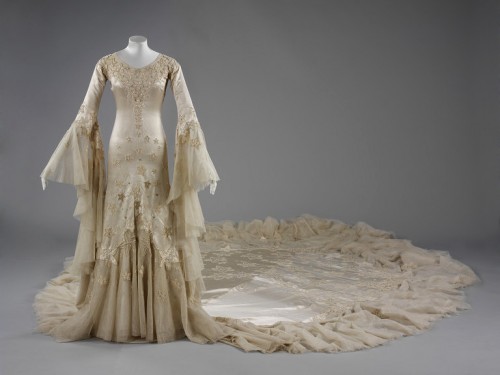
At the event we oversaw the opening of the crate containing the spectacular 1933 Norman Hartnell dress worn by Margaret Whigham, later Duchess of Argyll (yes, that Duchess of Argyll) for her first wedding.

Wedding dress, January 1933 (made) 21 February 1933 (worn), Norman Hartnell, V&A

The whole media event is part of a wider movement in the museum world to ‘de-mystify’ museums – to allow the public to see a little of what goes on to make exhibitions happen, and to display fragile objects.  It’s a movement I heartily approve of: I feel the more we know about historical objects, the more we will feel connected to them and responsible for their care.

I’ve worked in museums, and been intimately involved with the transport of objects and exhibition install, but the wonder of seeing an exquisite, fragile, quite old object travel huge distances and go on display never fails to thrill me.  Every time is a privilege, and I hope I can share some of that with you.

So how exactly do you transport an 80 year old silk charmeuse and tulle confection covered in beads with a 5.5 metre train halfway across the world?

Really, really carefully, in a custom made crate!

First the whole dress, on its purpose built mannequin, is placed on a support board that will travel with it.  The dress gets wrapped in custom-made silk habotai covers which drape over the dress without ever resting on it.   The mannequin hands and the beaded areas are supported with padding, and the train is placed in a padded ‘sandwich’ which will protect the beading and keep it from creasing.   The whole thing is then covered with tyvek, a static-free, acid-free, breathable but moisture and dust resistant museum fabric.

The train, in its supportive, protective ‘sandwich’ cover with outer tyvek layers, is then carefully lifted up and draped over two trestles, so that it doesn’t take up 5.5 metres of travelling space, but is completely supported for the transit and doesn’t fold or crease.  The V&A affectionately call the arrangement of trestles “the toast rack”!

With the dress all wrapped and padded for its journey, it is ready to go in its crate.  The support board is then picked up with a special dolly, and carefully slotted into a crate that will have been built to an exact set of dimensions.  The top of the mannequin slots into a series of blocks fastened to the top of the crate, and the bottom of the mannequin is supported by blocks on the support board, so that the whole thing can’t wobble or move in any way.

Unfortunately I didn’t get photographs at the event, but Te Papa has a flickr set of the exhibition install, including this one of the wrapped dress with the train on the ‘toast rack’.  And the Dominion Post has a few photos too.

Most museum objects are accompanied by an expert (a curator, collection manager, conservator, or museum courier, depending on the object and museum) from the museum that the object belongs to when they travel.  Their job is to make sure that the items are safe on the trip, and to help unpack and install them when they arrive.  Keira Miller from the V&A accompanied the Hartnell dress (and all the other drool-worthy wedding gowns in the exhibition), and talked us through the un-packing of the dress.

When the dresses arrived at their destination the whole packing process gets reversed, and that’s what I got to see.  The train very, very carefully lifted off the ‘toast rack’ (that’s me in the black and white), the wrappings come off one by one,  the hands get unwrapped, everything gets straightened and smoothed, the top of the mannequin goes back in, and then the fun begins.

The fun is condition reporting.

Every single inch of the dress is gone over: every single pearl bead is counted, and any changes in condition are noted.  I’m not kidding.  They literally have diagrams of the dress that note the tiniest pull, and a single missing bead, so that anything new can be documented.

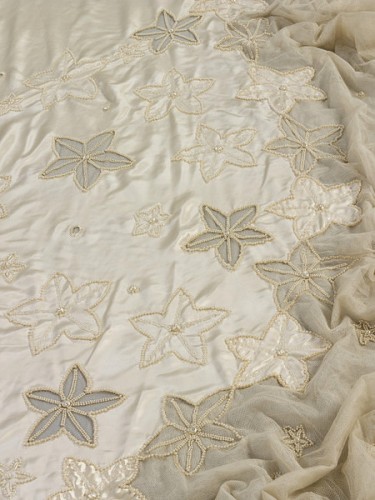
Wedding dress (detail), 1933, Norman Hartnell, V&A

The condition reporting makes me think of all the unnamed seamstresses who spent weeks labouring over the dress in 1933 for their paltry share of the 53 pounds it cost Margaret. Their actions mirror each other: heads down, focused on each minute pearl, following the inverse and reverse appliqued stars around the hem of the dress.  So much care and love from both parties.  All so that we can enjoy the dress, and enjoy their work and effort and artistry long after the wedding.

Rate the Dress: Hedvig Charlotta in mid 18th century candy stripes

Well dear readers, you have spoken on the 1860s cotton wedding dress, and the verdict is in: you LOVE it!  Well, most of you.  The ruffles were a bit much for some, and that era does come with its own cultural baggage, so the rating came in at a still very approving 8.7 out of 10.  

It would have been even higher but for the half dozen of you who were so overcome by love that you forgot to include a rating in your “LOVE, ZOMG, WANT, DROOL etc.” posts!  If you don’t give a rating I can’t really count it!

Will this week’s Rate the Dress also meet your approval and continue the winning streak?

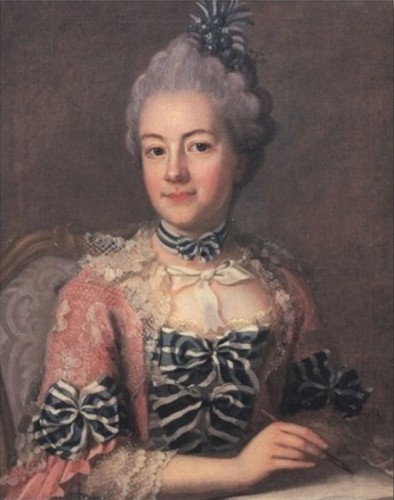
I present influential Swedish poet and feminist, Hedvig Charlotta  Nordenflycht, caught in the act of writing a poem by Swedish artist Ulrika Pasch.

Portrait of Hedvig Charlotta Nordenflycht (1718-1763) by Ulrika Pasch, ca 1750

Hedvig is very modishly attired in a pink robe with striped ribbon trimmings (do they remind you of peppermint candies?  Or licorice allsorts?  This outfit always makes me crave lollies!), lace cuffs, and a lace capelet.

Is the combination of pink and stripes and lots of bows too cutesy?  Or the perfect blend of 18th century pastels and Hedvig’s own darker personality?

Rate the Dress on a Scale of 1 to 10