Latest Posts

Shell’s dress: a winter-wear petticoat

I’m almost done telling you about Shell’s dress; I just need to parse out the last few posts so that I can show you finished wedding photos on the very first day I’m allowed to!

That day is the day of Shell’s second wedding.  As an American bride and a Kiwi groom, they are having the official wedding here in NZ first, and then a second reception in the States so that family and friends there can be part of it.

As it will be winter, and cold, for the second wedding I made Shell an extra petticoat that can be worn under the dress for another layer of warmth.

It was the perfect thing to make out of that stretch cotton that we bought with all the other wedding dress fabric  just because it was so cheap, and the perfect colour.

I cut the petticoat as a restrained version of the dress skirt: two less front panels, two less back panels, and narrower panels all round.
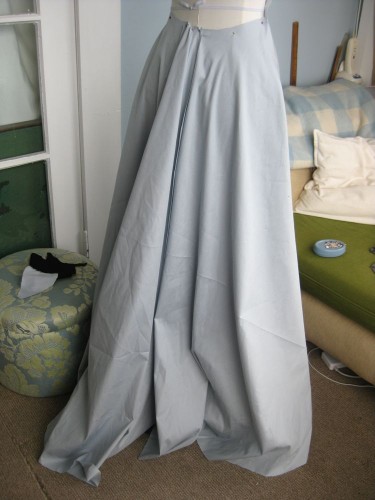
Narrow back panel, two side back panels, and a dreadfully messy room

The petticoat is still very sumptuous: I wanted it to be beautiful in its own right if she picks up her skirt.
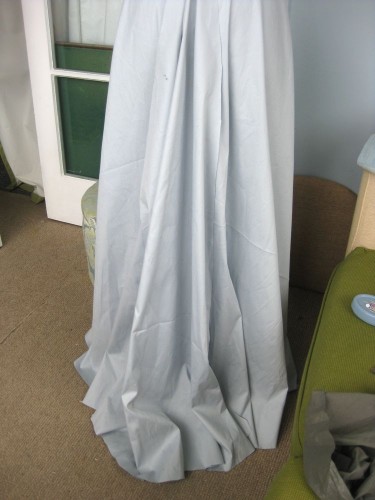
Looking down the narrow back panel

Finished, it’s so pretty it could almost be worn as a skirt on its own.
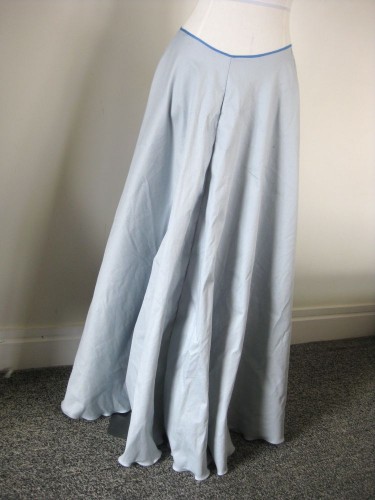
The front two panels, with a centre front seam

It looks like it trails on the ground on Isabelle, but it shouldn’t on Shell, who is fabulously tall.
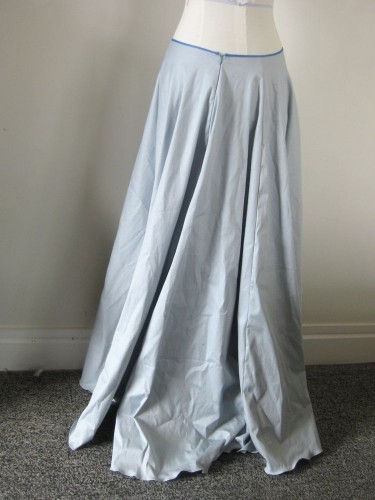
Swoosh! (and yeah, a bit of crumple)

The invisible zip sits to one side of the centre back panel, so it doesn’t interfere with the back buttons.

I rarely work with stretch fabrics, but sometimes they are so easy.  The stretch will allow this skirt to smooth over her hips without any bumps and with a minimal wasteband.
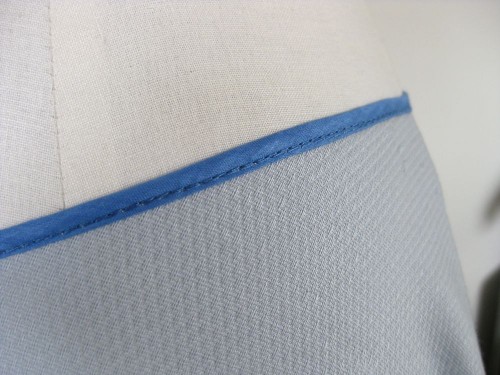
A simple bias-bound waistband. In blue of course!

The stretch also meant I could pull out Gemma, my too rarely used overlocker, and thread her with all the greys and pale blues I own to make pretty overlocked seams.
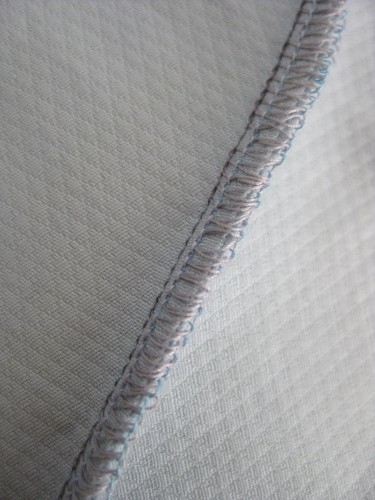
Overlocked seams - only on stretch!

Just as in the skirt, I narrow hemmed the bottom.  I’m not sure if I like the lettuce leafing quite as much on this fabric.
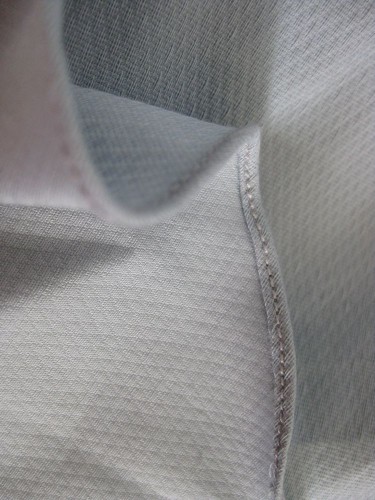
Narrow hemming

And for a final pretty touch, a blue bow at centre front, so she knows which way to put it on!
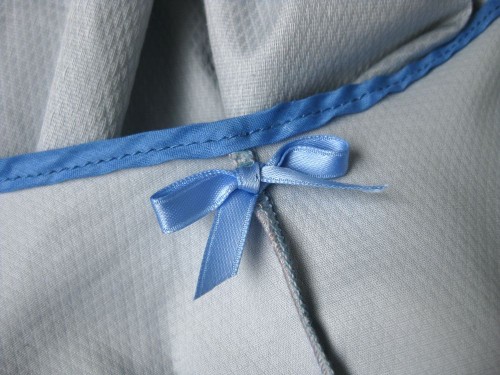
D'awwwww

Rate the Dress: Evening ensemble of 1958

Last week you did NOT appreciate our 17th century allegory and her very festive frock.  You found the colours garish, the headdress decidedly odd, and the neckline, well, just a little too festive (if you take my meaning).  Poor astrology needs to do a better job at aligning her wardrobe elements, as she came in at a pitiful  3.2 out of 10, making it the first pre-20th century outfit to rate below a 4.

This week I’m sticking with the metallic and red holiday colour scheme, but moving it up three centuries.  Are you thinking of holiday parties?  Why don’t we rate a holiday party-worthy frock?

This silver evening gown comes with its own matching red velvet  satin evening coat (good catch Sarah!), lined in the same textured silver fabric as the dress (click through twice  on the image to see a large version)

Evening ensemble, American, 1958, Designed by Arnold Scaasi, American, born in 1930, Worn by Arlene Francis, American, 1907—2001, MFA Boston

What do you think?  Just the thing to make a statement, or too matchy matchy?  And is the textured dress fabric just divine, or just a bit much?

Rate the Dress on a Scale of 1 to 10

These are the stays that never end

I’m still working on my ill-begotten silver stays.  They are not moving very fast, partly because I haven’t had a lot of free time, but mostly because they are cursed.

Every time I take them somewhere intending to work on them I find I have missed something important:  the kid leather binding, my awl for doing the lacing holes, the thread for the lacing holes, the thread for the binding, my snips, a needle, or (in the case of my Australia trip) HALF of the stays!

Here is where they stays are now:

Cover on, mostly bound, front eyelets done

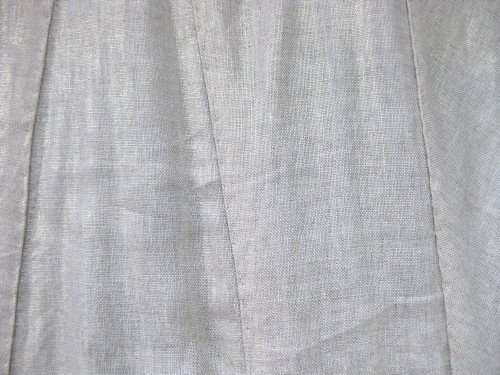
Since the last post I sewed down all of the gilded linen outer covering fabric:

Little tiny linen on linen stitches - front on the right

I also worked all of the front eyelets, binding them in blue thread for a bit of contrast, and to match the lining:

Sigh. I still can't get my eyelets perfect and even

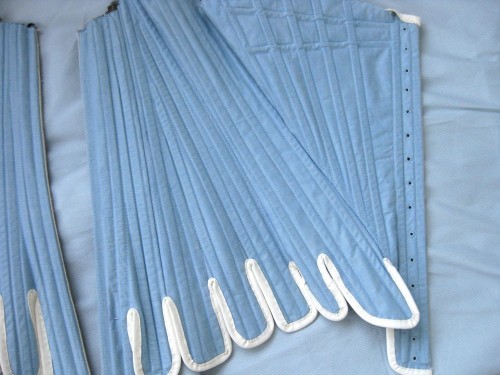
The lining is completely done, but I still need to work all of the back eyelets:

The lining

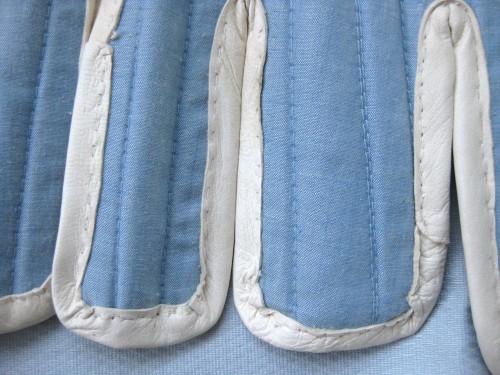
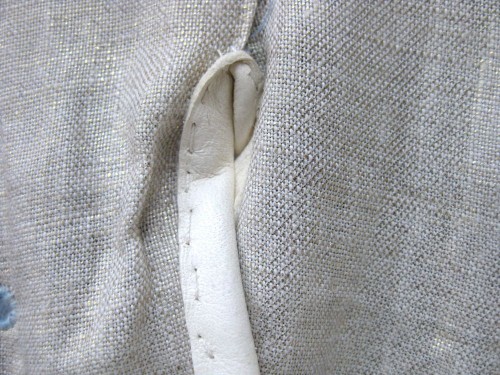
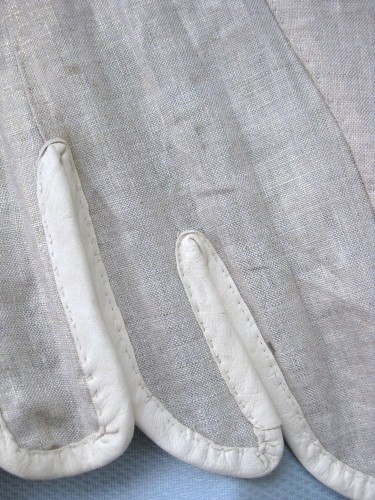
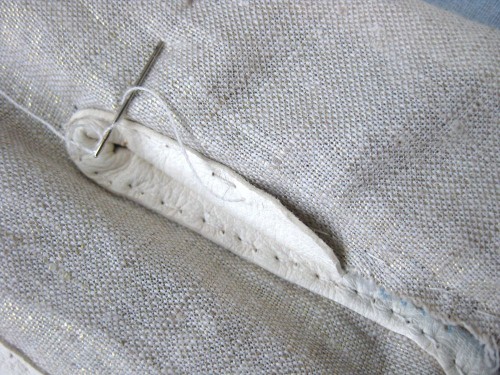
I’m binding all the edges in white kid leather cut from damaged vintage gloves:

The binding with two overlaps from one length of kid to the next

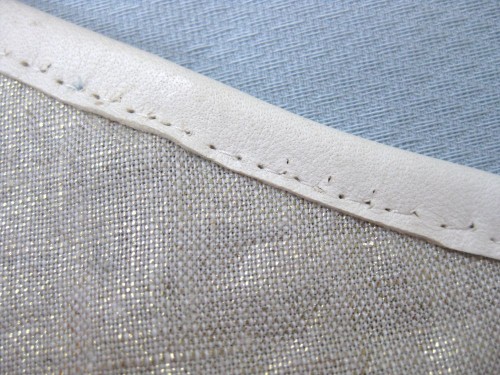
The binding isn’t completely accurate – it has both raw edges showing, and most extent examples that I am aware of have one edge folded under, and the other covered by the lining or outer fabric (usually the lining).

Raw edges and imperfect binding stitches

For all the progress, the curse continues in more ways than missed opportunities to work on the stays.  First there are the things that are horrible and irritating, but fixable, like this nasty little pucker on the bottom of one of the front tabs:

Grrrrrr....do not like!

I didn’t smooth the linen outer fabric to the edges properly, so it’s forming a pucker.  If I take off a few inches of binding, smooth it out, trim off the excess gilded linen, and then put the binding back on it will be almost perfect.  Only an hour or so of work.  Sigh.

My other problem is not so fixable.  Somehow I got a bunch of stains on the gilded linen right in one area:

Grrrrr. Really do not like!

Because the linen has been so fragile (the gilding comes off) I don’t want to try scrubbing at the stain, and the stays aren’t dry-cleanable.

So yes, not my favourit, happiest project ever!  Still, I can see the finish line in sight with them, and it will be useful to have another pair of stays.

One stitch at a time