Let’s face it: sewing with really lightweight fabrics can be hard, even for the best seamstress. And it only gets worse with fabrics like chiffon and silk charmeuse, which twist and warp as you work with them. And it get’s really tricky when you try to sew on the bias of the grain, either with a bias cut garment, or with a skirt cut with multiple A-line panels.
Shell’s dress has multiple A-line panels in the skirt, so I had to be really careful in sewing it.
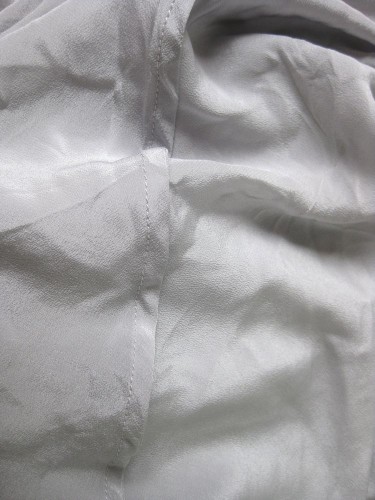
A 'rippling' bias seam = not good. Fixed with hanging.
Here are some things that I have found that make working with chiffon and lightweight silks easier, and that increase your chances of a good finish.
Cutting:
- Lay your fabric out on a surface big enough that you won’t have to move it to cut out all your pieces. Once your fabric is laid out, go away for half an hour so that the fabric completely ‘relaxes’ before you cut it.
- Lay your fabric piece over tissue paper to cut them, and cut the fabric and the tissue, as one. This helps keep your fabric from shifting and warping as you cut it, and means you will know exactly what size the piece should be.
- Use lots and lots of fabric weights to keep the fabric smooth and stable as you cut.
- Don’t double your fabric: cut each piece individually. For pattern pieces that say to cut on the fold, make a double of that pattern piece and tape it, so that you can cut the piece without folding your fabric. This helps keep the fabric underneath from warping.
- If you have them, use serrated scissors or a rotary cutter to cut your fabric. These make it easier to cut without slipping.
- Pin! Use good, fine, new pins, and pin each seam carefully, with pins at frequent intervals. Make sure you don’t stretch the fabric as you pin. Or, better yet…
- Baste. Yes, it seems time consuming, but so much less than unpicking a bunch of unsatisfactory sewing!
- Use a brand new, very fine, ‘sharp’ needle. A brand new needle ensures that it hasn’t blunted or picked up hooks that could snag on your fabric.
- Pick your thread carefully. I find that extra fine threads work best on silk. I often use a very fine rayon embroidery thread for sewing silk chiffon.
- Put a piece of masking tape over the hole in your sewing plate where the needle goes down. This will help keep your fabric from being sucked into the bobbin area. Raise and lower an old needle to punch through it before putting in your new needle (to keep the new needle from gumming up).
- Test your stitch length on scraps of your fashion fabric cut at the same angle as the seams you will be doing. Generally I find that a much smaller stitch than normal works best for me, but I know other seamstresses who swear that a longer stitch is best for keeping the fabric from stretching as you sew.
- With some fabrics, and especially with fully bias-cut garments, you may find it best to use a very tiny zig-zag stitch to sew your seams. You can then finish these seams with a double zig-zag stitch.
- Use directional sewing: sew from the hem, up to the waist. If you sew down a seam you sew into the grainline, and stretch it. If you are using French seams, be sure to use directional sewing for both seams.
- Carefully guide your fabric through the machine. Make sure not to stretch it as you sew.
- I like to use French seams on lightweight silk garments. Not only does it look pretty, but I find that it stabilizes the seams, and helps keep them from warping.
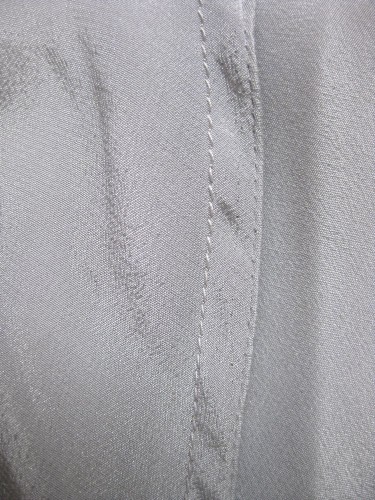
Pretty French seam with little-bitty stitches
- If your seams get stretched steam ironing can help the fabric shrink back to its original size. Just make sure your fabric is steam friendly!
- I pin bias cut garments & garments with bias seams in onto Isabelle (my dressform) and leave them hanging for 24 hours before finishing them. I find that seams that initially look warped often fall straight with a little help from gravity. Sometimes I even put bring Isabelle into the bathroom with me for showers so that the fabric gets steamed. Hanging is particularly important for hemming: otherwise your fabric can stretch a little with time, and leave you with an uneven hem.
- While your fabric is hanging you can gently grasp the fabric on either side of the seam, along the line of the grain (so one hand will be higher than the other), and ‘equalise’ the grain across the seam. This helps the diagonal grain to ‘continue’ from one side of the seam to the other, so the fabric hangs as if there is no seam. Attempt this with caution though: it can warp some fabrics!
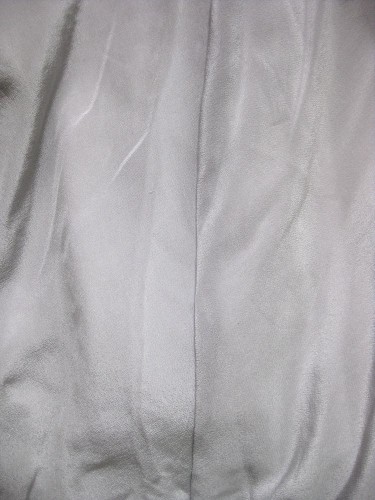
The diagonal grain continues from one side of the seam to the other
And that’s all I know! Anyone have any other brilliant tips of their own?