Latest Posts

Friday Reads: Kilmeny of the Orchard

Ok, I think I had better be right up front here.  I love L.M. Montgomery as an author.  I’m a diehard fan, I adore her books, and would own all of them if I could.

Well, almost all of them.

Kilmeny of the Orchard is the one exception.

The original cover of Kilmeny of the Orchard

It’s Montgomery’s one big flop (literary wise, not sure about financial wise).  I’m sure somewhere along the line someone, Montgomery, a publisher, someone must have noticed that it sucked.  Apparently they said “Meh, who cares, we’ll publish it anyway.”

These are the things that are wrong with Kilmeny of the Orchard: Racism, sexism, classism, disabilityism (OK, that isn’t even a real word, but you know what I mean), and my ultimate literary cliche pet peeve: the gorgeous girl who thinks she is ugly.  There is also some low level, but still totally creepy, pseudo-pedophelia.  And wanna-be incest.  And some pretty old fashioned ideas about the worth of people born outside of marriage. And…well, you get the idea.

OK, so basic plot:  Eric Marshall (the pseudo-pedophile) is rich and bored and goes off to teach in a rural community as a favour to a friend.  No girl has ever been good enough for him: they all have to live up to his memories of his dead mother.  On a walk in the woods he finally meets the perfect girl, only she is ‘tragically imperfect’ because she is dumb (mute dumb, not stupid dumb).  Oh, and she is the product of a not-actually marriage, so poor girl is also illegitimate.  So of course he tries not to fall in love with her.  He just revels in her beauty and company and childlike innocence and how untouched she is by the outside world on a daily basis.  And they both keep it secret from everyone else.  Charming.

Unfortunately, Eric’s belief that his status requires him to have someone who is perfect in every way, not just perfectly beautiful and accomplished and charmingly childlike, isn’t enough to protect him from falling in love.  Much hand wringing of the ‘I can’t marry a dumb bastard but I love her’ and the ‘I must sacrifice myself and not let him love me because I can’t speak and I’m illegitimate and also I’m a hideous freak of nature’ variety ensues.  Charming.

Also ensuing are page long descriptions of how beautiful Kilmeny is every half dozen pages apart from the minute she makes her appearance in the book.

Oh, and in the meantime Kilmeny’s adopted brother Neil is madly in love with her, and has been working to convince her that she is hideous.  But Neil would never do for Kilmeny because even though Kilmeny is dumb and illegitimate, Neil is Italian, which is so much worse.  And Kilmeny comes from good Scottish stock, so even tainted as she is, she couldn’t possibly marry the son of Italian peasants.  Charming.

SPOILERS:

And after a couple of more chapters of hand wringing, everything gets resolved.  Eric gets to marry his beautiful, childlike Kilmeny, now cured of most of her flaws.  Neil runs off having demonstrated that no matter the education and training you receive, being Italian still makes you a potential murderer.  Eric’s rich dad accepts Kilmeny because her people are better than the other people in the village, and everyone lives happily ever after.  Charming.

So yeah, not Montgomery’s better work.  One day I’d like to read Una of the Garden, the serial novel that was the first published version of Kilmeny of the Orchard, and see how they compare.

The recently re-published Una of the Garden
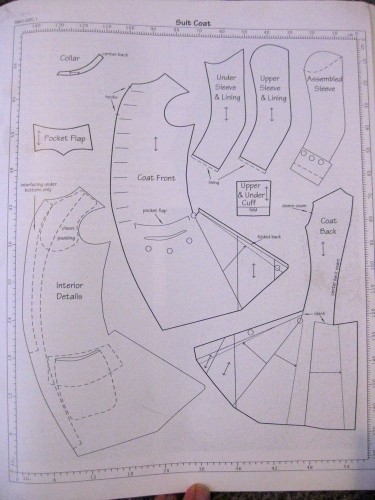
The 18th century man’s jacket: construction & fittings

I didn’t take a lot of construction photos while I made the 18th century man’s jacket, but I’ll do my best to explain how I made it.

I’m sure it is not a historically accurate technique, but it made a very sturdy garment, with no machine sewing showing on the outside.

I started with the two front chest pieces of the jacket

First,  I sewed around the front edge, bottom edge, and the edge of the first pleat of the jacket, with the outer and lining fabric right sides together.  This meant that when I turned the pieces right side out and pressed them, the front, hem, and pleat edge were all finished.

Curved front edge, bottom edge, including the slight turn, and up the first pleat edge

Then I sewed placed the back pieces with their lining fabrics, right sides together, and sewed down from the centre back pleat, along their hems, and up the side pleat.  Then I turned them right sides out, and pressed the now-finished hem.

So basically,  all the hemming on the jacket was done by bag-hemming.

With the back pieces hemmed, but still separate, I sandwiched the finished front piece between the back outer fabric and back lining fabric, with the right sides of each fabric facing each other. Then I sewed down the side seam.  This meant I could turn back the back pieces, and have a finished side seam on both sides of the jacket (outer and lining).  It was my way of approximating the sewed-down lining you find in lined 18th century garments.

With each half of my jacket assembled, I sewed the centre back seam of my outer fabric, and the shoulder seams of the outer fabric.  The neck and lining shoulder seams were still open, so this gave me enough room to maneuver the jacket around my machine to sew the centre back seam of the lining. fabric.

At this point I basted in one sleeve and did a fitting.  I found out that the back needed to be a lot narrower than my original draft, and that I needed to cut my shoulders in, and my sleevehole bigger.

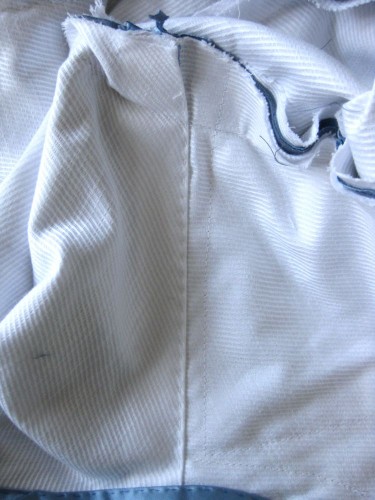
You can see the wider seam allowance where I took in the back and the side seams under the arms through the lining

I ended up taking in almost an inch of the back piece, and half an inch of the front under the arms, tapering it down to the original measurement where the pleats opened up.

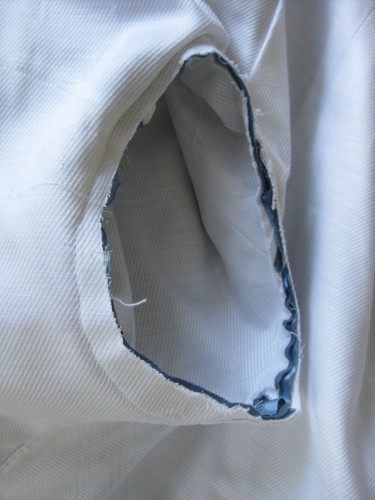
I took most of the extra fabric out of the armscythes and shoulders by cutting it out, but I left a fairly big seam allowance – just in case!

The unfinished armsycthes, with wider seam allowances at the top of the shoulders.

With the fittings all done, I could do the last bits of construction: sew down the shoulder seams of the lining (I did this by hand), and set in the sleeves.

My lovely hand-stitched shoulder seam

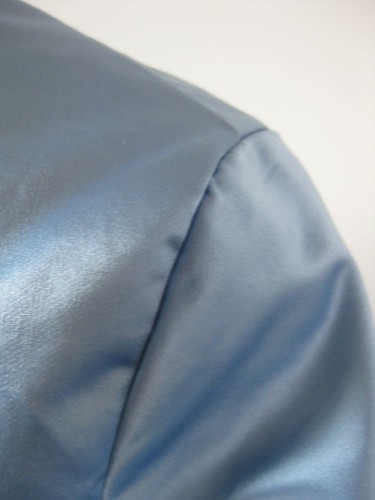
I’m really pleased out how the sleeve heads turned out.  Perfect on the first try!

Of course, they don't look so perfect on a hanger or Isabelle!

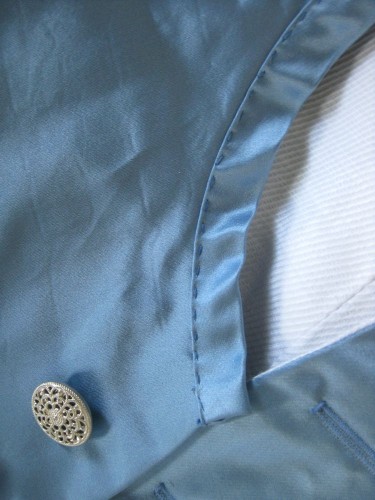
Then I hand-stitched on a binding for a collar.  I did try to do a proper standing collar, but I couldn’t get one to sit right, and I was running out of fabric (really running out of fabric.  I reduced the blue silk to pieces under 2″ long), so I settled for something that looked OK.

Hand stitched bias-bound collar

Finally it was on to finishing touches:  tacking down the pleats, false buttonholes, buttons, etc.  I’ll tell you about those in a few days!

I know this was word-heavy, picture light, but hopefully it makes sense, and (more importantly) is helpful for anyone else attempting this.


Rate the Dress: Marie Christine in lots of pink

With most of the ‘Rate the Dresses’ I’m happy to sit back.  I like hearing what you have to say: the comparisons, the opinions, the different design perspectives.  Very, very occasionally though, I feel the need to leave my own comment.  Last week’s Rate the Dress was one of those.

And because this is my blog, I get to post it up front and centre:

If  Worth Jr’s contemporaneous afternoon dress  was “small furry animal tipped the inkwell over, amused itself in the subsequent puddle, then took a stroll across the sketches for the new season” with results included in the final garments, this dress was ‘small furry animal vomited hairball on sketch, then tipped the inkwell over and rolled in the puddle, shedding copious amounts of hair in the process, and finished up by leaving hair-enriched turds on top of it all’ with results included in the finished garment.  If I could give this a -10, I would, but the lowest the rating goes is 1 out of 10.

But clearly you guys didn’t agree with me.  Many of you even liked the dress, bunny ears, chest breadsticks, raggedy hemline and all, giving it an inexplicable (at least to me) 6.5 out of 10.  Even including my vote would only take it down to a 6.2 out of 10

Since last week was far too scary for me, this week’s Rate the Dress is retreating to safer territory: the lovely, comfortable, consistently well-rated 18th century.  And a famously fashionable 18th century family too boot: Marie Christine was the daughter of Maria Teresa of Austria, and Marie Antoinette’s sister.

Based on this portrait, she shared her sister’s taste for extravagant fashion, and looks far more likely to have desired the notorious necklace of the affair of the diamond necklace.

Archduchess Maria Christina of Austria, Duchess of Teschen, circa 1765

Maria Christina sports a dress of pink silk brocade elaborately patterned in a design that echoes her lace sabot sleeves, and the lace around her neckline and down her stomacher.  Dark pink rosettes add a counterpoint to the pink of the dress, but the highlight of the outfit is the aforementioned jewels, which centre the rosettes, sparkle around her wrist and neck, in her ears and down her front, and are scattered through her hair.  You almost don’t notice the fur lined velvet throw which her nice and snuggle, or the a cluster of rosebuds and white flowers hinting at the oncoming of spring.

What do you think?  Too pink?  Too busy?  Too much jewellery?  Or were diamonds (and pearls) a girl’s best friend, especially when paired with a pink dress, well before Marilyn, back when gentlemen preferred greys?

Rate the Dress on a scale of 1 to 10