
Thank you for everything!

Mum and I in Haleakala Crater, Maui, Hawaii
Thank you for everything!
Mum and I in Haleakala Crater, Maui, Hawaii
Remember Madame Ornata’s gorgeous silk brocade pet en l’aire? No? Oh…that would be because I was a bad blogger and forgot to post about it for almost a year.
Eeek.
Sorry!
To make up for that, I’ll give you a little update on the sewing progress, and in just a few days I’ll do a whole post with the finished pet and petticoat and the most gorgeous, drool-worthy stomacher ever.
So, sewing updates!
When I last posted, Madame O and I had draped the pet, using a lovely cotton voile for the draping so that it could then be used as the lining. We’d also cut out the glorious silk brocade she picked.
After the draping, Madame O decided that the voile lining was too white, so she tea-dyed it:

Dyed cream on the left, original white on the right
It looks much better with the silk brocade too:

Mmmm...pretty striped silk!
Madame Ornata then disappeared with all her fabric, and a few days later she casually mentioned that she had ‘gotten a tiny bit of work done’, and would I check it?
Yeah, tiny bit! This is what she had done:

Completely pleated and sewn back
And this:

Completely pleated and sewn side pleats
And this:
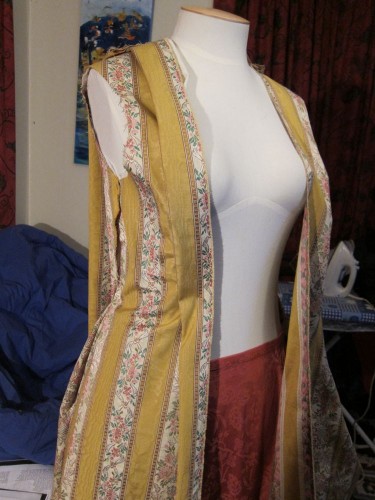
Well...OK. the front doesn't look that exciting at this point
And to get to this point in a pet (or robe a la francaise) don’t forget that you have to sew a complete bodice under-structure, with lacing all the way up the back.
Now, some people cheat and use metal eyelets for the lacing holes, because they are never seen. I don’t do that because I’m a historical stickler. Madame O doesn’t do that because she is a manic handsewer.
These are her amazing, beautiful handsewn eyelet holes:
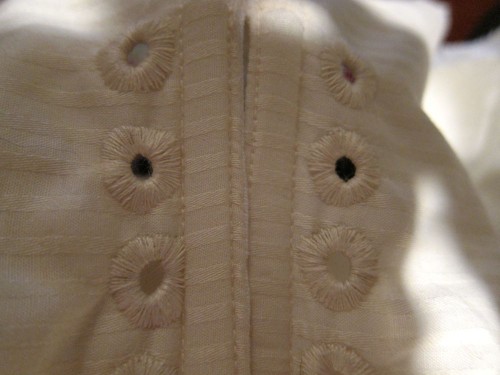
Those are never, ever going to rip out!
Look at how many lacing holes there are!
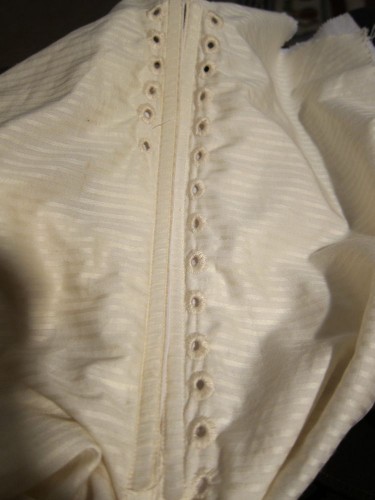
So many! So amazing!
So yeah, sometimes progress isn’t that exciting. But wait until you see the photoshoot of this made up. Wowee is it something!
Writing Friday Reviews is hard work, and sometime I run out of things to review. Besides, they can’t be that interesting for those of you who don’t live in NZ and can’t visit the stores I blog about.
So, I’m going to break things up by doing book reviews/recommendations/musings on Friday. Not the usual book reviews, but reviews of old, historical, and often quite obscure books.
This weeks book isn’t so obscure: it made a list of the 100 most beloved English books, but it is historical, and is well worth reading.
I Capture the Castle is (as I like to say in my brightest schoolmarm voice) “a bittersweet coming of age tale about a young woman discovering the joys and pitfalls of love and life.”
Please don’t hold that against it!
It’s also a beautifully detailed snapshot of English rural life in the 1930’s, and of the peculiar lines that were drawn between the classes in an age when social status was all about your family, and when even the upper class could be destitute.
Most of all, it is a book about fascinating people, so vividly described that you can imagine them rising from the pages of the novel, and become convinced that Dodie Smith must have known the Mortmains, the Cottons, and the other characters who fill the pages and whose loves and aspirations become hopelessly entangles.
You can see Cassandra, the narrator, who is “Jane Eyre with a touch of Becky Sharp”, and looks just like Romney’s ‘Girl with a Mousetrap’, except that instead of feeding the mouse to the hungry cat she would “let the mouse out of the trap and find a nice dead sardine for the cat”.
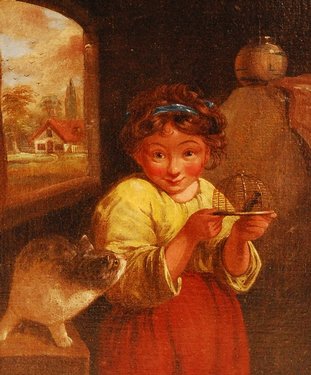
Girl with a Mousetrap by a follower of Joshua Reynolds, circa 1784
There is also her sister Rose, the frustrated beauty longing for luxury, old fashioned enough to wear a crinoline to a dinner party, and desperately calculating enough to marry for money (or is she?). Rose is a Romney, quite a bit like Lady Hamilton.

Emma Hart, later Lady Hamilton, in a straw hat by George Romney
Weaving through the story (occasionally wearing nothing more than wellington boots) are a host of other characters. Their stepmother Topaz is attempting to live up to her strikingly dramatic and unworldly looks, posing well, painting badly, and trying to hide her surprisingly practical nature, a Blake without enough flesh on her bones.
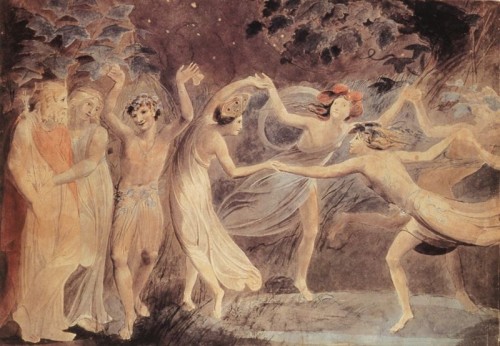
Oberon, Titania and Puck with the fairies dancing, William Blake, ca. 1785
There is also the greasy-haired photographer Leda Fitz-Cotton, a Dali “with snakes coming out of her ears” who pursues Stephen (who longs for Cassandra who loves Simon who adores Rose who really wants…)

Leda Atomica, Salvador Dali
And Stephen himself, the simple, noble farm boy in the guise of a Greek god.
Hiding in the gatehouse is father Mortmain, the failed author, grabbing at herring bones and children’s puzzles as odd inspirations.
Most of all there are the American Cottons, Simon and Neil, shaking up the entire village and the lives of the Mortmains forever.
Finally, there is the castle itself “a crumbling ruin in a sea of mud” or the romantically strange and lonely abode of a Bronte heroine, or just home.
Around the castle are set a series of scenes both fantastically preposterous (Cassandra with green hands, the escaped circus bear, Rose wishing on the devilish angel, midnight swims in the moat, and midsummer rites on the mound) and totally ordinary, so that you see both the possibilities of inventiveness, and the poignantly pragmatic details of poverty in the 1930s.