Latest Posts

If I had been a bride in 1800

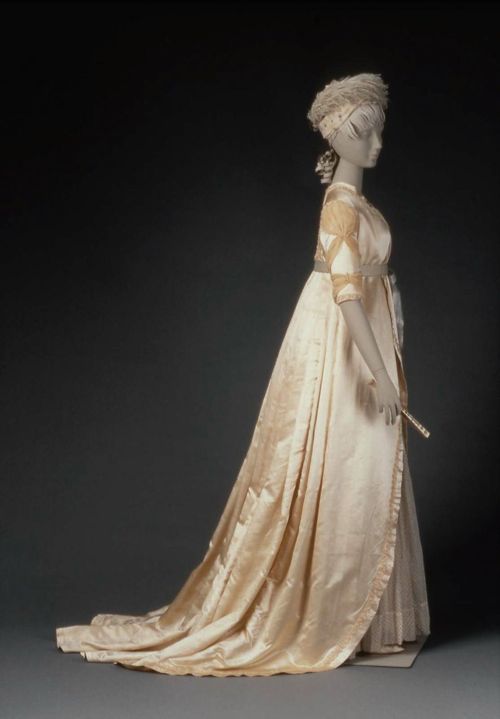
I would wear this dress:

Wedding dress, about 1799, MFA Boston

I’m not sure about the hairstyle, but the dress?  I’m so there!  The over robe, the wrapped sleeve trimmings, the pleated ruffle, and the metallic gold trimmed petticoat.  *swoon*

I guess I would prefer if it were a little more white, and a little less oyster

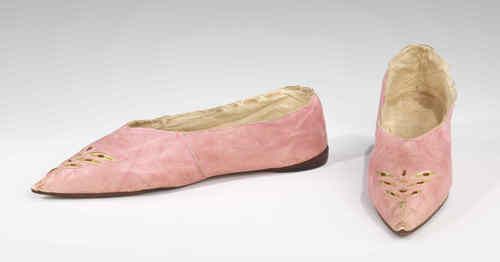
I think I’d wear it with these shoes:

Pink slippers, 1795-1810, Met

Or a pink and white version of the bridesmaids shoes (below)

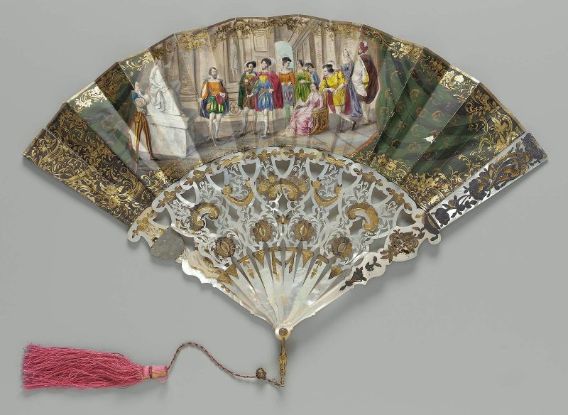
With the necessities taken care of, every well dressed bride needs a fan:

Painted fan with mother of pearl sticks, circa 1800, MFA Boston

Do you think a suitably romantic pastoral scene, something with nymphs and roses, would be too much to ask for?

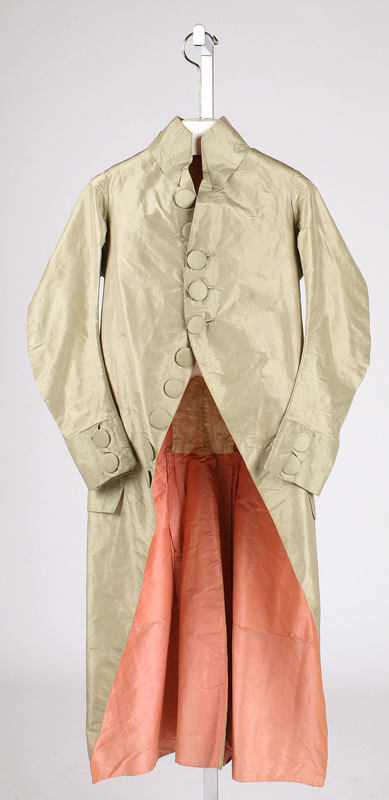
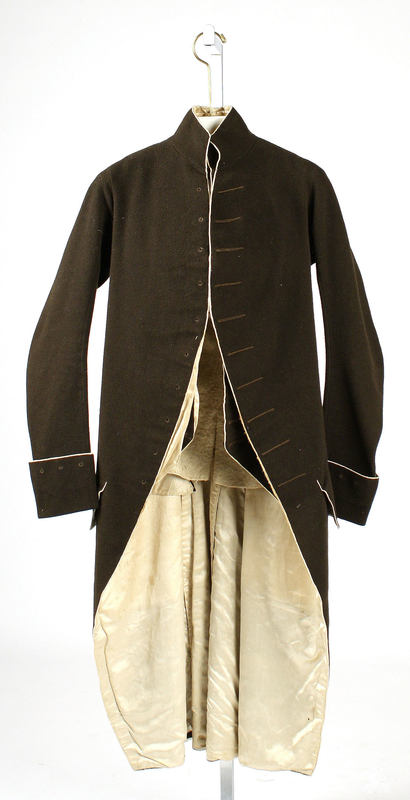
For my groom, I’m trying to decide between this coat:

Coat, 1790, French, Metropolitan Museum of Art

And this one (only in black, which may be the colour it was to begin with anyway):

Suit, late 18th c, Metropolitan Museum of Art

(in a totally imaginary wedding it’s OK that he doesn’t get a say, right? right?)

For bridesmaids, this robe, in grass green.  Divine!

Robe, 1800, Manchester galleries

If I were the evil bride, I’d make them wear these dresses.  Hehe.

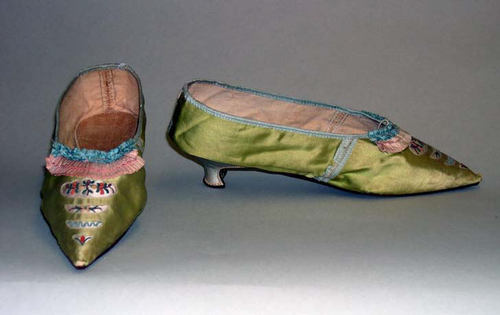
Since I’m not though, I’m even going to let them wear these shoes.  *drool*

Slippers, 1790, Metropolitan Museum of Art

And since I adore children, how’s this for an utterly darling ring bearer outfit (only in grass green)?

Child's suit, 1770-1790, Tidens Toj

And for flower girls (only with big fat trailing pink satin sashes):


Anne Isabella Milbanke, later Lady Byron, 1800, by John Hoppner

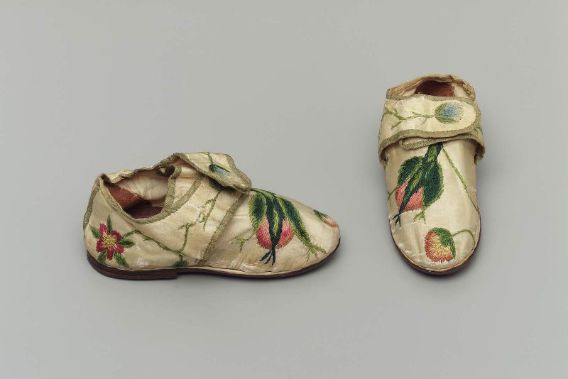
And for the littlest ones shoes:

Child's shoes, late 18th c, MFA Boston

Sound good?  Whose coming?  What would you wear as my guest?

A thoroughly calculated wedding: Napoleon III and Eugenie

One of the things that studying royal weddings teaches you (very quickly!) is that romance often had very little to do with marriage, even among those monarchs who could choose their own spouse, and who claimed to marry for romance.

The best example of this is the “romance” and marriage of Napoleon III and  Eugenie de Montijo.

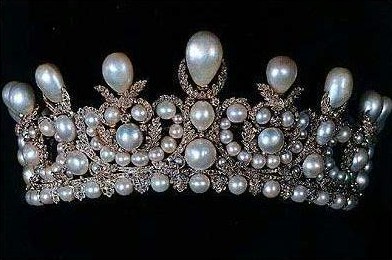
Eugenie's goal - the tiara

Napoleon III was a notorious womaniser, and  Eugenie was a notorious virgin – notorious for such because she refused to enter into affairs for reasons that were more strategically based than morally based.

Eugenie and Napoleon first met in the early 1850s when he was president of France.  The Spanish  Eugenie was in Paris on a husband-hunting tour of Europe, and  was the toast of the town for her beauty and grace.  Naturally, Napoleon was intrigued, and began to pursue  Eugenie, to no avail.   One didn’t catch a husband by becoming the mistress of the President of France.  Even once Napoleon staged a coup and became Emperor,  Eugenie was not swayed.

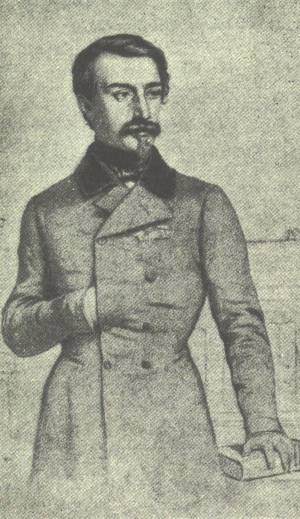
Napoleon III in 1848

By all accounts the young  Eugenie was what 1950s movies would call a ‘tease’.  She loved to behave as provocatively as possible, often straying well beyond the bounds of propriety (there are accounts of dancing on tables with her skirt drawn up to her thighs), but when it came to actual action she refused even the smallest kiss.

Throughout the early 1850s Eugenie and Napoleon played cat and mouse.  He tried to take her arm, she reminded him that her mother took precedence over her, and consigned her frustrated swain to escorting her mother on walks.    She made it clear their was no action without marriage, he sent official emissaries to call on Dona Manuela and Eugenie  to inform them that under no circumstances would he be marrying  Eugenie.  He sent her completely inappropriate gifts, the sort that men sent mistresses, not women they were courting,  she accepted them, and reciprocated with…nothing!  He invited  Eugenie to events specifically engineered to tempt or trick her into an assignation, she stubbornly remained surrounded by chaperones and other men.    At once house party Napoleon is reputed to have asked  Eugenie the way to her room (some versions say ‘heart’), to which she coyly replied “through the chapel Sire.”

Saucy minx!

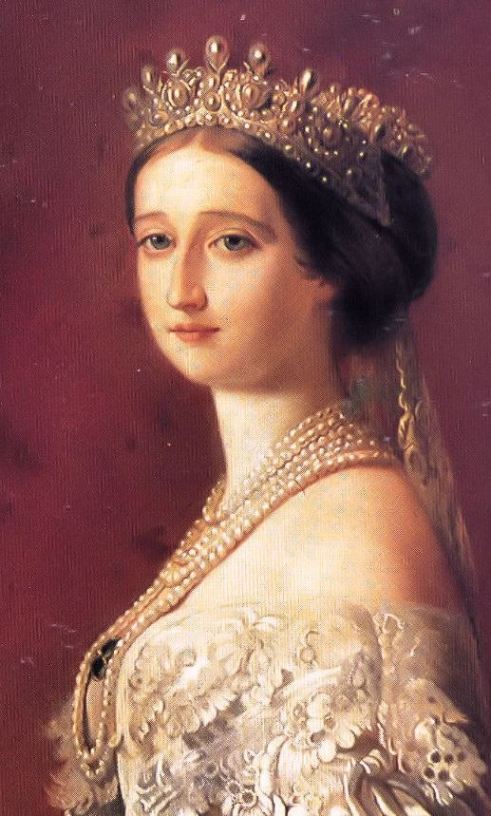
Empress Eugenie wearing her pearl and diamond wedding tiara

All this would have been unremarkable, the height of propriety even, if  Eugenie had not made it clear to Napoleon that she wasn’t interested in him and only wanted him for his status and his family lineage.  And he didn’t care.

In 1852 both parties reached an impasse, and Napoleon turned his attentions from wooing  Eugenie to courting a ‘suitable’ princess.

First he offered marriage to Carola, Princess Vasa, but her father opposed the marriage, and 20 years later, when Napoleon’s dynasty failed he triumphantly stated “I foresaw that correctly!”

Immediately upon receiving Carola’s rejection he proposed (via a letter) to the 16 year old  Princess Adelheid of Hohenlohe-Langenburg, Queen Victoria’s niece, whom he had never met.  Adelheid was thrilled, Queen Victoria was scandalised (Napoleon III’s position being too shaky, and his lineage too murky for one of Victoria’s relatives), and  Adelheid’s parents sided with their influential English relatives and turned Napoleon down flat.

Thank goodness, because the impulsive Napoleon had already succumbed and proposed to Eugenie without waiting for Adelheid’s response!  He narrowly avoided having two fiancees and sparking a major international incident!

With disaster averted, Napoleon announced the engagement on 22 Jan 1853, saying:

“I have preferred a woman whom I love and respect to a woman unknown to me, with whom an alliance would have had advantages mixed with sacrifices”

The French elite expressed envy disguised as scandalised propriety and snobbery at the match –  Eugenie was a  mere  countess marrying an emperor. But at least it was for love, how romantic, how French.

The rest of Europe expressed undisguised amusement, both at the elitism, and the claims of romance.  Eugenie was, after all, descended from a long line of nobility – Napoleon III was only three generations from an unknown Corsican family, even if he wasn’t illegitimate.  And no one believed the claims of love – everyone knew she was marrying him for his position, and he was marrying her because he couldn’t have her any other way.

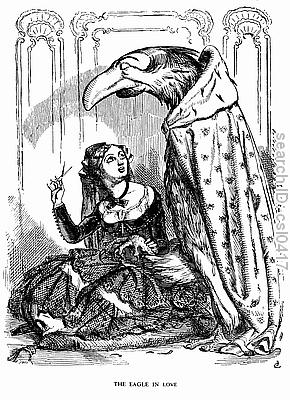
A cartoon depicting Eugenie trimming Napoleon III's claws

Having finally put temptation above international alliances, Napoleon wasn’t going to let little things like propriety, political stability, and good sense stop him from marrying  Eugenie as soon as possible.

Yeah, so they were married less than two weeks after getting engaged, on the 30th of January.

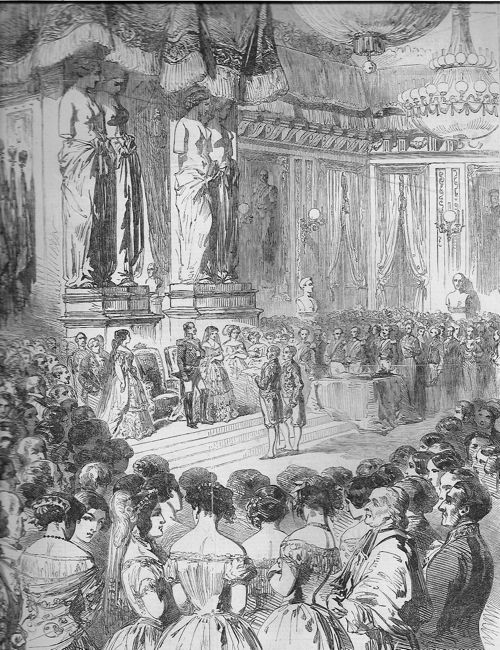
The wedding of Eugenie de Montija and Napoleon III

Romance isn’t everything though,  despite all the odds, and in contrast to romantic marriages (like that of Elizabeth of Austria and Franz Joseph), the marriage was actually a success.

And Eugenie wore a fab wedding ensemble 😉

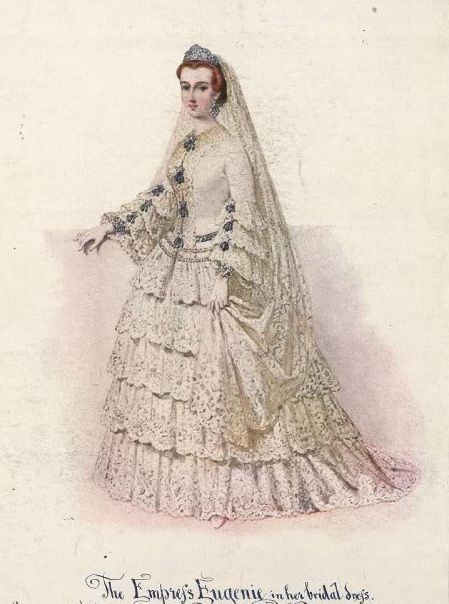
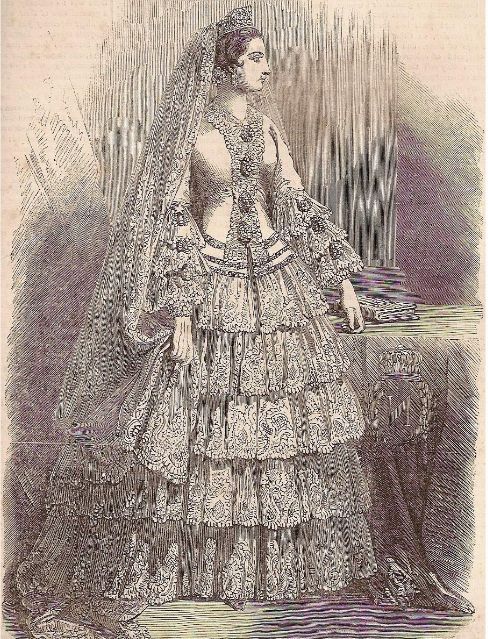
Eugenie's wedding gown

And notice that it is white, an idea she borrowed from Victoria to add a regal and proper touch to the wedding.

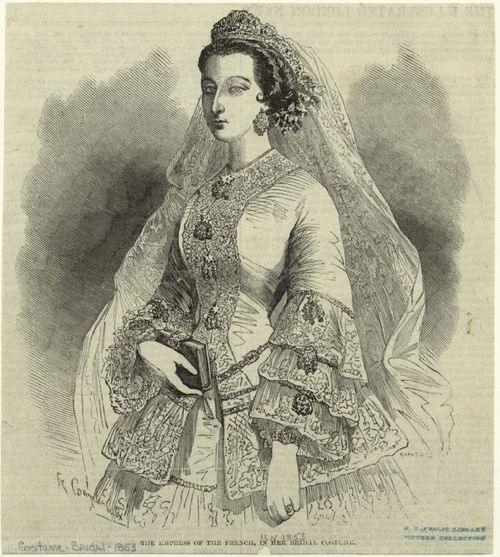
Eugenie's wedding bodice

Empress Eugenie in her wedding attire

The 18th century wedding dress: then, and now

The 18th century was the dawn of the modern wedding dress: it saw the first emergence of white dresses as a trend, the first dresses specifically for weddings, and it is the oldest century from which we have a reasonably large selection of extent dresses.

The 18th century is also a very popular era among this blog readers, and is a stunning, and unusual (at least at the moment) era to draw dress inspiration from.

So let’s look at some 18th century wedding gowns, and some more recent 18th century inspired wedding gowns.

First, a complete ensemble with excellent provenance, from the Boston Museum of Fine Arts.  No, it’s not white.  And most modern brides aren’t into bonnets, but it still has so many elements I would instantly steal as a wedding dress designer.  That fabulous quilted petticoat…  The pinked fabric framing the face and bust…  The beautiful sleeve ruffles… Or you could just wear the dress exactly as it is, as it’s already a thing of beauty.
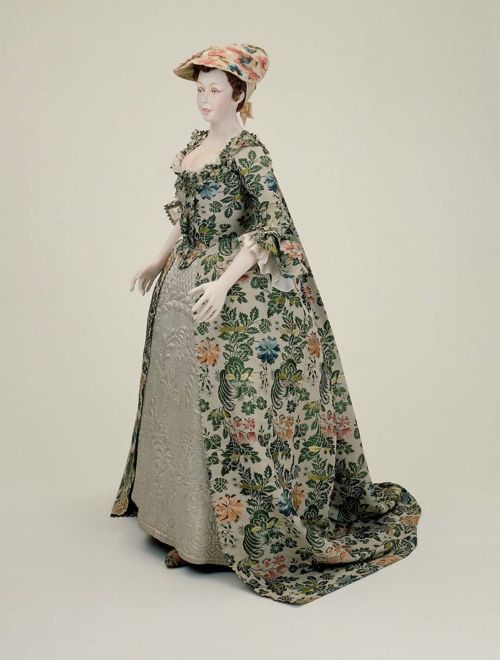
Wedding dress, 1742, Boston Museum of Fine Arts

Next, another coloured wedding dress.  The shape of this one isn’t quite so elegant, and the reproduction petticoat and front aren’t helping, but it’s still a charming design.  You can imagine  a woman wearing this to her wedding, and to many a gala afterwards.  Also, I want that fabric.  And a bride who wants a patterned floral dress.  Patterns are way too under-used in modern wedding dresses!
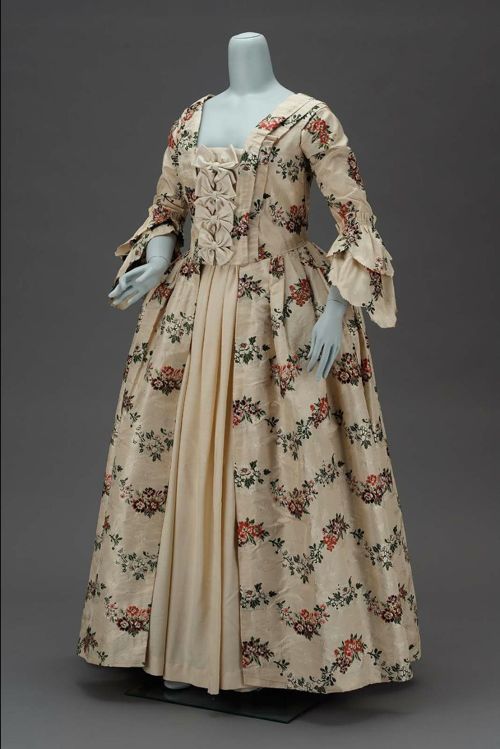
Wedding dress, 18th century, American, Museum of Fine Arts Boston

Now, how about a white dress?  The provenance of this stunning ivory frock as a wedding dress is not certain, as it is based on family history, but it’s certainly not hard to imagine a bride trailing down the aisle in it, feeling like the most beautiful women in the world.  Of course, I have to like this dress – I used it as a reference for Lady Anne Darcy’s wedding dress – my recreation of a 1780s wedding dress!

Robe a la francaise, probably a wedding gown, 1775-1780, V&A

Those poofs around the neckline, the puffs on the skirt, the hanging tassles…oh…it’s all so beautiful!

It’s not white, but we do have another example of a single coloured wedding dress, and I love it  It’s so elegant and simple, and that fabric is totally drool worthy!
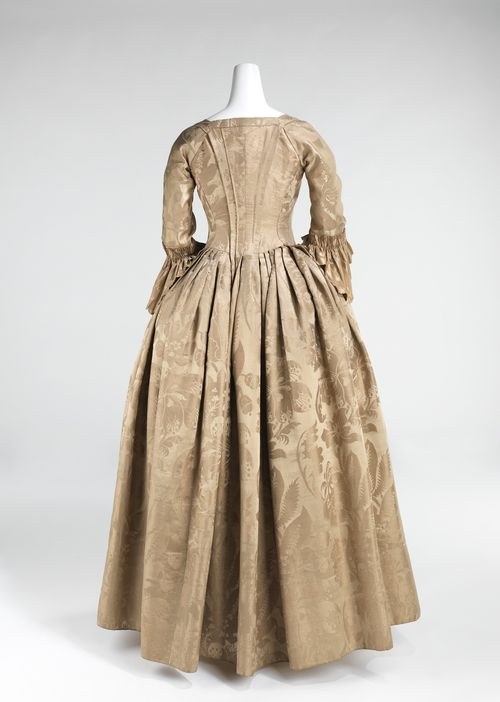
Wedding dress, 1776, American, Metropolitan Museum of Art


Moving on, this isn’t an actual wedding dress, but the doll’s outfit was made by the bride using scraps from her actual dress, so probably represents a reasonable copy.  Alas, the image does not show us the colour of the dress, but we can deduce that it was a light fabric.

Doll in a wedding suit, Mrs Powell, 1761, Collection of the V&A

Once again we see the most common elements of 18th century wedding dresses: the open skirts, the delicately patterned fabrics, the sleeve ruffles.

With a pattern established, how has the 18th century influenced later wedding dresses?

A particularly gorgeous example is this wedding gown from the early 1880s, which combines 18th century inspiration with Victorian taste with masterful flair.  It’s definitely a case of the best of both worlds!
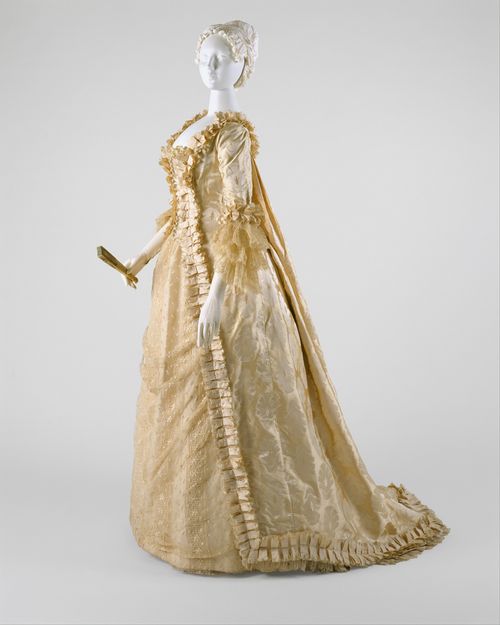
Wedding dress early 1880s Met

Borrowing elements from the 18th century must have been a popular trend in 1880s wedding dresses, as evinced by these two examples
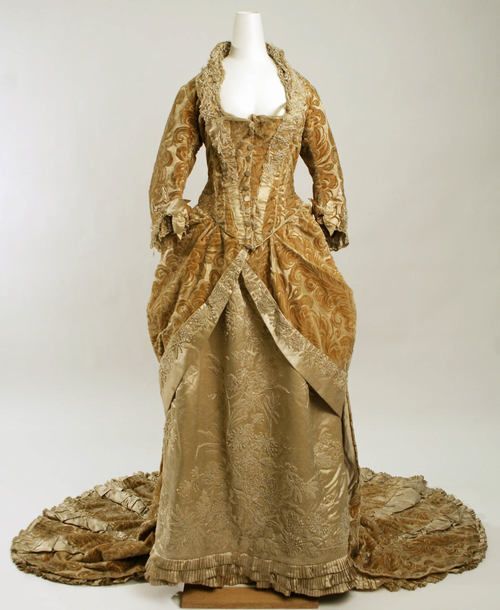
Wedding dress, 1881, American, Metropolitan Museum of Art
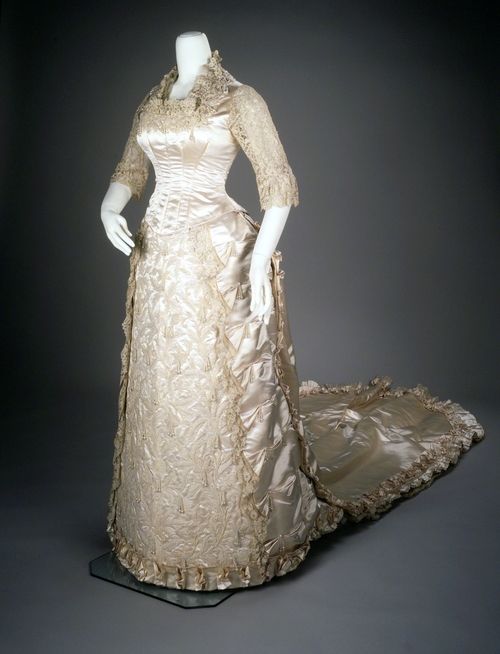
Wedding dress, 1881, American, Metropolitan Museum of Art

I don’t like the first one so much, though the very early 18th century inspiration is intriguing – it looks more like a manuta than a robe.  Isn’t the second one fabulous though?  The colours, the tassles, the lace sleeves, the collar, the smooth bodice…I love them all!  It really reminds me of the white V&A 1775-1780s dress.  If I had been married in 1880, this would have been my dress, hands down!

The 18th century stayed a popular inspiration period for the next decade, even inspiring one royal wedding dress:
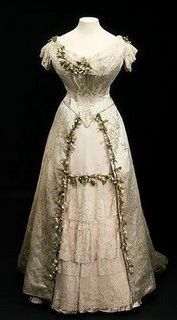
Mary of Teck's wedding gown, 1893

The inspiration is slight, but the open skirt, pointed bodice, and luxurious tone on tone fabric all evoke the styles of a century and a quarter before.

Moving into the 20th century, what about this 1963 wedding dress, from Victor Stiebel’s final collection?  In some ways, it is stark and modern, completely unlike the 18th century.  The influences are still obvious though: the pleated watteau back, the 3/4 length sleeves, the pleating on the skirt, and finally, the faint patterning of the moire fabric all evoke the Georgians.
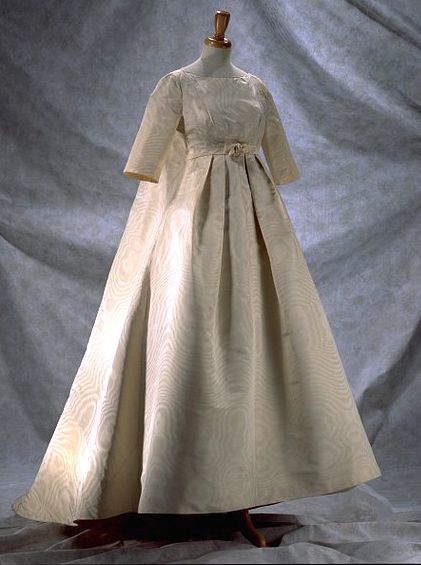
Wedding dress, 1963, Victor Stiebel, V&A

And what about today?  Where to look if you want an 18th century inspired wedding gown?  Well, there isn’t a lot out there!  You can go with designers who do beautiful but literal and slightly costume-y reinterpretations, or you can get a dressmaker to custom make you something.  Alas, you aren’t going to get Watteau pleats, 3/4 sleeves, flat stomacher fronts, or pinked trim in the collections of mainstream wedding dress designers, and even classic looks such as open front skirts are few and far between.  I guess it just isn’t the trend right now.  I guess we’ll have to change that!