Hana-Marmota asked to see 1840s corsets (or stays, as they were still called by all but the most genteel), so here are some I have found. It’s not quite the hundreds I mentioned, but that would make for a very long post!
1840s corsets/stays (see this post for more information on the history of the terms and what to call what when) are probably relatively hard to find in museum collections because the 1840s was a period of transition in styles in corsets. Many corsets that were made or worn in the 1840s are probably identified as earlier, if they follow earlier fashions and techniques, or slightly later, if they use just-introduced cuts and materials.
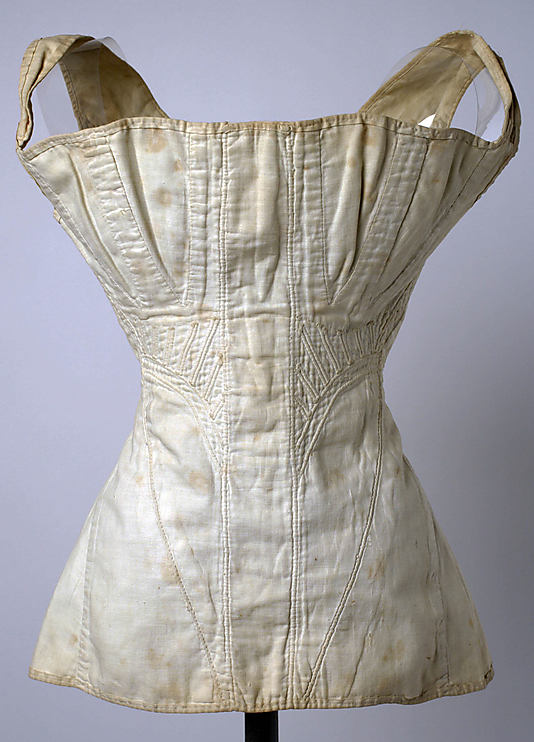
The style of corsets that would have been on its way out in the 1840s is based on the so-called ‘longline’ corsets of the 1810s and 20s, with a solid front busk, bust gussets, hip gussets or princess seams (well, what we would come to call princess seams) and shoulder straps. The waist suppression for these corsets is fairly minimal, and creates a longer waist. Like their earlier counterparts, these corset rely almost entirely on the busk and cording for support, and have minimal, if any, boning:
They differentiate from the earlier longline corsets of the 1810s/20s in their shaping. The hip gussets are wider, and 1840s corsets have far more emphasis on the waist, and on the bust/waist/hip differential. The classic hourglass shape that would characterise the ideal body shape of the later half of the 19th century is beginning to appear, and the bust-on-a-stick silhouette of Regency fashions is being left behind.
The majority of these style of corsets are made of cotton (primarily white or natural coloured), with cording of various materials, and wooden front busks. Most examples lace up the back with hand-worked lacing holes, though metal grommets, invented in the 1820s, are seen on some examples. Most lace with spiral lacing, but a few examples show even lacing holes, indicating that criss-cross lacing would be used:

Corset, 1830-40, Museum of Fine Arts, Boston
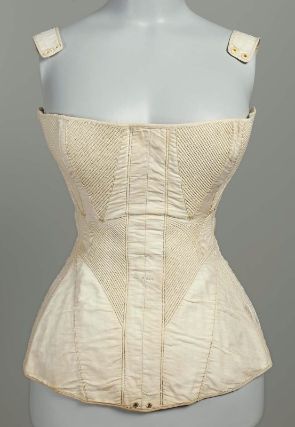
Wedding corset, 1839, MFA Boston
The newer, fashion forward and innovative style of corset puts more emphasis on the curved, hourglass figure, with a shorter, nipped in waist, rounder hip gussets, and more shaping achieved through boning, rather than cording. The divided front busk has yet to appear. One of the biggest innovations, beyond the pattern, is the appearance of corsets made in silks and trimmed with lace. This coinciding with the more decorative aspect of undergarments as a whole, as the middle classes grow and the textile revolution makes machine lace and other luxury fabrics to become cheaper and more readily available.
In addition to the two main styles of 1840s corsets, there are a few extent pieces that are sartorial novelties, such as this example, with lacing over the bust:
I would place this on the later end of the Met’s dating spectrum – more 1840s/50s than 1810s, though of course it is impossible to tell without being able to examine it in person. It is a fascinating piece. Is it a nursing corset? If not, what is it?
There are also a few examples of some interesting waist wraps. This first one is most intriguing, as it looks quite professional in its make. Is it a child or mans corset? One for an invalid?
And what about this odd, rather roughly made waist cincher? From the front, it makes perfect sense, but the back view shows that the strap tapers to a very narrow ribbon: Not very helpful for supporting the weight of a skirt!
For more images of 1840s corsets and undergarments, check out my pinterest pages, which are (rather unhelpfully for the purpose of this post) divided into 1820s-40s undergarments, and 1840s-60s undergarments.