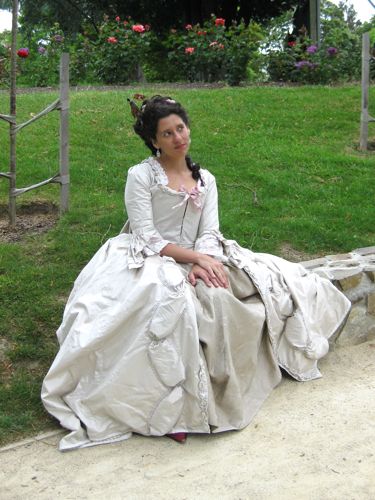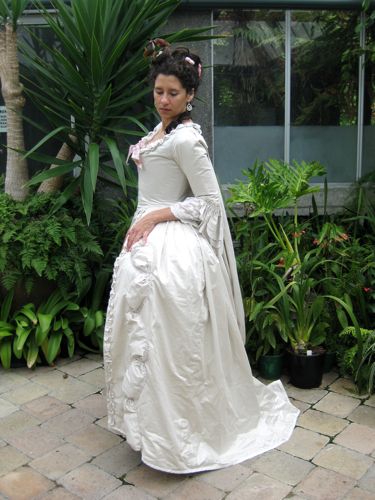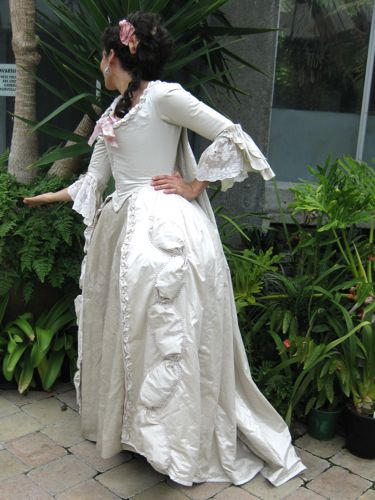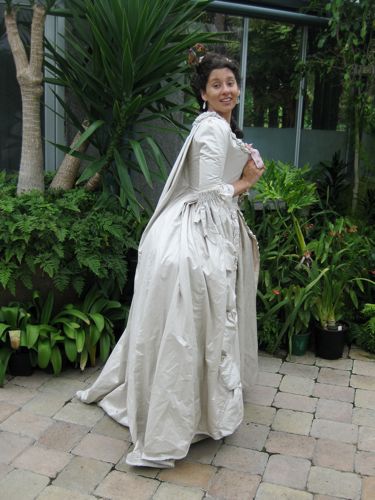
While making the Juno dress, I had a bit of a conundrum with the bodice and train.
There was no way to make my original bodice look just like the inspiration bodice.
So, making a virtue of necessity, I had the idea that I could make a second bodice that fit me perfectly, and looked just like the inspiration bodice. Then I could add additional hooks to make the skirt waist smaller, and the Juno dress would fit a wider variety of models.
But then I encountered a problem. I’ve been studying similar late 1880s gowns for a while, and wondering if the trains actually attached to the bodices rather than the skirts.

Evening Dress, House of Worth, ca. 1890, back view, 2009.300.635, Metropolitan Museum of Art
Doesn’t the train look as if it might extend from the bodice rather than being part of the skirt?
The theory is sound: it would be much more comfortable to have the weight of the skirt coming from the bodice and hanging off the shoulders rather than hanging from the waist. Additionally, attaching the train to the bodice opens up the possibility of making a second bodice for balls, as trains are a pain to dance in.
Theory, however, needs to be backed up with actual examples of the practice.
So I did some research, and with help from lots of friends, I found these mentions, all from Cecil Willet Cunnington’s English Women’s Clothing in the 19th Century. The emphasis in each quote is mine.
For 1886
Evening gowns: These are frequently without trains, except for mature matrons when the train is fastened round the hips instead of to the back…there is a tendency to use the low bodices for dinner dress. For ball dresses the curiasse bodice…
For 1887
The full evening dress is trained, the train being plain and often gathered to the back of the bodice.
For 1889
Many dresses are made en princesse with ‘V’ backs, laced, the skirts being open in front over an underskirt… The skirt is trained only for full evening dress…
These quotes, while difficult to interpret precisely, seem to imply that the train is usually fastened to the back of the bodice, and that trains were not always used: evidence for fastening my train to the bodice.
I also found this image (from EWCit19C):
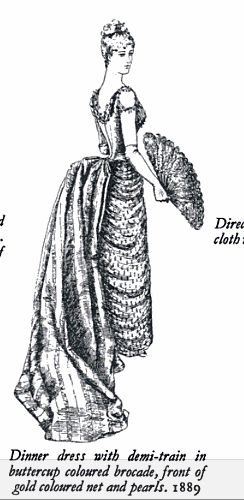
Doesn’t the train really look as if it is attached to the bodice?
And these images, from La Mode Illustree:

The ballgown certainly looks as if the train (well, not a train, but the back skirt part) is attached to the bodice rather than to the skirt.

I can’t quite tell if the entire evening dress is princess cut (in one piece), or if the bodice and train are one, and the skirt is separate.
A couple of quotes and pictures are great, but only a pattern or extent garment would really prove that bodice + train was done for the type of late 1880s evening gown I was aiming for.
Enter the fabulous VandE, who kindly looked through her magazine collection for me and found this picture from Harpers Bazaar, and the pattern that goes with it.
Victory!
Of course, while I had determined that trains could be attached to bodices, and while I know of numerous examples of skirts of the same era that had multiple bodices (this very similar ensemble, for example), I didn’t actually know of any skirts with multiple bodices where one bodice had a train.
To add to this, I realised that if I permanently attached the train to the one bodice, than whenever the other was used the skirt would be train-less, and while still beautiful, not nearly as striking.
So I decided to leave the train as an entirely separate piece than can attach to either bodice.
The only historical Worth examples I know of with completely detachable trains are formal court presentation gowns such as this one from 1886, and this one from 1888, which has three possible bodices, as well as as this one from 1872.
The Juno dress’s train is a bit short for a formal presentation gown, so I’m going to keep looking for other examples of evening dresses with detachable trains in order to support the historical accuracy of what I am doing.