Duck attack!

My parents have flocks of ducks on their farm in Hawaii, and every time I go home for a visit I pester them to put a clutch of eggs on to incubate.

Their ducks are mainly khaki campbells and mallards, but they keep a few muscovy ducks (muscovy are to ducks what donkeys are to horses – they can breed, but their offspring will be sterile ‘mules’) as mothers.  Muscovy are much better mothers than many other duck breeds – they are devoted nest sitters, and intensely protective of their young.  My parents let their muscovys (and muscovy-cambell hybrids) create nests and lay a clutch of sterile eggs, and then they swap them out for fertile khaki campbell or mallard eggs.

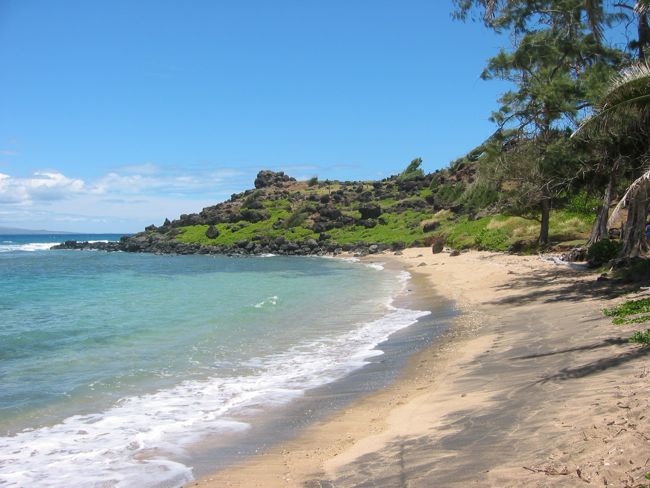
On my last trip home they started a clutch of eggs the week before I arrived, to hatch the week I would leave.  I waited and waited, and the darn things didn’t hatch.  On my last weekend Mum and I went away to Kalaupapa (if you haven’t read that story you really must), and when we got back, there were the ducklings!

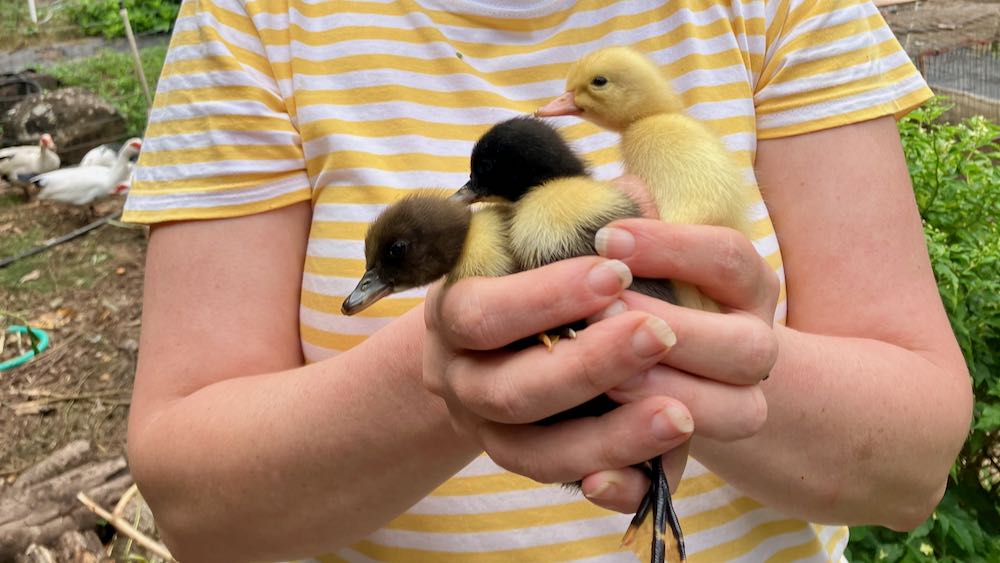
Muscovy-cambell hybrid with khaki campbell ducklings

Well, sort of.  Mama muscovy was so protective we could hardly see them behind her, and she kept hissing at us.  I leaned over the fence and cooed at her anyway, until a sudden rainstorm forced my Dad and I to flee for cover under a garden shed.

Sitting on the porch of the shed, looking out over the rain sweeping over the garden, I noticed something odd.  One of the ducklings was trying to climb the fence.  It was doing a good job of it for such a wee thing too – getting a good half a metre up the fence.  What was it so desperate to get at?

When the rain ceased we went to investigate, and quickly discovered why the duckling was scrabbling up the fence: the poor thing had managed to get under one layer of fence, and was now trapped between the fine inner layer and the heavy outer fencing, with its frantic mother stuck on the other side.

I carefully reached down and extracted the duckling, Dad fixed the fence, and (of course) as long as I had a duckling in hand, I got a few shots:

Duckling! (with anxious mama behind me)

Oh, hello cutie!

Mama fluttered frantically during all this, scolding and hissing at us, wanting baby back.  With pictures snapped and the fence secured, I leaned over the fence to put the baby down gently and then….

DUCK ATTACK!

DUCK ATTACK! (see that blur?  That’s mama duck having a go at me)

Yep.  Mama duck totally took me on – launching herself off the ground and using wings, beak and claws for all she was worth.

Evidence?

Duck scratches

I ended up with a bite on my thumb and some pretty reasonable scratches on my wrist, plus lots of mud.

Bites and scratches

Silly mommy duck.  I was just trying to help!


(and a reminder, do enter the giveaway if you haven’t already!)

Princess with a kahili (tribute to Nahi’ena’ena)

When Theresa and I did the photoshoot at the Old Museum building I took one of my kahili with me, and we did a series of images inspired by the Dampier portrait of Nahi’ena’ena.

Yellow is the colour of royalty in Hawaii, and there is an interesting comparison between Ninon, the French noblewoman who managed to escape what was expected of her and forge her own path, and Nahi’ena’ena, the Hawaiian princess who was trapped and destroyed by all the expectations piled upon her.

I like the images, but I think I want to do this photoshoot again outdoors, with Nahi’ena’ena’s trees and sea view.

Op-shop Kahili

I love op-shops.  I love the the thrill of discovery: finding unexpected things, finding bargains, finding pieces no-one else will have.  I’ve bought some beautiful pieces over the years; gorgeous fabrics, pretty little antiques, beloved books, favourite clothing items.  Some things though, you never expect to find in an op-shop, and this year, I found one of those.

Or two, to be more specific.  These two:

The ones at the top.  Not the books, or the thread, or the scissors, or the embroidery.

So what are those things, and why was I so excited about them?

Those are a pair of kahili.  Remember kahili?  Nahi’ena’ena is carrying one in her portrait.

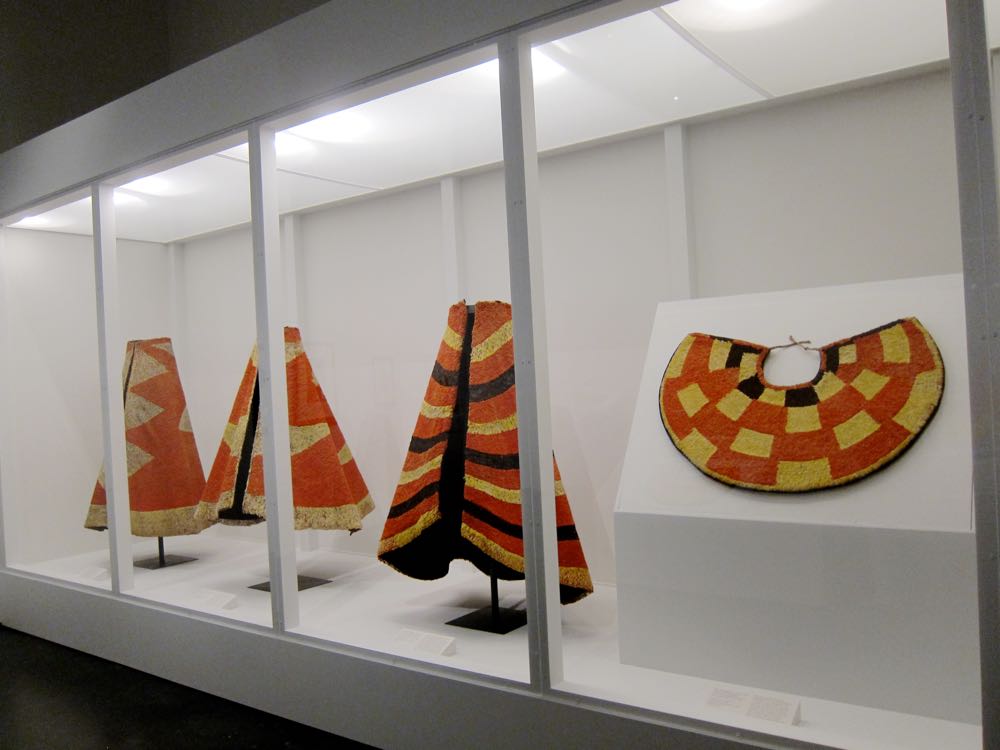
Kahili are Hawaiian feather standards, symbols of rank and status.  They are the Hawaiian versions of scepters, or rank badges, or standard flags.

They come in both small hand-held versions (kahili lele), and full-sized versions that are carried by standard bearers.

There are extent historical kahili in museums in Hawaii and around the world, but there are also craftsmen who make modern recreations.  The recreations are seen at festivals in Hawaii, and are sometimes given as ceremonial gifts.  I know that the Museum of New Zealand Te Papa Tongarewa was presented with a pair as a symbol of the ties between Hawaii and New Zealand.

Modern or historical, even in Hawaii though true feather kahili are rare; the old ones are fragile, rare and priceless, the new ones are incredibly difficult to make, rare and expensive.

So when I walked into an op-shop in Miramar Wellington, I did not expect to find a pair of beautifully made kahili stuck in a vase.  How did they get there?  I do not know.

I did know I couldn’t leave them there.  The op-shop thought they were dusters.  There are very few people in NZ who would recognize and understand what they are.

They are beautifully made – the feathers so closely packed you can’t see the waxed thread that holds them to the base, the feathers spiraling up to a cluster at the tip.  They are works of art.


So now they are mine.  They sit on pride of place in a vase in my lounge, next to a gorgeous silver flower holder that Elise gave me (thanks Elise!), with the occasional vases of peonies for company.  They still need names, but at least they are loved.

Page 1 of 1812345»10...Last »

Meet the Dreamstress

Leimomi Oakes is the Dreamstress, a textile historian, seamstress, designer, speaker and museum professional. Leimomi is available for educational and entertaining presentations, textile and fashion advice, special commissions and events. Click to learn more

Come sew with us!

Make a pair of 1760-80s paniers

Archives