All posts filed under: Textiles & Costume

Terminology: the history of the cardigan

A cardigan is a knitted sweater with a buttoned or zipped front, with a V or round neck, with or without a collar.  The cardigan  takes its name from the 7th Earl of Cardigan, James Thomas Brudenell (1797-1868) whose unfortunate claim to fame (other than the garment) is that he led the 1854 Charge of the Light Brigade. The cardigan as we know it today is based on a fur or braid-trimmed waistcoat  of knitted worsted wool worn by British Army Officers during the Crimean war (some sources say ‘purported to have been worn by’, or that it was only worn by Cardigan himself)). Whether or not cardigans were actually based on garments worn during the Crimean war,  within a few decades of the war the garment had become decisively linked with it, so much that editorials chiding the government for their neglect of veterans (some things never change…) make black-humour jokes about how “they might, at any rate, be provided with Cardigan Jackets.” The original ‘cardigan’ was a sleeveless vest or waistcoat, but by …

1900s nightgown thedreamstress.com

Vintage sewing details & a most unfortunate monogram

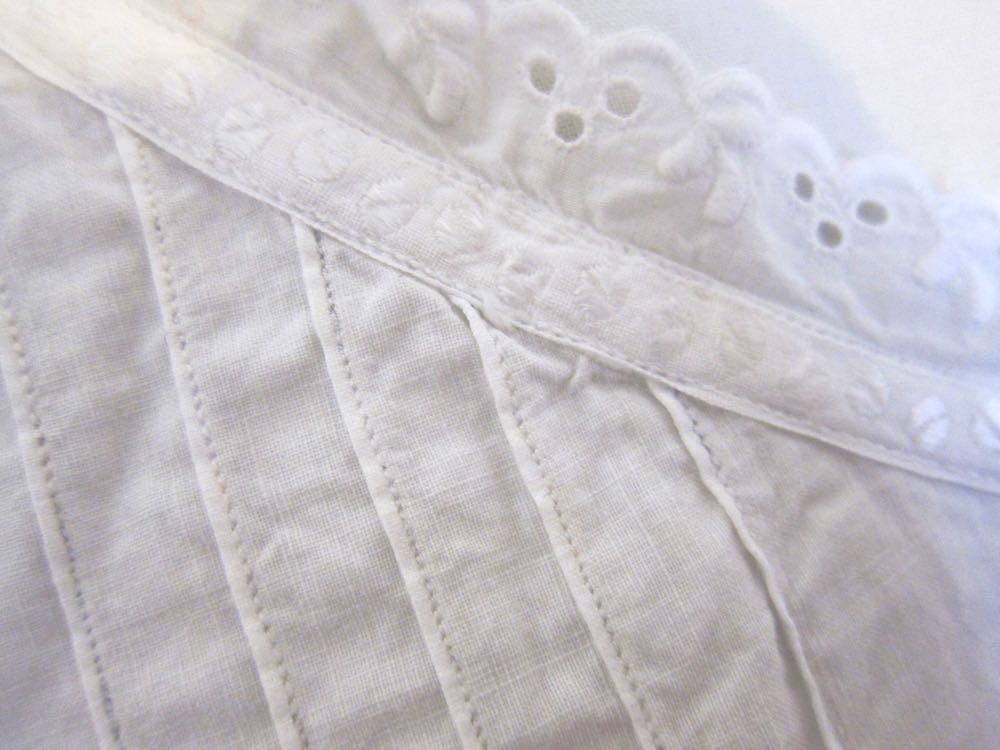
It’s quite uncommon to find really old textiles and garments in New Zealand op-shops: anything older than the 1950s is quite exciting.  And every once in a while I get very lucky, and find something quite exciting: even if it isn’t. This nightgown really isn’t exciting as a garment per se: it’s plain, and shapeless, and certainly not romantic.  But it’s exciting to find something so old here in NZ (especially since I only paid $4 for it), and even an un-exciting garment is exciting in the details it reveals about period construction techniques; carefully studying and copying the construction details can help to make a reproduction look like the real thing. The gown is a little hard to date: you see pieces like this anywhere from the late 19th century, all the way to the 1940s.  The materials in this one suggest that it’s probably from the 1910s or 20s, and was likely made by or for  an older woman. We know a little bit about the woman who used it: she monogrammed her …

A ca. 1920 sinamay sunhat (and what is sinamay)

You may have noticed that I made a number of hats for the Mansfield Garden party, so it’s probably no surprise that some of them are showing up as entries for  the Historical Sew Fortnighly ‘Protection’ challenge. Hats were essential fashion items throughout the first half of the 20th century, but they were also important for protection.  Sunglasses were extremely uncommon, and the wide brims of summer hats helped to protect the eyes from the sun’s glare, and also to protect the skin and preserve the pale, untanned complexions that were considered fashionable. They work extremely well for both functions: I get terrible headaches if I don’t wear a hat or sunglasses, but with one or the other, I’m fine.  And New Zealand’s sun is notoriously harsh, but my models and I stayed happily un-sunscreened and un-sunburnt for a whole day out in the blaze courtesy of our hats (and parasols). This particular hat represents the styles of hats worn in the very late 1910s and early 1920s.  It was also an experiment in some …