Latest Posts

Rate the Dress: Doucet goes for gold

Happy New Years!

To celebrate the holiday, I’ve picked a Rate the Dress suitable for wearing to a grand New Years event: a glimmering gold number by Doucet.

Last week:  a ca. 1821 afternoon dress in red & green

I really wondered how last week’s zig-zagged 1820s dress would go.  The 1820s have not exactly been popular in Rate the Dress.  And that fabric was, by any stretch of the imagination, obnoxious.  (I should point out that I sometimes love obnoxious!).  The fabric definitely lost the dress some points.  But other raters felt that the obnoxious fabric somehow balanced the weird 1820s details perfectly – gaining it points.  One thing most could agree on was that the hem ruffles weren’t working.

The Total: 8.1 out of 10.

Respectable, but not fabulous.  Better than the 1910s dress of the week before.  It’s not often 1820s beats 1910s!

This week: a Doucet evening dress in glittering gold organza:

This Doucet evening dress might have been worn to a New Years eve ball.  Perhaps in 1900!  It’s just glittery and celebratory enough.

In double-keeping with the New Years/circle of time theme, this is a dress that demonstrates that there is nothing new under the fashion sun, from cold-shoulders to see-through evening gowns:

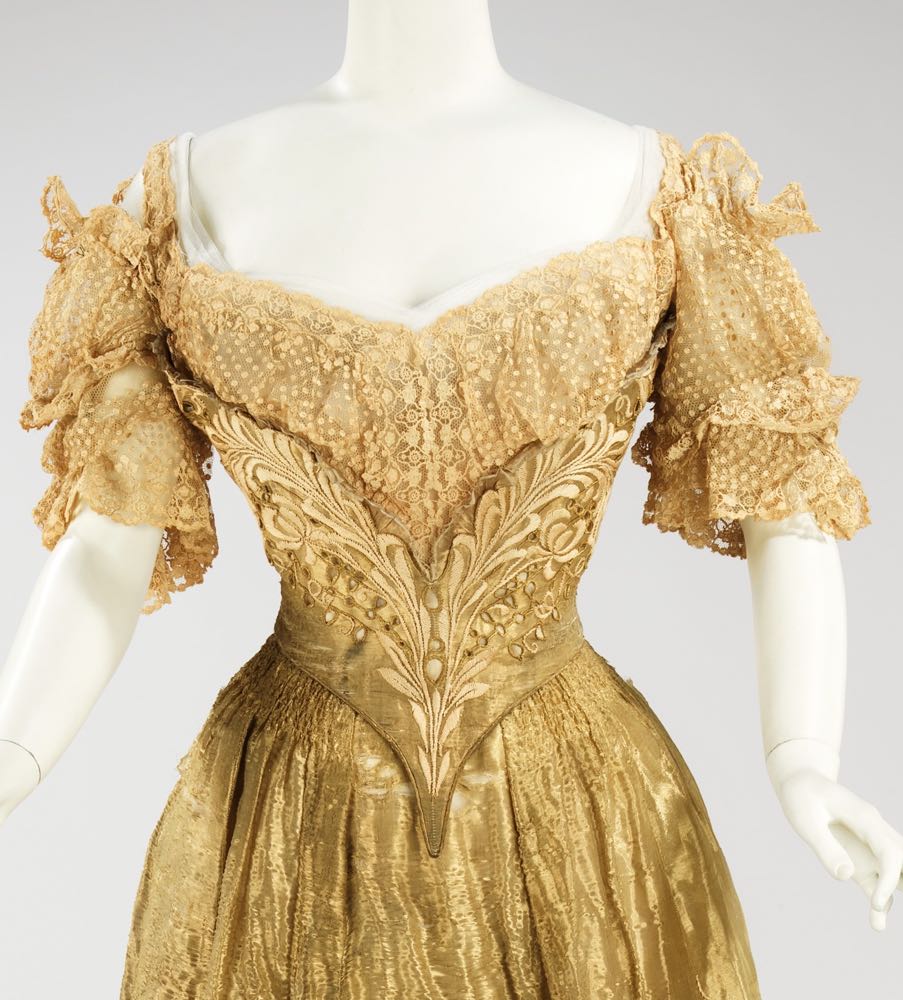
This extravagant evening or ballgown features glimmering gold organza, lavishly decorated with art nouveau inspired satin stitch and broderie anglaise style embroidery.

The gold organza forms a full, sweeping trumpet skirt, gathered in to the small waist with rows of shirring.  The small waist is emphasised by the fitted lower bodice, which is almost reminiscent of a swiss waist, or the newly fashionable S-bend corset.

Layers of delicate spotted and floral lace hang over the fitted lower bodice: hinting at the full Edwardian pigeon breast silhouette to come.  The lace is perfectly matched to the shape of the dress: indicating it was custom made for this creation.

The same lace is used to form delicate puffed sleeves, with straps on the shoulders, double puffed sleeves sitting off the shoulders, forming and a saucy ‘cold shoulder’ effect.  (so 2017!)
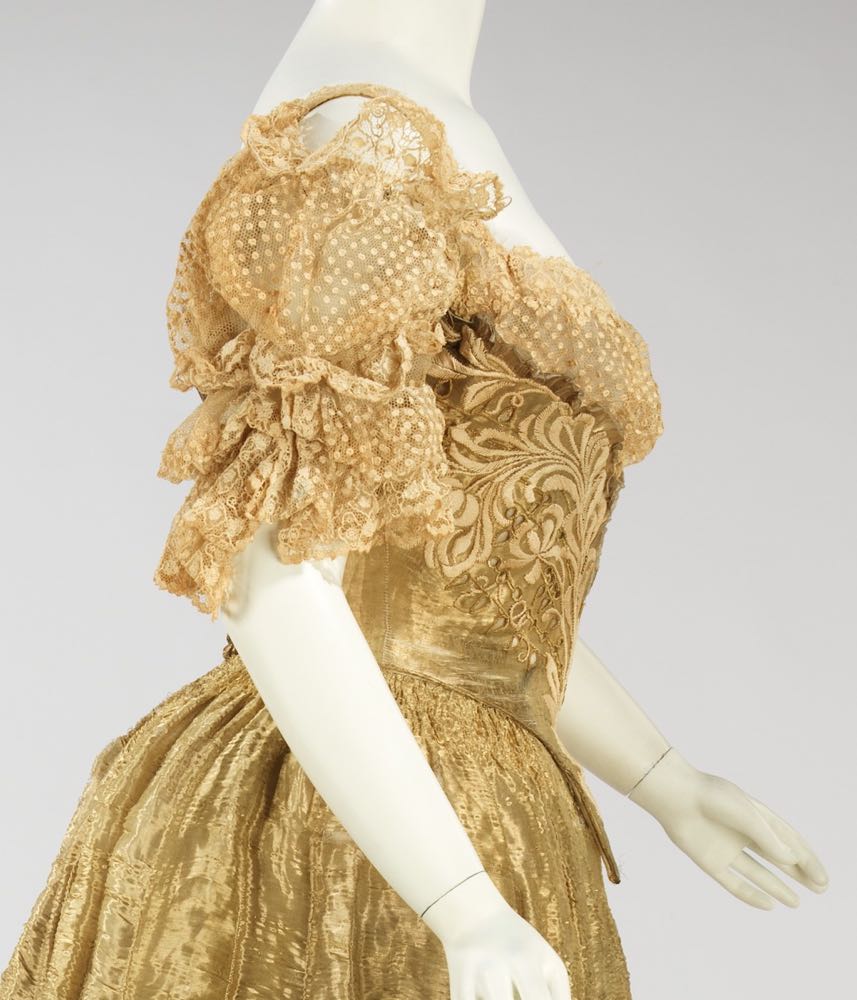
The dress fastens up the back with fastenings that are both hidden, and highlighted, by decorative organza bows and rosettes.  Elaborate back fastening decorations were a peculiar and distinctive feature of very late 1890s evening gowns.
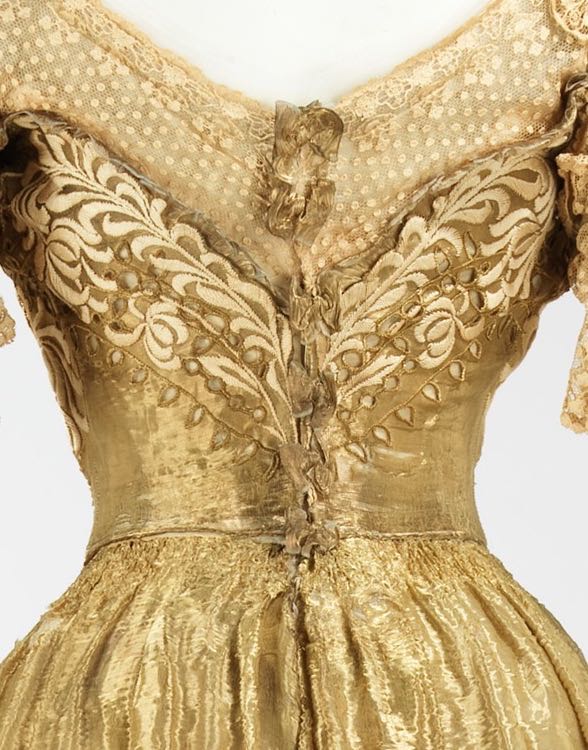
Ball gown, Jacques Doucet (French, Paris 1853—1929 Paris), 1898—1902, silk, metal, linen, Metropolitan Museum of Art, 2009.300.3274a, b

There is something decidedly lingerie-esque about this dress.  The fitted lower bodice and cascade of lace over it are evening gown mirrors of a low-busted Edwardian S-bend corset (already in use amongst the fashion-forward in 1898) topped by a frothy chemise.  Even the effect of the sleeves falling of the shoulders references depictions of women dressing: their chemise straps and sleeves not yet secured on by tightening the beading ribbon threaded around the neckline.

The fabric and decorations also play on the theme of undergarments.  Although made of extravagant gold silk organza, the embroidery, particularly the use of broderie anglaise, heavily foreshadows the ‘lingerie gown’ fashions so typical of the 1900s and 1910s.

Typically of Doucet, the dress is composed of layers of semi-visible colours and fabrics: an eternal play of conceal and reveal.  The sheer organza and openwork embroidery allow peeks of the ivory silk under-layers.   Rows of delicate ruffles at the hem would have been exposed as the wearer moved and turned, further emphasising the idea of gown-as-petticoat.

Doucet was known for dressing actresses and the demimonde, though respectable society women also wore his art-influenced creations.  Whoever wore this, she was definitely a woman who was quite sure of herself.  She was someone who wasn’t afraid to wear a dress with more than a faint suggestion of being the most extravagant, luxuriant variation of underwear possible.

What do you think of this glimmering gold-and-lace evening gown?  Is it just saucy enough for a self-assured beauty to have a little risque fashion fun?  Or is underwear inspired outerwear, even when done by Doucet, terribly, terribly tacky?

Rate the Dress on a Scale of 1 to 10  

(as usual, nothing more complicated than a .5.  I also hugely appreciate it if you only do one rating, and set it on a line at the very end of your comment, so I can find it!  Thanks in advance!)

The Historical Sew Monthly 2018 – it’s on!

Historical Sew Monthly 2018 thedreamstress.com

As you may have noticed, the Historical Sew Monthly 2018 is on – all the details and challenges are up.

Here’s the big secret about 2018…

(so big even the other moderators don’t know about it).

In my mind it wasn’t going to happen.

Participation has dropped a bit, it’s been going for five years (seriously y’all, FIVE YEARS!).   I figured five years was enough.  We’d had a good run, we’d made some amazing things, and it was time to say goodbye.

The Knitter Asleep, Jean-Baptiste Greuze (1725-1805), ca. 1750

But I was so busy in the last half of 2017, that before I could find time to discuss it with the other moderators it was December, and they, brilliant wonderful people that they are, had planned everything.  There had organised a Challenge theme brainstorming session on FB, collated all the suggestions in our moderator group, had a discussion and poll on the choices, made a Hero image for the year…

All I had to do was vote on my favourite challenges in the poll, and write the HSM 2018 page.  So I couldn’t pull the plug at that point!

So here’s to the fabulous moderator group for the Historical Sew Monthly 2018:

Without them, the Historical Sew Monthly would be dead in the water – both in 2017 and 2018.  They are an amazing group of people, and do so much to keep the HSM running, interesting, and cordial.

And here’s to all you participants!  You’ve made the whole journey (all five years of it!) such a joy.

Here’s to the Historical Sew Monthly 2018!  Here’s to a sixth year that is the best yet!

Go forth and make!

SaveSave

Rate the Dress: 1821 Red & Green Zig-Zags

It’s Rate the Dress day again! Every week I feature a historical garment — whether an extant original, or an artistic depiction, and you have your say about its aesthetic merits within the context of its time. This week’s pick is a seasonally inspired 1820s dress with red & green zig-zags.

Last week: ca. 1910s purple polka dots

Last week’s purple polka dotted frock was an interesting one.  Nobody loved it enough to give it a 10/10, and a few of you really didn’t like it, but most of the ratings were pretty positive.

I have a love/hate relationship with the purple number.  Or, more accurately, a hate/love relationship.  My initial reaction was “Gah, it’s hideous!”  The more I looked at it, the more I found elements that I ought to love, or that were beautifully done.  There is so much there that is good, and yet somehow, for me, it just doesn’t work.

The Total: 7 out of 10.

That’s the lowest we’ve had in a while, and pretty bad for the perennially popular 1910s.

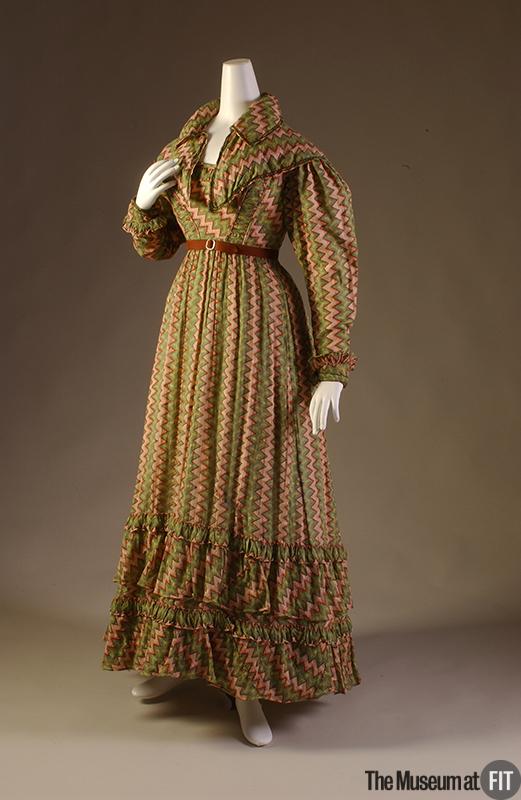
This week: a ca. 1821 afternoon dress:

To celebrate the holidays I’ve chosen a red-& green dress:

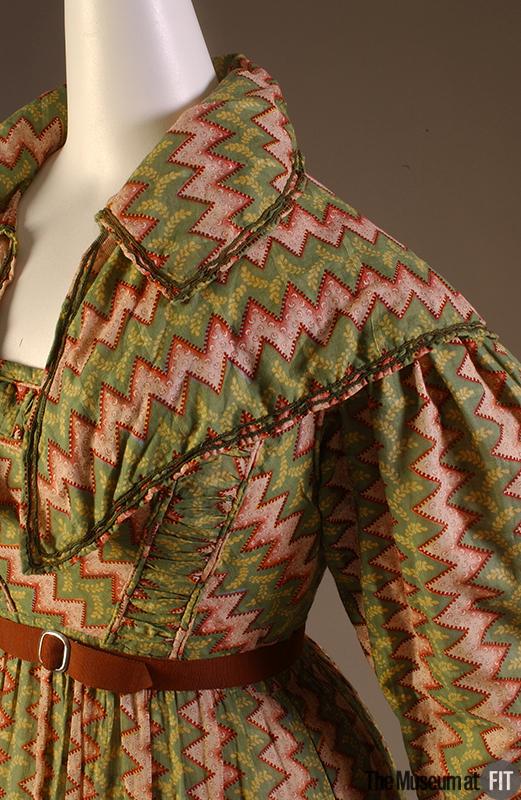
The most obvious and striking feature of this early 1820s dress is the red & green zig-zagged fabric.  The fabric takes advantage of advances in printing, bleaching and dyeing technology that revolutionised early 19th century fabrics.  The print is created with engraved metal roll-printing; an invention which allowed relatively detailed prints to be created reasonably cheaply, bringing previously prohibitively expensive printed fabrics, if not to the masses, at least to a wider expanse of the general public.

The impact of engraved roll printing was made even more pronounced by improved dyeing and bleaching techniques which allowed prints with multiple contrasting colours to be printed directly next to each other on the fabric at a relatively reasonable price-point.

So this fabric, while perhaps a bit fuddy-duddy to modern eyes, would have been quite new and exciting in the 1820s, justifying the extensive use of it for almost every aspect of the dress.

Note the use of contrasting stripe placement on the pereline body and collar, and the bias-cut of all the major bodice pieces.  The bodice is trimmed with double rows of self-fabric piping, and stripes created by gathering stripes of fabric cut along the green stripes.  The bodice stripes highlight the lowered waist of the 1820s, and the curvier, more waist-focused, silhouette.

The same stripes trim the tops of the double layer of skirt ruffles.  The ruffles utilise an interesting change in stripe placement from the top to the bottom ruffle, creating visual movement at the hem of the dress, emphasising the softer, fuller skirts of 1820s fashion.

The only non-fabric trim element is the narrow wool braid that edges the pelerine and the cuffs of the dress.

Rate the Dress on a Scale of 1 to 10

Tell us what you think!  Do the zig-zags, and the way they have been used, add a bit of festive fun to this afternoon frock, or is this example of an 1820s dress a bit of a dud?


(as usual, nothing more complicated than a .5.  I also hugely appreciate it if you only do one rating, and set it on a line at the very end of your comment, so I can find it!  Thanks in advance!)
SaveSave

SaveSave

SaveSave