
Last week I showed you a very brief (from a historical perspective) 1920s Jean Patou dress with heavy beading and a bit of an Egyptian twist. You generally agreed that the mannequin wasn’t doing the dress many favours, but after that your opinions diverged: some of you thought it would have been so much better in bolder colours, some of you though that the restrained colour scheme was all that kept it from being garish; some of you though the dark beads were off, some thought it was exactly what the dress needed. Most of you thought that it was complete perfection, and the dress came in at 8.9 out of 10, just a hairs breath away from making a perfect 9.
UPDATE: a historical costumer involved in the exhibition of this dress at the Palais Galleria informs me that it has NO provenance Madame Elisabeth.
I’m leaving the blog post mostly as it was, so as not to sweep the mistake under the rug and cause confusion. I’ll remove any reference to Madame Elisabeth in the photo comments, to help prevent the misinformation from spreading via pinterest, etc. If you see any further photos with the attribution to Elisabeth, please help to correct the record.
This week, let’s move from silk to cotton, and from beading to embroidery, for a dress that sounds much simpler, but has an even more illustrious pedigree.
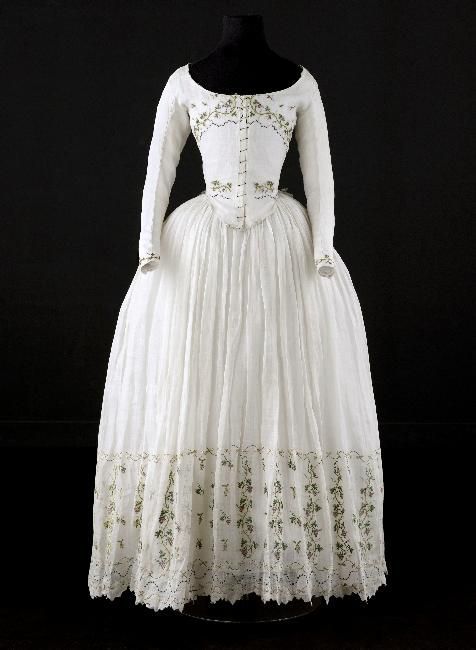
Caraco and petticoat, ca. 1789, Cotton, embroidered with grape vines, Palais Galliera, Musee de la Mode de la Ville de Paris
This ensemble is an excellent example of the transitional styles of the 1780s and 90s, as fashions moved from the structured bodices and more elaborate fabrics of the Rococo, to the softer silhouettes and lighter fabrics of the turn-of-the-century.

Caraco and petticoat, ca. 1789, Cotton, embroidered with grape vines, Palais Galliera, Musee de la Mode de la Ville de Paris
The very fitted caraco bodice, with its boned front lacing, harkens back to older fashions.

Caraco and petticoat, ca. 1789, Cotton, embroidered with grape vines, Palais Galliera, Musee de la Mode de la Ville de Paris
The embroidered details on the bodice evoke zone front bodices, and the pockets on men’s waistcoats.

Caraco and petticoat, ca. 1789, Cotton, embroidered with grape vines, Palais Galliera, Musee de la Mode de la Ville de Paris
The ruffled pierrot tail of the jacket, with its elaborate embroidery and delicate edge finishes, emphasises the fashionable pronounced rear of the silhouette.
The ensemble was displayed in an exhibition on Madame Élisabeth at Versailles, along with a matching fichu, softening the severe neckline of the dress.
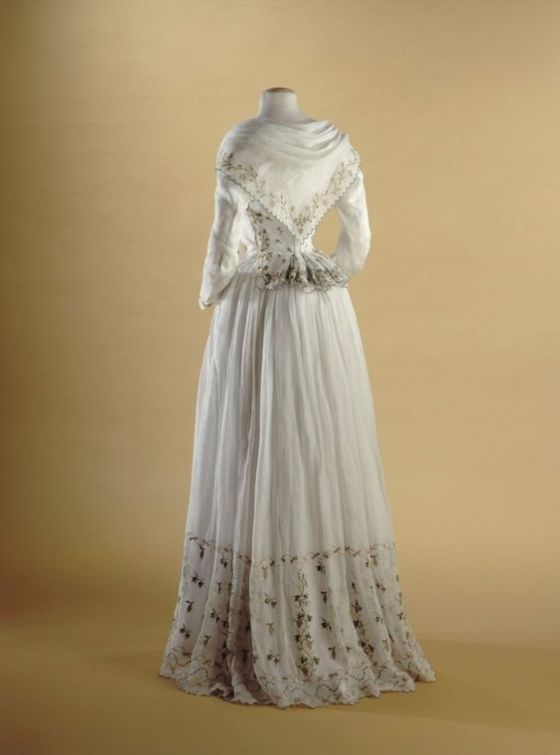
Caraco and petticoat, ca. 1789, Cotton, embroidered with grape vines, Palais Galliera, Musee de la Mode de la Ville de Paris
What do you think? Princess worthy?
Rate the Dress on a Scale of 1 to 10