Latest Posts

Ninon's Dress thedreamstress.com

Costume College 2016 – I’m going! And need ideas!

As I mentioned in an earlier blog post, I’m going to Costume College 2016.  CoCo (as it is called) isn’t actually college – it’s pretty much the biggest conference for costumers (particularly amateur-ish, historical-ish ones) around.

I’ve wanted to go to CoCo for years, but I’m in New Zealand, and it’s in LA, and that’s a long (aka expensive) way to go.*  This year I was privileged  enough to get a full scholarship to Costume College, and a really good deal on airplane flights to the US, which has made it possible.**

In addition to going to CoCo, I’d actually like to teach a couple of classes.  I’ve brainstormed a few ideas, but I’m having a combination of tall-poppy-avoidance panic and ‘let’s have a brilliant idea’ induced brain blank (my brain is like a cat.  Tell it to have a brilliant idea and it glares at me and turns its back and proceeds to wash between its toes with great dedication).

So, if you were going to a big Costume themed conference, with a variety of choices in hour-long classes, both large lecture-y ones, and small group ones focused on techniques, what, of all the things I’ve made or blogged about or mentioned or seemed to teach, would you most like to hear me talk about?

If you’ve been to CoCo, what are your favourite types of classes?  What are you most likely to get excited about, or find useful later?

Some things I’ve thought about or have had suggested:

  •  Fabric Identification (including burn tests, if we’re allowed to do them in a hotel conference room!)
  • Costuming & Cultural Appropriation: the fine (and not so fine) line between preserving & pillaging
  • Fitting bodices
  • Fashion in the furthest flung empires: making do without the mode in Colonial New Zealand
  • Costuming groups: how to do it, and what to bring
  • Living in a longline corset: what it’s like to be a WWI era housewife for a week.

Clearly I’m a bit all over the place at the moment!  These ideas are all pretty rough, and need refining.  I do have to keep in mind that I’m travelling and have a luggage allowance, so can’t do some of the classes I might do simply because I can’t bring 6 sample corsets.

I’d really love to hear your thoughts: people are often interested in things that I do so much that they are  quite mundane to me.  And I’d especially love to hear your thoughts if you’ve been to CoCo

And if you’re also coming to CoCo: YAY!  Can’t wait to meet you there!  Please come say hello!

*Also, it’s in LA in late July/August, and I’m not very good at heat, but that’s another story.

** Though I’m not totally out of discretionary income for the year, but hopefully it will be worth it!

Rate the Dress: Restrained florals and bows in 1888

Last week I showed you an 1820s fashion plate featuring a the epitome of youth and sweetness in ballgown form.  Combined with the model’s  expression, I call it the ‘Someday my Prince will come’ dress.  There were the usual complaints about not liking to rate fashion plates because they aren’t fully developed dresses.  I think makes fashion  even more rateable, because we get to see the idea of a fashion at its most extreme and pristine, rather than a fashion adulterated by the skill of the seamstress, the preferences and body shape of the wearer, and the ravages of time.  (So no, I’m not going to stop showing fashion plates, and please humour me and either rate them or just keep quiet about it).  And it was certainly interesting to see the interpretations of the dress depending on exactly what fabric you imagined it in – and the comparisons to extant gowns of similar fabric and trims.  A most fascinating discussion!

Overall, while a few of you really liked the dress for its iconically 1820s features, the rest of you just couldn’t get over the heavy hem decoration, with comparisons ranging from hoverboats to daleks.  The visual weight of the hem dragged the rating down (Har har. I’m sorry, I tried and tried, but it is almost literally impossible to not make this sentence a pun!) to a very poor 5.8 out of 10 – the lowest we’ve had in a LONG time.

This dark blue dress from the Metropolitan Museum of Art, features the almost severely fitted and body-enclosing  silhouette of the late 1880s, softened through the use of draping and ruching,  a gathered skirt with a slightly bustle, and touches  of lace and velvet.

What do you think? Do the floral fabric and the softer touches manage to give a bit of youth and levity to what can be quite a stark, restricting shape? Do you like the combinations of fabrics and textures?

Rate the Dress on a Scale of 1 to 10

A 1900s petticoat thedreamstress.com

Just a boring old petticoat

One of the problems with my sewing is that  I sew A LOT, and not all of it looks particularly interesting and dynamic unless I manage to do a whole photoshoot in it, in a picturesque locale (which, luckily, there are lots of in the Wellington region!).

Thing is, photoshoots take a lot of time and planning, and a willing photographer (which, unluckily, Mr D is not often).  So I do a bit of self-timed photos, and a lot of mannequin photos.

Even with good images, some sewing isn’t that interesting without a really good story, and it’s too easy for too many blog posts to be summed up as:

tl:dr – I sewed something and there were a few tiny problems but I fixed them and now I mostly like it.

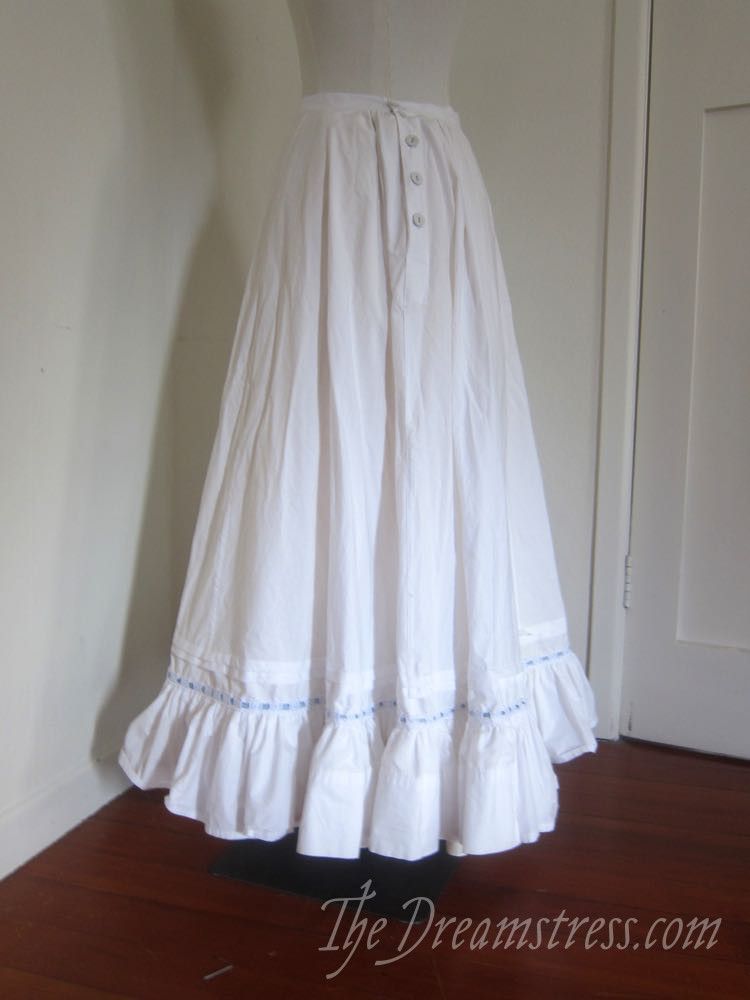
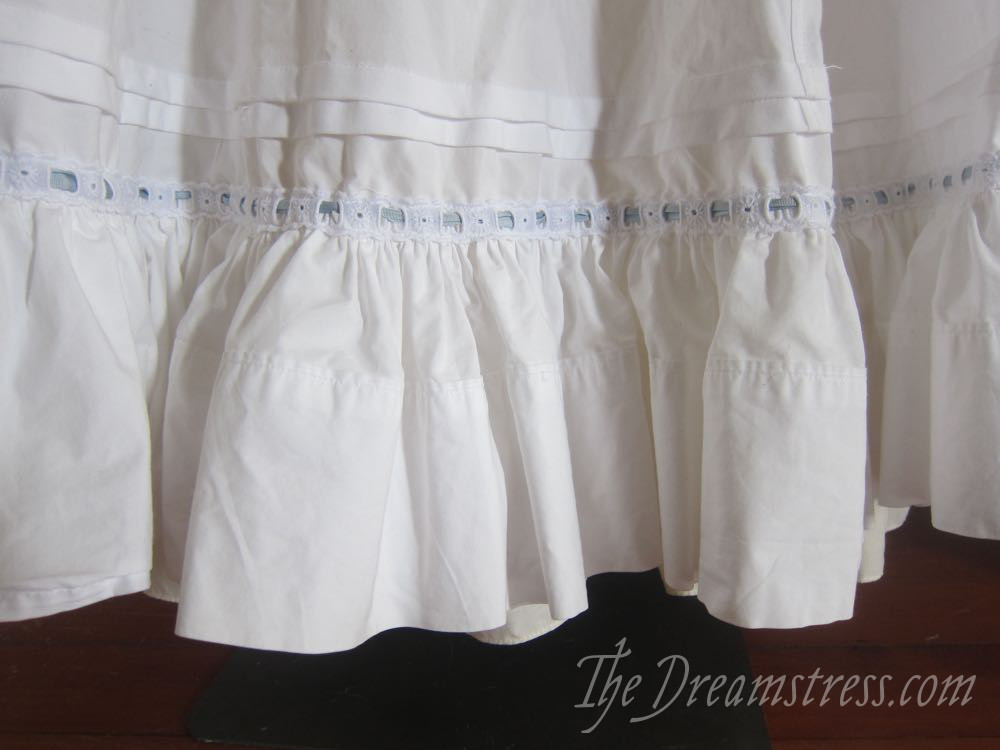
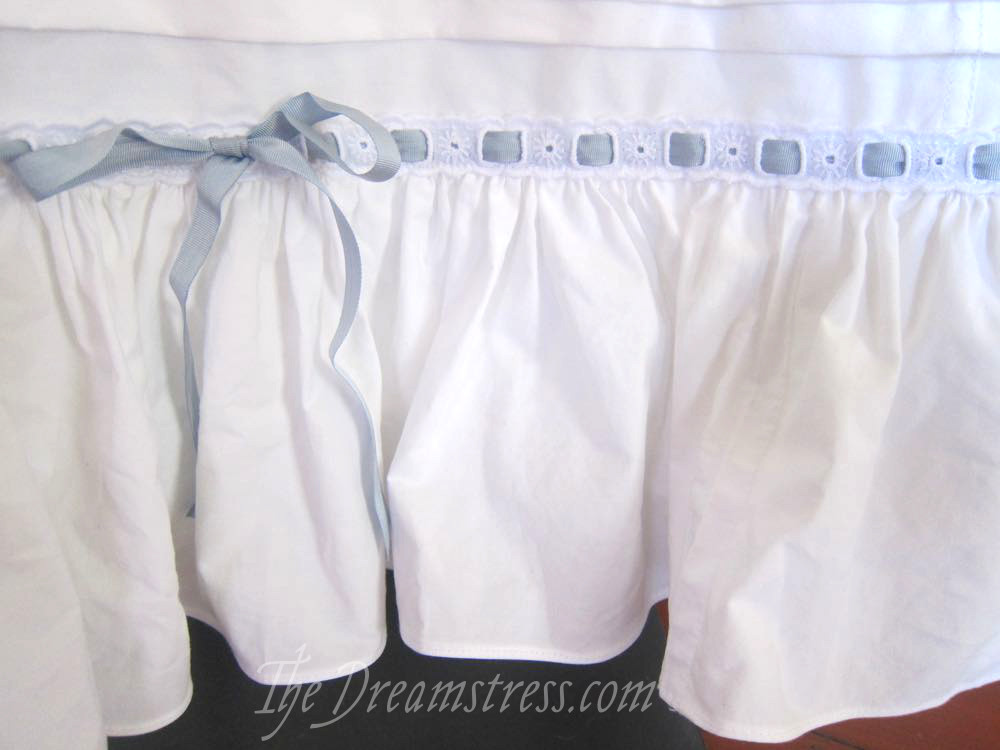
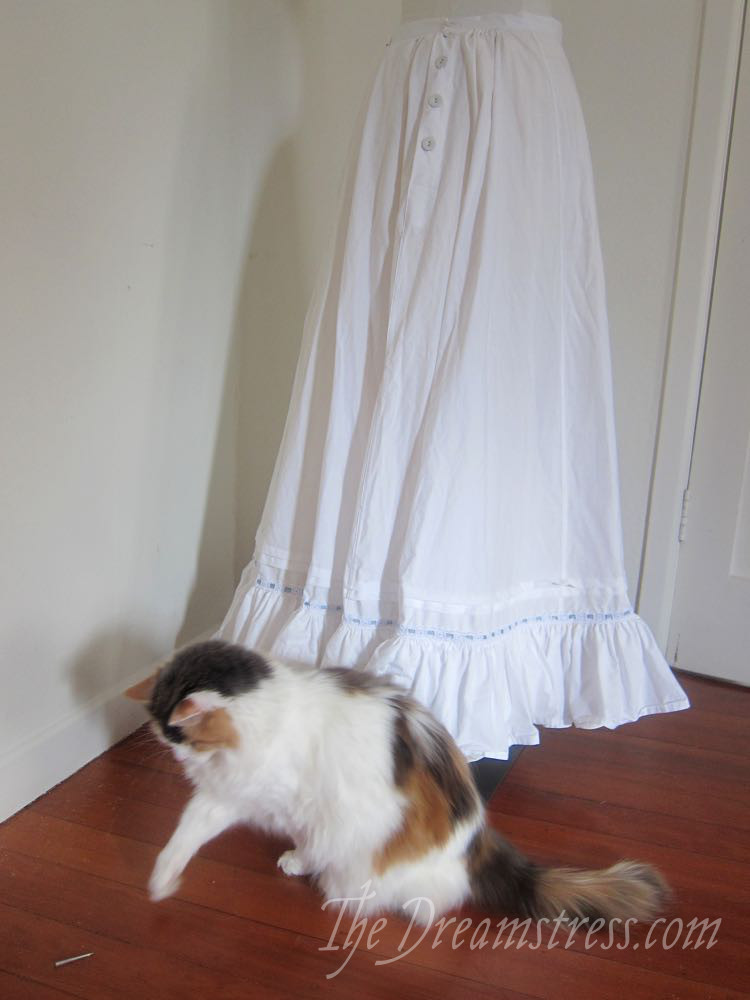
There isn’t a particularly interesting story for this sew.  It’s a petticoat suitable for wear under late Victorian and early 1900s garments.  It’s a basic 5-gore pattern with a bit of back gathers and a  placket  closure.  It has tucks and a layer of ruffles to give it body at the hem, and a bit of beading with blue ribbon for a decorative element.

A 1900s petticoat thedreamstress.com

Vaguely interesting bits:

1. It’s made from an old sheet, and I used every single bit of the sheet in it, so you can even see the wide top hem in the back panel of ruffle.

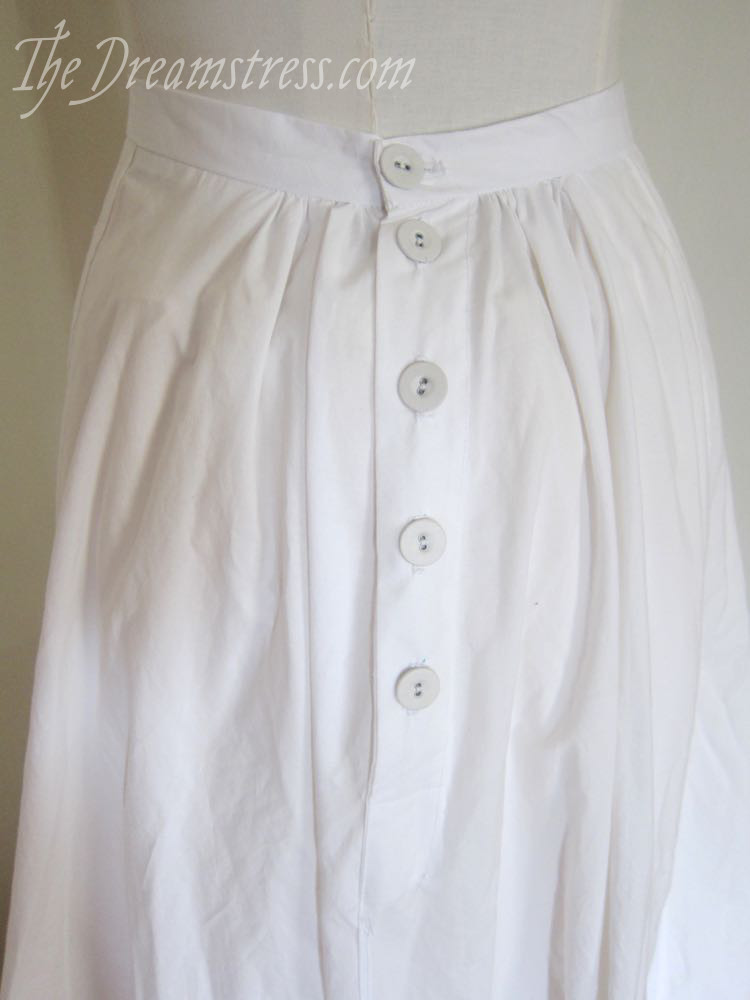
A 1900s petticoat thedreamstress.com2. It fastens with vintage lingerie buttons: I found a whole tube of them at an op-shop for $60cents.  Whoot woot!

A 1900s petticoat thedreamstress.com

3. The ruffles were made using the corded gathering technique, so took me 1/57th of the time and teeth-gnashing that standard gathering would, and look much better.

How to sew corded gathering & ruffles thedreamstress.com

4. I’m showing the petticoat over another petticoat, because on a mannequin  even petticoats need petticoats to avoid looking limp and flat (this is why museums show everything over custom crinolines & supports).

A 1900s petticoat thedreamstress.com

5. Felicity!

A 1900s petticoat thedreamstress.com

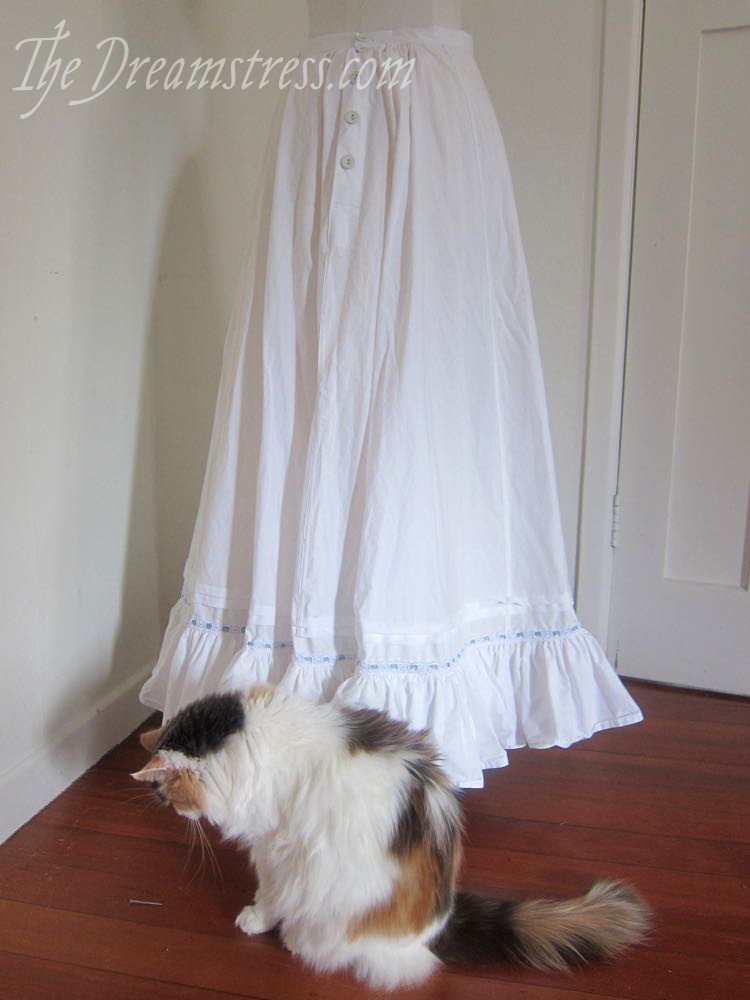
Felicity is, of course, far more than vaguely interesting.  In these photos she’s playing with a nail.  We’ve been doing a bit of summer DIY on the house, and somehow she found a nail and LOVES it.  She bats it about and does the adorable prey-pounce and stalk routine.

We only let her play with it under supervision, just in case.

A 1900s petticoat thedreamstress.com

The Challenge:  Re-Do

Challenges this is re-doing  (once again, I am attempting to re-do every challenge from the year in December, though each item can cover multiple challeges):
—  #1 Foundations:  A petticoat is an obviously an important foundation garment.
—  #2 Blue:  Thanks to the little touch of decorative blue ribbon
—  #3 Stashbusting:  The sheet has been hanging around in the back of my linen closet for years, because it’s the wrong size for any of our beds, and I bought the blue ribbon at a Fabric Warehouse sale at least 4 years ago, probably more.
– #5 Practicality:  I’m stretching a tiny bit, but by the standards of Edwardian fashion, this is an extremely practical petticoat: quite plain, short enough and durable enough to be worn under a walking skirt.  It’s the kind of petticoat a typewriter or shopgirl would have worn.
— #10 Sewing Secret:  It’s made from a sheet!

Materials:  One sheet

Pattern:  Based on a basic 5-gore skirt pattern.

Year:  ca. 1900

Notions:    Cotton  thread, cotton beading lace, rayon ribbon, lingerie buttons.

How historically accurate is it?  There are period accounts of making petticoats and other undergarments from sheets.  The hand, thread weight, and general feel of this fabric is similar to, but not identical to some late 19th century petticoats I’ve worked with, so it’s not perfect, though I don’t  that a period seamstress would find it too odd.  Pattern, trims and sewing techniques are all in line with period examples.  80% or so.

Hours to Complete  5ish.

First worn:  Not yet, but  I’m sure it will be a very useful item!

Total Cost  under $10