Latest Posts

Tunnel beach, Dunedin thedreamstress.com

Travels in New Zealand: Tunnel Beach, Dunedin

I spent last week in Dunedin, which was quite lovely, as I’ve never really had the opportunity to be a tourist in New Zealand.  I had lots of fun adventures, and I’ll be blogging a few of them.

This one started the minute I got off the plane.

Airport corridors in New Zealand are plastered with panoramic views of local scenic spots, and little stories about them.  De-planeing  in Dunedin, I caught a few sentences of one story “the tunnel was hand-carved through meters of solid rock” “workers were forbidden from using the beach” “his daughter bathed in privacy” “local mermaid sightings increased.”  (sadly I didn’t get photos because of all the impatient people de-planeing with me, so if you happen to be in the Dunedin International Airport (aka the tiny building in the cow pasture) and can photograph or transcribe the actual story for me, you’d be my hero!)

Intrigued, I asked my hosts about the story.  “Oh, that’s Tunnel Beach!  We’re going to take you there!”

This is the story I compiled  from them and other Dunedin sources about the beach:

In the 1870s John Cargill, the son of Captain Cargill, one of the city founders of Dunedin, had a great deal of money, and very beautiful daughters who liked to bathe in the sea (in the Victorian sense of swimming or playing in the water, while fully clothed in modest swimwear – NOT in the modern sense).  Cargill  was uncomfortable with the attention his daughters attracted  at the crowded public beaches in Dunedin, so he had the workers on his land dig a tunnel down through the rock to the tiny, private beach now known as Tunnel Beach.  He kept the project secret, and surprised his daughter with the beach as a birthday present.

Thereafter, his daughters, in the presence of a chaperone, bathed at their own beach.  Cargill’s workers were forbidden from visiting the vicinity of the beach, so they could not spy on the girls, but local fishermen noticed girls swimming at what was thought to be an inaccessible beach, and brought back stories of mermaids.

Tragically, Cargill’s youngest daughter drowned in the dangerous currents of Tunnel Beach, and, in grief, Cargill abandoned the beach and left New Zealand, never to return.

Digging into the history reveals that the story has been rather embellished and muddled.    The various versions I heard differed as to how many daughters he had (just one, or four), whether she wanted a private beach because she didn’t like the crowds, or whether he made the tunnel because he refused to allow her to swim in public, whether there was already a clandestine love affair in the mix (a detail probably borrowed from his niece’s controversial marriage to the architect of his brother’s house), and whether a daughter drowned.  Some accounts also have him confused with his father or brother, so the stories state that  Captain Cargill (his father), or the lord of Cargill’s Castle (his brother) had it built.

Cargill did indeed have the tunnel carved so his family could access the beach in the 1870s, but details about creating it to hide his daughters away from the public seem to be later additions.  He did have four daughters  from his first marriage to Sarah  Charity Jones (d. 1866):  Charlotte (b. 1851);  Madeleine (b. 1853,  m.1877);  Eleanor (b. ?) & Isabella  (b. 1864),    all of whom lived to adulthood.  He had a further three children from his second marriage to Eliza Catherine  in 1869: two boys, and a  child that died at 8 months.  Tragic, but not a daughter drowning.  He did leave New Zealand forever in the mid 1880s, but period accounts suggest he left because of financial setbacks.

I suspect that what actually happened is Cargill (or someone in his family) looked down from the  cliffs, saw the charming little beach, and though “Oooh, we’ve got lots of money, labour is cheap, let’s get our workmen to build a tunnel down and we’ll have our own private beach!”

By the early 1900s the beach was known to the public, and used for public events.

In any case, I got to visit the beach, and whatever the story, the area itself  is amazing.  So come on a walk with me!

Tunnel beach, Dunedin thedreamstress.com

The path starts at the top of a hill, and soon dips steeply down, revealing a spectacular view of sea cliffs – and yes, that’s where were going!

Tunnel beach, Dunedin thedreamstress.com

In spring the path is closed for lambing, but here in summer the sheep were far away, and bee-covered flowers fringed the waysides

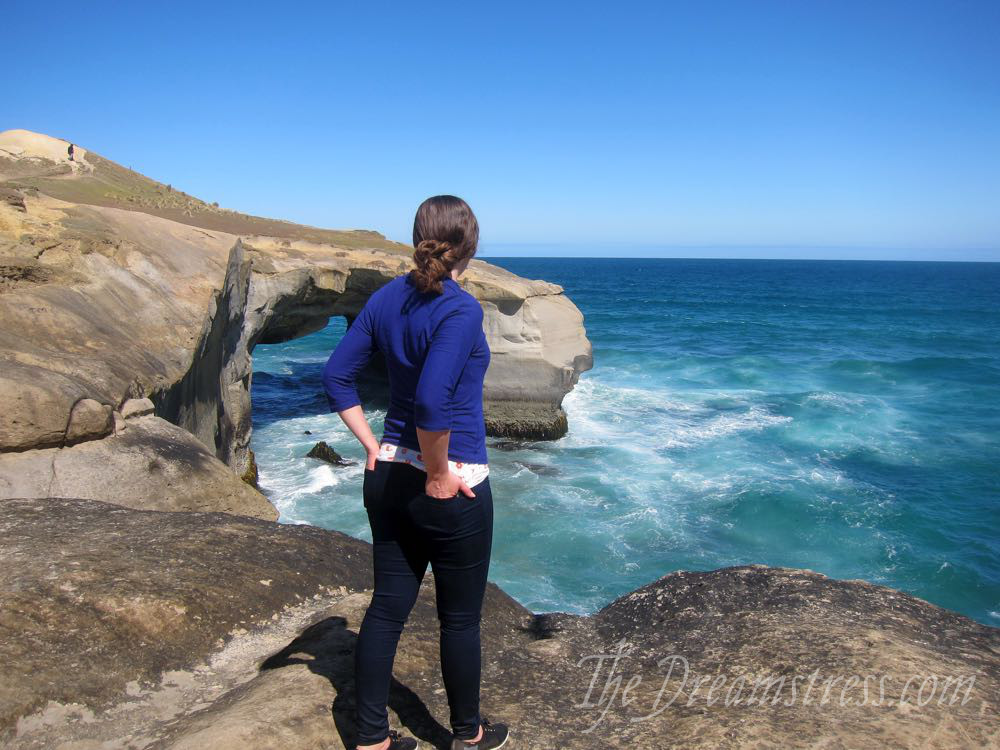
As we approached the cliffs I could see that the little peninsula out over the sea was more than just that: it was a sea-arch, with the cold salt water rushing under the rocks and smashing up against the cliffs, slowly eroding them:


Tunnel beach, Dunedin thedreamstress.com

Tunnel beach, Dunedin thedreamstress.com

Tunnel beach, Dunedin thedreamstress.com

What a view!

Tunnel beach, Dunedin thedreamstress.com

Confession time:

I’m afraid of heights.  Even worse than being on a height myself is watching someone else on heights:

Tunnel beach, Dunedin thedreamstress.com

I am so bad about it that even watching the seagulls dropping off the edge of the cliffs and taking flight freaked me out.

Tunnel beach, Dunedin thedreamstress.com

OK, so spectacular cliffs, yes.  Sea tunnel: amazing.  But what about the beach, and the people tunnel?

Here is the beach, tucked just to the side of the little peninsula with the sea-tunnel:

Tunnel beach, Dunedin thedreamstress.com

And here is the people tunnel, tucked in a little hollow, all fringed ’round with hebe.

Tunnel beach, Dunedin thedreamstress.com

Down it goes, descending steeply through 60 meters of sea cliffs.

Tunnel beach, Dunedin thedreamstress.com

Tunnel beach, Dunedin thedreamstress.com

Down below is the perfect private little beach:

Tunnel beach, Dunedin thedreamstress.com

Somewhat less private on a beautiful sunny public holiday:

Tunnel beach, Dunedin thedreamstress.com

We sat in the sun, gazed at the sea, marvelled at the cliffs:

Tunnel beach, Dunedin thedreamstress.com

And I even attempted a little minor rock-climbing!

Tunnel beach, Dunedin thedreamstress.com

Tunnel beach, Dunedin thedreamstress.com15

I’m now having serious thoughts about 1870s bathing costumes and seaside wear, and return trips to Dunedin…

Tunnel beach, Dunedin thedreamstress.com

Corded gathering sewing tutorial thedreamstress.com

Tutorial: How to sew gathers & ruffles with cord gathering (aka the easiest way to gather, ever)

There are certain things in sewing that you just hate doing. Some people hate setting zips (if you do, use the zip method in this tutorial and they will come out perfect every time), some people hate setting sleeves, and some people hate gathering.  I was one of the latter.

My very first proper sewing project, made well over half a lifetime ago, was an 8-gore double-circle skirt, with HUGE amounts of fabric gathered into the waistband.  I did not mind learning how to do a tiny rolled hem and hemming the meters of fabric, but I did NOT  enjoy gathering in the gores at all.  A decade of sewing did not improve my dislike of gathering one bit, and I just tried to avoid garments that involved it.  I would do anything but gathering: tiny cartridge pleating, tiny knife pleats, little box pleats…

Then I figured out  how to do cord gathering, and the skies parted, and angels sang.  Cord gathering is AMAZING.  It allows you to quickly and easily gather in huge amounts of fabric, perfectly and evenly, with no need to sew multiple lines of thread, no need to start and stop your stitching every two feet or so, so the threads don’t get too long, and no chance of broken threads as you gather.  Oh, and the gathers look much,  much better than standard gathers.

Have I mentioned that cord gathering  is amazing?

So, the next time you need to gather in a huge skirt, sew acres and acres of ruffles, or just do a wee bit of gathering for a little girls frock, here is the 100% effective, 100% painless way to do it.

Corded gathering tutorial thedreamstress.com

For this tutorial you will need:

  • The  fabric you want to  gather.
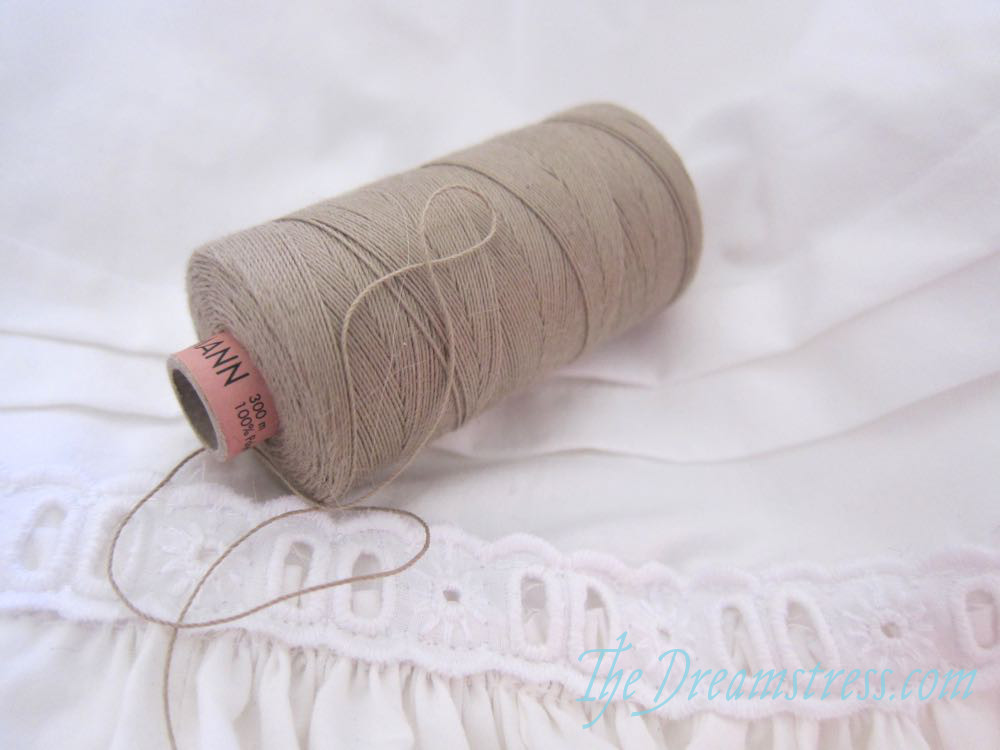
  • A thin, strong cord for gathering, such as heavy-duty  thread, dental floss, or fishing line.
  • Thread, scissors, a sewing machine, etc.

How to sew corded gathering & ruffles thedreamstress.com

A note on cord choices:

I like to use heavy-duty thread for my gathering, because I prefer the way it feels as I work with it.  I also like that it’s (or at least can be) a natural fibre, so there are no synthetics left in my garments if I choose to leave it in.  Unlike finishing line, heavy thread will have minimal effect on the overall fall of your garment if left in.

Many people prefer to use fishing line because it’s much harder to catch in your stitching, and easier to pull out when you are finished.  I don’t like to use it because I  hate the way it feels  running through my hands (it gives me the same heebie-jeebies as fingernails on a chalkboard), but that’s a weird personal things.  There is also the small possibility that if you do hit the fishing line as you stitch, you’ll cut right though it, and have to start over, whereas you can unpick and rescue your gathers if you stitch through the thread.

Dental floss works well, and is useful because almost everyone has some around the house (hopefully!).  It pulls out easily, doesn’t affect the fall of the finished garment, but can be caught in the stitching.

All of the types of cord  have advantages and disadvantages, experiment and pick the one you like working with best.

Preparation:

Set your sewing machine to a fairly tight, medium height zig-zag stitch.  On most sewing machines your stitch length should be between 1.5-2.2, and your stitch width (height) should be between 1.5-3.

How to sew corded gathering & ruffles thedreamstress.com

Tie a nice BIG  knot in one end of your cord, 10ish cm / 4ish inches from the end of the cord, so you have a little tail to hold on to:

How to sew corded gathering & ruffles thedreamstress.com

If you are gathering in a large amount of fabric (say, a huge skirt, or a ruffle for a petticoat), divide your fabric into at least four sections, and mark the start/end point of each section.  Then, measure out a  length of cord as long as  you want the finished gathered length of fabric to be, divide your cord into four sections, and mark  the start/end points of each section on the cord.  Pilot Frixion pens work great for marking the cord and fabric.  The marks will help you to gather the fabric to the correct length as you sew.

And now, for the gathering:

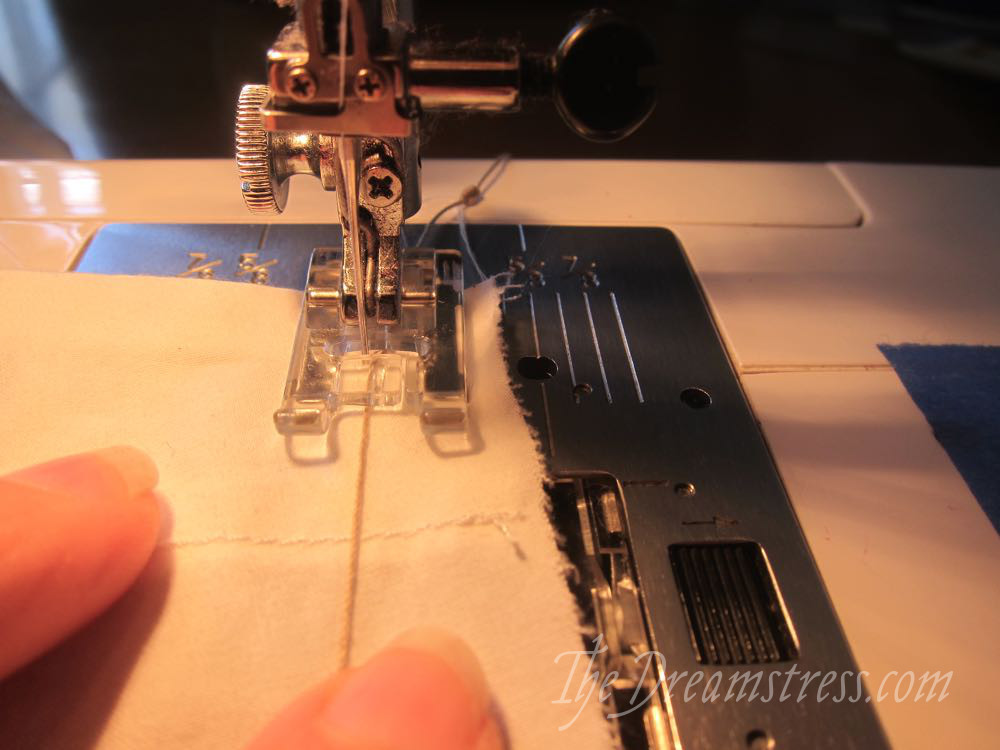
You’re going to be zig-zag stitching over the cord, just within the seam allowance of the fabric.

Place the edge of your fabric at the 1cm / 1/2″ seam line (assuming your garment to sew has a standard 1.5cm / 5/8″ seam allowance – you want the gathering to be in the seam allowance), and place the cord so it runs directly between the inner and outer edges of the zig-zag stitch.

How to sew corded gathering & ruffles thedreamstress.com

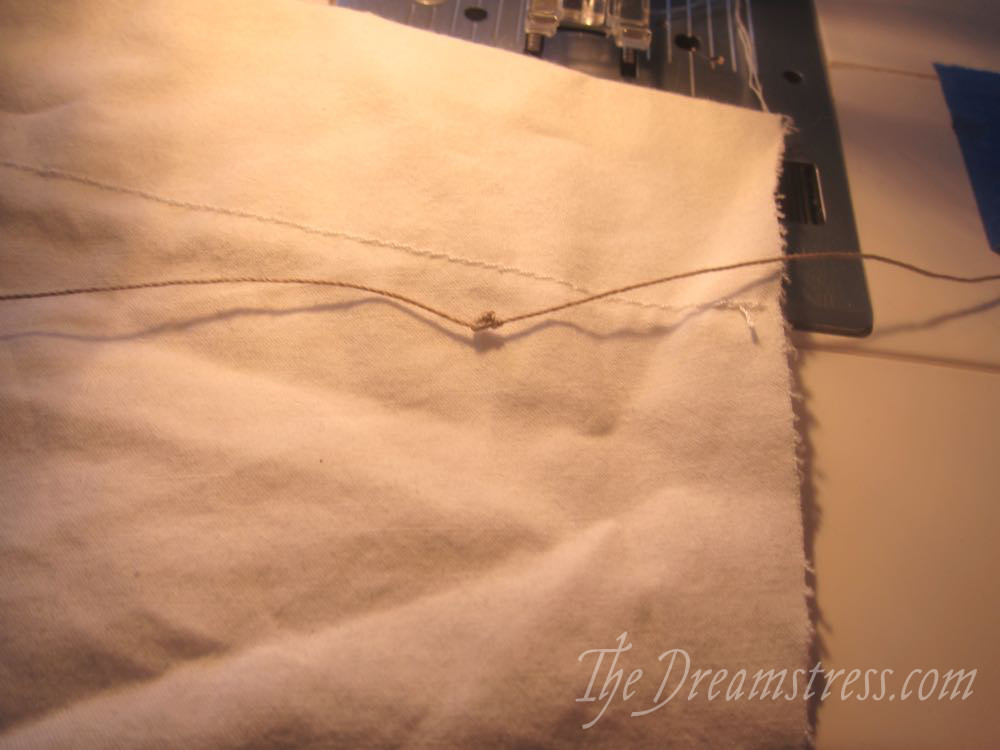
Start stitching, backstitching at the beginning, and making sure that your zig-zag stitches fall on either side of the cord, enclosing the cord in stitching.  Make sure that you do NOT sew through the cord at any point, as you won’t be able to gather along it if you do.

Here is what it should look like:

How to sew corded gathering & ruffles thedreamstress.com

As you sew, pull on the cord from the front, to gather in the fabric over the cord as it comes out from behind your foot.

How to sew corded gathering & ruffles thedreamstress.com

Use the marks on your cord and fabric to make sure you are gathering the correct amount for each section.

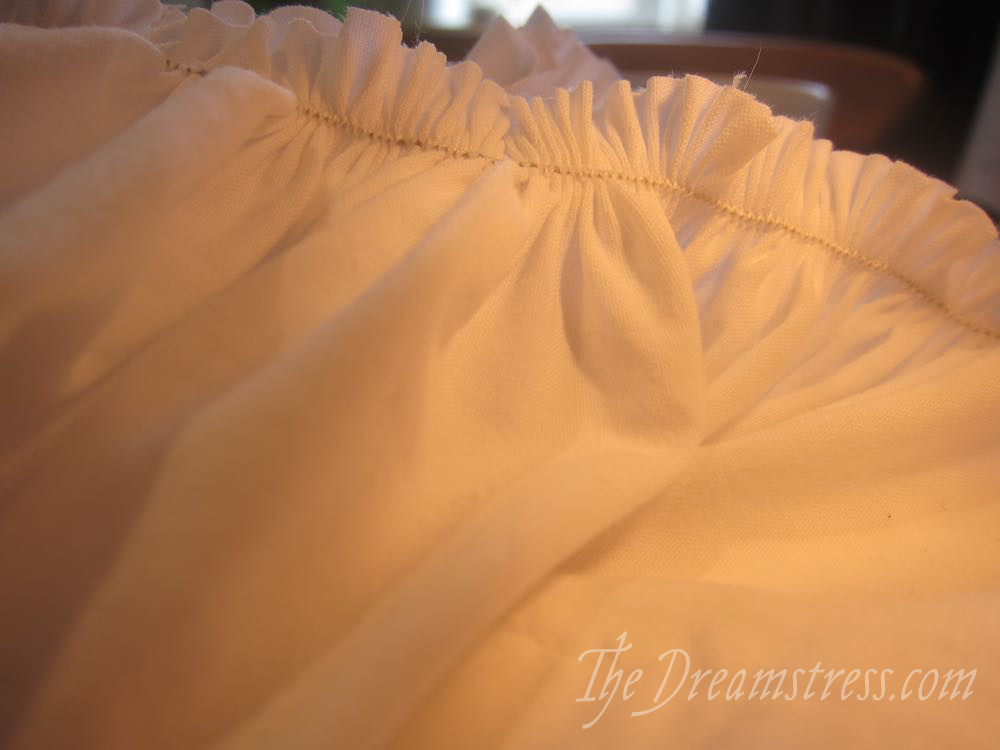
Here is what the finished gathers look like:

How to sew corded gathering & ruffles thedreamstress.com

See how neat and crisp they are!  Now all you have to do is attach them to your skirt, waistband, dress etc!

How to sew corded gathering & ruffles thedreamstress.com

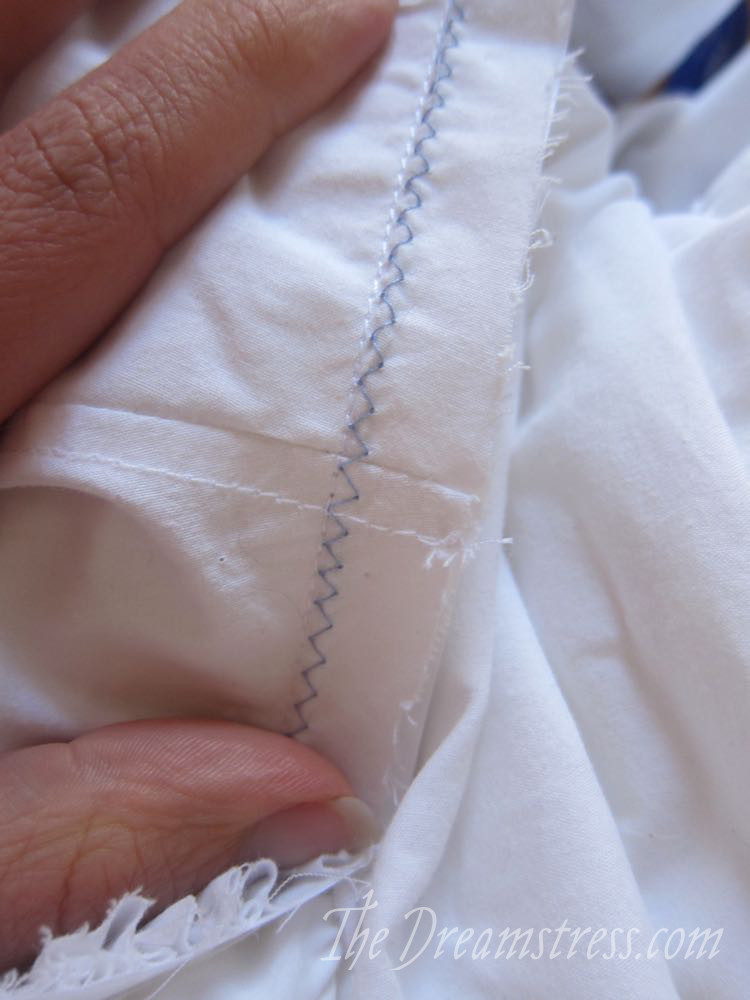
When you attach them, be sure to sew just below the zig-zag stitching, so it doesn’t show through on the right side of the garment.  After you have sewn your gathered fabric on to a waistband etc, you can pull out the cord you used for gathering.

Here I have sewn the gathered fabric on to the waistband (I’ve shown the un-gathered section, because it is easier to see).  Note how my stitching is below the zig-zag corded stitching, so it doesn’t show on the outer finished garment:

How to sew corded gathering & ruffles thedreamstress.com

For ruffles on a petticoat, I use lace or beading to cover the raw edges of the fabric:

How to sew corded gathering & ruffles thedreamstress.com

If you don’t want to have raw edges that need covering, use the fold method of cord gathering (see below for more info).

The zig-zag technique  works for almost all applications, and almost all fabrics.  It is not, to the best of my knowledge, a historically accurate technique (zig-zag stitching was not available on most machines until the 1950s), but it’s quick, easy, painless, and makes beautiful ruffles.

You can also do cord gathering by folding your fabric over a cord, stitching close to the cord using a zipper foot, and then gathering the fabric along the cord like a drawstring.  I’ve described that method of cord gathering in much greater detail in this tutorial.  I have seen the second method of cord gathering on at least one garment from the early 1900s, so it is period accurate to that era (though uncommon).  It does not, however, work well on heavier fabrics, nor does it work for any type of gathering where you don’t have an edge to fold over.

How to sew corded gathering & ruffles thedreamstress.com

Rate the Dress: Oh So Sweet 1825

Last week’s New Years Rate the Dress was a glam-but-slightly quirky Vionnet gown with a bow-trimmed lace overdress and a gold lame slip.  Some of you didn’t like the bows because they were bows, and some of you didn’t like them because of the under-bust placement.  Overall most of you thought it was rather fabulous, but the bow aversion  pulled the rating down to 8.3 out of 10, rather than something more impressive.

Since  the main objection to last week’s dress was the bows, which some of you dislike on principle for their connotations of little-girl saccharinity, this week I’ve picked a dress that, while it is completely devoid of bows, is in complete contrast to the sophistication and sexiness of last week’s frock by being just about as sweet as you could possibly get without covering a dress in bows.

This 1825 ball dress is pink and white, and features typical mid 1820s embellishment like heavy lower skirt trims, combined with the equally fashionable Renaissance-inspired historicism in the form of faux front-lacing, sleeves which manage to echo the hem trim and the look of slashed sleeves, and a tabbed bodice.  The whole effect is very  feminine, very sweet, and very youthful.

What do you think?  Too saccharine?  Too many elements?  Or