
Latest Posts

A tale of sewing secrets revealed…

One of the things that I really love about  fashion history is that clothes are both individual and societal stories.  There are general overall societal truths and trends, but there are also examples in every period of people creating things that were totally unique, making do, and making things up.  There are a lot of examples of quite unique innovations in early NZ fashion history, as people attempted to follow European fashions with limited resources and without access to a full range of materials and patterns.

This particular story of someone’s clever make do, and the unfortunate  reveal of their secret has always amused me.

During the recent windy weather I was meandering along Kaponga Road in the evening when I espied a fair damsel turning the Bank corner.  She wore one of those arrangements the ladies call a ‘waterfall’ which the wind blew to one side, and shewed to my horrified gaze, a neatly tied bundle of straw, doing service as an improver.

The story is recounted in  Eve Ebbet’s In True Colonial Fashion: A Lively Look at What New Zealander’s Wore.  Sadly, Ebbet  does not tell us the name of the writer, or the date (only that it was from “the years when the bustle was in fashion”).  I’m working my way through her original sources, and hope to discover more precise details.

It’s not precisely a sewing secret, but it’s still great inspiration for the Sewing Secret’s Challenge

The fair damsel’s ‘waterfall’ ensemble  may have looked a bit like this, but probably wasn’t nearly as fancy:

Walking dress, 1880s

Walking dress, 1880s

In addition to finding the original source for Ebbett’s quote, I’ve also discovered that I need to do a terminology post on waterfall bustles, as  a quick scan of sources reveals they referred to slightly different styles across the bustle era, and that the term is a bit muddled and confused – more research is needed!
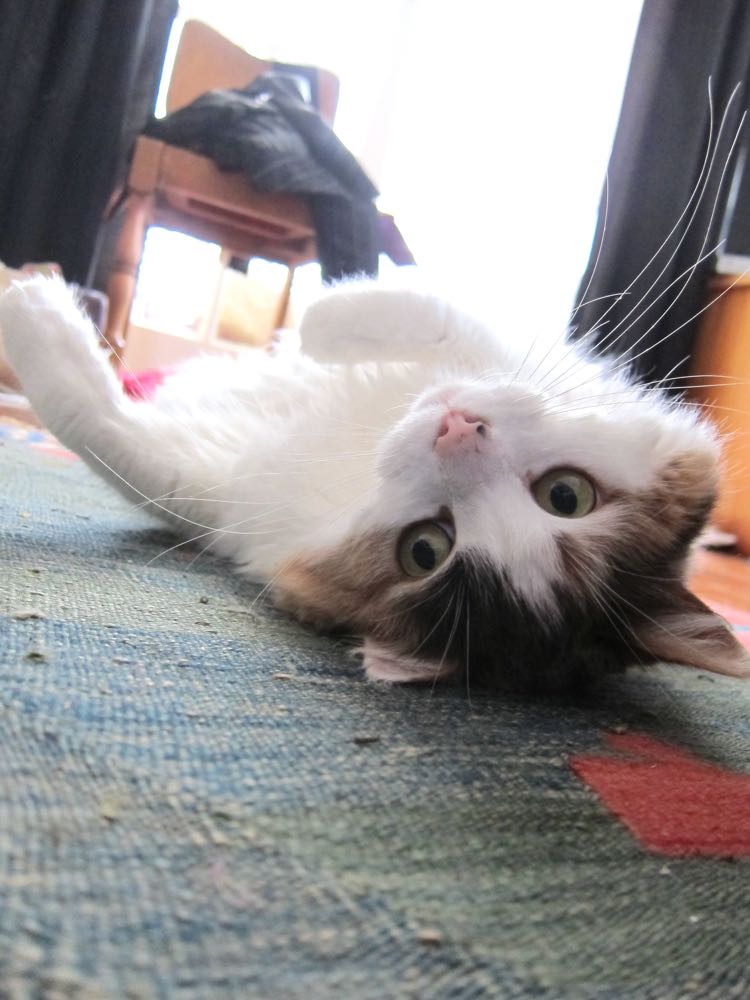
Felicity the cat thedreamstress.com

Felicity has a new trick…

It’s called ‘how to disappear and throw your people into an absolute panic.’

And she’s REALLY good at it.

It started last week Friday.  I headed off to teach my evening class, and had just finished setting up and was just about to welcome my students when my phone started getting text messages.  Mr D & I have a rule that he is only to call me when I’m teaching if it’s an emergency.

So I ignored the texts, assuming that he was just asking me to pick up bread on the way home, or something else.

But the texts kept coming, every few minutes.  And I started to get worried.  Finally I stole a moment to check my phone while all the students were on their machines, happily sewing away.

The first text message said “Did you see Felicity today?  Can’t find her anywhere”

The next one: “Are you sure you didn’t lock her outside?  She is NOT in the house”

Then:

“Not coming when I call”

“Really starting to panic”

“When did you see her last?”

Cue major panic on my part as I frantically cast my mind back to when I had last seen Felicity.

And then I remembered.  I’d seen her just before I left the house, as I locked the back door from the inside.  She was sitting by it, giving me the aggrieved look of a cat who has been locked inside and is about to be deserted.  She was definitely inside the house.

And Felicity comes when you call when she’s outside.  When she’s inside, she doesn’t bother.  She knows she’s already where she’s supposed to be, and doesn’t see what all the fuss is about, and it’s not her fault you haven’t noticed her tucked behind a cushion or lying on the floor next the guest bed.

I was just about to call Mr D and tell him this when I got another text message.  This one said:

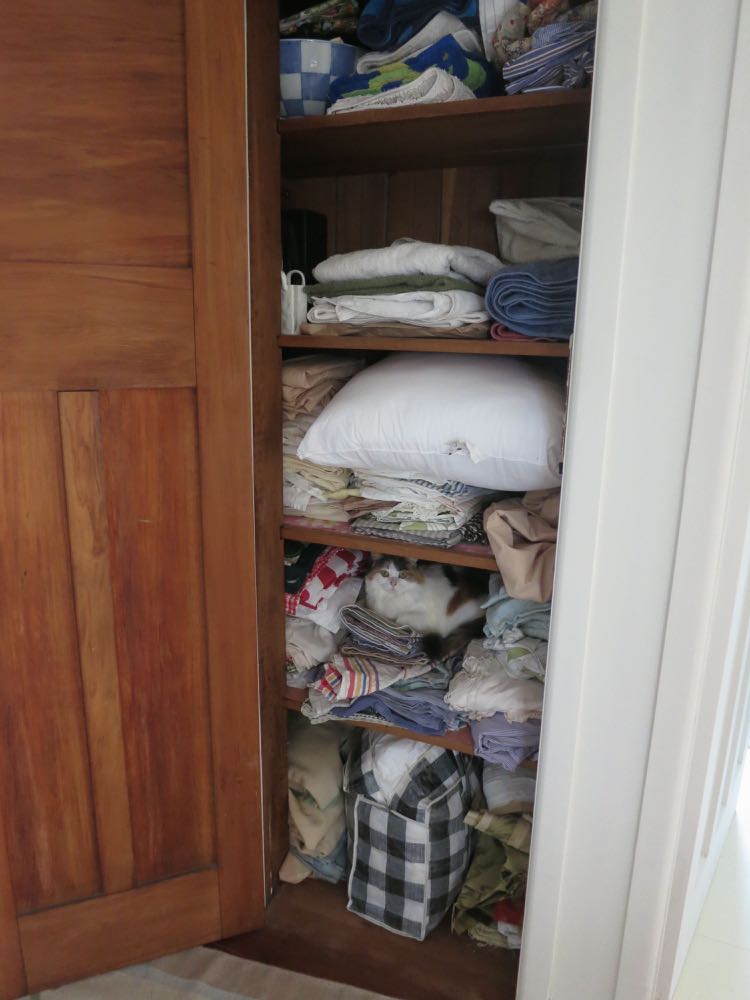
“Found.  Shut inside linen closet.”

Inside the linen closet?  How is that possible?  It wasn’t even open when I left the house, much less shut with her in it.

Now Felicity is notorious for her ability to open doors.  She hooks and pushes and bangs until she gets them to open.

But closing doors?  That’s a whole ‘nother  step!

But I certainly didn’t shut her in the linen closet…

So it was a mystery until yesterday, when I was cooking dinner.  I can just see the linen closet door from the stove, and I noticed Felicity stroll down the hall, stop at the linen closet, and begin tugging at the door.

I kept as quiet and unobtrusive as I could while she worked it open just enough to slip in.  Then I watched as she disappeared behind the door into the closet.  There was the soft sounds of a bit of rummaging around, and then a faint thump as she jumped up to the first shelf.

And then I saw one little white paw reach around the side of the door, and hook it almost shut  – so that to a casual glance it would look properly shut.

The little minx!

A few minutes later I crept up and threw open the linen closet door, to expose Felicity, cool as a cucumber, curled up on the sheets.  She looked up at me, so innocent butter wouldn’t melt in her mouth.  “Oh, were you looking for me?”

Felicity the cat thedreamstress.com

My cat is too bloody smart for her own good!

Rate the Dress: Chiffon, stripes & tucks ca 1900

Last week I showed you an 1880s dress, with a skirt that had been re-made from an 18th century petticoat.  You were almost unanimously in favour of the petticoat – though not necessarily remade into a 19th century gown, a bit of re-use which frankly, horrified some of you!  The more recent additions to the ensemble got mixed reviews.  Some of you REALLY didn’t like it (it’s hard to get past our modern sensibilities that see quilting like that as a home furnishing look, rather than a clothing look), and some of you REALLY liked it.  The dis-likers brought the score down to a still very positive 8 out of 10.

This evening dress by obscure French designer Raoul Lafontan features the soft, romantic, slightly transitional 1900s  silhouette, with the bodice moving from the more fitted 1890s style, towards the full pigeon breast of ca. 1904.

The bodice fullness may be slightly restrained, but the colours, fabrics, and other design details are heading intp full-blown Edwardian mode.  The dress is made from fabric striped in chiffon and eu-de-nil satin, with the chiffon sewn together in tucked pleats for most of the skirts, only releasing to its fullness near the hem.

The dress is trimmed in eau-de-nil chiffon and a gauzy ecru fabric, looped  round the neckline in asymmetrical swags, and bound around the arms in a style that evokes Greek & Roman drapery.

There is a slight suggestion of fading and darking in the fabrics of the dress, so it may have been slightly lighter and brighter originally, though the golden ecru and palest eu de nil were certainly fashionable shades in the first five years of the 20th century.

What do you think of the dress?  I think we can all agree that Lafontan  displays exceptional technically mastery in this dress.  But does that make it a good design?

Rate the Dress on a Scale of 1 to 10