Latest Posts

An erudition of books*

And I’m back!  Apologies for mostly disappearing from the blog for the last couple of weeks: I’ve been knee deep in The Project and simply haven’t had time to write posts.  I’m over the biggest hurdle of The Project (and it’s amazing) but it will still be a couple of weeks before I can show you.  In the meantime, I’ll be back to entertaining you with sewing and cats and travel and pogey bait on a regular-ish basis.

Today: literary pogey bait!

I have had the most fabulous luck with books in the last few months.  Between op-shops, online auctions and generous friends I have accumulated a stack of delicious examples of the written word: from reference books to novels.
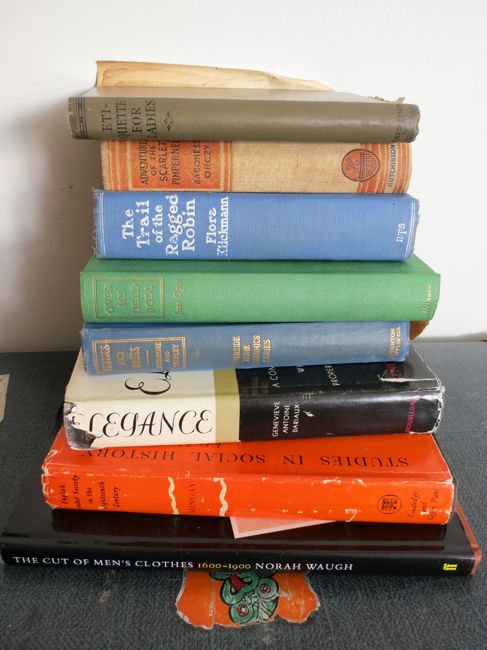
An erudition of books thedreamstress.com

Starting at the top, Etiquette for Ladies (found at a local op-shop for $5) from the between-the-wars period gives advice on how to behave when being presented at court to Queen Mary, what to give as gifts for people going away to live in the Dominions (light coloured parasols and riding crops being good choices), and how to write wedding and dinner invitations.  It also provides notes on how to cope with the newly relaxed post-war manners.  What a fabulous glimpse into the changing world of the 1920s!
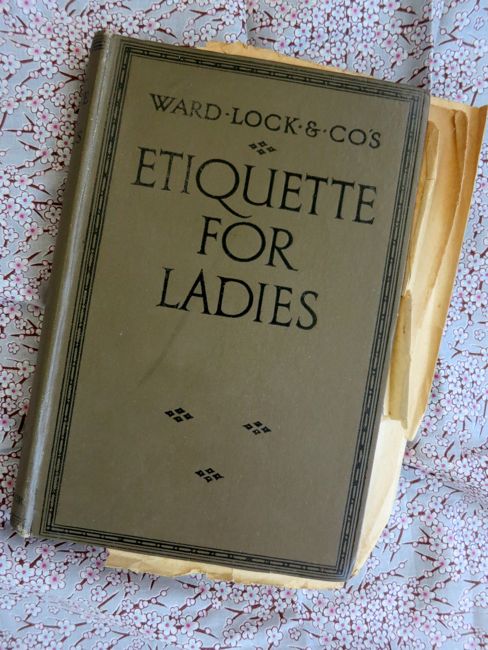
1920s Etiquette for Ladies thedreamstress.com

Slipped inside it is a 1930s guide to table manners, with delicious illustrations.  Here is a preview, and I’ll show you the whole thing presently:

!930s table manners thedreamstress.comLook at those outfits!  I want to make every single one of them, and then get a group of friends together to recreate the picture!

Next down are three bits of lighter reading.
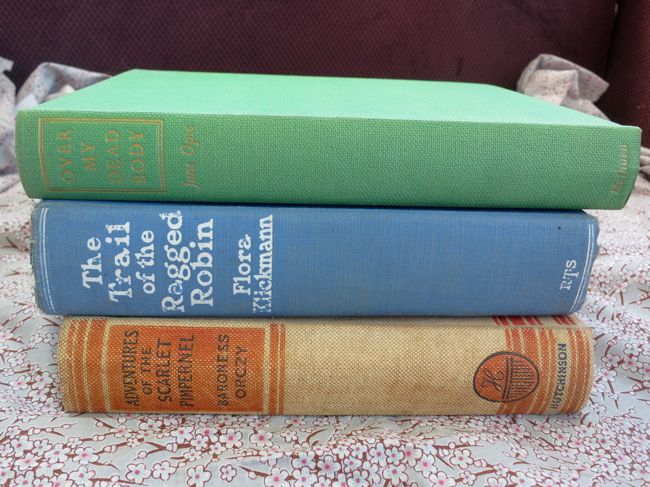
An erudition of books thedreamstress.com
First, June Opie’s  Over My Dead Body.  I thought it was a murder mystery, but for 50 cents I was willing to risk it if it was rubbish.  It turns out it’s the  memoir of a New Zealand woman in the 1950s, and is most certainly NOT rubbish.  I’m divided between writing a whole review on it, or just telling you to order a copy without reading ANYTHING about it, because it’s amazing, and even more so if you can read it without knowing any of the background (as I did).

Next, Flora Klickmann’s The Trail of the Ragged Robin, meaning that my trio of her nature books is now complete.  Happiness!

And then a lovely old edition of The Adventures of the Scarlet Pimpernel.  Did you know there are a dozen Scarlet Pimpernel books, each more hilarious and preposterous than the last?  Plus related books about his ancestors and relations!

Quickly becoming my favourite book every is Fabrics and Dress, a 1931 home economics textbook for high-school age girls.  It has everything wonderful and delicious.  There are discussions on the follies of past fashions:
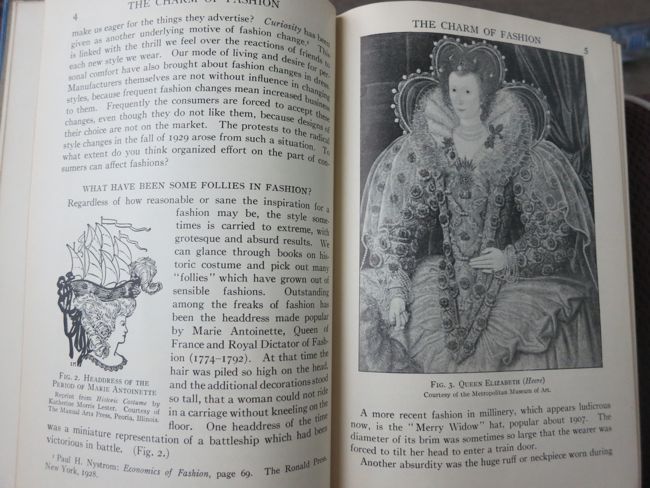
Fabrics & Dress 1930s textbook
Guides to how to wear your hair to suit your face shape:
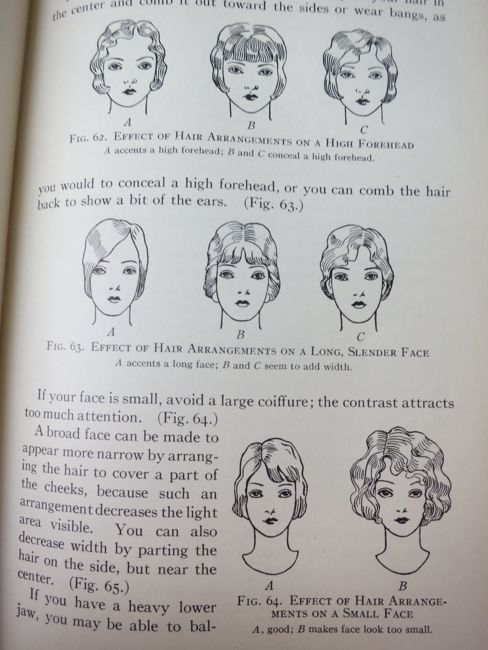
Fabrics & Dress 1930s textbook thedreamstress.com

And guides to well designed clothes (they agree with you that asymmetry is an undesirable feature in clothes!)
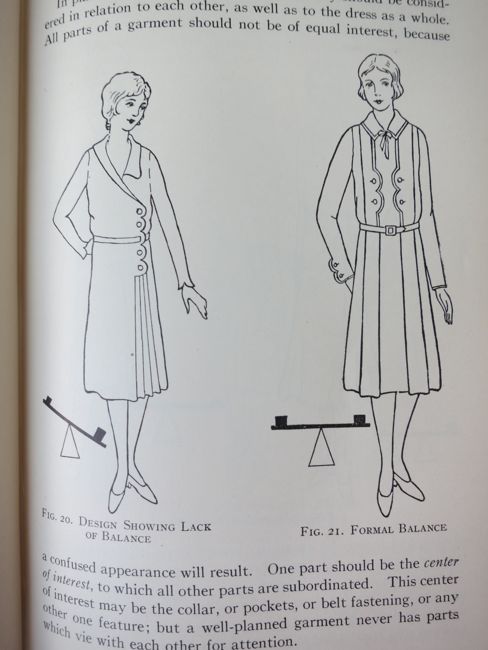
Fabrics & Dress 1930s textbook thedreamstress.com

And, of course, advice for health and grooming!

If you prefer a more recent attitude towards dress Genevieve Antoine Dariaux’s 1960s Elegance promises to be ‘A Complete Guide for Every Woman Who Wants to be Well and Properly Dressed on All Occasions’
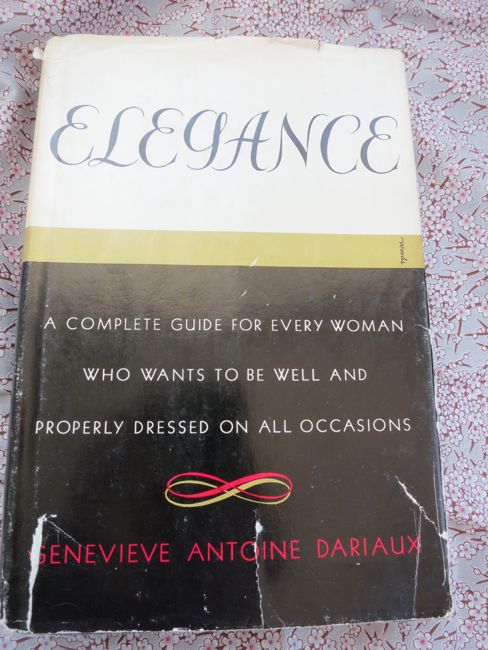
Elegance thedreamstress.com

It has advice on dress arranged alphabetically (shown are Hemlines and Husbands – the former should vary with fashion, and the latter should have no say in it!)
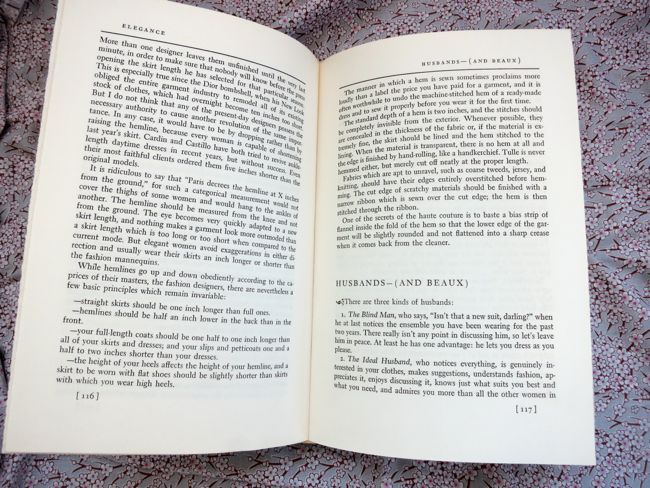
Elegance thedreamstress.com

Elegance is occasionally a bit didactic: if every lady followed it the world would be so elegant as to be boring!

Elegance thedreamstress.com

Both Fabrics and Dress and Elegance were presents from Elise, who is spoiling me far too much!

The ‘heaviest’ book in my stack is English Landed Society in the Eighteenth Century,  a steal at 50 cents (it is available as an e-book, but I much prefer paper editions).
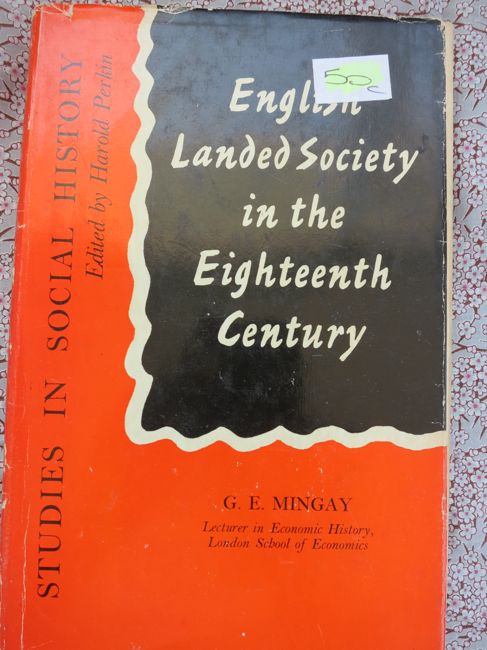
English Landed Society in the Eighteenth Century thedreamstress.com

Despite being published in 1964, the research is so comprehensive that it stands up well to modern scrutiny (unlike many older social and costume history books), and, of course, all the original quotes never go out of date.  Shown is proof that the myth of the great unwashed aristocracy of the 18th century is just that.
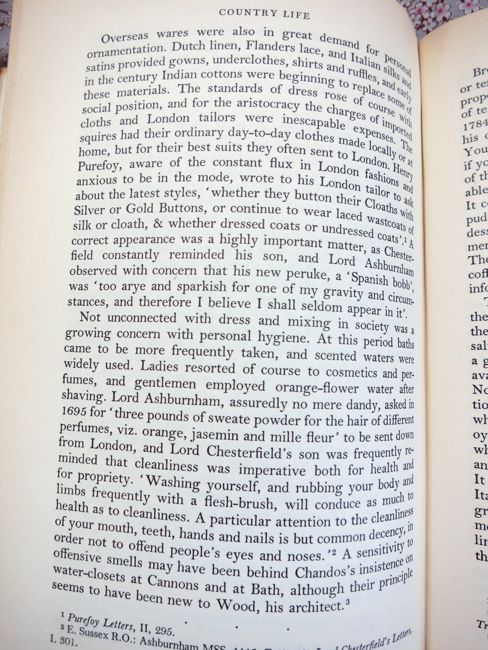
English Landed Society in the Eighteenth Century thedreamstress.com

Finally, the most expensive purchase: Norah Waugh’s The Cut of Men’s Clothes 1600-1900.  I managed to get it in an online auction for NZ$45, including shipping!  So more than 50 cents, but still an amazing deal for a Waugh!
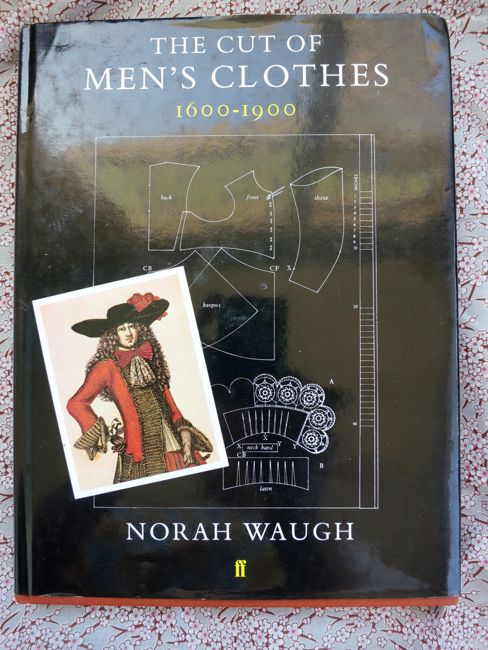
The Cut of Men's Clothes thedreamstress.com

Now I just need more bookshelves to put all my delicious readings on…

* The title is the newest addition to our list of collective nouns for costuming, literature isn’t quite costuming, but a collection of books is obviously an erudition of books!
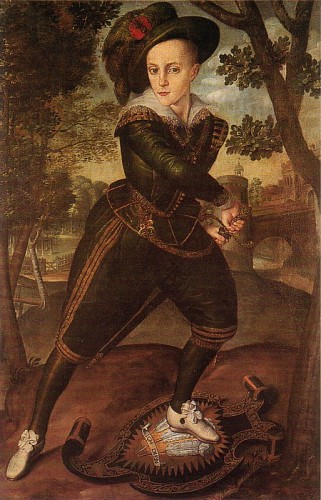
Rate the Dress: Adolescent Swashbuckling in 1608

Last week I showed you an 1880s ensemble that has been enormously popular.  There were a few naysaysers (as always) but the general consensus was extremely positive.  I haven’t tallied the votes yet (The Project has completely taken over my life and I’m afraid you aren’t likely to hear from me again for a few days more), but I’m sure it will be in the 9s.

Moving away from the feminine and the colourful, and the super popular, it’s time for black.  Early 17th century (always a worrisome era on Rate the Dress) black menswear (also problematic), to be precise.

Well, kinda menswear.  Prince Henry was between 10 and 15 when this portrait was painted.  Not exactly manly, though the tailor and Peake the Elder tried their best with the pose and costume.

Prince Henry Frederick, eldest son of James VI & I and Anne of Denmark, ca. 1608, by Robert Peake the Elder, Palazzo Reale, Turin

Poor Henry barely got to be a child, his life overshadowed by what was essentially a custody battle between his still married parents.  And he never grew up to be a man either, his life tragically cut short by typhoid at 18, which is why there was never a Henry IX of England.

What do you think of his outfit?  Princely, manly and timely, all at once?  Or just ridiculous?

Rate the Dress on a Scale of 1 to 10

The ca. 1860 Paisley Petticoat

Remember this petticoat?

Petticoat, 1855—65, American, cotton, Metropolitan Museum of Art

Petticoat, 1855—65, American, cotton, Metropolitan Museum of Art

I’ve posted it as inspiration for pretty much every HSF challenge it would qualify for: Under it All, White, Eastern Influence, Embellishment…

Clearly I’m madly in love with it, and I’ve always wanted to recreate it, but the dream seemed impossible.  I simply don’t have the time to do the amazing handiwork, and what were the chances of finding a similar fabric?

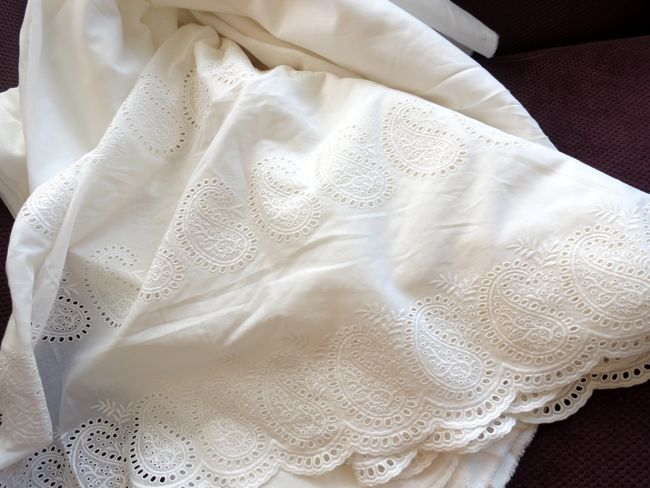
And then this arrived at The Fabric Store (yes, that’s actually it’s name):

Paisley embroidered lawn thedreamstress.com

Ah-maze-ing!

Naturally, I had to have it.  But it wasn’t exactly cheap…

I restrained myself for two days, and then had to go back to TFS for a necessity, and I saw that half the bolt was already gone.  So I bit the bullet and forked out (brace yourself when you see the price below) and bought four metres of it – which may have been slightly overkill.

I didn’t regret it, because I was in the shop again a week later and it was all gone.

I’ve been desperate to make it up ever since I found it a year ago, but there were other commitments for every challenge, and it just never happened.

Then, after I’d already finished my Smooth Sewing trousers for Innovations, I came across the fabric again, and got ambitious and attempted to make the petticoat up as a second Innovations entry (my innovation would have been bleach, and decorated underthings).  I quickly realised it was going to be much more complicated than I had planned.

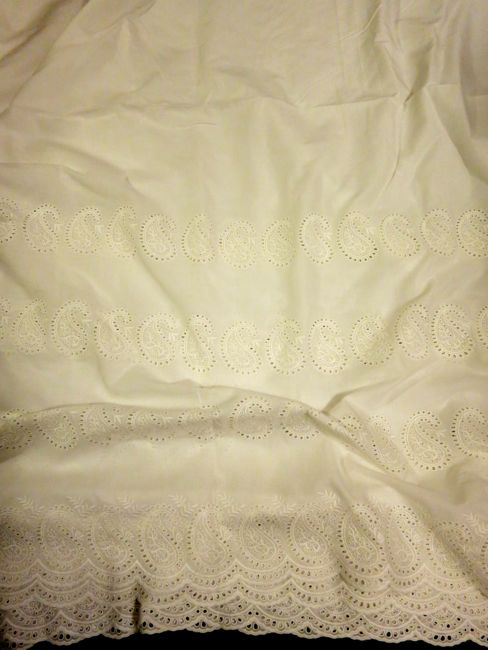
The first problem was sorting the rows of paisley embroidery.  My inspiration petticoat only has the one border, and 6 rows of tucks.  My fabric had a wider  border, and then three further rows of paisley embroidery.

Paisley embroidered voile thedreamstress.com
To best match the aesthetic of ca. 1860 originals, I cut out the two middle rows of paisley embroidery (I’ll use them to trim a matching set of chemise and drawers, or to create a faux paisley muslin shawl) and then hid the join seam in a tuck.  I’m pleased with the paisley border, double tuck, row of paisley embroidery, double tuck pattern that is my end result.

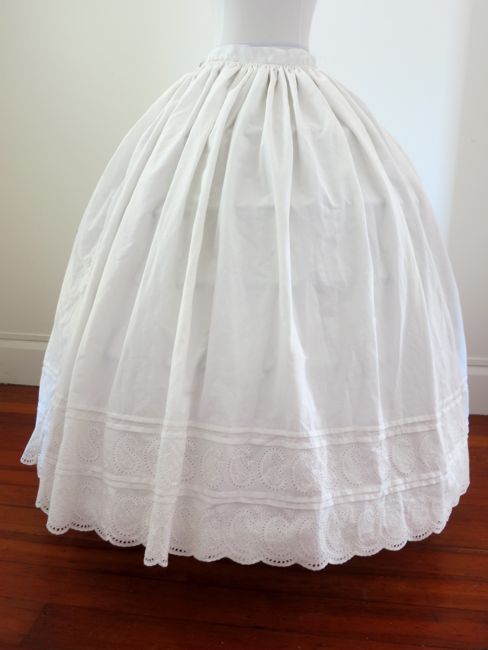
Replica ca. 1860s paisley embroidered petticoat thedreamstress.com

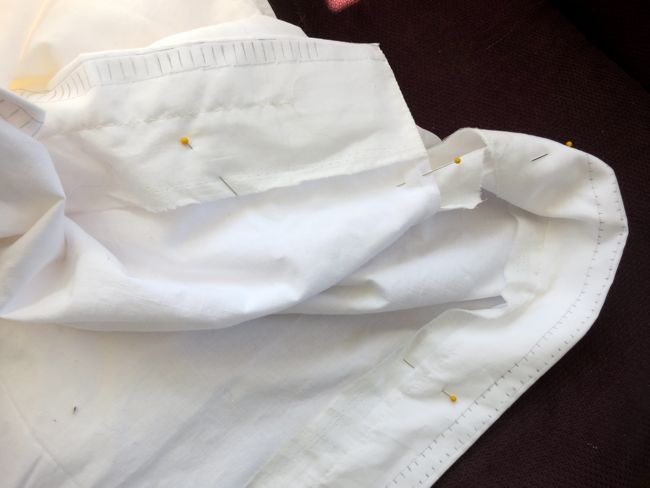
My other big problem with the weight of the fabric.  My fabric is a very light cotton voile – much finer than the fabric my inspiration petticoat would have been made out of.  So in order to get it to sit right around the waistband and to hang correctly over a hoopskit I had to add another layer of fabric with a similar hand to an 1860s original.  I ended up using a vintage cotton sheet, as none of the other white fabrics I had on hand were the right weight.  And, of course, working with two layers of fabric instead of one makes everything infinitely more difficult.

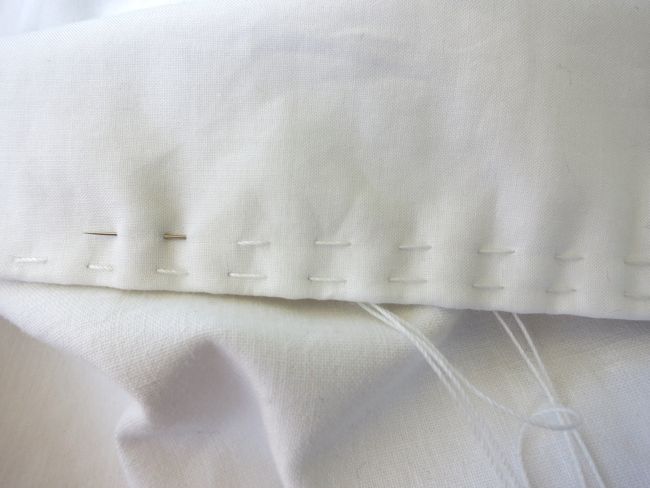
Quarter inch cartridge pleating thedreamstress.com

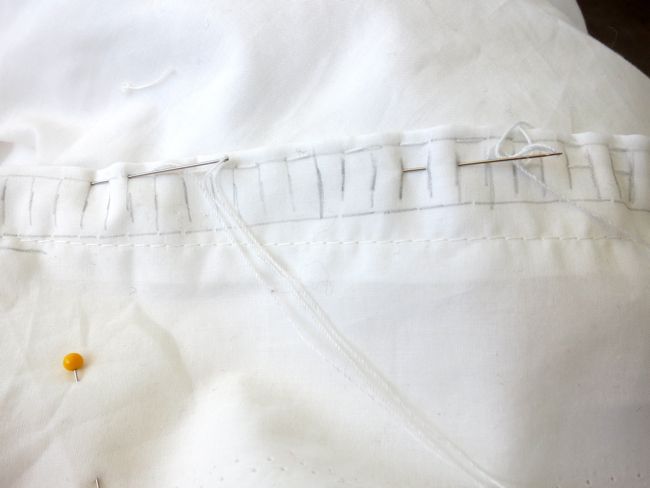
So instead of being a one-day project, it turned out to be a one-hour-a-day-for-four-weeks project!  This is what happens when you quarter-inch cartridge pleat three metres of fabric…

Quarter inch cartridge pleating thedreamstress.com

Quarter inch cartridge pleating thedreamstress.com


Annoying, yes, but the teeny cartridge pleats do look beautiful on the finished skirt:

Replica ca. 1860s paisley embroidered petticoat thedreamstress.com

Not getting it done for Innovations turned out to be a blessing in disguise when The Project arose – I had only a couple of hours of work to do the last of the pleating and hand-work the buttonhole to have it finished for Under it All.  Not quite the corset I’d planned, but so wonderful to have fulfilled my dream of a paisley petticoat!

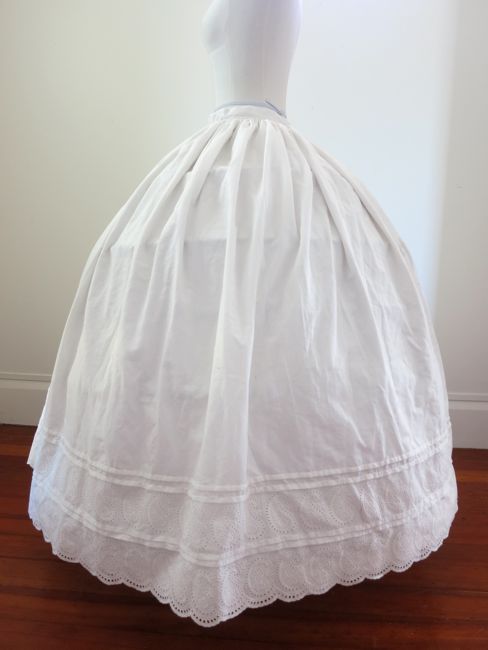
Replica ca. 1860s paisley embroidered petticoat thedreamstress.com


Seeing it on the hoopskirt reminds me that it really is time for me to make a new, proper, and slightly smaller, set of bell hoops.

The Challenge:  #4  —  Under it All

Fabric:    3m of paisley border-print cotton voile ($25 per metre, but I’m counting it as $15pm, because the rows of paisley embroidery I cut out would easily by $5pm as trim – that’s fair, right?), plus a vintage sheet ($4 at an op-shop)

Pattern:  None, just based on squinting at period examples.  I think 3 metres may have been slight overkill in width though.  

Year: ca. 1860, just like the original it is based on.  I wanted it to fit in with the most extreme hoopskirt silhouette, and to come from a time when a mix of hand and machine sewing would have been plausible.

Notions:  Thread, a fabric lingerie button ($2 for 50 at an op-shop, so 4 ¢ a piece – score!)

How historically accurate is it?  The aesthetic is spot on, but the fabric is far too lightweight to be period accurate, and I know of no examples of double-layer petticoats from this period, so 60%.  Getting your fabric right in hand, as well as fibre content, is so important…

Hours to complete:   21.  I’m a very slow cartridge pleater!

First worn:  Not yet, but I’m enjoying admiring it on Isabelle!

Total cost:  $49.04

Replica ca. 1860s paisley embroidered petticoat thedreamstress.com


Replica ca. 1860s paisley embroidered petticoat thedreamstress.com