Last week’s summer suit proved difficult for many of you. You wanted it to be one thing or another, and struggled with the transitional silhouette, neither Edwardian pigeon-breast, nor Empire-Revival, nor later-teens tailoring. Or you struggled with the colour – too neutral, too drab, too boring. Or you struggled with the embroidery – too drooping, too unflattering on a large busted woman (so unfair! Not all dresses can be made for large-busted women! There has to be something for us flatties to wear!). And yet, after listing all the things you didn’t like about it, many of you gave it very high ratings, and it came in 7.4 out of 10. It was an outfit that you liked in spite of yourself.
I had an incredibly difficult time picking something for this week’s ‘Rate the Dress’. My last few picks haven’t been very popular, so I didn’t want to pick something too obviously problematic, but at the same time, there isn’t much fun in showing you one of the historical costuming ‘best-sellers’ that has been recreated half a dozen times, and which everyone already knows and is madly in love with. In my attempts to find the perfect item I ended up with 14 different tabs open, with options ranging from medieval gowns to 1950s evening frocks.
One of my brilliant ideas for a Rate the Dress was something in Schiaparelli’s famous shocking pink. What could be pinker for the HSF pink fortnight, right? Problem: no one can seem to agree on which shade was shocking pink, and none of the things that I thought were the most likely candidates were very interesting.
But I did find this Schiaparelli dress, and it is pink, and it is fascinating:
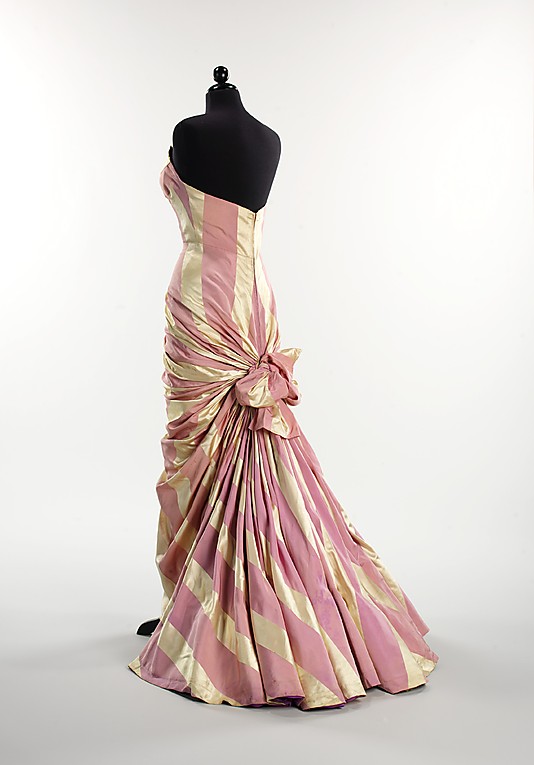
Evening dress, Elsa Schiaparelli, ca. 1948, French, silk, Metropolitan Museum of Art, 2009.300.2923
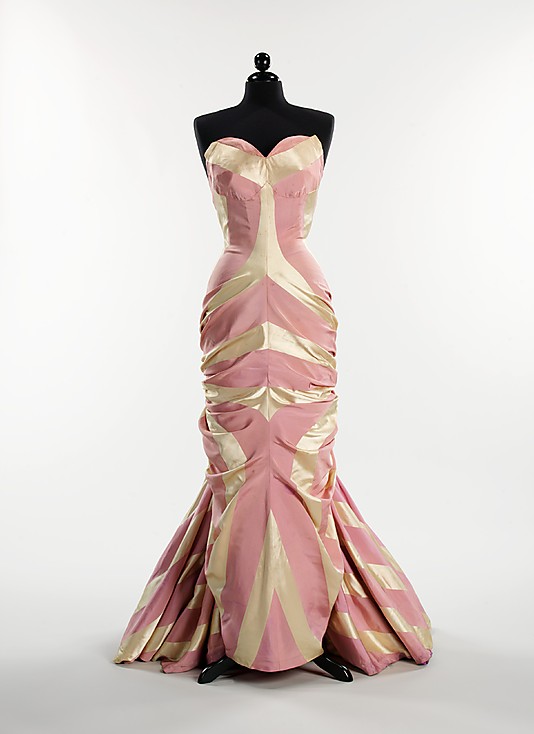
Evening dress, Elsa Schiaparelli, ca. 1948, French, silk, Metropolitan Museum of Art, 2009.300.2923
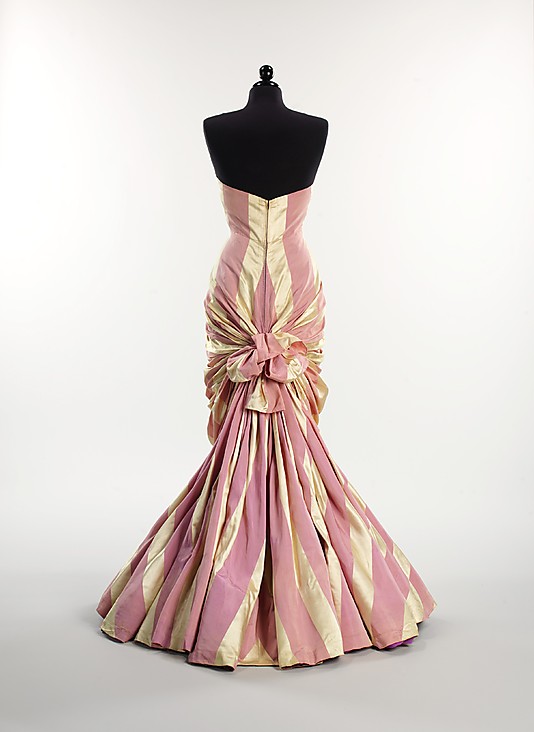
Evening dress, Elsa Schiaparelli, ca. 1948, French, silk, Metropolitan Museum of Art, 2009.300.2923
In this dress Schiaparelli combines ivory satin and lavender-pink faille into a frock that celebrates the female form and two of Schiaparelli’s biggest design influences: Victorian fashion and Surrealism. The slim silhouette, draping lines and low-bustled back emphasis evoke late 1870s natural-form dresses. The front view, with its curved bottom skirt, give a nod to Schiaparelli’s obsession with lobsters, and the wide stripes hint at the skeleton beneath all the layers of dress and flesh.
The frock is certainly challenging: it’s sweet meets surreal, avant-garde and decadent, all at once. Too much? Or was Schiaparelli up to the challenge?
Rate the Dress on a Scale of 1 to 10.