Ikat (also spelled ikkat), abr (also spelled ebru), warp-printed and chine (or chine a la branche) are different names for variants of the same technique: fabric woven from yarns which have been pre-dyed (using a resist method) or printed with the intended pattern, producing a characteristic soft, blurred pattern once the yarns are woven into a cloth.

Robe à la Polonaise of chine silk (detail) ca. 1780, British, silk, Metropolitan Museum of Art 1981.245.2
Strictly speaking, ikat and abr are created by pre-dying the threads with a resist dye method before weaving, and chine and warp-printing are created by printing the warp threads before weaving, though the line between the two different techniques, both in which fabrics are called which, and in how the fabrics are produced, is as blurred as those on the fabrics they describe.
Ikat is the Indonesian term (from the Malay mengikat ‘to bind’), and is the most commonly heard name for the fabric in modern times. 18th century fashion enthusiasts will know the French name, chine or chine a la branche, which specifically refers to multi-coloured warp-patterned fabric, and Pompadour silk, a later English term for the same fabric. More prosaically, English-language sources also call it by the technical description of ‘warp-printing’. Finally, there is the Turkish terms abr, which literally means ‘cloud’, an apt description for the soft edges of the resulting designs.
The ikat dyeing and weaving technique goes back millenia, and was developed independently in different parts of the world: there are very old examples from Japan, Indonesia, Turkey, Yemen, and pre-Columbian South America.

Fragment from an Ikat Shawl, late 9th—early 10th century, Yemen, Cotton, ink, gold; plain weave, resist-dyed (ikat), painted, Metropolitan Museum of Art, 29.179.10
Ikat, under the name chine, became popular in Europe in the mid-18th century as part of the craze for Eastern designs and fabrics. The name chine literally means ‘Chinese’ in French, because of the fabric’s association with China and the East. Though the first examples probably did come from China, by the 1760s France was producing its own warp printed chine fabrics.

Robe à la Francaise (detail), French, 1760s, chine silk, LACMA
According to the Kyoto Costume Institute, the fabric was frequently worn by and particularly associated with Madame de Pompadour, and so is sometimes called ‘Pompadour taffeta.’ However there is a bit of doubt and confusion around this term. First did Madame de Pompadour even wear chine a la branche? If Madame de Pompadour did ever wear a dress of chine silk, she would have been on the forefront of the fashion (which is, of course, entirely fitting with her character) as the first examples of chine silk gowns date from the mid-1750s. Pompadour died of tuberculosis in 1763.

Dress of chine silk, 1755—65, French, silk, Metropolitan Museum of Art, 50.168.1ab
The first usage of the term, in English, not French, of course, dates to 1762, when Mr. Clarke “dressed in pompadour, with gold buttons; and his lovely Dolly in a smart checked lutestring, a present from her mistress” are mentioned in Smollet’s ‘The Life and Adventures of Sir Launcelot Greaves.’ However the fabric described by Smollet may not have been a chine taffeta at all, but a different fabric altogether. Further references to fabrics as Pompadours confuse the matter even further. Almost ever decade of the 19th century called a fabric ‘Pompadour’, usually meaning something that combined flowers and stripes, though the ground ranged from wool to dupion to specifically black. When reading a reference to Pompadour silk/taffeta/chine it’s difficult to tell exactly what fabric is meant by the reference.

Robe à la Française, 1760—70, French, silk, Metropolitan Museum of Art C.I.60.40.2
In 1768-9 the barely-teenage Marie Antoinette was painted in a gown of chine silk in a portrait that was sent to her prospective bridegroom so that he could see his intended bride. The gown in the portrait is more fashionable than grand, and Marie Antoinette wears no jewels except for the ubiquitous pearls. It’s an interesting portrait: the gown gives an impression of culture, worldliness, knowledge. Or perhaps her gown was just meant to give a subtle nod to France’s textile industry, as the chine for Marie Antoinette’s dress was likely have to been woven there.
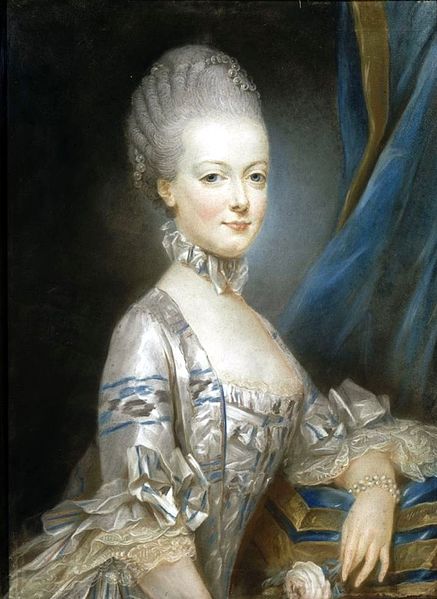
Marie Antoinette in a dress of chine a la branche, at the age of thirteen; by Joseph Ducreux (1769)
Chine silks reached the heights of their popularity in the 1770s & 80s, and though they were still considered exotic, and certainly luxurious, they were far more likely to have been made in France than in China. France was even weaving chine combined with velvet: an incredibly difficult, and thus expensive, process.
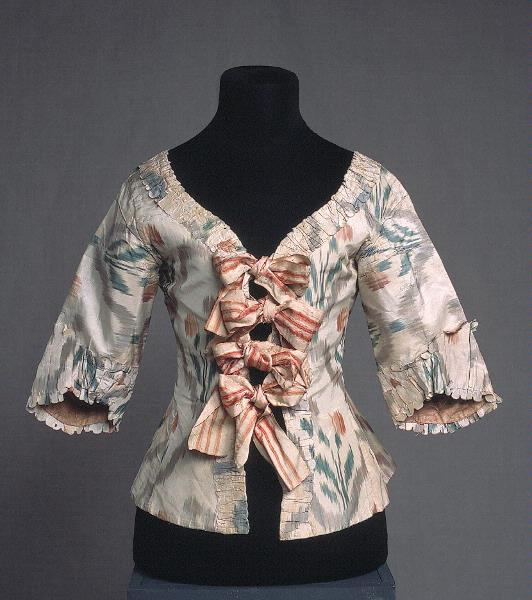
Jacket, late 18th century, Kulturen
Chine gradually fell out of fashion in the 1790s, though there are a few examples of chine, both in silk and, more unusually, in cotton, in Regency dress, and 18th century chine fabrics were likely re-used throughout the 19th century.

Evening overdress, 1797—99, British, silk, linen, Metropolitan Museum of Art, 2009.300.219
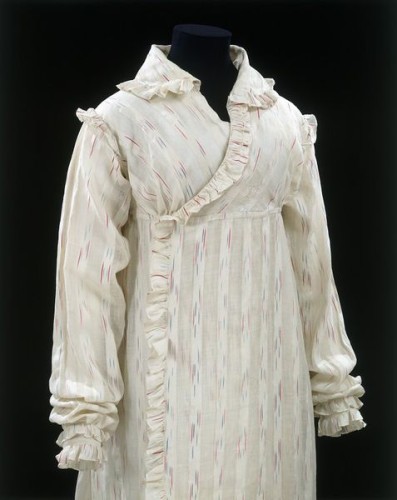
Peignoir, India (fabric) Great Britain (garment), 1812-1814, muslin dyed in the ikat technique, T.798-1913 V&A Museum
Chine saw a major re-surgence in popularity in the 1840s-1860s. In contrast to the larger, softer, more abstract chines of the 18th century, or the very simple geometric chine of the first decades of the 19th, mid-19th century chine silk tended to be more literal; with smaller, brighter, easily recognisable floral patterns.

Gown of warp printed silk satin, late 1840s, Augusta Auctions
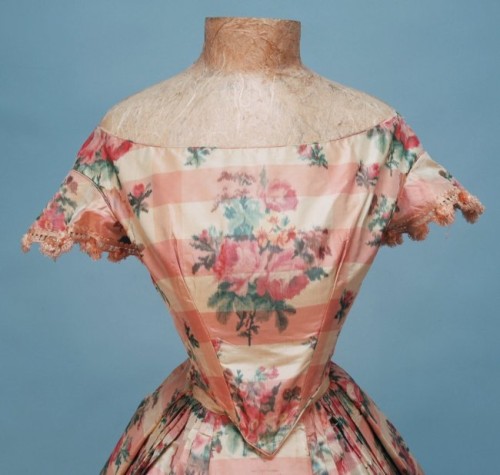
Ball gown, warp printed silk, 1840s, Whitaker Auctions
In 1859 Theodore de Banville described an old woman “dressed in the most irritating height of fashion. Over a dress of pompadour taffeta in white with designs of flowers, fruit and birds she wore a tulle mantelete, striped in velvet with two great flounces in chantilly lace.”

Dress of chine silk worn by Sofia of Nassau, Queen of Sweden, circa 1850, Royal Armoury Collection, Sweden
Though it never returned to the popularity it had enjoyed in the late-18th and mid-19th century, chine fabric and ribbons continued to be used in fashion throughout the 19th century, and were produced in France into the early 20th century. The flower strewn Jean-Phillipe Worth dress that you found so charming as a Rate-the-Dress was made from chine silk.

Evening dress (detail of bodice), House of Worth, Jean-Philippe Worth, 1902, French, silk, rhinestones, metal, Metropolitan Museum of Art
Ikat, as a term, wasn’t used in English until the 20th century, but has since become, along with warp-printing, the most widely used and recognised term for the technique. While chine lost its original exotic connotations, ikat continues to be used in fashion and furnishing to evoke a distinctly ethnic and organic feel.

Cocktail ensemble of ikat, Bonnie Cashin (American, 1915—2000), Eunice Cashin (American) 1957, silk, wool, Metropolitan Museum of Art, 2009.300.3285
There is also a very rare variant of ikat, double-ikat, where both the warp and weft threads of the fabric are pre-dyed.
Sources:
Cumming, Valerie and Cunnington, C.W.; Cunnington, P.E, The Dictionary of Fashion History (Rev., updated ed.). Oxford: Berg. 2010
Fukai, Akiko. Fashion : the collection of the Kyoto Costume Institute : a history from the 18th to the 20th century. Köln [etc.]: Taschen. 2002. p. 56.
Scott, Phillipa. The Book of Silk. London: Thames & Hudson Ltd. 1993
“Printing of Silk Warps for the Manufacture of Chine Silk”. Posselt’s Textile Journal. December 1907. Retrieved 12 December 2012.