A few weeks ago, when I wrote about the difference between kerchiefs, buffonts & fichus, I posted a picture of a ‘fichu en marmotte.’

Gallerie des Modes et Costumes Français. Jeune Dame coiffee d’un Bonnet rond avec un fichu en marmotte, un Ruban en rosette, une Polonoise et un mantelet blanc, 1788
We had a bit of discussion about what a fichu en marmotte actually meant, and why it was called a marmotte, and where the term might have come from. I was pretty sure that a marmotte actually referred to a marmot, but did the headscarf and the rodent have anything to do with each other, and why?
Being me, I kept wondering about marmots and marmottes, and kept digging and researching, and I am pleased to say I have figured out why a fichu en marmotte is en marmotte.
It turns out that fichus en marmotte are named after marmots, in a roundabout way.
In the 17th & 18th century peasants from the alpine region of Savoy would train marmots and dance with them as street entertainment.

Petits metiers, cris de Paris (Street vendors of Paris), Claude-Louis Desrais (1746-1816) (Nanette, the hurdy-gurdy Savoyarde and the dancing marmot are shown in the last two sections)
Yes. You read that right. 18th century. Streets of Paris. Dancing groundhogs. DANCING GROUNDHOGS.

Savoyarde with a marmotte, after Watteau, François Boucher, Wikipedia
Basically they were a precursor to the more-famous organ grinders with monkeys of the 19th century. Only, y’know, with GROUNDHOGS.
Right. So why were alpine marmots dancing in Paris anyway, and what does this have to do with headscarfs?
Mid-17th century Savoy had a strong link to France, as the Duchess of Savoy, Christine Marie of France, was Louis XIII’s sister. From 1637 onwards she was regent of Savoy, and the Duchy was effectively a satellite state of France. The close ties between the two countries saw her son marry two French princesses, and Savoyarde peasants, including the dancing-marmot street entertainers, travelled to Paris to find work during the economic depressions that plagued Savoy. The dancing marmots were so iconic that Savoyarde peasants were soon called ‘marmottes‘ (which, if considered from a modern perspective, is horrifically un-PC.)

Jean-Honore Fragonard (1732—1806), Jeune Fille à la Marmotte (The Savoyarde organ grinder), Portland Art Museum, USA
The most notable feature of the dress of Savoyarde peasant women was a kerchief tied beneath the chin. When pastoral fashions became all the rage in mid-18th century France, the marmotte’s headscarf, along with the shepherdesses-broad brimmed hat, were adopted by the upper classes. The broad brimmed hat was literally called a shepherdess (bergere), and the headscarf, in its turn, was called after the people it was taken from: the marmottes. So a ‘marmotte‘ is simply a kerchief tied under the chin in the style of the Savoy peasants, the marmottes.

Une Savoyarde, Noël Halle, 1757

The first depictions of upper-class French women in marmottes at the end of the 1730s show them dressed as Savoyarde, organ/marmot box and all – a literal adaptation of the costume that was possibly worn as fancy dress. By the 1740s Savoyarde fashions had amalgamated with mainstream elegant peasant-wear, and were no longer just dress-ups.

Countess Christina Margareta Törnflycht Augusta, Countess Wrede-Sparre of Sundby (1714-1780) dressed as a marmotte, 1739, Gustaf Lundberg, sold at auction
When marmottes first became fashionable they were strongly linked to pastoralism, and so projected an air of bucolic innocence and alpine purity. The most proper of women could dress as marmottes, or in the marmotte fashion, without censure.
In 1751, the dauphine, Marie-Josèphe of Saxony (she of the loveliest MIL/DIL story, and one of my favourite pretty, pretty princesses), was painted in a private portrait which she gave to a friend dressed in Savoyarde fashion. The informal portrait in fashionable, rather than court, dress, represents a major departure in etiquette for a French dauphine, but Marie-Josèphe was pregnant with the heir to the throne, was a court favourite, and was known for her virtue and impeccable character. Her position was quite secure, so the portrait was not a risk (this is in comparison to informal portraits of her daughter-in-law, Marie-Antoinette, executed when she was in a much less secure position), and her chic alpine-inspired peasant look simply accentuated her morality.
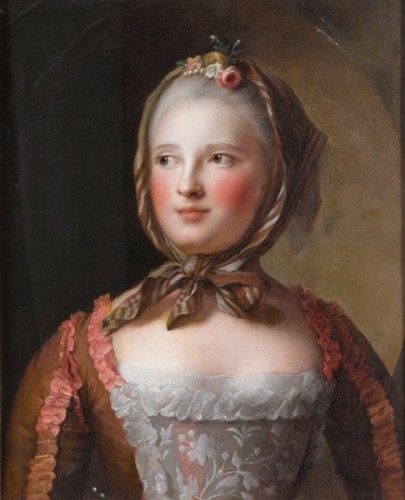
Marie-Josèphe of Saxony in the Savoyarde style, 1750-51, Jean-Marc Nattier. Palace of Versailles.
By the end of the 1750s, morality and marmottes were fast parting ways. Savoyarde peasant women in Paris were turning to an occupation somewhat older and more profitable than street entertainment with dancing marmots, and their headdscarfs became a signal of their new profession.
Rather than abandoning the marmotte once it lost its implications of pastoral purity, the decadent French court embraced its new connotations of sauciness. The scarf went from bucolic simplicity to innocence lost – with a thoroughly modern wink and nod. Rather than advertising virtue, the later 18th century marmotte (and its many elaborations) advertised fashionable daring.


By the end of the 18th century the marmotte as a fashion item had probably lost both meanings – it claimed neither rural simplicity, nor risque worldliness. Marmottes, however, remained fashionable throughout the early 19th century as simple, practical but still moddish headgear: the Regency answer to the bad hair day.
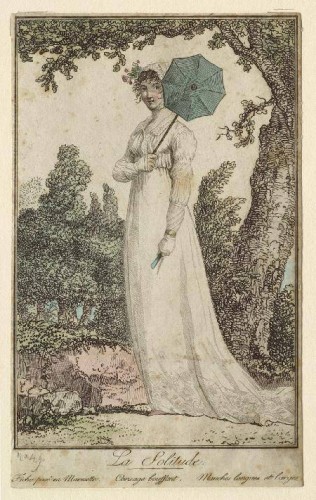
Modes et Manières No. 49 : La Solitude (Fichu pose en Marmotte. Corsage bouffant. Manches longues et larges), Debucourt, Philibert-Louis, 1755-1832, 1801
Marmottes were so ubiquitous and useful that it was used as a word for headscarf at least into the 20th century in certain regions of France. Marmotte also became a synonym for ‘winding’ particularly around the head (obviously because the kerchief is wound around the head).
The Savoyarde musicians, with or without marmots, also continued past the 18th century. This charming early 19th century fabric shows a street musician, still in her characteristic headscarf, entertaining a young family with a dancing animal:

Petite Savoyard or La Reconciliation Date- 1815—25 Culture- French (Nantes) or (Rouen, possibly) Medium- Cotton, Met
In this 1860s cartoon, the street musician with his rodent (though the marmot has become a mouse) is very much the symbol of Savoy. The woman asks “Little Savoyarde, what have you done with your white mouse?” and the musician replies “He’s here madame, but now he’s French so he’s taken on the national colours”. The cartoon is a commentary on France’s annexation of Savoy in 1860 as part of the Treaty of Turin.

In addition to being a fascinating early example of alpine-inspired fashion trends, the Savoyarde movement added one further word to the French vocabulary. Marmotte was also used to describe a rectangular travelling case that resembled the boxes that the original Savoyarde musicians used to carry their marmots in. The term seems to have added to a bit of artistic miscommunication, which added to the confusion of attempting to research this term.
So what happened? Well, Watteau produced a number of sketches depicting Savoyarde musicians in the early 18th century. Some, like this sketch of a female Savoyarde in her scarf, do not include a marmot, though the box with a breathing hole is clearly for carrying a small animal.

Some of the sketches clearly showed the marmot on top of the box. Usually called ‘Savoyarde avec sa marmotte‘ (Savoyarde with his marmot), the sketches were widely reproduced as engravings and by other artists. Boucher copied one (his version is the second image in this post), and he presumably had actually seen a Savoyarde and knew what a marmotte actually was, so included a marmot in his version. The English artists who copied Boucher copying Watteau were unlikely to have seen a marmot, were not privy to this information, and assumed that the marmotte was solely the box itself, and interpreted the dark lump on the box as part of the musicians sleeves, rather than seeing it as a small furry animal. Thus we have museums that translate Watteau’s ‘Savoyarde avec sa marmotte‘ as ‘Savoyarde with his box’ or ‘Savoyarde with his travelling case’, completely ignoring the marmot sitting on the box!

Sources: