There are historical costumers who like making corsets, and there are those who don’t. I am definitely in the ‘likes making corsets’ group.
I love making corsets – I love the fitting, I love the precision, I love the scope for playing with really lux fabrics that you couldn’t afford for a full garment. I love that they don’t have sleeves, and I love that even the fanciest corset is usually pretty minimalist – the trim on finished garments is really where I get bogged down. Most of all, I love them for what they do to your overall look. A corset is a foundation garment; it is the foundation to your outfit. Without the right corset, your outfit just won’t look right.
I’ve made many corsets over the years, mostly from my tried and true personal corset pattern, which does 1870s-1890s well. However, I always love trying new patterns, and there is one pattern I’ve long meant to try. Well, not one pattern, one specific style of corset. There are a whole swathe of 1890s corsets made from nearly identical patterns, with no gussets at bust or waist, and long princess seams running up and down the body.

Corset, Worcester Corset Company (American, 1864—1950) ca. 1893, American, cotton, metal, bone, Metropolitan Museum of Art
Salen’s Corsets: Historical Patterns & Techniques has a pattern for this exact style of corse. The late 1880s corset pattern from Corsets & Crinolines (the corset the pattern is based on is also shown in Corsets: Historical Patterns & Techniques) is another example of the type. I’ve also studied a couple of 1890s corsets with very similar shapes and makes. Based on these examples, I amalgamated a pattern that had all the characteristics I wanted.

Late 1880s corset pattern from Norah Waugh’s Corsets & Crinolines
Along with the princess seams, my pattern has separate top-stitched boning channels, a slight sweetheart neckline, and cording across the bust – all typical of corset styles from 1890-1900.

Corset, 1890s, French, silk, Metropolitan Museum of Art
My corset is made from black silk satin (recycled from a vintage obi).
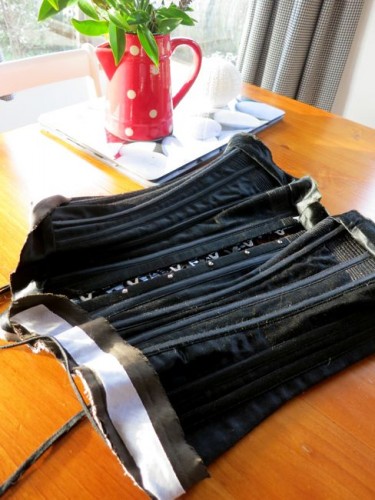
I’ve lined it with a fantastic baroque inspired quilting cotton. Isn’t it fabulous?
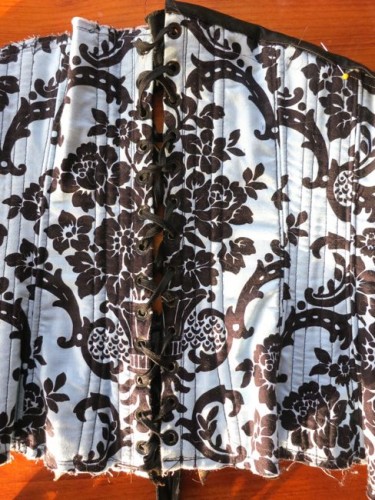
Due to fabric constraints, I didn’t match the lining pattern all the way around the corset, but I did manage a full vase of flowers centred on the back lacing, a full vase centred on the front lacing, and full vases on the side pieces.
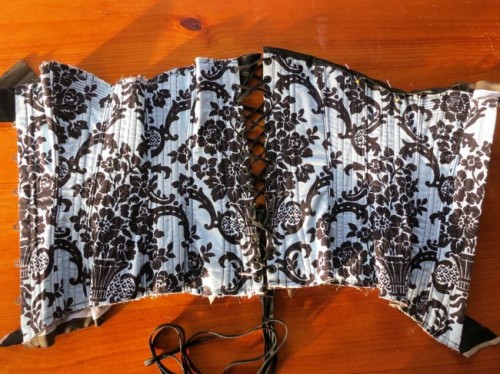
Plus this perfect bit of matching at the side-front seam. Go me!
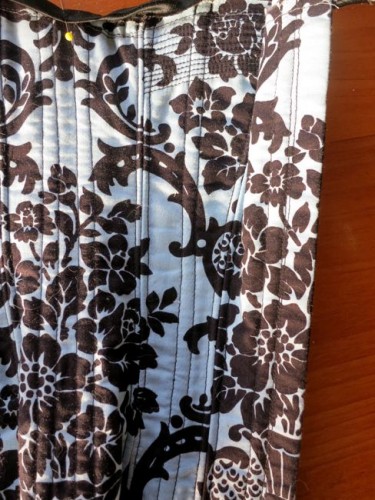
Sadly, the patterned cotton lining isn’t period-accurate, but corset linings is one place where historical accuracy doesn’t bug me. It doesn’t affect the wear and shape of the corset in any way, it’s completely invisible when the corset is worn, and it makes the corset more fun to wear and sew.
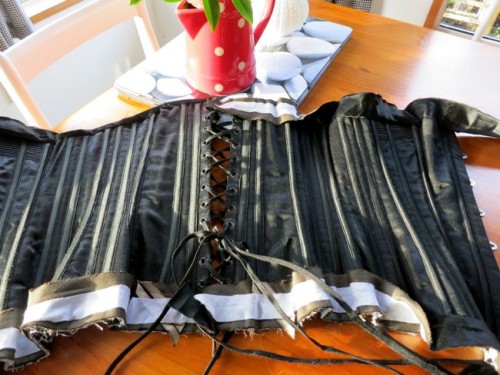
Because I’m trialling the pattern and don’t expect it to be perfect, I’m using this corset as an opportunity to try some variants in my corsetmaking techniques. They are mostly things that students have asked me about when making corsets (“hey, what happens if I do it this way?”). There is no better way to answer those types of questions than to try myself, find out, and know with certainty.
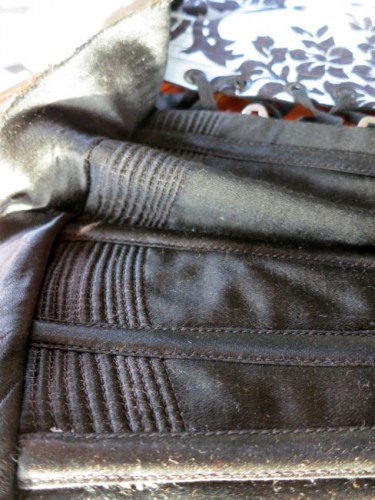
In terms of design, my pattern is extremely close to the Corsets & Crinolines pattern (and the Salen pattern, and the two corsets I studied (really, they are so similar!). Based on corsets I studied, I’ve placed my cording right along the upper edge of the corset – rather than lower on the bust, as in the Corsets & Crinolines pattern. The choice was primarily aesthetic based – I simply thought it looked better.
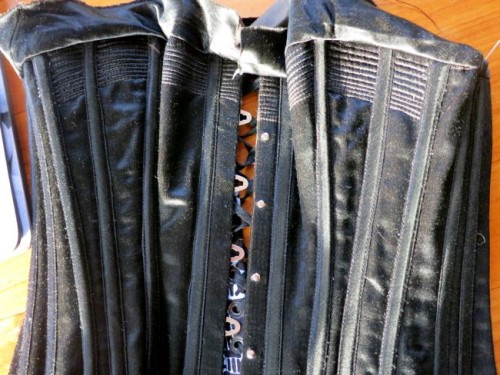
As you can see, it’s almost done! I’m spending this weekend re-doing and sewing the top and bottom binding, and trying to source lace trim for it, though I won’t be heartbroken if I can’t find the right lace.