Latest Posts

Making an 18th century fur muff – the actual sewing

Once I’d figure out a design for an 18th century fur muff that seemed historically plausible (clearly it wasn’t going to be perfectly accurate, as I was using a repurposed 1940s fox fur sleeve as my base) it was time to sew.
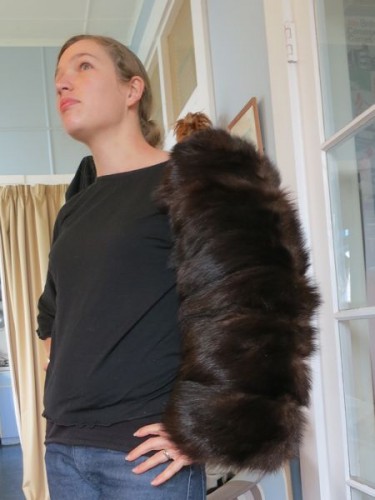
Fur sleeve thedreamstress.com

To start out, I had to deconstruct the sleeve I was making the muff from.  I had assumed, based on the striped effect of the sleeve, that it was formed of fairly wide strips of fur, and the join of the strips formed each stripe.  Pulling apart the sleeve at one stripe would be very easy.

Then I investigated the inside of the sleeve.

Pieced fur sleeve thedreamstress.com

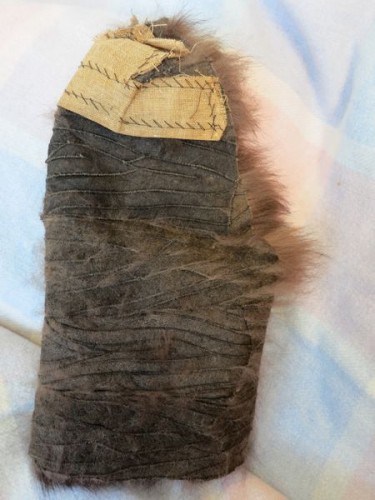
Wowzers.  It’s not large strips at all – it’s a patchwork of little-bitty pieces of fur!  Can you imagine sewing that!?!  The work put into constructing this sleeve, and piecing all those minute pieces of fur, just floors me!

This is the upper half, after I detatched the portion that I needed.  Look at all those little pieces!
Pieced fur sleeve thedreamstress.com

The sleeve head is shaped and supported by a fabric stiffener.  I’ll use a similar sewn-in interfacing on the lower part of the sleeve to help my muff retain its nice round shape.
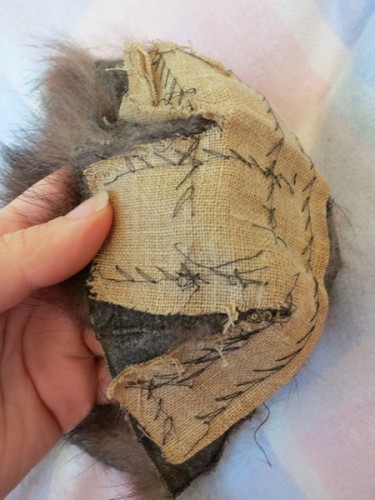
Pieced fur sleeve thedreamstress.com

Since I had to work with a crazy patchwork of fur, with seams running all over the place, rather than the straight seams I had anticipated, things got a lot trickier.  First I unpicked the bottom half of the sleeve along a series of pieces that roughly followed the line I wanted.

This turned out to be a little short in places, so I carefully cut a bit extra in a straight line (teeny, tiny super-sharp scissors are fabulous for cutting fur btw, allowing you to get in and cut only the skin, without cutting any fur).  Then I re-sewed the extra piece back on to the seams I had unpicked with linen thread.  My sewing is so messy compared to the original seams!
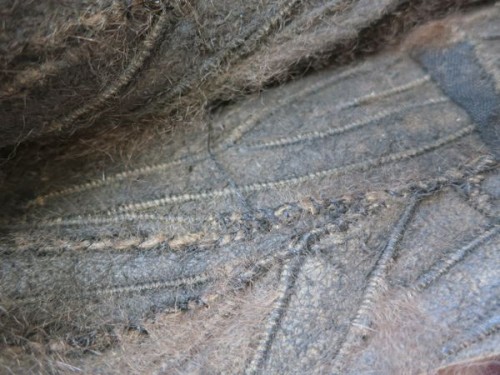
Pieced fur sleeve thedreamstress.com

Once I finally had a tube of fur from the bottom of the sleeve that was 13″ long, with a nice even top, I needed to figure out the lining.

I’d originally planned on lining the muff in white silk satin, with layers of batting between the fur outer and the silk inner.  However, when I played with this option, the layers of batting and the lining were too unstable.  How was I to keep them in place?

Then, researching mid-18th century clothing, I had a brainstorm.  There are a number of examples of garments made from re-fashioned quilted petticoats.  What would you do with any extra pieces of quilted fabric?  Line a muff?  It’s stretching the bounds of plausible, but not entirely beyond the bounds of possibility.

Quilting my lining would have two advantages: one, it would keep the batting and lining firmly where I wanted it to be, and two, it would give me a chance to trial the type of quilting I would do on a full quilted petticoat.

So tempting…

And then, I had the final brainstorm.  I could quilt my lining in a scale pattern.  It would be a ‘Fur & Scales’ muff!

The quilting, done in blue silk thread on white silk satin over two layers of wool batting, actually went very quickly.  A full quilted petticoat is definitely a possibility.
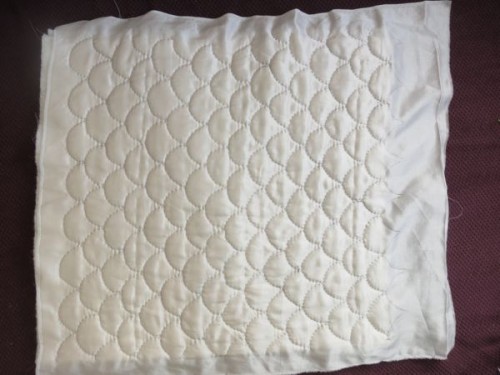
Scale pattern 18th-century inspired quilting thedreamstress.com

The only thing that gave me any problem was that I started my scale pattern in the middle of the 13″ x 24″ piece of fabric.  Drawing and sewing scales up – super easy.  Drawing them down?  Not nearly as easy!  My pattern gets a lot less tidy as it goes downwards.  At least now I know to start my petticoat pattern at the hem and draw upwards.
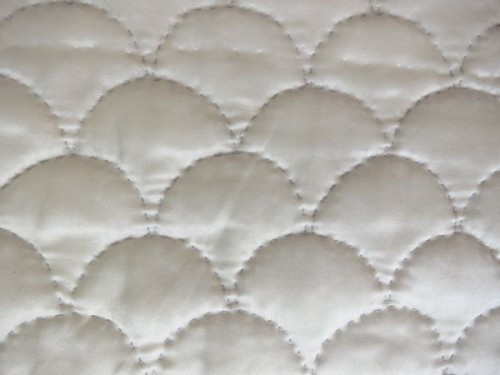
Scale pattern 18th-century inspired quilting thedreamstress.com

Once I had finished my quilting, I rolled the quilted fabric into a tube, folded under one raw edge, matched the quilted scales as best as possible (not very well I’m afraid), and whip-stitched the join down.
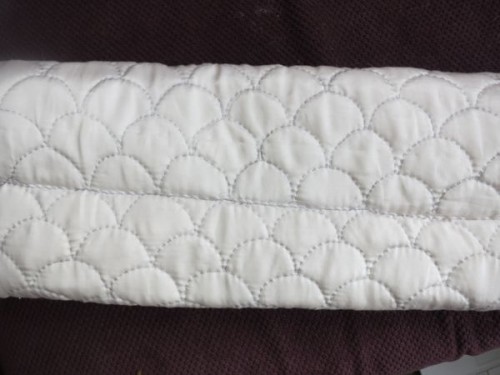
Scale pattern 18th-century inspired quilting thedreamstress.com

My whip-stitched join:

Scale pattern 18th-century inspired quilting thedreamstress.com

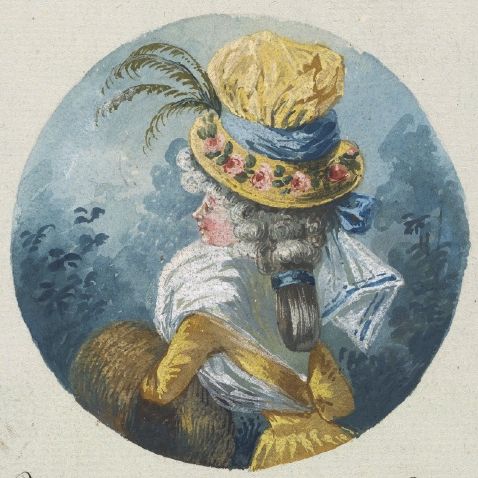
With my lining constructed, I had one last thing I needed to do before I sewed the lining to the fur.  I loved the look of the later 18th century muffs with bows sewn into the fur:
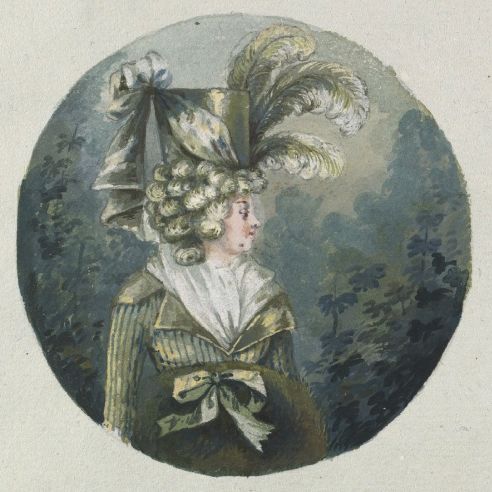
Costume Sketches,  Anonymous, French, 18th century, Possibly connected to Antoine Caire-Morand (French, Briançon 1747 - 1825 Turin),1785-1790, MFA Boston

Costume Sketches, Anonymous, French, 18th century, Possibly connected to Antoine Caire-Morand (French, Briançon 1747 – 1825 Turin), 1785-1790, MFA Boston

However, I didn’t want to make the muff un-usable for a different decade, nor was I willing to commit my muff to one distinctive colour scheme.  Also, a ribbon bow would soon get soiled and crushed.  Sure, I could baste one on and take it off and replace it, but I had a better idea.
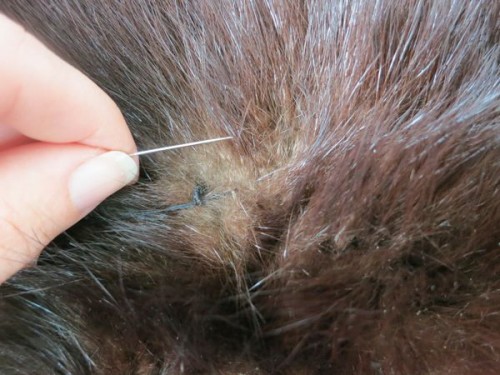
Working a bow-loop into a fur muff thedreasmtress.com

Using heavy linen thread, I worked a loop into the fur on the muff.  It disturbed the fall of the fur slightly, but it’s quite subtle, and now I can slip any colour of ribbon I want through it, tie it in a bow, and replace it for a different outfit or if it gets crushed and dirty.
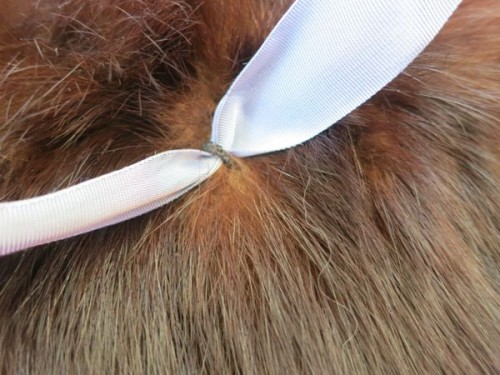
Working a bow-loop into a fur muff thedreasmtress.com

With the loop sorted, I was ready to put the whole muff together.  I turned the quilted satin tube inside out, slid it into the fur tube, folded one edge of silk satin under, and whipstitched the fold to the cut edge of the fur.
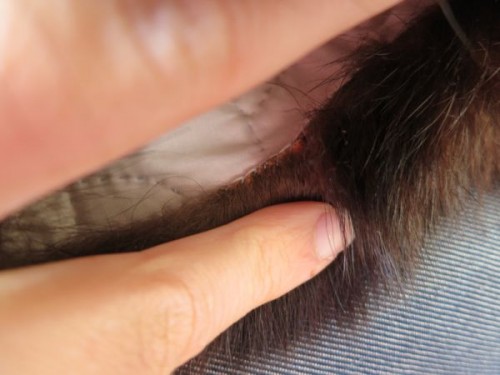
Sewing the quilted lining to the fur

Once the fur and lining were firmly sewn together I tugged the lining past the other end of the tube, making the fur at the sewn end double back on itself slightly, forming a lovely fur brim to the muff.

Since I had the turned and finished fur hem of the sleeve end to work with on the other side, I didn’t need to worry about how to form a fur hem on that side.  I just turned my lining under, tucked the raw edges in, and whipstitched the lining to the turned end of the fur.
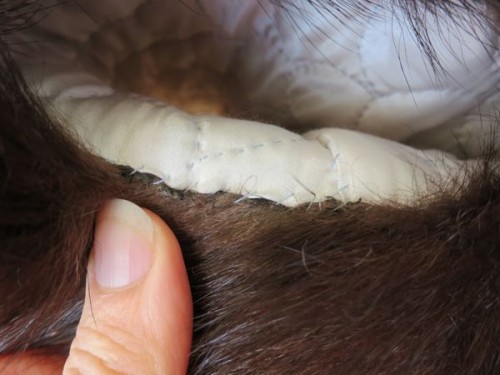
Sewing the quilted lining to the fur thedreamstress.com

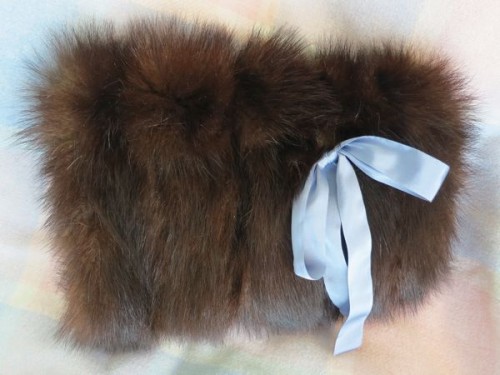
Ta da!  Done muff!

Reproduction 18th century fur muff thedreamstress.com

Isn’t it pretty?  I’m so pleased with it and proud of myself!  And look how beautiful the lining looks:
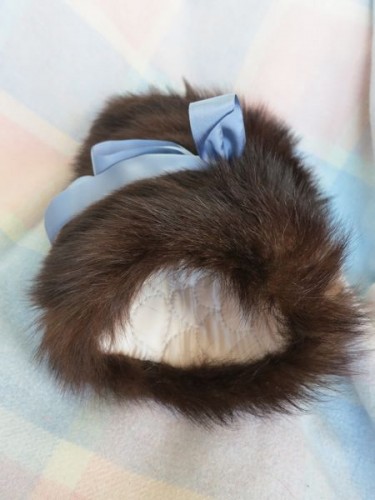
Reproduction 18th century fur muff thedreamstress.com

I’m hoping to do a photoshoot this weekend with my muff, and the other thing I am making for Flora & Fauna (Oooh…), but that will depend on the weather, and if I can get someone to be the photographer, and I also promised Mr D I would do something fun with him (and in his books historical photoshoots don’t count, as they are ‘me’ time, not ‘us’ time!).

Also, since we are on the topic of quilted petticoats, boy do I have an exciting post to write…

Making an 18th century fur muff – the research

As I mentioned before, I wanted to do a really complicated project for the Flora and Fauna HSF challenge, but alas, I couldn’t find the right fabric.  Instead, I’m saving my energy for two big upcoming projects, and making some fun little things that will make current or future outfits fabulous.

The first of these is an 18th century fur muff.  The wonderful Lynne gave me a fur sleeve which had come off of her mothers 1950s fur coat a month ago, and I noticed how wide the lower sleeve was, and how it was a perfectly even tube for the last 14cm, and thought “Ooooh…super easy fur muff.”

Fur sleeve thedreamstress.com

Fur sleeve thedreamstress.com

Famous last words…

But that was all in the future.  First I needed to do a little research on 18th century fur muffs, to determine what the usual dimensions were, if my fur was plausible, and what they were lined with.

After quite a bit of research, I’ve found depictions of 18th century fur muffs ranging from the early 1760s, up to the end of the century.  Unfortunately I haven’t found a single extent 18th century fur muff, so I’m going to have to base mine off what you can see in paintings, and extrapolate the rest from 18th century fabric muffs.

In looking at 18th century fur muffs I came to the conclusion that while there were extremes of fashion in muffs, there was also a standard muff size (the logical, practical muff size) in fur muffs that was used throughout the century.

Here is Madame Sophie in 1762 with a lovely dark fur muff.  The texture of the fur, and the slight ridges and valleys in the fur, are very similar to my fox fur sleeve.  On a woman of my size, a muff the same proportions as Madame Sophies would be between 12″-14″ long, and at least 24″ in circumference.  It’s a bit hard to tell as you can’t see the bottom of the muff.

Madame Sophie de France (1734—1782) François Hubert Drouais (French, Paris 1727—1775 Paris) Date: 1762, Metropolitan Museum of Art

Madame Sophie de France (1734—1782) François Hubert Drouais (French, Paris 1727—1775 Paris) Date: 1762, Metropolitan Museum of Art

As the century progressed, muffs tended to get larger.  Madame Mole Reymond’s fantastic 1780s brown fur muff that is definitely a bit larger than Madame Sophie’s muff:

 Mme Mole Reymond by Elizabeth Vigee-Lebrun, 1787

Mme Mole Reymond by Elizabeth Vigee-Lebrun, 1787

And while this muff isn’t quite as exaggerated, it is on a slightly larger scale:

Costume Sketches,  Anonymous, French, 18th century, Possibly connected to Antoine Caire-Morand (French, Briançon 1747 - 1825 Turin),1785-1790, MFA Boston

Costume Sketches, Anonymous, French, 18th century, Possibly connected to Antoine Caire-Morand (French, Briançon 1747 – 1825 Turin),1785-1790, MFA Boston

While larger seems to have been most fashionable, there are enough depictions of smaller muffs in the later 18th century to make me think that they were still reasonably common:

Robe de matin à l'Anglaise avec des manches en amadis jupon coupe à grand volant de mousseline fichu à double garniture Cette femme est coëffee d'un chapeau de Vegogne a long poil avec un ruban au tour, Gallerie des Modes, 1782, MFA Boston

Robe de matin à l’Anglaise avec des manches en amadis jupon coupe à grand volant de mousseline fichu à double garniture Cette femme est coëffee d’un chapeau de Vegogne a long poil avec un ruban au tour, Gallerie des Modes, 1782, MFA Boston

This is good, because my sleeve isn’t big enough to make an enormous muff!  And I’d love it if I could use my muff for different decades in the 18th century.

With size sorted, what to do about the lining?  There are a few fashion plates that show the side of a muff, but it’s hard to determine if the dark hole they depict indicated a dark lining, or was just the idea of a hole.  I rather suspect it is the latter.

Costume Sketches,  Anonymous, French, 18th century, Possibly connected to Antoine Caire-Morand (French, Briançon 1747 - 1825 Turin),1785-1790, MFA Boston

Costume Sketches, Anonymous, French, 18th century, Possibly connected to Antoine Caire-Morand (French, Briançon 1747 – 1825 Turin),1785-1790, MFA Boston

Costume Design or Portrait Types Anonymous, French, Possibly connected to Antoine Caire-Morand (French, Briançon 1747 - 1825 Turin), 1785-1790, MFA Boston

Costume Design or Portrait Type, Anonymous, French, Possibly connected to Antoine Caire-Morand (French, Briançon 1747 – 1825 Turin), 1785-1790, MFA Boston

Dark holes aside, the only definitive visual evidence I could find for what a muff was lined with is Lawrence’s portrait of Elizabeth Farren carrying an elegant, oversized muff. Elizabeth’s muff looks like it is lined with a white satin that matches her fashionable hooded cloak.

Elizabeth Farren (born about 1759, died 1829), Later Countess of Derby by Sir Thomas Lawrence (British, Bristol 1769—1830 London), 1790

Elizabeth Farren (born about 1759, died 1829), Later Countess of Derby by Sir Thomas Lawrence (British, Bristol 1769—1830 London), 1790

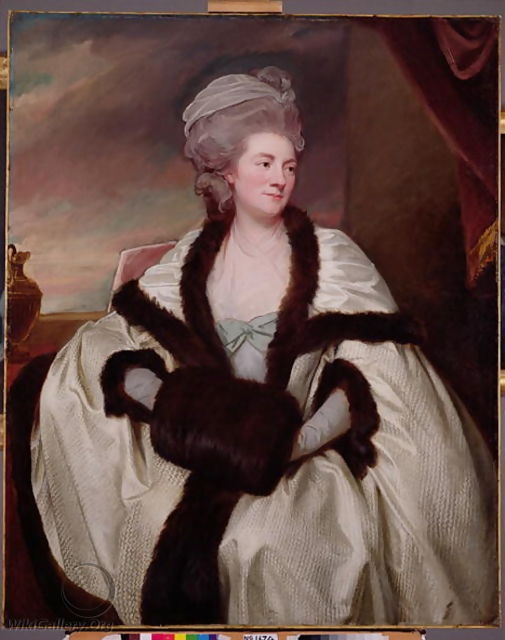
There are numerous portraits and fashion plates that show matching fur-trimmed cloaks and muffs, and presumably the lining of those muffs also matches the cloaks.  My favourite example is Mrs Wilbraham Bootle, with her beautiful fur-trimmed cloak and small brown fur muff – so close to what I hope to achieve.  I imagine her muff is lined in the same white satin that lines the hood of her cloak.

Mrs. Wilbraham Bootle, 1781 by George Romney, oil on Canvas,  National Gallery of Scotland

Mrs. Wilbraham Bootle, 1781 by George Romney, oil on Canvas, National Gallery of Scotland

I also quizzed the amazing Carolyn of Brocade Goddess as to what an 18th century fur muff would be lined with, and she suggested a thin silk.  So, as I’m trying to sew from my stash, I settled on a scrap of white silk-cotton satin left over from Carolyn’s wedding dress.

And then, as I was struggling to figure out how to keep my wool batting from moving around too much between the silk lining and the fur outer, I had a brilliant design idea, and blithely ignored all the historical evidence.

What did I do?  I’ll show you tomorrow!

In the meantime, if you want to see more 18th and other century muff goodness, check out my pinterest page.

Need more fashion history reading?  The latest issue of Glory Days magazine is out, and my article on The Bifurcated Woman is on page 36.

Rate the Dress: Jean-Phillipe’s turn-of-the-century flower garden

I had anticipated that last week’s leopard-print suit would elicit a variety of responses, and I was not disappointed.  A few of you were utterly horrified, many of you were thoroughly delighted, and some of you belonged to the camp, best expressed by Melissa, that while the outfit was the “18th century equivalent of metallic platforms, it is fabulous anyway.”  Thanks to the less impressed, the rating came down to 7.7 out of 10 – pretty good for a guy in a leopard print suit!

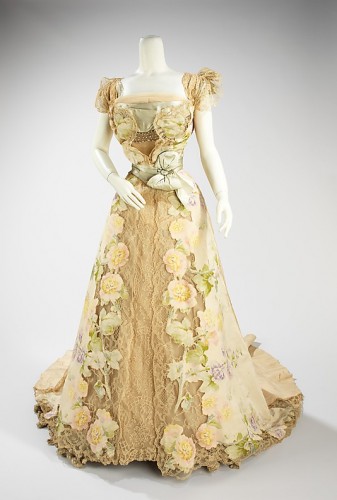
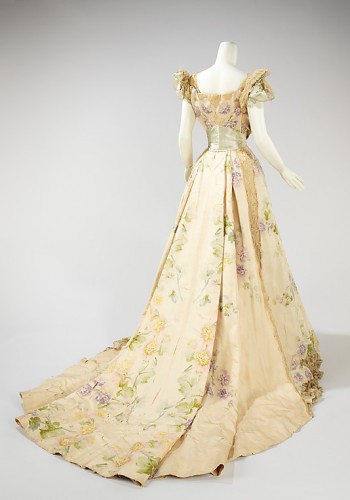
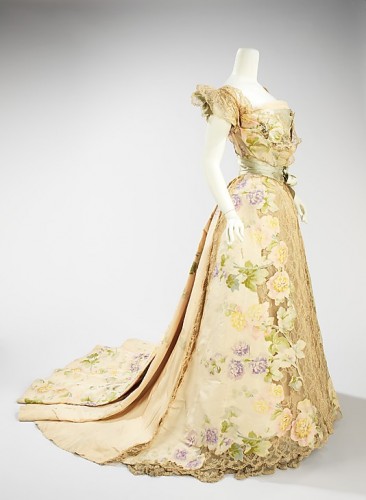
Since we looked at fauna last week, let’s rate a flora themed frock this week.  If you want flowers, I do believe this 1902 evening gown by Jean-Phillipe Worth fits the bill perfectly:

Evening dress House of Worth, Jean-Philippe Worth, 1902, French, silk, rhinestones, metal, Metropolitan Museum of Art

Evening dress House of Worth, Jean-Philippe Worth, 1902, French, silk, rhinestones, metal, Metropolitan Museum of Art

The dress is a walking flower garden and a froth of femininity, with lace and diamantes and satin bows and flower garden chine silk which is appliqued to the lace.

Evening dress (detail of bodice), House of Worth, Jean-Philippe Worth, 1902, French, silk, rhinestones, metal, Metropolitan Museum of Art

Evening dress (detail of bodice), House of Worth, Jean-Philippe Worth, 1902, French, silk, rhinestones, metal, Metropolitan Museum of Art

The romantic flower garden theme and delicate femininity of the dress are further emphasized by the soft pastel colours, and the blurred soft focus of the chine silk.

Evening dress, House of Worth, Jean-Philippe Worth, 1902, French, silk, rhinestones, metal, Metropolitan Museum of Art

Evening dress, House of Worth, Jean-Philippe Worth, 1902, French, silk, rhinestones, metal, Metropolitan Museum of Art

The intriguing layout of the floral pattern, with distinct areas of unpatterned space, and a strong overall pattern, is very characteristic of late 19th century and early 20th century Worth textiles.  It’s slightly unexpected and challenging and provides a bit of tension to counterbalance the overwhelming sweetness of the frock, but could also be considered a bit awkward and clunky at certain angles.

Evening dress, House of Worth, Jean-Philippe Worth, 1902, French, silk, rhinestones, metal, Metropolitan Museum of Art

Evening dress, House of Worth, Jean-Philippe Worth, 1902, French, silk, rhinestones, metal, Metropolitan Museum of Art

What do you think?  Is the dress too frilly and saccharine for your taste, or is this the way to do über-feminine in the Belle Epoque?

Rate the Dress on a Scale of 1 to 10.