Latest Posts

Sea and sky and sunset hills inspiration

I’m working ahead on my ‘By The Sea’ Historical Sew Fortnightly items.  I’d love to make a fantastic Victorian or Edwardian wool bathing suit, but alas, am making myself be a teeny bit practical and sensible and I’m making two items which both come from stash, and have been on my to-do list for ages and ages.

The first is more sea inspired than strictly by-the-sea.  I’ve got a wedding to go to this autumn, and haven’t got a suitable dress (really, they are all too formal, or not formal enough, or black or white or scarlet, none of which will do).

One evening, out for my walk, thinking of inspiration dresses and trying to decide what to make, I stopped at my favourite outlook for the view.  I love the last hour of light in New Zealand in the autumn: it’s one of things that reconciles me to the oncoming winter.  The sea calms and goes the most delicious grey-blue, and the hills glow gold with the reflected light.

Grey blue sea and golden hills

Grey blue sea and golden hills

The combination is so distinct, and striking, and at the moment when I looked out at this view, the hills reminded me of my Capelet of Yay, wrapping their warmth around the cool blue of the harbour like a velvet stole.

Grey blue sea and golden hills

Grey blue sea and golden hills

Could I replicate that look?  Create a dress the colour of the sea at evening, and pair it with my velvet and be the sea and hills at sunset?  At first I wanted the dress to be in silk crepe – a simple, straight, strapless sheath that hung from my bust to the floor without any shaping.  Alas (but to the benefit of my vow to sew only from stash) I could not find a single piece of silk crepe in Wellington in the right shade of blue.  There was grey, and sky blue, and teal blue, but nothing grey-blue.  I’d almost given up when I remembered this lace in my stash:
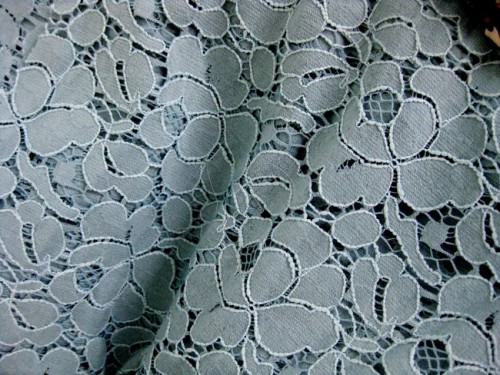
Evening blue cotton/synthetic lace

Evening blue cotton/synthetic lace

I’d hoped to make this up as an evening gown for Art Deco Weekend last year, but it hadn’t happened. Sewing it up would mean I was sewing from stash, and getting something off my to-do list.  Of course, since it is lace, the simple sheath idea I had had wouldn’t quite do it justice.

I’d originally thought of using my wedding dress pattern:
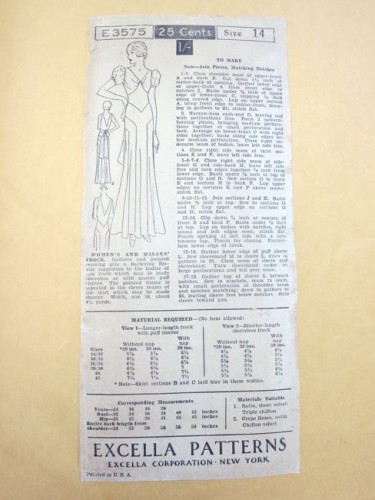
Excella E3575

Excella E3575

When I inspected it again, I decided all the seaming was much too fussy for the lace, though the silhouette was perfect.  I looked for other inspiration.

I love the simple lines and exposed shoulders of this 1936 beauty:

Simple Simple Simple - The tiny V decollete held by great clip. The back bare, sleeveless, a corselet front, and a skirt spreading in soft folds on the floor. Auckland Star, 19 Dec 1936

Simple Simple Simple – The tiny V decollete held by great clip. The back bare, sleeveless, a corselet front, and a skirt spreading in soft folds on the floor. Auckland Star, 19 Dec 1936 via Papers Past

And the cuttaway back of the floral frock in this pair:
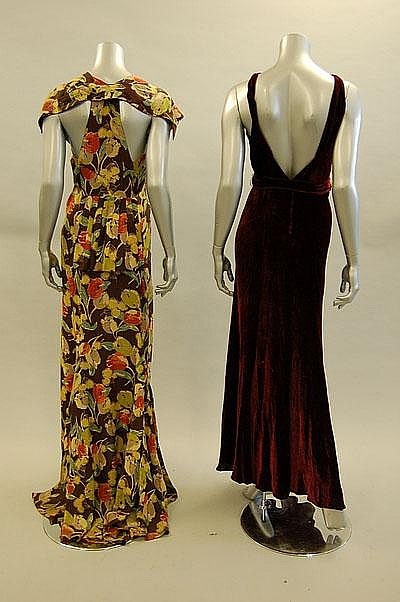
Two evening gowns (back), 1930s. Left- Floral-printed crepe with bustle back and trained skirt. Right- Wine velvet with matching belt with millefleur beaded buckle.

Two evening gowns (back), 1930s. Left- Floral-printed crepe with bustle back and trained skirt. Right- Wine velvet with matching belt with millefleur beaded buckle. Kerry Taylor Auctions

And finally, the way the lace is simply sewn as a fabric, with distinct seamlines instead of lace matching, in ’30s frocks like these ones:
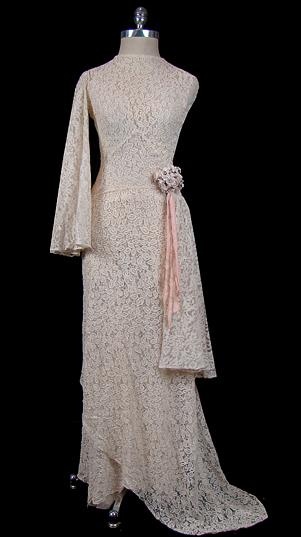
Dress, 1935, via The Frock
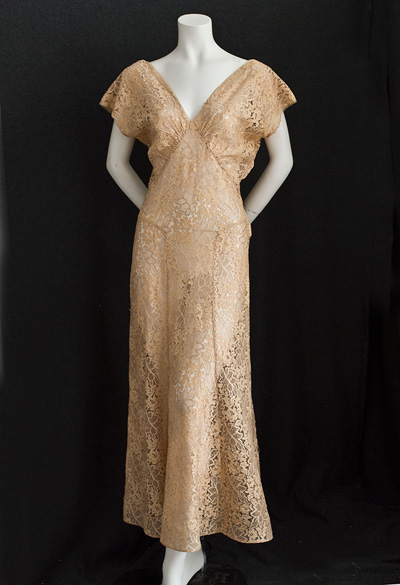
Dress, 1935, via The Frock

1930s lace dress, Vintage Textile

1930s lace dress, Vintage Textile

So, I’ll be making a mid 1930s lace evening dress, with a slim trumpet/mermaid silhouette, exposed shoulders and a cutaway back.  The pattern?  What about a modified, evening version of my Garden Party Frock?

Perfect!  Solved!  And away I go to sew…
Tutorial: How to turn a straw sunhat into an 18th century bergere

Here’s a quick and easy tutorial to turn a modern straw hat into a mid-late 18th century bergere style hat.  It’s not, of course, historically accurate, but it’s quick, easy, and looks effective.

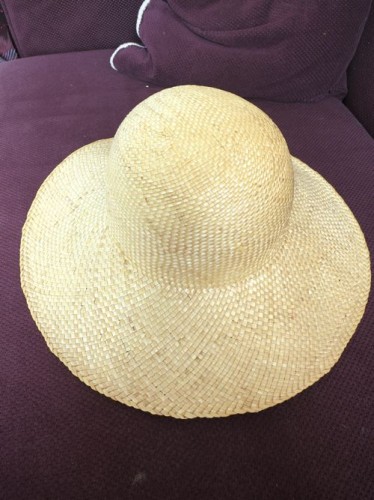
We’ll go from this:

Modern straw hat

Modern straw hat

To this:

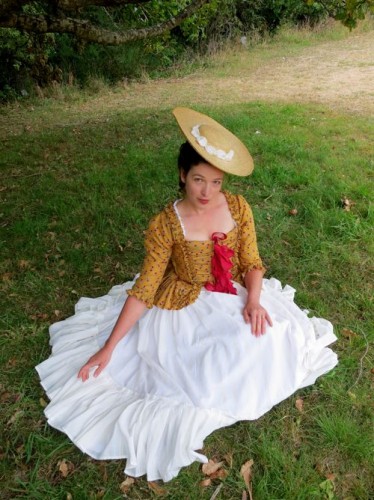
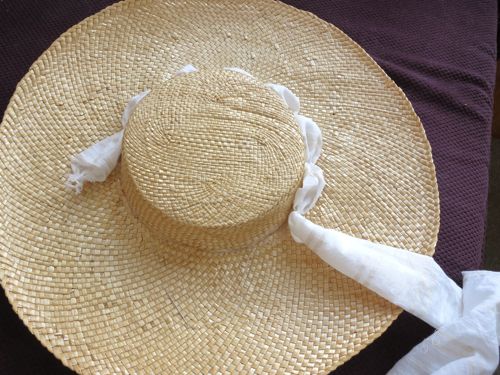
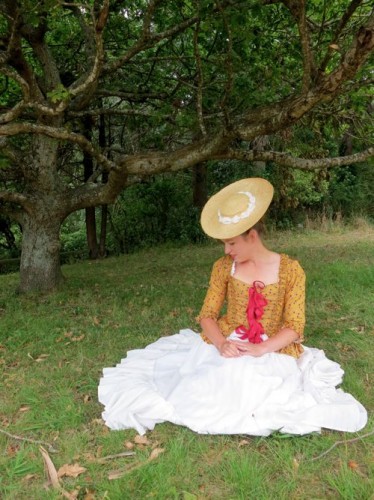
18th century inspired bergere

18th century inspired bergere

You’ll need:

– A broad brimmed,  woven straw hat.  It doesn’t matter if it fits you, but it has to be woven (not braided and sewn together), and it has to be straw.
– Scissors
– Hot water
– A round metal pan or bowl with a flat base approximately 6 inches/ 15 centimeters across
– A hot glue gun
–  Needle and thread
– Ribbon, fabric, feathers etc. for trimming.

First, have a look at a few 18th century straw hat inspiration pictures, and decide what style you want.  Note that some have very shallow crowns, some (usually later in the 18th century) a bit deeper.  Some have teeny-tiny crowns, some much wider.  Brims can be broad or narrow, can turn up or down.  Plus there are all the variants in trim.  All of these help to balance your face, and the look and period of your outfit.

Start with your straw hat:

Modern straw hat

Modern straw hat

Cut off the top of the straw hat about 1.5″ above the point where the brim turns in to the crown.  If your crown is really shallow you can work with it as it is, if it’s a bit deeper (like mine) cut off another 1.5″ strip, and discard it.

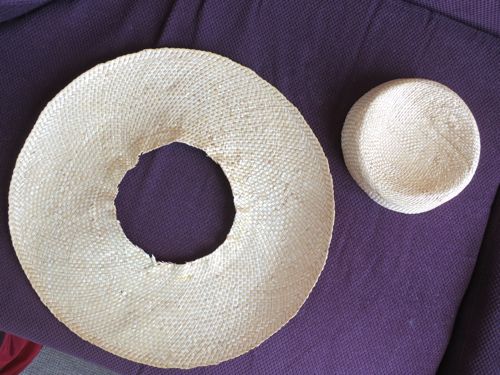
Brim, strip to be discarded, new, shallow, crown

Brim, strip to be discarded, new, shallow, crown

Now, time to reshape your brim and crown.  Wet them both with hot water.

Flatten the 1.5″ rise of the brim down towards the centre hole so it is flat with the rest of the brim, and dry it flat.  I put mine beneath a heavy book slipped in a plastic bag to protect the book from the damp.

Flattened brim and reshaped crown

Flattened brim and reshaped crown

Reshape your crown by molding it over the bottom of your flat bowl or pan, so that it has a flat top and a crisp turn, rather than the rounded bowl shaped crown.

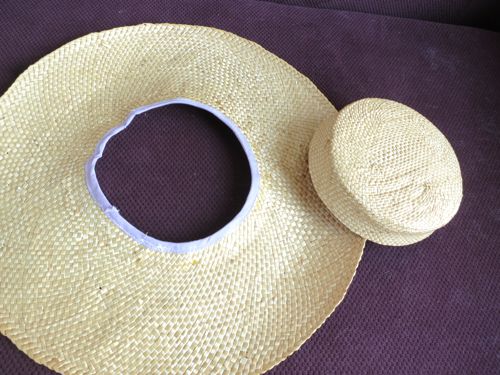
To keep the cut inner edge of the brim from unravelling and scratching you, bind it with some bias tape.

Inner brim edge bound with bias tape

Inner brim edge bound with bias tape

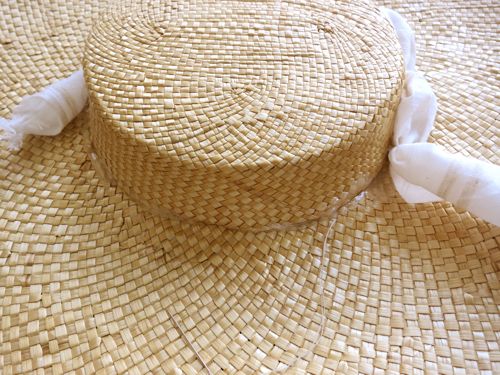
Now, check that your crown is the height that you want it to be, and trim a bit more off if it is too tall.  Once you are happy with the height, attach your reshaped crown to the brim with hot glue, ensuring it is firmly secured together.

The hot glue join

The hot glue join

Cover the join with trim – I used a tube of fabric sewn into ‘puffs’ (my favourite trim technique), but pleated ribbon, ribbon puffs, and florals and foliage are all options.

Creating the 'poof' trim

Creating the ‘poof’ trim

Add any extra trim or decoration that you desire, and  sew some loops or ribbons to help hold it on if needed.

Ta da!  All done!

18th century inspired bergere

18th century inspired bergere


Terminology: What is a bergere?

Tomorrow I’m going to be doing a tutorial on how to make a mid-late 18th century inspired bergere hat, so I thought that perhaps first I should tell you exactly what a bergere is, and we should look at lots and lots of bergere inspiration.

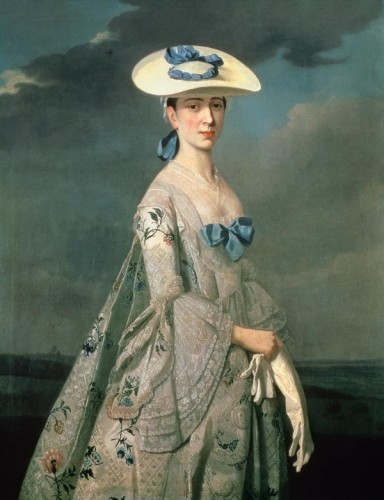
Eleanor Frances Dixie in a bergere, c. 1753, by Henry Pickering

Eleanor Frances Dixie in a bergere, c. 1753, by Henry Pickering

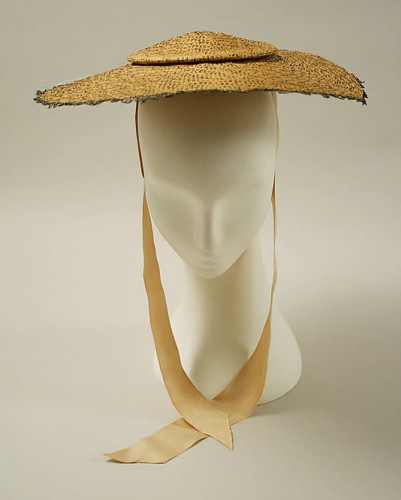
A bergere is a low crowned, wide-brimmed hat, usually of straw, but sometimes made of other materials covered in silk.  Bergere hats first appeared in the 1730s, and were popular in various forms throughout the 18th century.

Bergère hat, 18th century, British, straw, Metropolitan Museum of Art

Bergère hat, 18th century, British, straw, Metropolitan Museum of Art

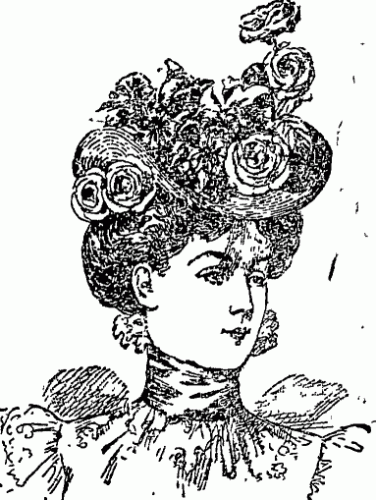
The style saw a revival in the 1860s, and the name was occasionally used in the decades after that to describe hats based on similar shapes, though these were more commonly called Gainsborough or picture hats.  A 1930s fashion column even makes the link between the two.

"Hat of blue straw, bergere shape" from the Auckland Star, November 1898

“Hat of blue straw, bergere shape” from the Auckland Star, November 1898

Bergere literally means shepherdess (the masculine shepherd is a berger), and the style has a strong link with 18th century pastorialism, and pastoral fashions.  Bergere hats are also sometimes called milkmaid hats.  It’s easy to see how a simple, wide-brimmed straw hat would be a useful part of a shepherdesses or milkmaids costume, protecting the skin from the sun and the eyes from glare.

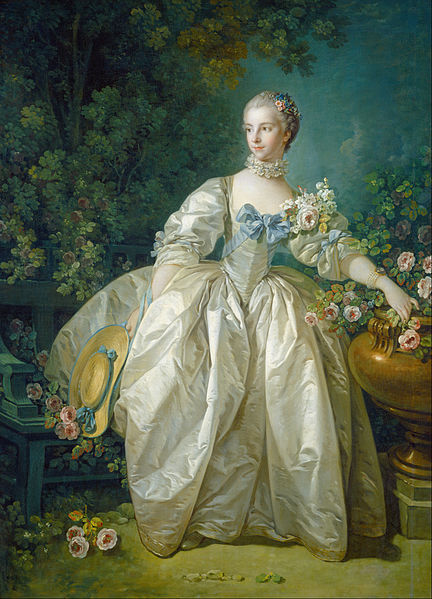
Some authors have suggested that the bergere hat is named after Boucher’s famous portrait of Madame Bergeret with a bergere hat.  This is very unlikely as the style of hat predates the painting by some ’30 years, and there is such a clear link between the shepherdess aesthetic and the bergere hat.  More likely the painting is a coincidence, or Madame Bergeret posed with a bergere hat as a witty allusion to her name, somewhat like the juniper in Ginevra de’ Benci’s portrait.

Madame Bergeret, c.1766,  François Boucher

Madame Bergeret, c.1766, François Boucher

Here are some more variants on the bergere as inspiration for tomorrow’s post:

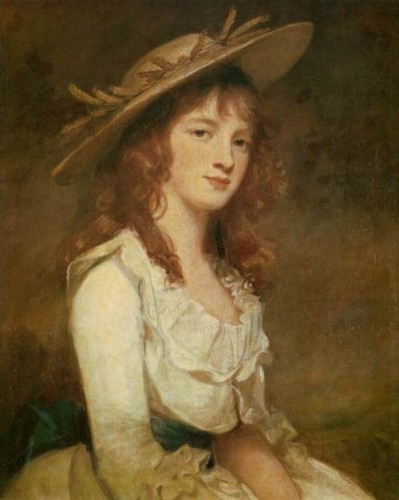
Miss Constable, 1787, George Romney

Miss Constable in a bergere hat, 1787, George Romney

Hat (bergère) French, 18th century, Straw with straw applique, MFA Boston

Hat (bergère) French, 18th century, Straw with straw applique, MFA Boston

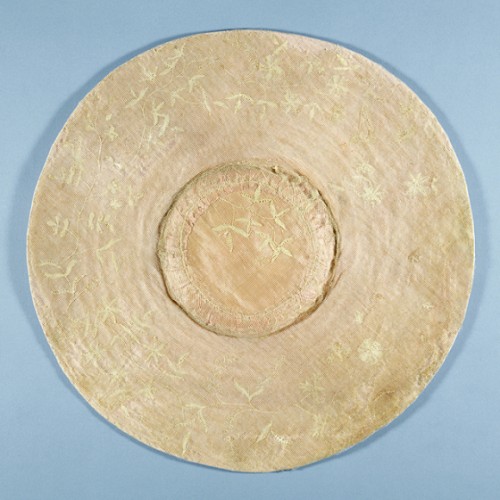
Bergere hat, 1760, straw with embroidered decorations (what collection is this from?)

Bergere hat, 1760, straw with embroidered decorations, Victoria and Albert Museum (thanks all for finding it!)

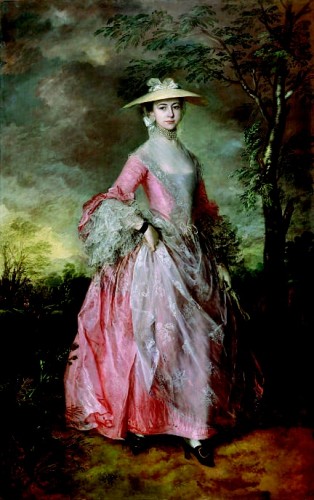
Mary, Countess of Howe in a bergere variant, Thomas Gainsborough, c. 1764

Mary, Countess of Howe in a bergere variant, Thomas Gainsborough, c. 1764

Woman's Bergère England, circa 1750, Silk, wood, paper, silk tulle, LACMA

Woman’s Bergère
England, circa 1750, Silk, wood, paper, silk tulle, LACMA

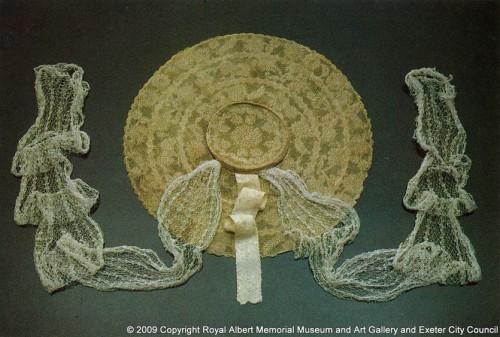
Bergere hat, English c1750, Royal Albert Memorial Museum

Bergere hat, English c1750, Royal Albert Memorial Museum

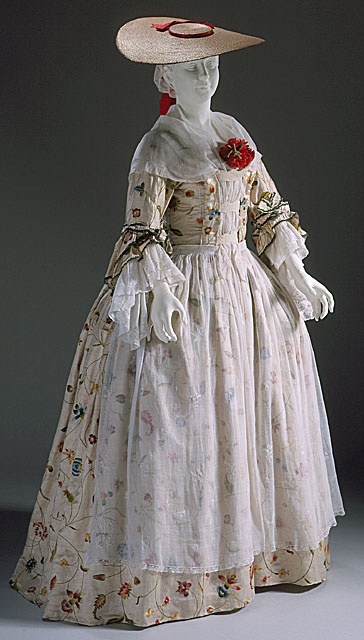
Hat, 1760s, LACMA or V&A?

Hat, 1760s, LACMA

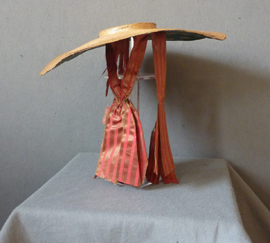
Bergere Hat 1760-1785 English, silk over straw, replaced ties, Colonial Williamsburg

Bergere Hat 1760-1785 English, silk over straw, replaced ties, Colonial Williamsburg

Bergere Straw Hat, c 1780, Meg Andrews

Bergere Straw Hat, c 1780, Meg Andrews

And check out the silk brocade lining of this one:

Bergere Straw Hat, c 1780, Meg Andrews

Bergere Straw Hat, c 1780, Meg Andrews

Bergere hat, 1780s, lined with ca 1715 Coromandel Coast chintz, Meg Andrews

Bergere hat, 1780s, lined with ca 1715 Coromandel Coast chintz, Meg Andrews

Sources:

Bermingham, Anne and Brewer, John.  Consumption of Culture: 1600-1800: Image, Object, Text.  London: Routledge.  1995

Cumming, Valerie and Cunnington, C.W.; Cunnington, P.E,  The dictionary of fashion history  (Rev., updated ed.). Oxford: Berg. 2010

Grantland, Brenda and Robak, Mary,  Hatatorium: An Essential Guide for Hat Collectors. Self Published.  2011

O’Hara, Georgina,  The Encyclopedia of Fashion: From 1840 to the 1980s.  London: Thames and Hudson Ltd.  1986