Latest Posts

A simple striped T

The Historical Sew Fortnightly Stripes challenge has really gotten me in the mood for stripes, whether they are historical or not.

I was even motivated to rummage around in my PhD (project half done – clearly a much more awesome name than UFO, because having multiple UFOs just makes you sound like a conspiracy theorist, while having multiple PhDs just makes you sound…awesome) pile  and fish out a striped T shirt that I’d originally dubbed the ‘Unimpressed T’, because that’s how I felt about it.

Doing my 'Unimpressed' face in the original version

Doing my ‘Unimpressed’ face in the original version

I was so unimpressed that I couldn’t even be bothered to blog about the original version here, though I did post it on the Sew Weekly (said post has now disappeared – very annoying).  I didn’t like the original because the stripes seemed overwhelming, and the neckline a bit unresolved, though I’d loved the same cut in my Gay Red Shirt.

Even Fiss was unimpressed by the shirt as it was:

"I bite things I don't like"

“I bite things I don’t like”

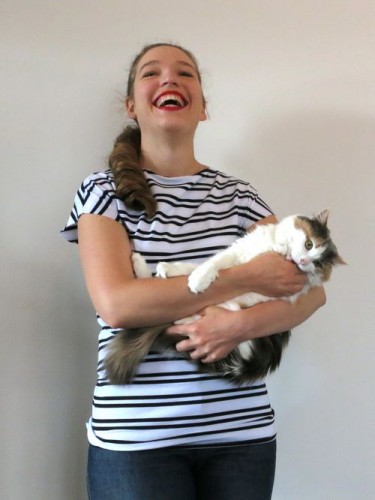
Still, with all this striped happiness happening, and with my Sewing with Knits class coming up, I felt bad having a knit PhD, so I pulled it out of the box it was in, cut 3 inches off the bottom, lowered the neckline, and hey presto:

Yay!  Impressed!

Yay! Impressed!

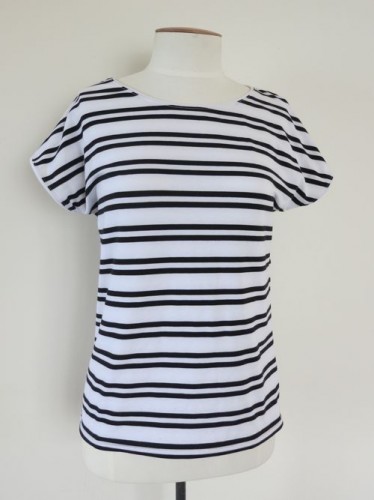
Neckline resolved, stripes toned down just enough so they aren’t overwhelming, and I am now very happy with the shirt.  It’s going to become another indispensible top – just as soon as it comes off display at Made on Marion

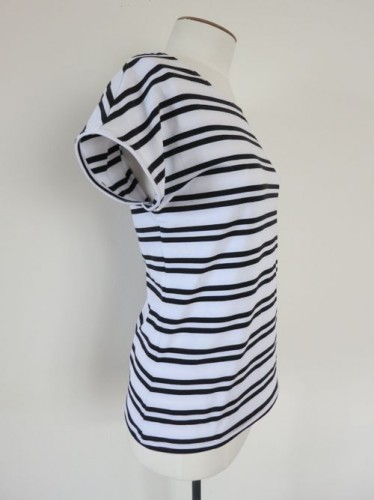
Happy stripe matching on sides and sleeves

Happy stripe matching on sides and sleeves

I can’t believe it took me that long to fix it.  Re-doing it took less than an hour!

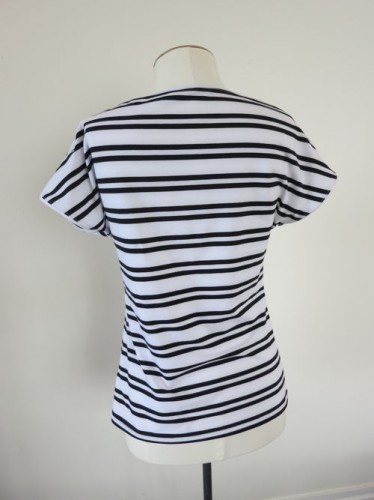
Stripes from the back

Stripes from the back

Just the facts, Ma’am:

Fabric:  90cm of mid-weight cotton jersey with added spandex, thrifted

Pattern:  3HoursPast’s Blank Canvas Tee, with some teeny-tiny alterations to the neck, and custom fitted at the sides.

Year:  2012-13

Notions:  Thread

And the insides?  Not finished, because I wanted to show that you could leave this fabric un-overlocked.

Hours:  2 + 1 to fix

First worn?: Sun 17 March, just as a hang around in it top, and to a Wellington sewing bloggers meet up (my first).

Wear again?:  Yes!

Make again?:  Yep, I’ve just offered my sister one.

Total cost:  $2

Rate the Dress: 1930s rainbow stripes

Wow.  I really never do know what you guys with think of a frock!  I post the most saccharinely sweet 1850s dress, and you like it, because you like the period, and then I post a fringe covered 1850s dress that almost makes me like fringe (and that’s saying a lot), and your reaction….well!  Elise called it “…what my spiritual ancestress would have worn in the 19th century to campaign for gay civil rights”, but the overall concensus was piñata.  Poor piñata frock took a hit at (OK, I haven’t managed to add up the scores yet, but I know it’s under 7 out of 10).

Update: Oh wow.  7 out of 10 was way ambitious.  The final tally: 4.5 out of 10.  The piñata is busted.

This week I’m sticking with the rainbow stripes for our striped theme.  This is Elizabeth Hawes’ 1937 “Alimony” dress, in all its circle skirted fuschia and teal and lime and lemon and ochre and mallard and pumpkin and gold and white striped glory.

Alimony dress, Elizabeth Hawes (American, 1903—1971), 1937, American, silk, Metropolitan Museum of Art

Alimony dress, Elizabeth Hawes (American, 1903—1971), 1937, American, silk, Metropolitan Museum of Art

To tone it down, and for chilly evenings, the dress gets worn with a muted burnouse inspired cape (yay!  Burnouses!  ) with a cleverly coordinated tassel.

"Alimony" dress worn with "Misadventure" cape, Elizabeth Hawes (American, 1903—1971), 1937, American, silk, wool, Metropolitan Museum of Art

“Alimony” dress worn with “Misadventure” cape, Elizabeth Hawes (American, 1903—1971), 1937, American, silk, wool, Metropolitan Museum of Art

I’ve just realised this is the first Elizabeth Hawes dress I have ever posted as a ‘Rate the Dress’, and I am astonished at the oversight.  I wonder if you like it?  It does have some design elements in common with the zig-zag 1942 Worth frock I posted which you weren’t so fond of.  And it has a lot of the same bright colours and striped going vertically and horizontally (and diagonally) that you thought were daft last week.  But it’s quite a different dress.  Will that make all the difference?

Rate the Dress on a Scale of 1 to 10

Striped and pleated petticoat details

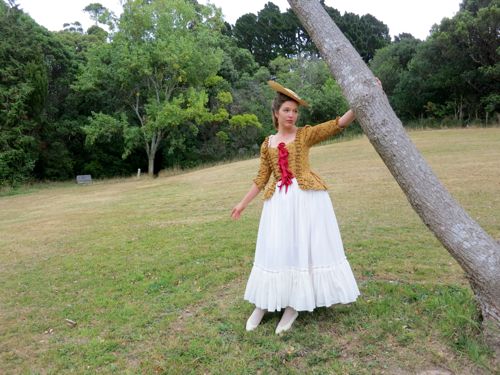
1780s pet-en-l'aire and pleated petticoat

1780s pet-en-l’aire and pleated petticoat

I’ve already shown you all the glamour shots of my new subtly-striped 1780s petticoat, but I thought some of you might be interested in the construction details.

For the overall look of my petticoat I was inspired by fashion plates like this one from 1778:

Gallerie des Modes et Costumes Francais. "Femme en Caraco plisse de taffetas changeant gorge de pigeon.." 1778, MFA Boston

Gallerie des Modes et Costumes Francais. “Femme en Caraco plisse de taffetas changeant gorge de pigeon..” 1778, MFA Boston

Obviously my petticoat doesn’t match my pet-en-l’aire, and I’ve made my ruffle a little narrower – less than 1/3 of the petticoat length, rather than almost 1/2 of the length, but I’m comfortable with the overall look.
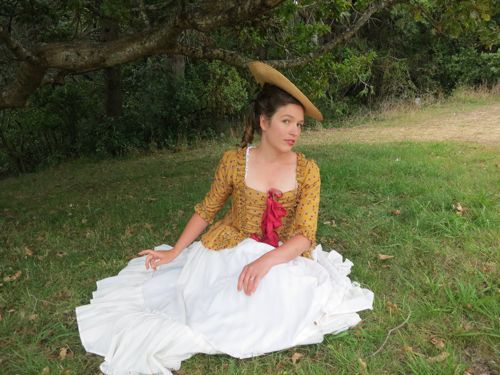
1780s pet-en-l'aire and pleated petticoat

1780s pet-en-l’aire and pleated petticoat

The skirt is made from three 36″ long widths of 45″ wide cotton muslin with a subtle self-stripe in bamboo.  The widths are sewn together with a 10″ long gap for the skirt opening left unstitched at the top of one seam.

Sewn together, I had 132″ of skirt to gather in to my waistband.  This is a little too much width for an 18th century petticoat – most examples that I can find are no more than 112″ wide, and if I did it again I’d probably omit that extra 20″.

To gather the skirt into my waistband I used  cord gathering, folding a bit of my fabric over the top of the cord and stitching it in.   I gathered the skirt widths so that the centre front width goes almost all the way to both my sides, and a full two widths are gathered on to the back, so there is more fullness at the back of the skirt to go over a bum-rump.
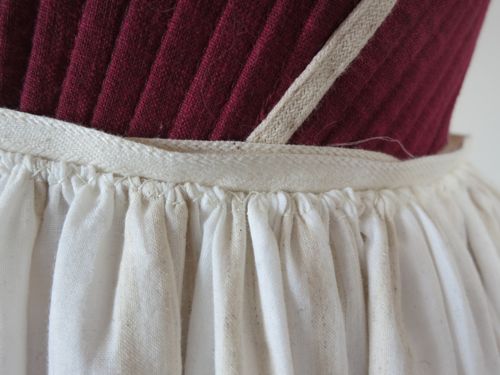
Cord-gathers

Cord-gathers

I attached the gathered widths to a simple twill-tape waistband which wraps around my waist twice and ties with zig-zag stitches.  Quick and dirty, but surprisingly effective.
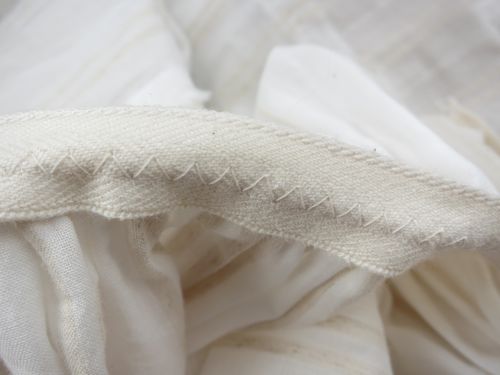
The zig-zagging on the back of the twill tape waistband

The zig-zagging on the back of the twill tape waistband

Zig-zag stitches don’t pull and squash the gathers like straight stitching would, and while it appears weak, I actually find this method to be stronger than straight stitching.

The petticoat gathered on to the waistband

The petticoat gathered on to the waistband

To give the petticoat body and support the hem and ruffles I cut a 132″ long x 4″ wide strip of stiff linen (it actually came out of a vintage obi, and was used to stiffen and support the obi) and folded the hem over it and sewed it in.

The stiff brown linen hem support seen through the sheer muslin

The stiff brown linen hem support seen through the sheer muslin on the interior of the skirt

All of the hems are done with a machine blind-hem stitch – totally cheating, but looks reasonably like hand-sewing from the outside.
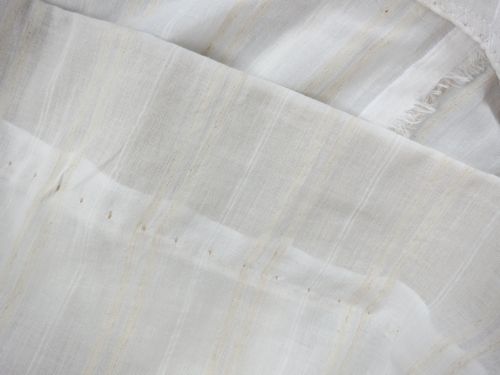
The stiffened hem and blind hem stitching seen from the right side

The stiffened hem and blind hem stitching seen from the right side

The hem stiffener shows through the skirt fabric slightly, but this isn’t a problem as the ruffle hides it.  The ruffle is made from 12″ long widths of the fabric – 9 in total (3 per each skirt width) as box pleats pleat up at a 3:1 ratio.  Making box pleats in striped fabric is so wonderfully easy, though time consuming, and I was even able to match the stripes.
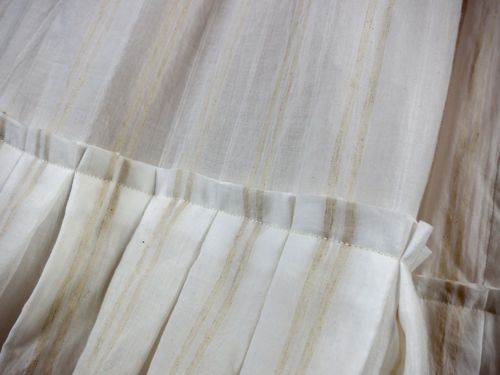
Box pleats and matched stripes

Box pleats and matched stripes

Gathering might have been more period accurate than pleating, but then I wouldn’t have been able to match the stripes, and obviously I’m not focused on historical accuracy with this petticoat.  Besides, I wouldn’t have been hand-gathering, and neither cord nor machine gathering would look right on the exposed ruffle.

Like the petticoat itself, the pleated border is hemmed with machine blind-hem-stitch, just a much smaller version.
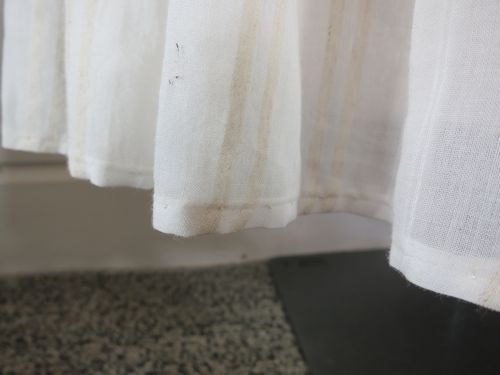
The blind-hem stitched hem
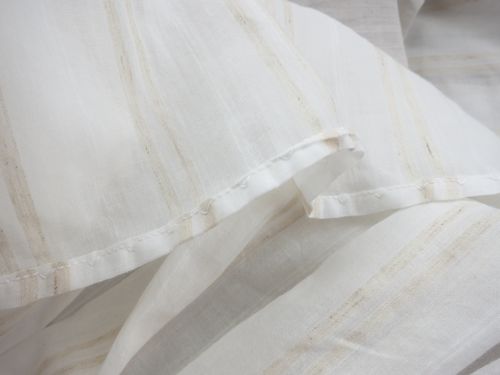
The blind-hem stitched hem

The wrong side of the blind-hem stitched ruffle

The wrong side of the blind-hem stitched ruffle

And there is my petticoat!  Next time I’ll do it ‘properly’, with less width of skirt, a longer hem ruffle, period appropriate fabric, and hand stitching.  You know what though?  I still love this version!
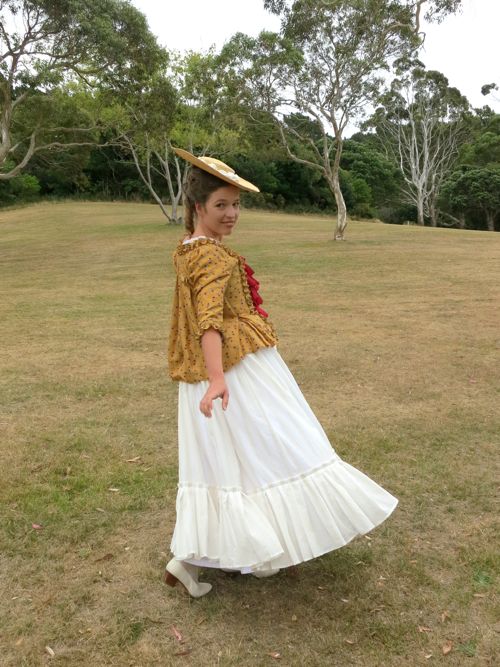
1780s pet-en-l'aire and pleated petticoat

1780s pet-en-l’aire and pleated petticoat

The Challenge:  Stripes

Fabric:  5 metres of bamboo-cotton blend with a self stripe

Pattern:  none, based on historical examples (only I made the petticoat fuller than any historical examples, and now I’m regretting it)

Year:  ca. 1785

Notions:  cotton thread, cotton waist tape, linen hem stiffener.

How historically accurate is it?  OK, so this was a quickie rather than a super-accurate project. It’s completely machine sewn and the stripes are bamboo (granted, machine processed bamboo rather than chemically processed bamboo, so more like linen than viscose). 50% maybe.

Hours to complete:    6. Even machine sewn, all those metres of hemming and pleating take time.

First worn:  for a photoshoot with my 1780s pet-en-l’aire

Total cost:  I bought the fabric so long ago I can’t remember how much I paid, but I think it was $4 a metre, so $20 for the skirt.