It’s been a long time since I did a Textile on Thursday post, and I thought it was high time I resurrected the practice and showed you a few bits more from my collection (also, you are probably well tired of posts about paniers and want something different!).
This item began with a totally unexpected parcel, and what may be my favourite-ever opening paragraph to a letter:
“Dear Leimomi,
You know when you inherit a period piece of clothing and don’t know what to do with it? And then you recall you have a pal who is a fashion historian? Exactly.”
It was from the wonderful Theresa, model and friend.
She went on to explain that the dress had belonged to her aunt’s husband’s family in Winnebago County, Illinois. She had no personal connection to it, could I do something with it?
For a few months my ‘something’ was just hoarding it and petting it and drooling over how pretty it is, but now it’s time to share it, and someday soon it will be time to re-create it (I even have the fabric).
The dress is of white cotton muslin, with a cotton net bodice lining. Based on the construction, materials used, and overall silhouette, I date it to between 1914-1916. It still has elements of earlier Edwardian fashion, but the skirt is becoming fuller, and is only calf-length, and the rigid body shaping is giving way to the looser ’20s silhouette.
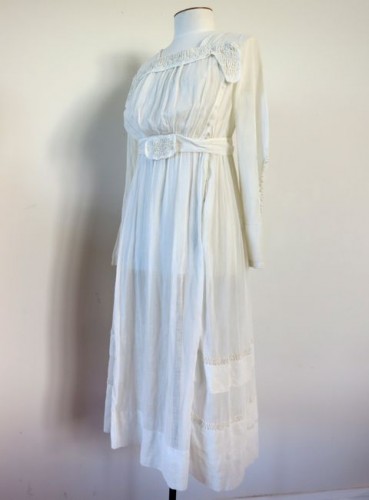
It’s a true size 8-10, with a slight pigeon breast front, and a slightly higher than natural waistline.
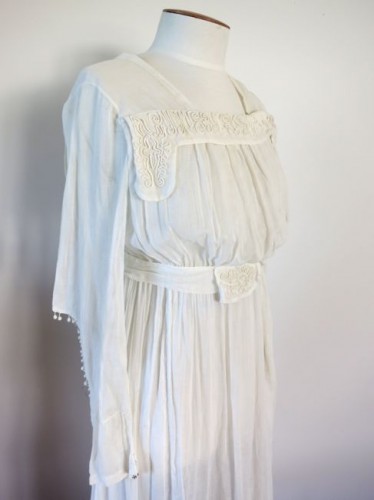
Theresa suggested that the dress may have been a graduation frock, as it is similar in style to photographs of her family in graduation gowns at the same era and in the same part of the country. I agree that that is a distinct possibility – there is something very youthful about the dress, and the size and shaping hint at a young, teenage figure.
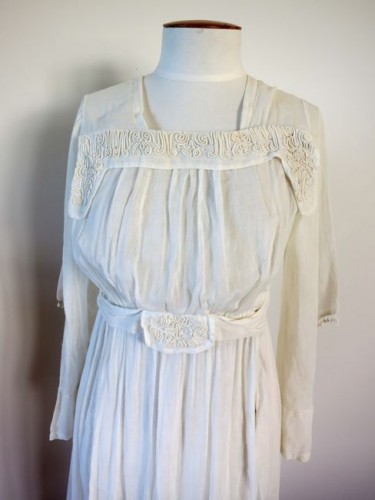
One of the most interesting aspects of the dress is the intriguing triangle shaped sleeves, with their narrow forearms, and shaped uppers decorated with beautiful wrapped-thread bobbles.
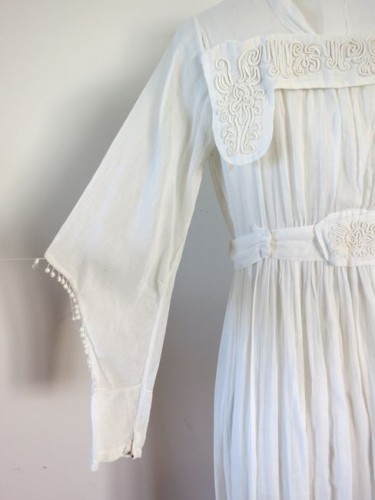
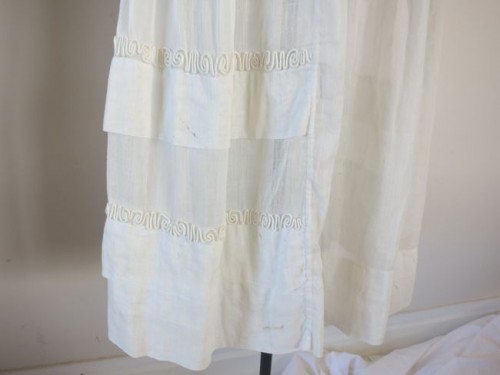
The other noteworthy feature is the beautiful soutache-work trim on the yoke, waist and skirt above the ornamental grow-pleats.
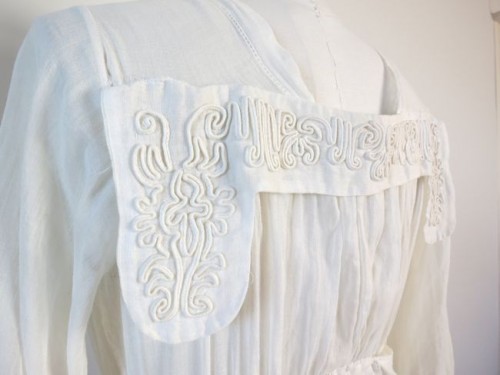
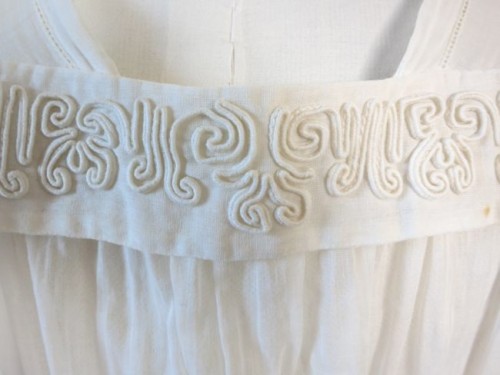
The skirt ornamentation echoes the Greek Key / meaner motif, while the more elaborate bodice decoration is reminiscent of Eastern European designs, and foreshadows the ’20s fashion for Orientalism.
I particularly love that the designs on the centre-front and back sash pieces aren’t symmetrical. It’s very subtle, but clever and unexpected.
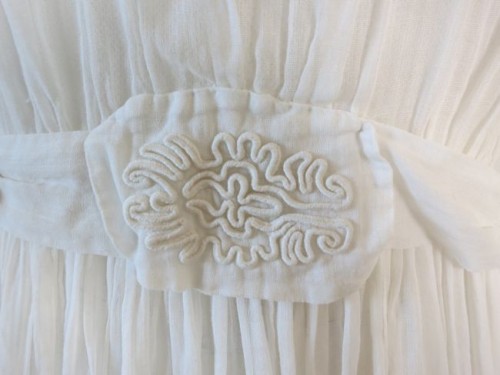
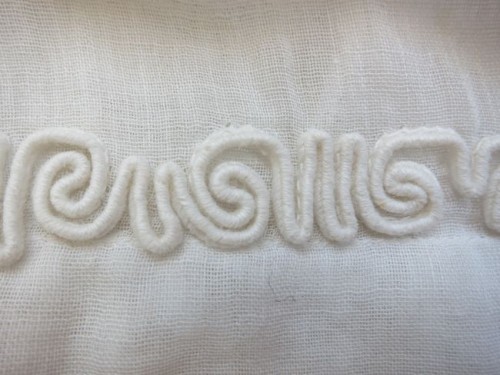
The soutache trim is also made of cotton, and was machine sewn on – clearly the work of a very patient and skilled seamstress. I’m going to need a lot of practice and freehand machine sewing before I can have any hope of recreating this work!
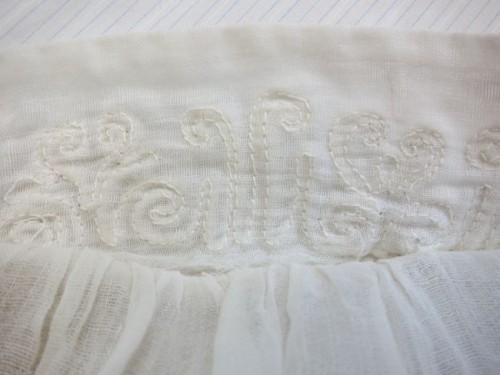
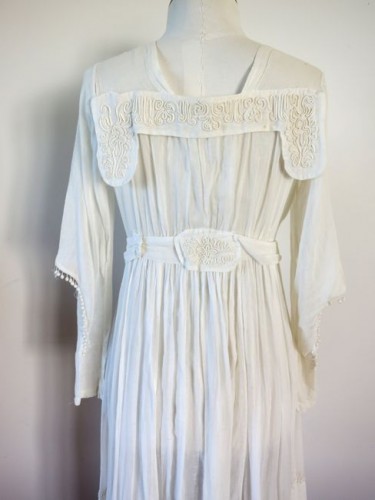
The back of the dress is almost identical to the front, but without the pigeon breast effect. The back is above, the front below.
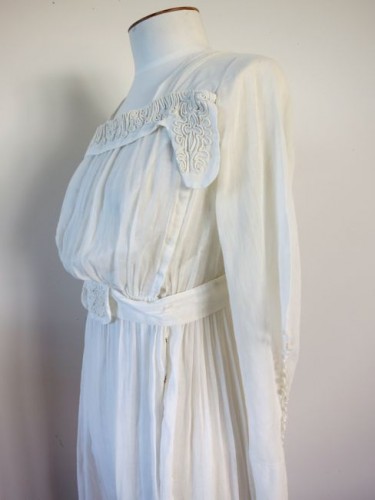
The dress fastens on the proper left side with a series of hooks and snaps (domes), which are partly concealed by the sash which wraps from front to back and then hooks on at the back.
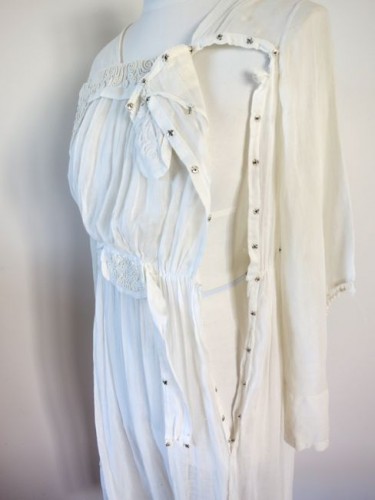
The hooks and domes continue all the way to the neckline under the decorative yoke, facilitating dressing over an elaborate full hairstyle, or up and over a petticoat.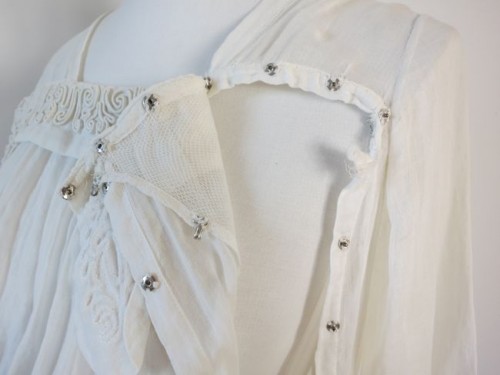
The dress would have been worn over a white cotton dress-petticoat, as it is too sheer to be worn without one. If it was (as we suspect) worn by a teenage girl, it probably would have been worn without a corset.

While the dress is essentially unlined, and would have needed petticoats underneath for modesty, the bodice has a full underlayer of cotton netting (now slightly damaged), which provides support and structure. It helps to create the pigeon breast shape, and also gives enough substance to hold up the elaborate soutached yoke.
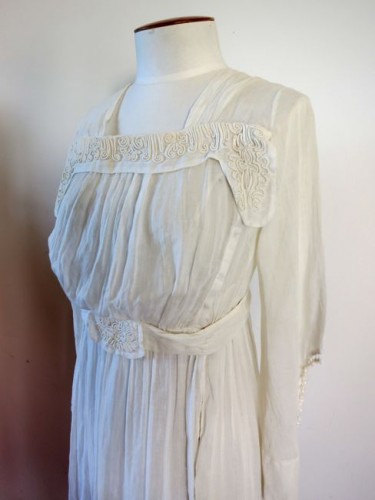
The whole dress is a beautiful example of later ‘teens fashion, and the transition from Edwardian fuss to ’20s simplicity.
(also, seriously, I have the best friends ever).